
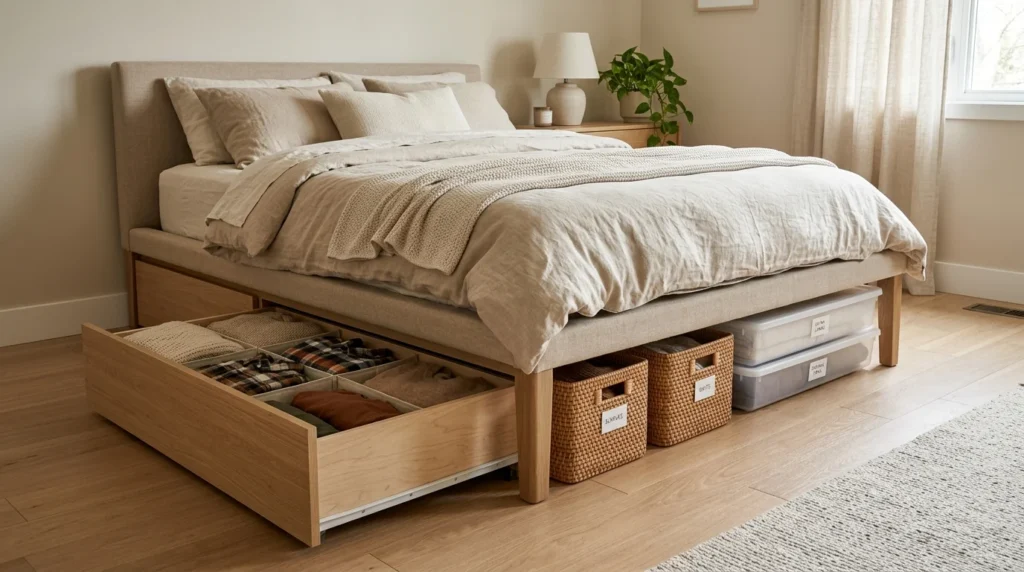
For years, the space beneath my bed was purely accidental storage, a chaotic mix of stray shoes, an old suitcase, and at least one item I genuinely couldn’t identify without getting down on the floor and dragging it out into the light. It wasn’t a system, it was just where things ended up when I didn’t have anywhere else to put them, and every time I actually needed something specific from under there, it turned into a small archaeological dig through dust and mismatched belongings. The shift happened when I moved into a smaller apartment and genuinely needed every available inch of storage to work harder, and that necessity forced me to finally think through under-bed storage as an actual system rather than a chaotic afterthought.
If your own under-bed space has fallen into that same disorganized state, here are 28 ideas, each explained in detail, based on how I eventually organized my own space and what I’ve seen work well in other homes since.
1. Measure Your Clearance Before Buying Anything
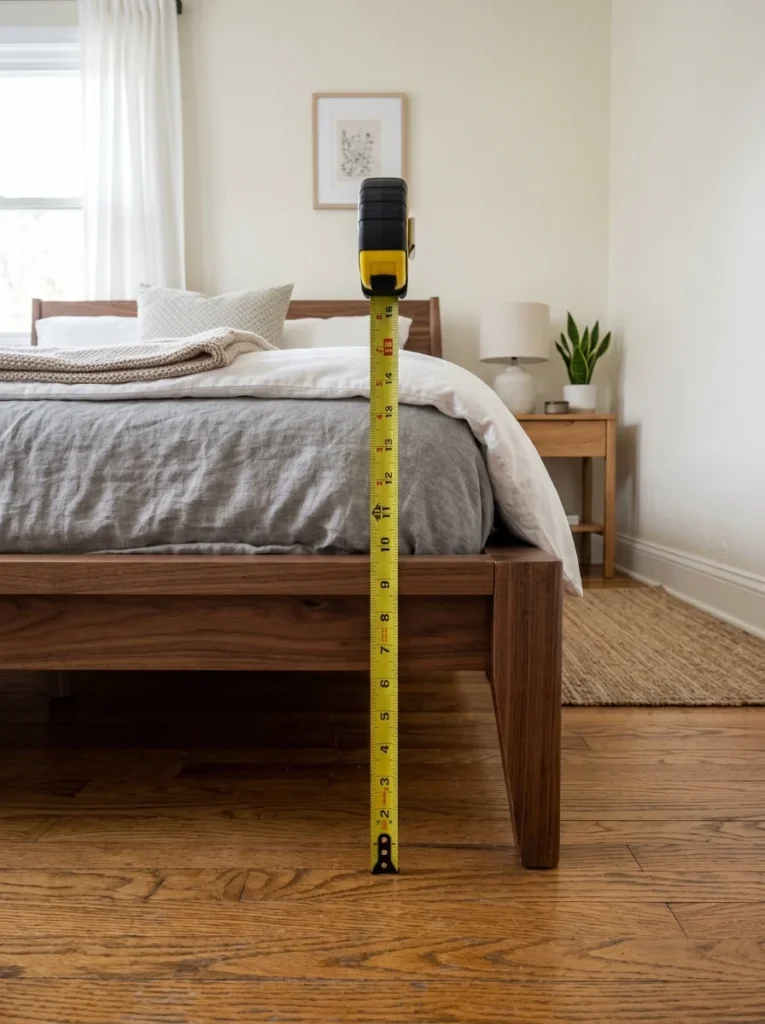
Before purchasing a single storage container, actually measuring the exact clearance between your floor and your bed frame’s lowest point is the essential first step that determines which of the following ideas will even physically work in your specific setup. My own bed frame has a fairly standard nine inches of clearance, which ruled out some of the deeper storage options I’d initially been considering before I actually got down and measured properly rather than estimating by eye. I’d recommend measuring at several points along your bed frame’s length, not just one spot, since some frames have supports or slats that reduce clearance in certain sections even when the overall frame height suggests more generous space is available throughout. This single step prevents the frustration of ordering storage containers that seem perfect based on photos and dimensions listed online, only to discover they don’t actually slide beneath your specific bed once they arrive, a mistake that’s genuinely common enough to warrant this extra bit of upfront diligence before making any purchase.
2. Use Flat Storage Bins With Lids
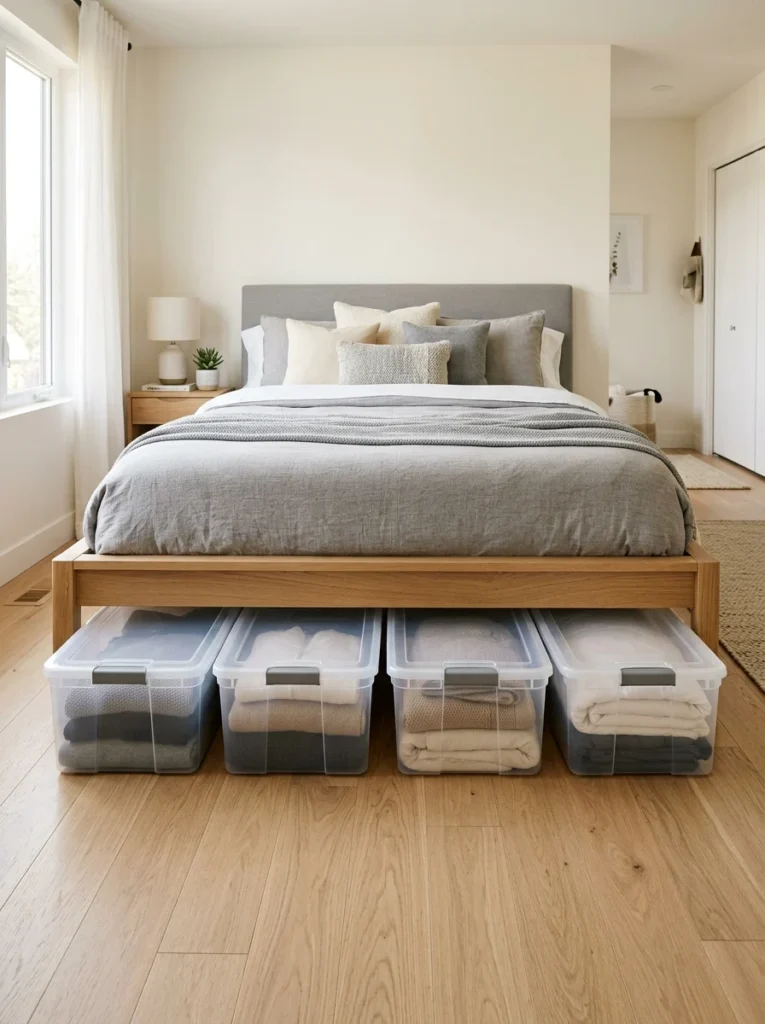
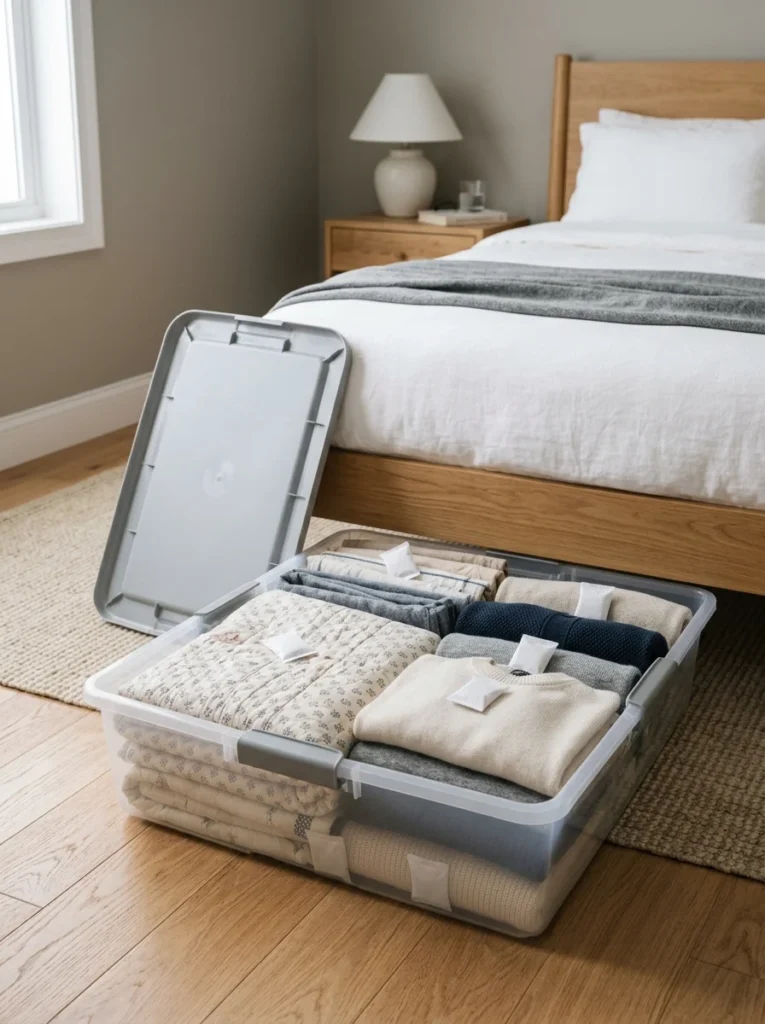
Flat, lidded storage bins specifically designed for under-bed use remain the most straightforward, widely available solution, offering enclosed, dust-protected storage that slides in and out relatively easily thanks to their low profile and often included wheels or smooth bottoms. I use exactly this solution for my own off-season clothing, and the clear plastic construction lets me see the general contents at a glance without needing to fully pull out and open each bin just to identify what’s inside during a seasonal changeover. I’d recommend choosing bins with a lid that locks or clips securely closed, rather than simply resting loosely on top, since a loose lid tends to shift and potentially spill contents during the repeated pulling and pushing motion of regular under-bed use over time. This is genuinely the most accessible entry point for anyone just starting to organize their under-bed space, widely available at most home goods stores and requiring no special measuring or custom fitting beyond confirming your basic clearance height accommodates the bin’s specific dimensions.
3. Choose Wheeled Storage for Easy Access
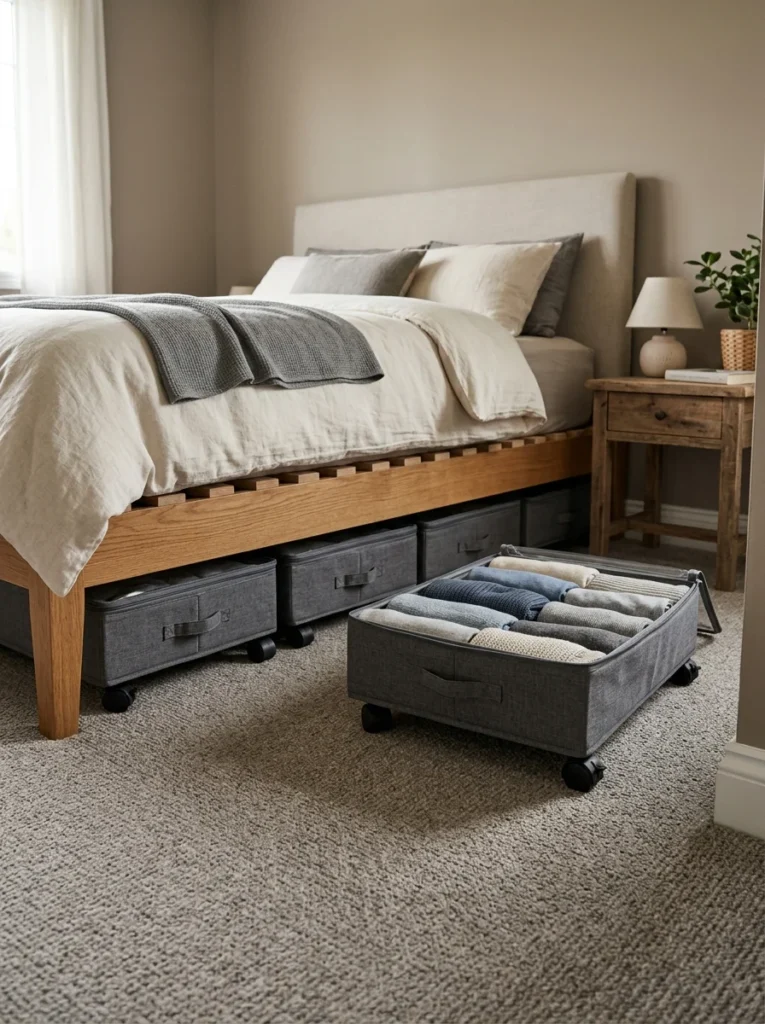
Adding wheels, either through purpose-built rolling storage bins or by attaching simple caster wheels to the bottom of a standard storage box, transforms the often frustrating process of dragging a heavy bin across carpet or hardwood into a smooth, easy pull that genuinely encourages you to actually use the storage rather than avoiding it due to the physical hassle involved. I retrofitted two of my own storage boxes with small caster wheels specifically because my bedroom floor is carpeted, and that small addition made an enormous difference in how willing I am to actually access that storage regularly rather than treating it as an out-of-sight, out-of-mind space I rarely bother retrieving anything from. I’d recommend this specifically for anyone dealing with carpet rather than hardwood or tile flooring, since carpet’s friction makes non-wheeled storage considerably more cumbersome to access regularly compared to a smoother, harder floor surface. This is a relatively inexpensive addition if your existing storage doesn’t already include wheels, typically just requiring basic adhesive caster wheels rated for your storage container’s approximate weight capacity.
4. Invest in a Bed Frame With Built-In Drawers
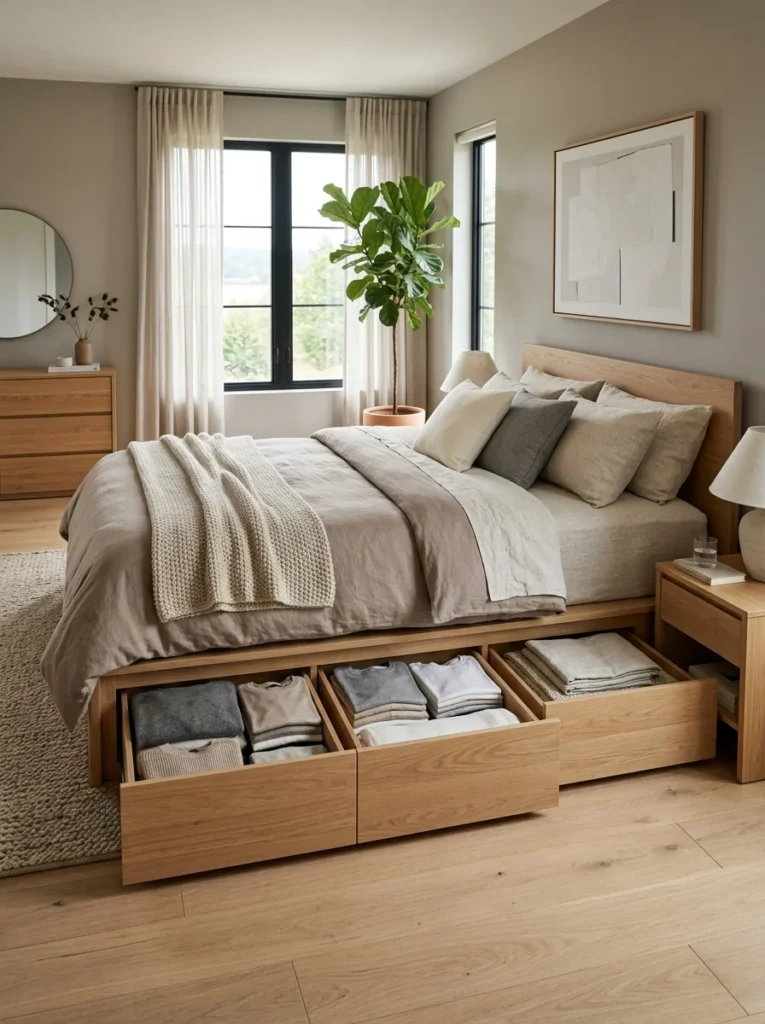
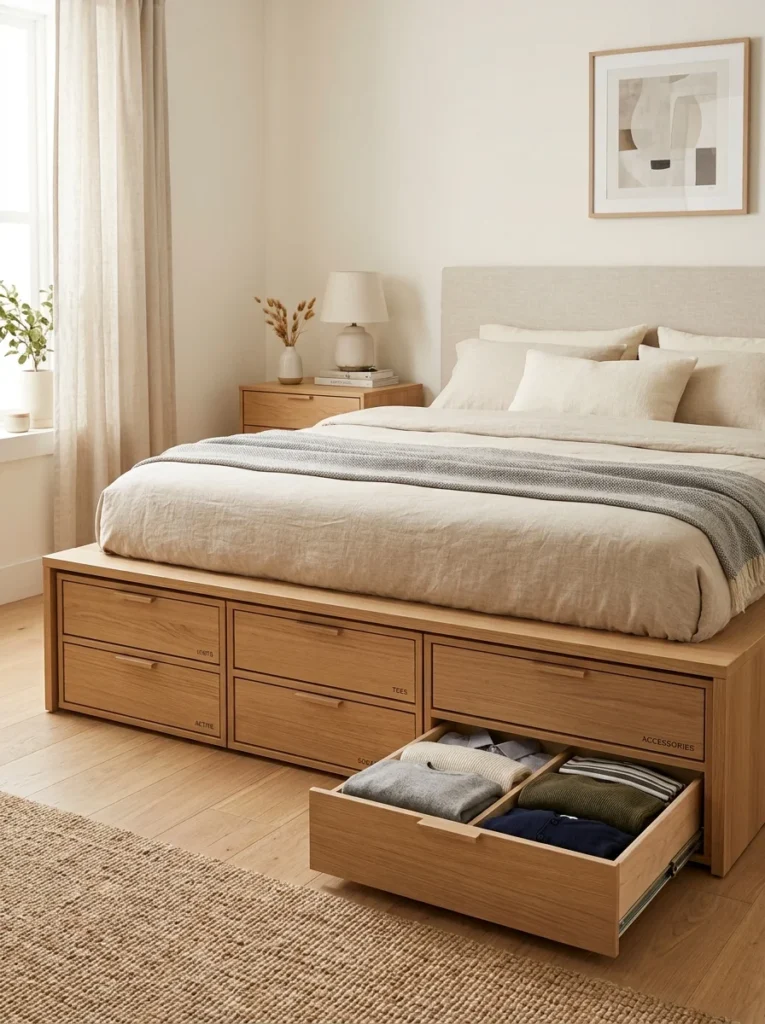
Rather than adding separate storage containers to an existing frame, choosing a bed frame with genuinely built-in drawers integrated into its base structure provides dedicated, purpose-designed storage that eliminates any guesswork about clearance or container fit, since the entire system is engineered specifically to work together as one cohesive piece. A friend chose exactly this option during a recent bedroom furniture update, and the built-in drawers beneath her platform bed now hold her entire off-season wardrobe with considerably more ease and better organization than her previous setup using generic bins beneath a standard frame. This represents a larger upfront investment compared to simply adding storage containers to furniture you already own, but for anyone furnishing a bedroom from scratch or genuinely needing to replace an existing frame anyway, it’s worth strongly considering this integrated option rather than treating bed frame and under-bed storage as two entirely separate purchasing decisions. I’d recommend this specifically for smaller bedrooms where maximizing every available inch of storage genuinely matters, since a frame with built-in drawers typically provides more usable capacity than loose bins alone can achieve within the same physical footprint.
5. Use Vacuum-Sealed Bags for Bulky Textiles
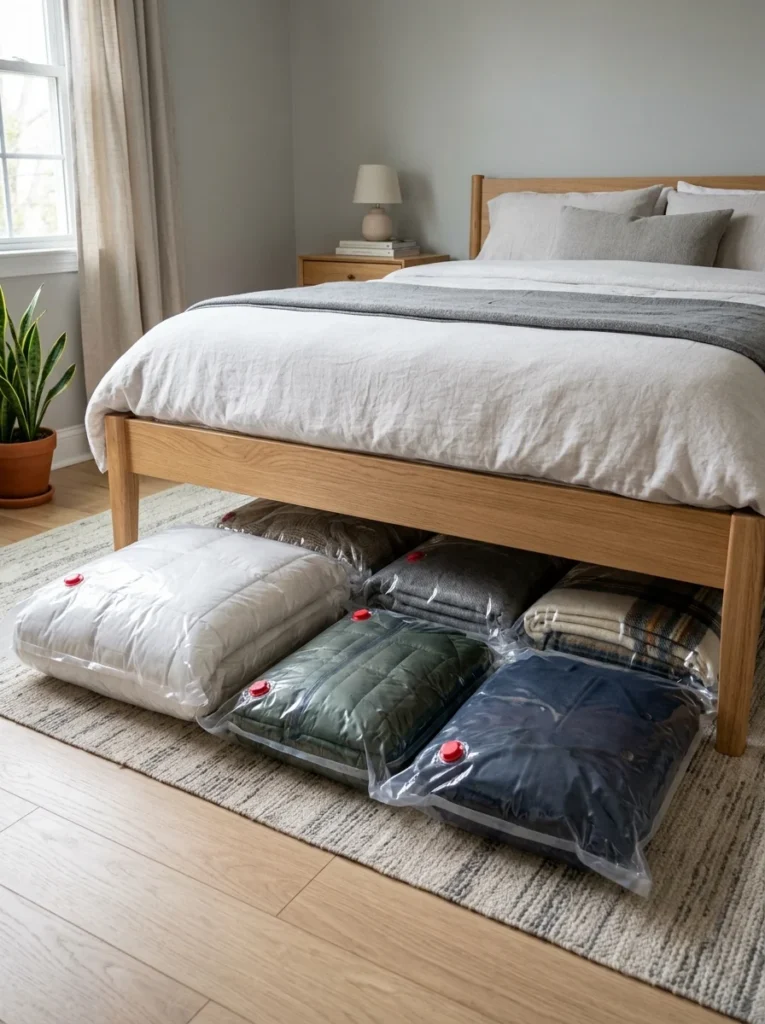
For bulky items like comforters, winter coats, or extra pillows, vacuum-sealed storage bags compress these bulky textiles down to a fraction of their original size, letting you fit considerably more into your available under-bed clearance compared to storing the same items in their normal, uncompressed state. I use these specifically for my heaviest winter bedding during warmer months, and the compression genuinely makes a meaningful difference in how much total storage capacity I can fit within my bed’s specific limited clearance height. This works particularly well for a bed frame with minimal clearance, since the compression can sometimes mean the difference between an item fitting at all versus needing to find storage elsewhere in your home instead. I’d recommend investing in a genuinely reliable vacuum sealing system rather than the cheapest available option, since a bag that fails to maintain its seal over time defeats the entire purpose, gradually re-expanding and potentially exposing your stored textiles to dust and moisture that the sealed bag was specifically meant to protect against in the first place.
6. Choose Fabric Bins for a Softer Aesthetic
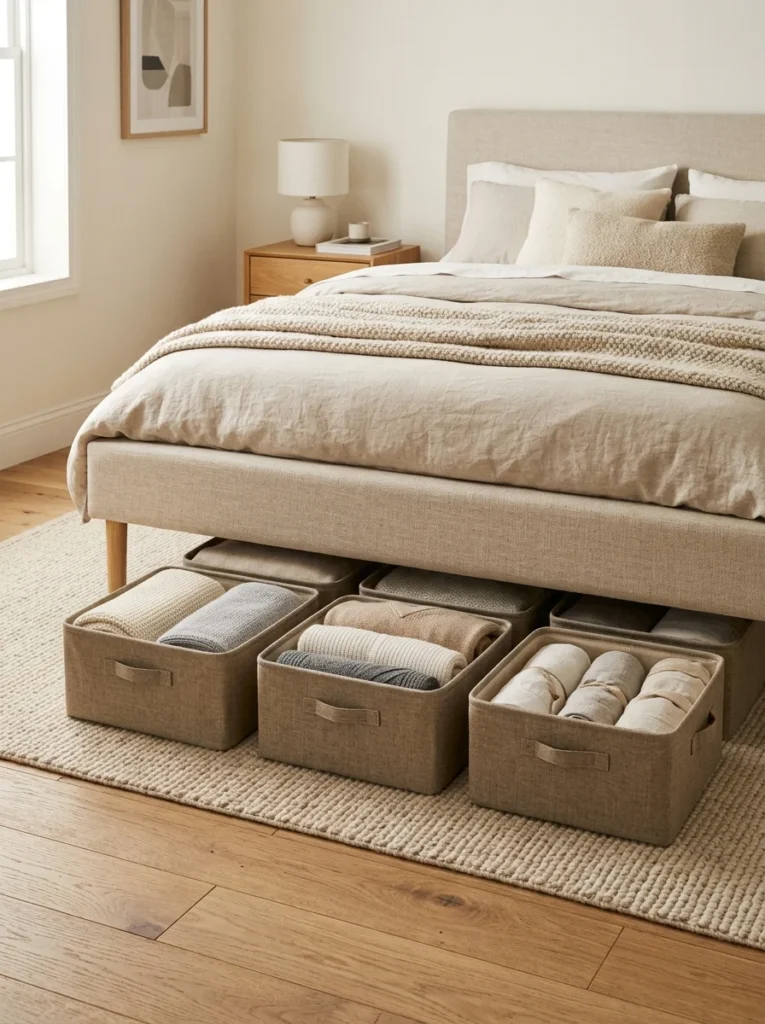
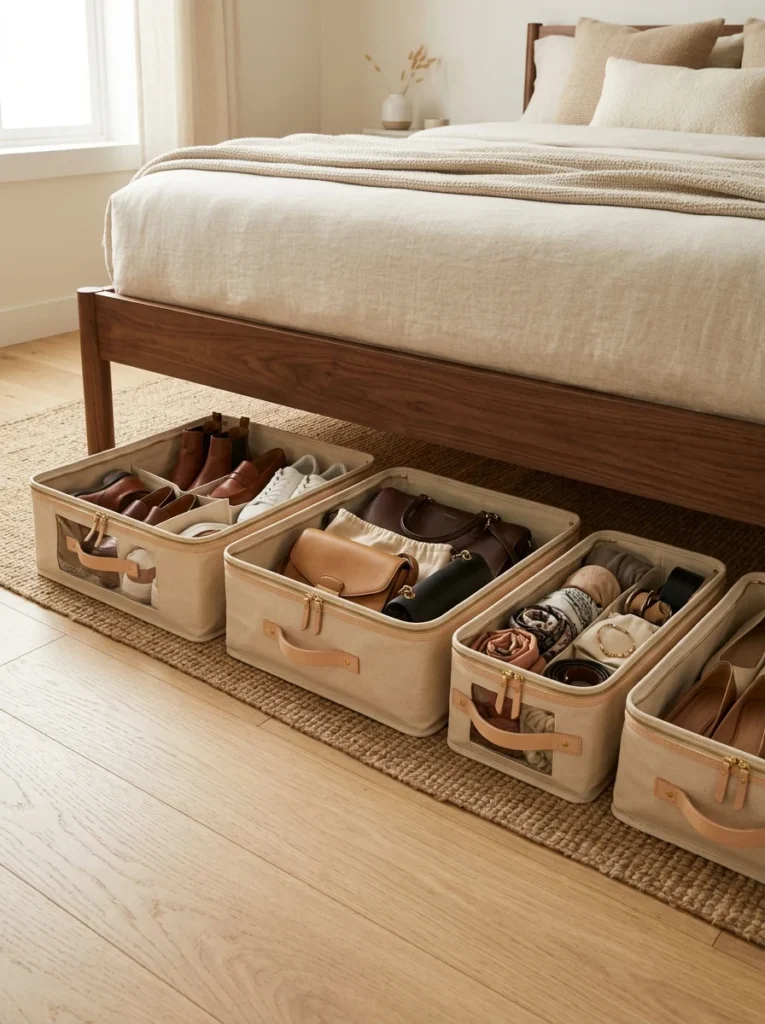
Rather than rigid plastic containers, fabric storage bins, often collapsible canvas or linen options, offer a softer visual aesthetic for anyone who occasionally glimpses their under-bed storage, whether through a bed skirt gap or simply when the bed is being made, and prefer that visible edge to look considerably less utilitarian than hard plastic typically appears. I switched several of my own bins to a simple canvas option specifically for this reason, appreciating how the softer material coordinates better with my bedroom’s overall aesthetic on the rare occasions the storage becomes at all visible during regular use. Fabric bins generally offer less protection against dust and moisture compared to rigid plastic with a proper lid, making them better suited to items less sensitive to that kind of exposure, books, out-of-season shoes, rather than delicate textiles or anything genuinely vulnerable to potential moisture damage over an extended storage period. I’d recommend this specifically for anyone prioritizing aesthetics for occasionally visible storage, while reserving rigid, better-sealed plastic bins for anything requiring more genuine protection from your bedroom’s ambient dust and humidity levels.
7. Add a Bed Skirt to Conceal Storage

A simple bed skirt, extending from your mattress down to the floor, completely hides whatever storage system you’ve chosen underneath, letting you prioritize function over appearance for your actual bins and containers since none of it remains visible during normal daily use of the room. I added a simple linen bed skirt specifically for this reason, freeing me to choose the most functional, if not necessarily the most attractive, storage containers without any concern about how they might look if occasionally glimpsed from the side. I’d recommend choosing a bed skirt with enough length to genuinely reach the floor on all visible sides, since a skirt that falls short leaves an awkward gap that reveals your storage anyway, somewhat defeating the purpose of adding this concealing element in the first place. This is a particularly good solution for anyone using a mismatched or purely utilitarian storage combination, mixing whatever containers happen to fit best regardless of their individual appearance, since the skirt makes that underlying inconsistency completely irrelevant to the room’s overall visible aesthetic.
8. Use Labeled Bins for Quick Identification
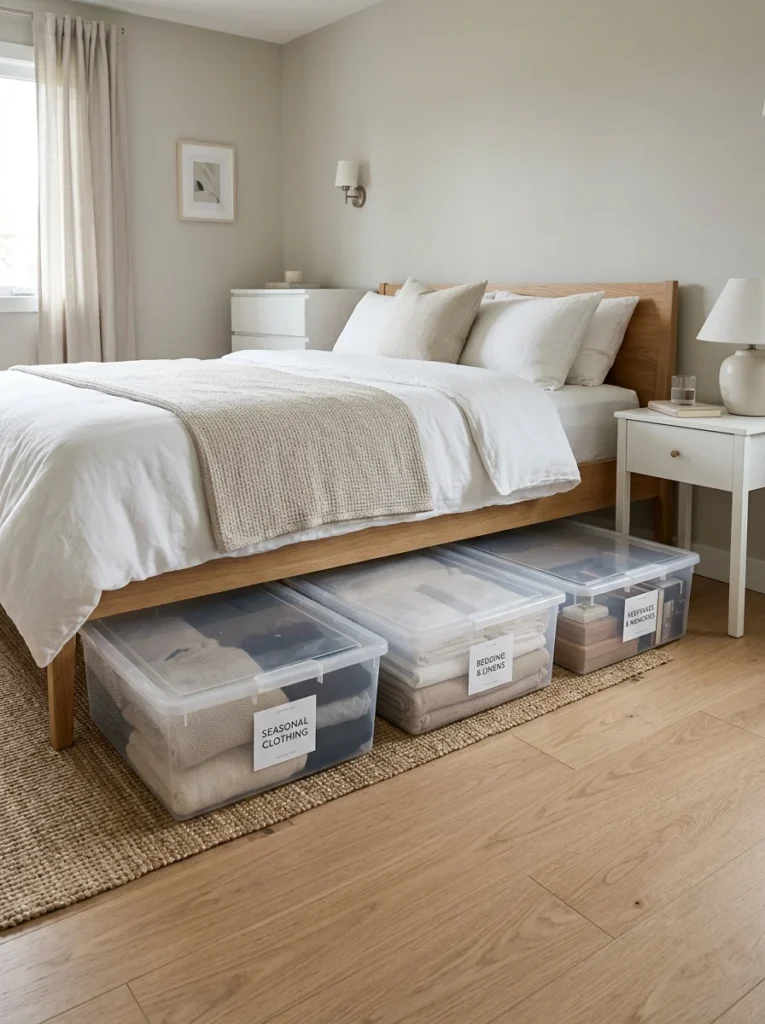
Adding clear labels to each storage bin, whether a simple handwritten tag or a more polished printed label, means you can identify contents without needing to pull out and open multiple containers just to locate one specific item, a genuinely time-saving improvement over my own previous system of essentially guessing based on vague memory alone. I label mine by category, winter clothing, extra bedding, memorabilia, and that simple system has made retrieving anything specific considerably faster and less frustrating than my previous approach of opening bin after bin until I happened to find what I was actually looking for. I’d recommend this specifically for anyone storing several different categories of items beneath the same bed, since labeling becomes considerably more valuable with multiple bins to distinguish between compared to a simpler setup with just one or two containers holding fairly obvious, singular categories of items. This is a genuinely low-cost, low-effort addition to whatever storage system you’ve already chosen, requiring just a label maker or simple tags rather than any additional purchase of storage containers themselves.
9. Store Shoes in Clear, Individual Compartments
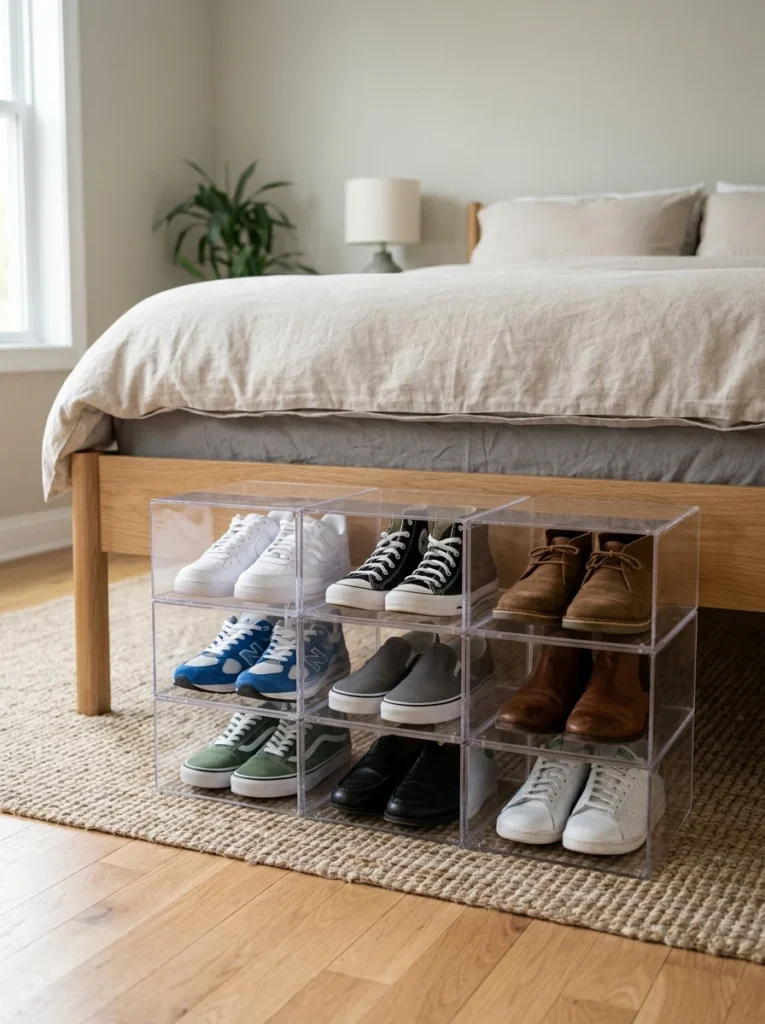
Rather than a single large bin holding a jumbled pile of shoes, a specifically designed shoe storage container with individual compartments keeps each pair separated and easily visible, preventing the scuffing and tangling that can occur when shoes are simply piled together within a larger, undivided space. I switched to this specific solution for my own shoe storage after growing frustrated with digging through a jumbled bin every morning, and the individual compartments have genuinely made my morning routine faster since I can locate a specific pair at a glance rather than searching through an undifferentiated pile. I’d recommend measuring your bed’s clearance specifically against this style of container before purchasing, since shoe-specific under-bed storage sometimes has a slightly different height profile compared to general-purpose flat bins, given the need to accommodate shoe height within each individual compartment. This solution works particularly well for anyone with a larger shoe collection specifically, where the organizational benefit of individual compartments becomes considerably more valuable than it would be for someone storing just a few pairs of seasonal shoes beneath their bed.
10. Repurpose a Rolling Cart for Craft or Hobby Supplies
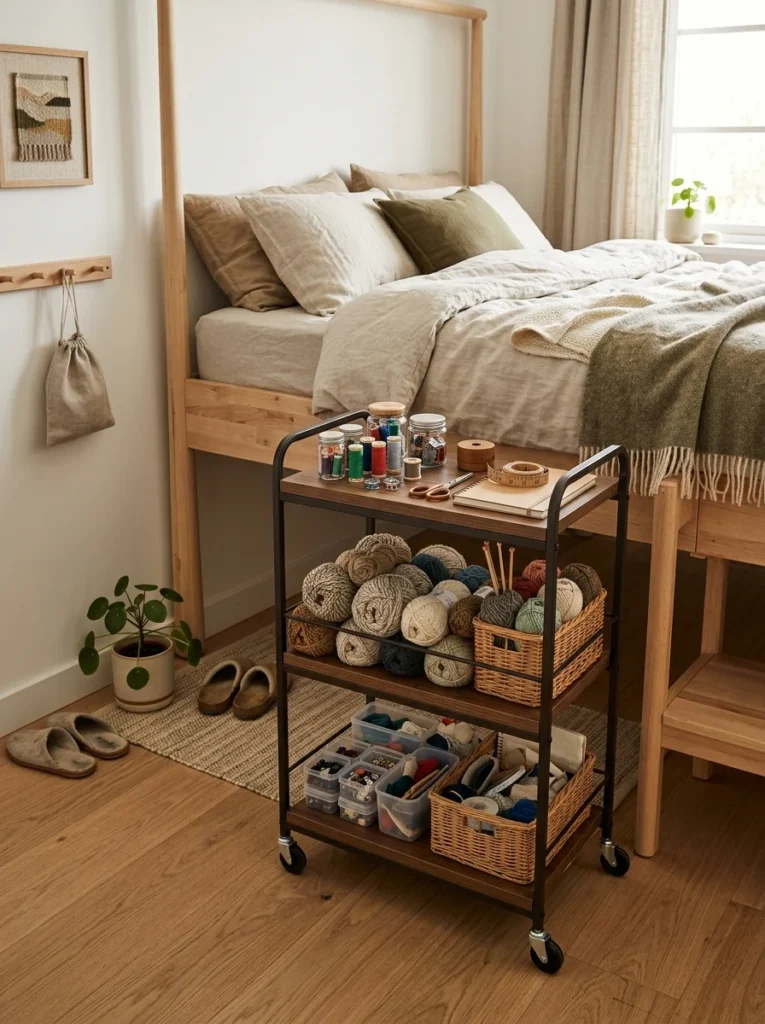
Rather than purpose-built bedding storage, a slim rolling cart, similar to those used in laundry rooms, can slide beneath a bed frame with adequate clearance and hold craft supplies, hobby materials, or anything else you want easily accessible without permanently occupying visible space elsewhere in your bedroom or home. A friend uses exactly this solution for her sewing supplies, rolling the cart out from beneath her bed whenever she’s actually working on a project, then tucking it back into that hidden storage the rest of the time when it’s not in active use. This requires a bed with genuinely adequate clearance to accommodate a cart’s typical height, generally taller than a flat storage bin, so I’d recommend measuring carefully before assuming this particular solution will fit your specific bed frame’s available space. I’d recommend this specifically for anyone with a hobby generating a meaningful amount of supplies but lacking a dedicated craft room or workspace elsewhere in their home, since this under-bed solution genuinely provides that missing dedicated storage without requiring any additional furniture or room.
11. Use Underbed Storage for Seasonal Decor
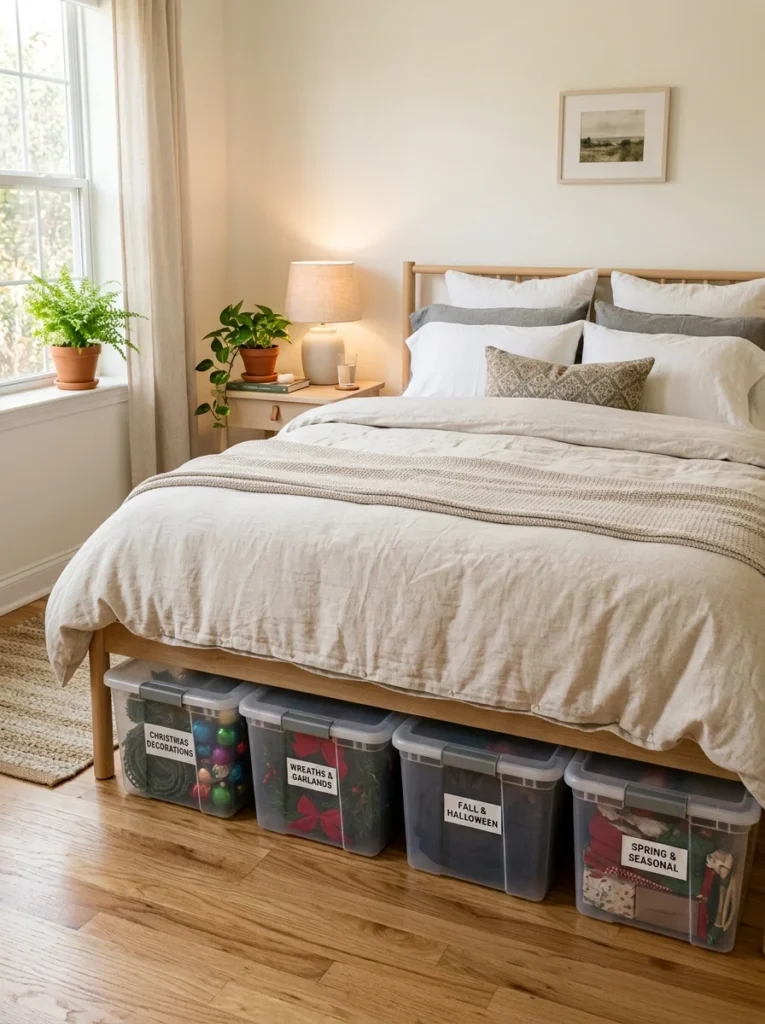
Holiday decorations, seasonal wreaths, and other decor items used only a few weeks or months out of the year are ideal candidates for under-bed storage, freeing up closet or attic space for items you need more regular access to throughout the rest of the year. I store my holiday decorations in a dedicated set of labeled bins specifically for this purpose, and having them tucked beneath my guest room bed means they’re out of the way for eleven months of the year but still genuinely easy to retrieve when the relevant season actually arrives. I’d recommend using your sturdiest, most protective bins specifically for any decorations that are fragile or sentimentally valuable, since these items typically sit undisturbed for considerably longer stretches between uses compared to some of the other categories on this list, making proper protection from dust and potential moisture exposure particularly important over that extended storage period. This is a particularly good use of a guest bedroom’s under-bed space specifically, since that room typically sees less frequent daily use than a primary bedroom, making the temporarily reduced accessibility during storage retrieval a reasonable tradeoff for that room’s specific usage pattern.
12. Choose Low-Profile Storage for Platform Beds
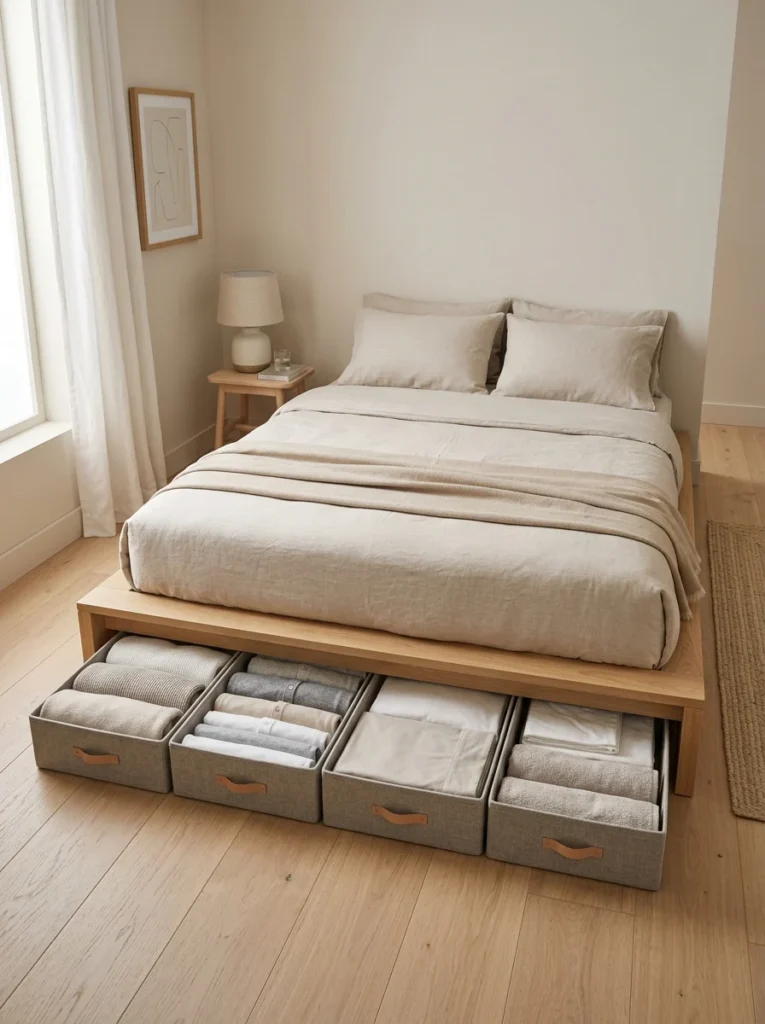
Platform beds often have considerably less clearance than a traditional frame with box spring, sometimes just a few inches, requiring genuinely low-profile storage solutions specifically designed for this more limited space rather than standard bins that might work fine beneath a taller traditional frame. I dealt with exactly this constraint in a previous apartment with a platform bed, ultimately finding slim, specifically low-profile bins designed for genuinely minimal clearance situations, though the overall storage capacity was admittedly more limited compared to what a taller traditional frame would have accommodated. I’d recommend measuring your platform bed’s exact clearance very precisely before shopping, since even a half-inch miscalculation can mean the difference between a storage solution sliding in smoothly versus not fitting at all, a particularly relevant concern given how limited platform bed clearance often is compared to other frame styles. For genuinely minimal clearance situations, flat storage specifically marketed as “low-profile” or “slim” under-bed storage, rather than standard bins, will generally offer your best chance of finding something that actually fits your particular platform bed’s constraints.
13. Add a Lift-Top Storage Bed Frame
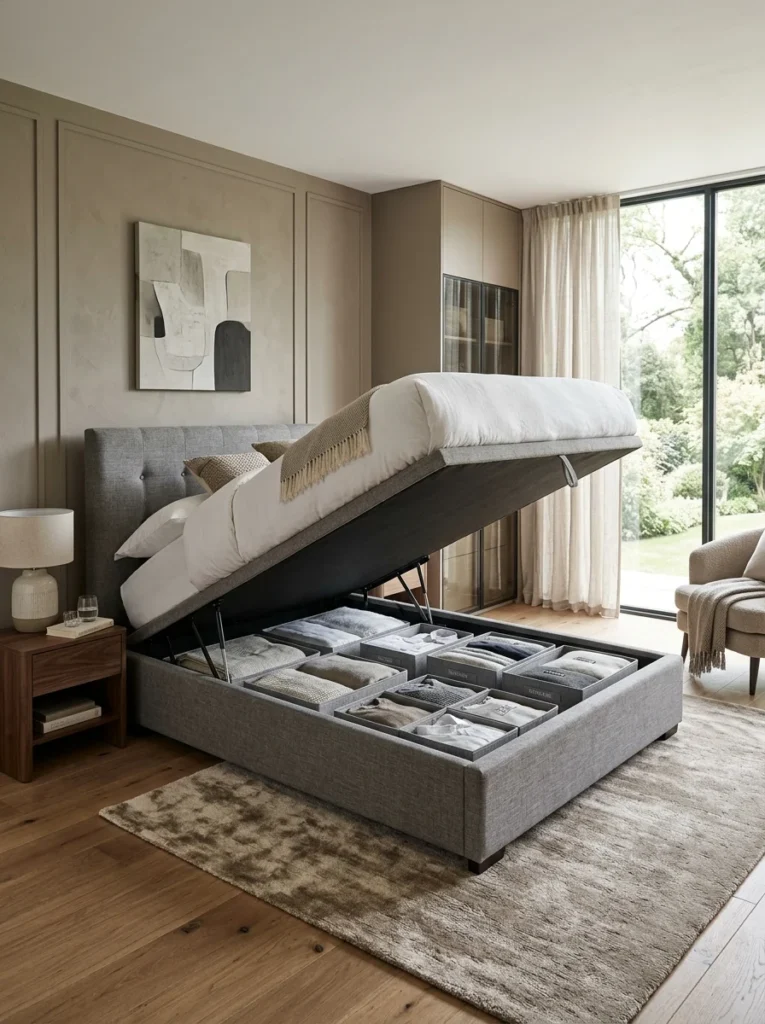
For maximum storage capacity, a bed frame with a lift-top mechanism, where the entire mattress platform hinges upward to reveal a large, deep storage compartment underneath, provides considerably more capacity than any combination of bins slid beneath a standard frame could achieve within that same general footprint. A friend chose this style specifically for her smaller apartment bedroom, and the resulting storage capacity beneath her mattress genuinely rivals what a small closet might hold, housing everything from off-season clothing to spare bedding to items she’d otherwise have needed additional furniture elsewhere in her apartment to accommodate. This represents a considerably larger investment compared to a standard frame with added storage bins, and I’d recommend this specifically for smaller homes or apartments where maximizing storage capacity within existing square footage genuinely matters more than the additional cost this specialized frame style requires compared to simpler alternatives. The mechanism itself does require some regular maintenance attention, ensuring the hinges remain properly lubricated and functional over years of repeated use, a consideration worth factoring into your decision alongside the genuine storage capacity benefit this style provides.
14. Store Books in Sturdy, Stackable Containers
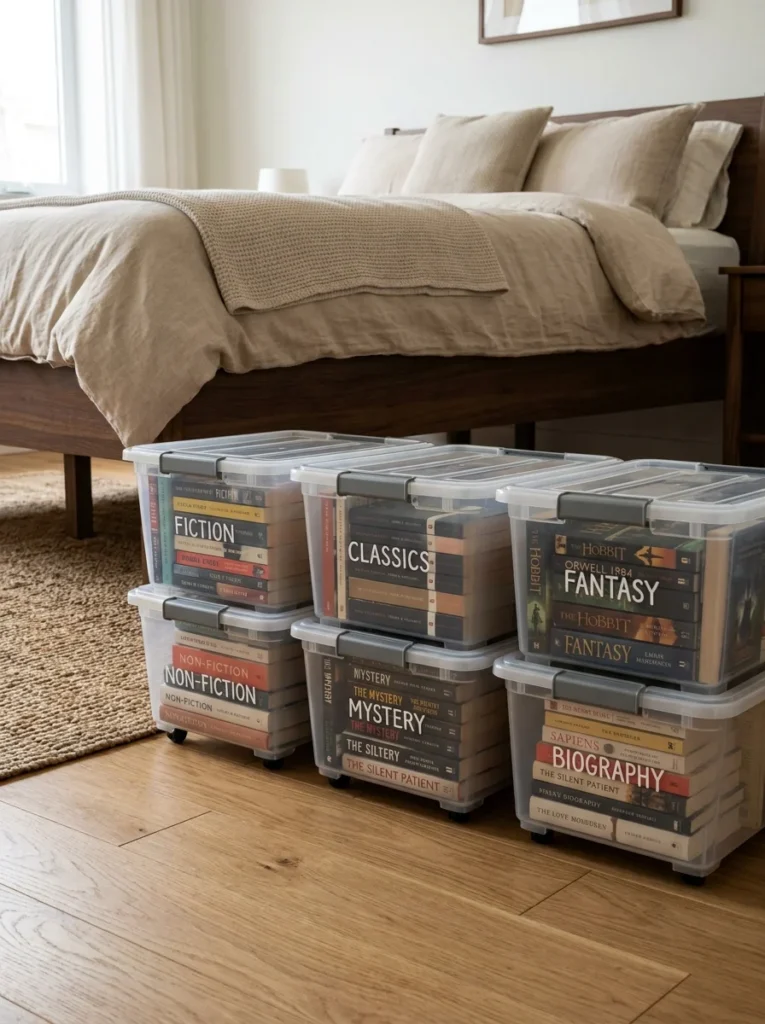
For book collectors running out of shelf space, sturdy, stackable under-bed containers specifically designed to handle book weight provide overflow storage for less frequently referenced titles, keeping your visible shelving reserved for current favorites while still maintaining access to your broader collection when needed. I use this solution for books I’ve already read but aren’t ready to donate, keeping them organized and protected rather than creating an unstable, precarious stack somewhere else in my home simply because my shelves had run out of available space. I’d recommend choosing containers specifically rated for heavier loads if you’re using this solution for books, since standard lightweight bins designed primarily for clothing or textiles may not hold up well to the genuine weight that a container full of books represents over repeated use and retrieval. This works particularly well combined with a labeling system organized by genre or author, making it considerably easier to locate a specific title later without needing to pull out and search through every single container in your under-bed collection.
15. Use Cedar-Lined Storage for Natural Moth Protection
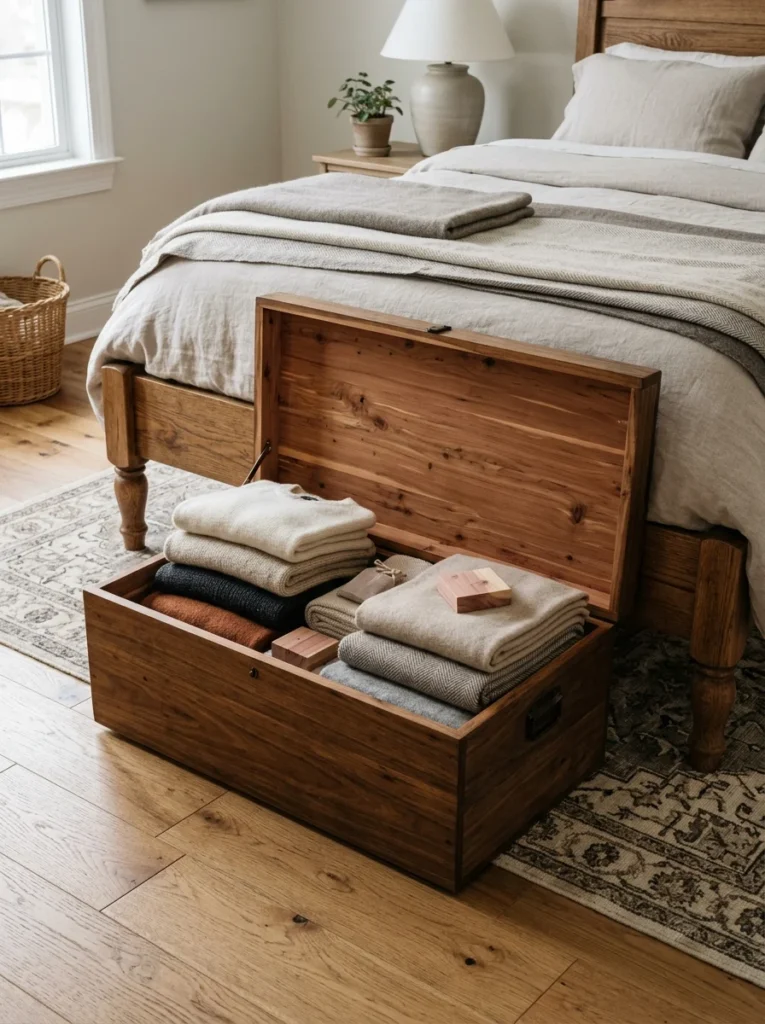
For anyone storing wool sweaters, natural fiber blankets, or other textiles vulnerable to moth damage, cedar-lined storage bins or simply adding cedar blocks to your existing containers provides natural, chemical-free protection against this particular concern, addressing a genuine risk that standard plastic storage alone doesn’t inherently protect against. I switched to cedar-lined bins specifically for my wool items after a previous, unfortunate moth incident with a favorite sweater stored in a standard plastic bin without any additional protective measure. I’d recommend refreshing cedar blocks or panels periodically, since their protective scent and effectiveness do diminish gradually over time, typically requiring either light sanding to refresh the surface or complete replacement every year or two depending on the specific product and your storage conditions. This is a particularly worthwhile investment specifically for genuinely valuable or sentimental wool and natural fiber items, where the relatively modest cost of proper cedar protection is easily justified compared to the potential loss of a favorite, difficult-to-replace garment to moth damage during extended storage.
16. Repurpose Vintage Suitcases as Storage

Rather than purchasing new storage containers, repurposing vintage suitcases specifically as under-bed storage adds genuine character and history to what’s otherwise typically an entirely hidden, purely functional space, while still providing perfectly adequate enclosed storage for whatever you choose to keep inside them. A friend uses a collection of vintage hard-sided suitcases beneath her guest room bed specifically for this dual purpose, and even though the storage itself remains hidden during normal use, she’s mentioned genuinely enjoying pulling one out and appreciating its vintage character each time she actually needs to access whatever’s stored inside. This works particularly well if you already own or can affordably source vintage suitcases with a reasonably low, flat profile suited to under-bed clearance, though not every vintage suitcase style will actually fit this specific application given how varied their original dimensions and shapes tend to be. I’d recommend this specifically for anyone drawn to that vintage, collected aesthetic and willing to search secondhand shops or online marketplaces for suitcases with an appropriately low profile, rather than assuming any vintage suitcase you happen to already own will necessarily work for this particular storage purpose.
17. Store Extra Linens Organized by Bed Size
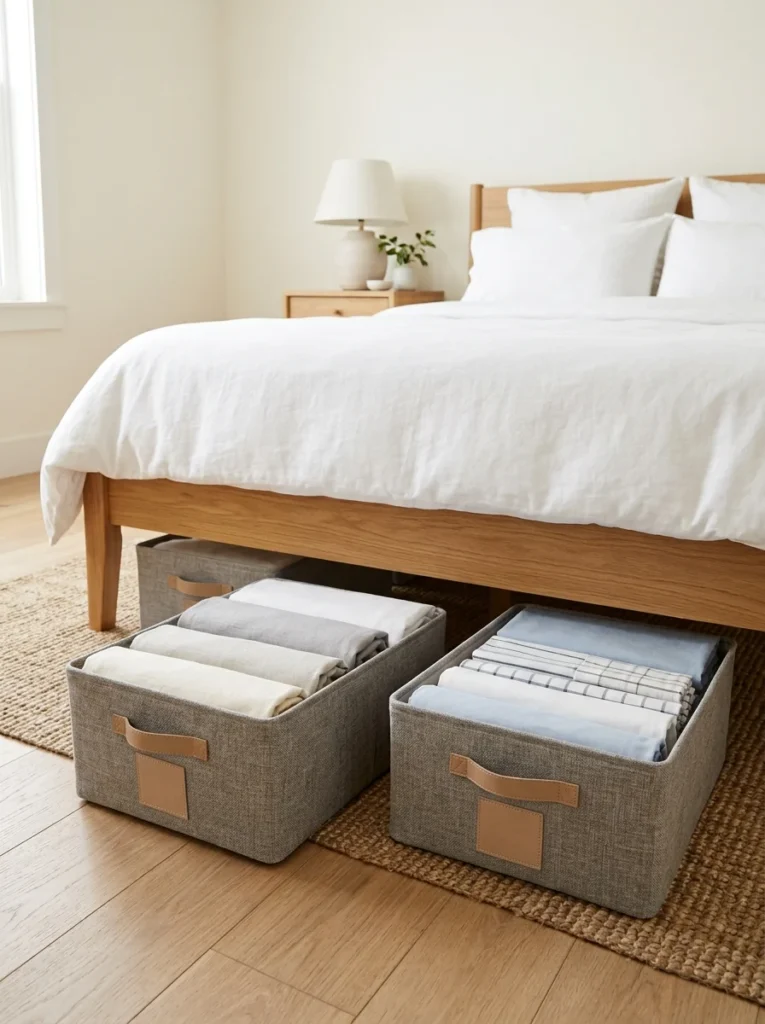
For households with multiple beds requiring different sheet sizes, organizing your under-bed linen storage specifically by size, keeping all queen sheets together, all twin sheets separately, rather than mixing everything together in one undifferentiated pile, makes finding the correct set considerably faster when you’re actually changing beds throughout your home. I organize my own linen storage exactly this way, with separate labeled sections specifically for my primary bedroom’s queen sheets and my guest room’s twin sheets, eliminating the previous frustration of pulling out an entire bin only to discover the wrong size sheets buried somewhere within it. I’d recommend this specifically for households with more than one bed size in use, since a single-bed household obviously doesn’t face this particular organizational challenge and can simply store all linens together without needing this size-based differentiation. This system pairs particularly well with the labeling idea mentioned earlier, since clearly marked size categories make retrieving the correct linens for a specific bed considerably faster than needing to unfold and check each set individually before determining whether it’s actually the size you need.
18. Add a Small LED Light for Nighttime Access
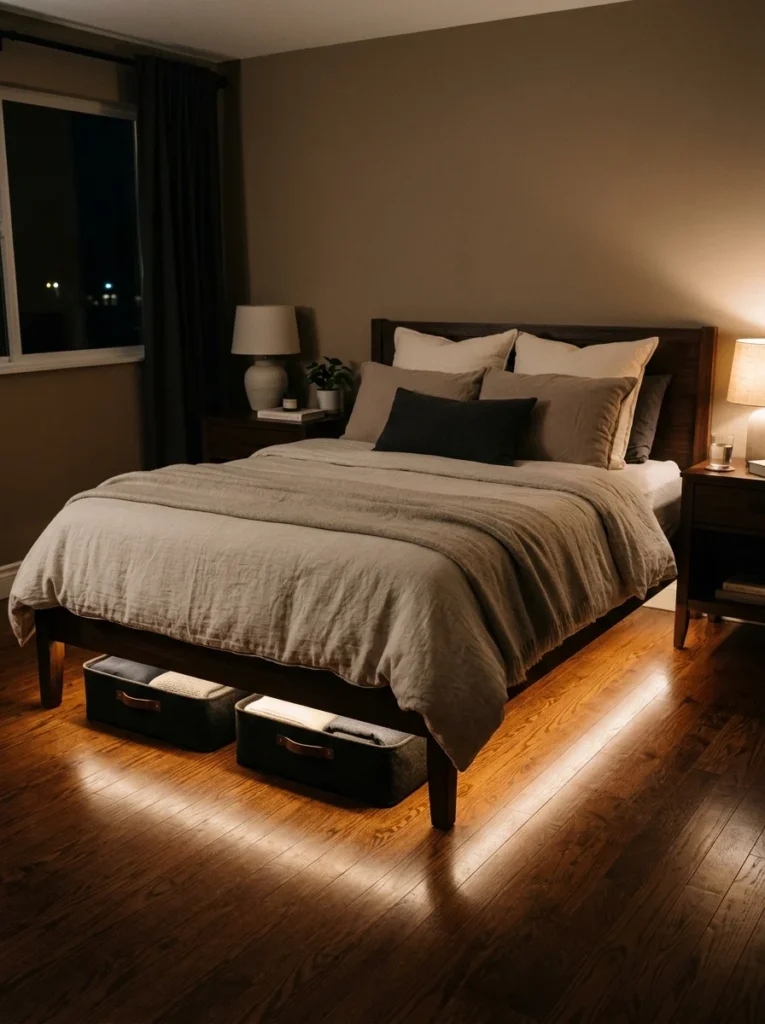
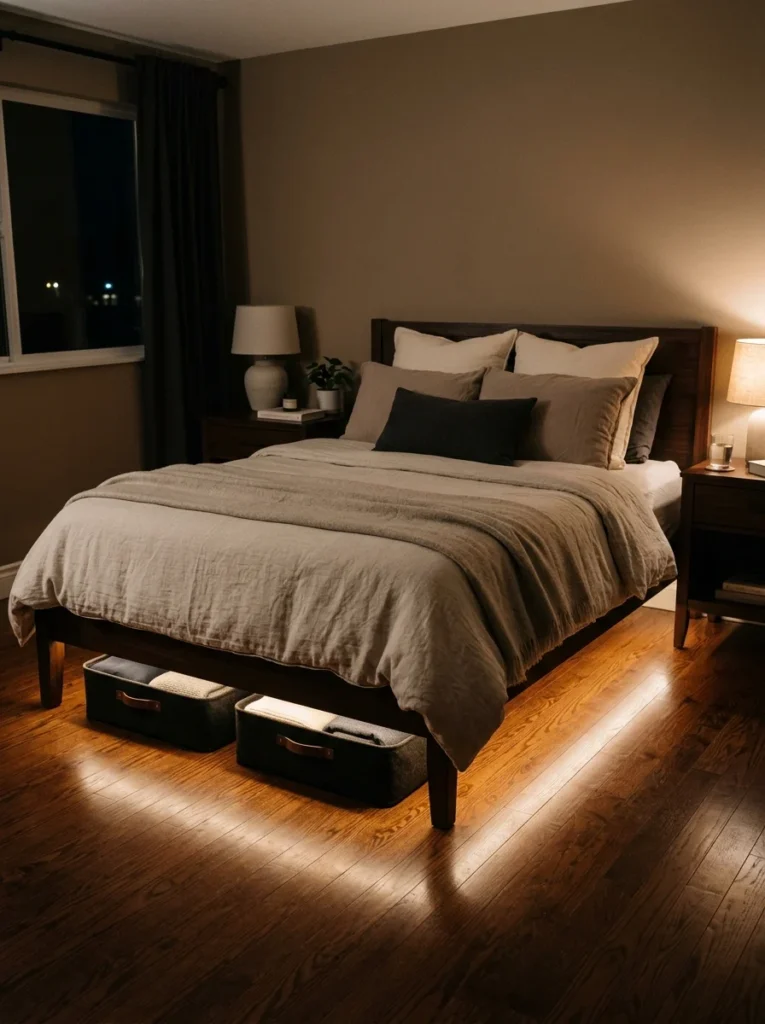
A small, battery-operated LED light attached to the underside of your bed frame or positioned near your storage containers makes retrieving items during nighttime hours considerably easier than fumbling in the dark or needing to turn on a bright overhead light that might disturb a sleeping partner. I added a simple motion-activated LED strip specifically for this purpose, and being able to quickly grab something from under-bed storage during the night without needing to fully wake up or disturb anyone else in the room has been a small but genuinely appreciated convenience. This is a relatively inexpensive addition, typically just requiring a battery-powered or rechargeable LED strip with adhesive backing, making it accessible even for renters who might not want to pursue any hardwired lighting solution requiring actual electrical work. I’d recommend this specifically for anyone who regularly needs nighttime access to under-bed storage, whether for medication, a nightlight for kids, or simply items you find yourself reaching for during evening hours more often than you might initially expect.
19. Use Modular Stackable Drawers for Flexibility
Rather than committing to fixed-size bins, modular stackable drawer systems specifically designed for under-bed use let you customize your exact storage configuration and adjust it over time as your actual storage needs change, offering considerably more flexibility than a single large bin that can’t be reconfigured once purchased. I switched to this modular system in my own smaller apartment specifically because my storage needs shifted somewhat unpredictably between different seasons and life stages, and the ability to simply add or remove individual drawer units as needed has genuinely proven more adaptable than my previous fixed-bin approach. I’d recommend this specifically for anyone anticipating their storage needs might change meaningfully over time, whether due to moving, a growing family, or simply evolving hobbies and interests, since the modular nature means your investment in this storage system continues to work well even as your specific requirements shift rather than needing complete replacement. This system also tends to make better use of irregular clearance situations, since individual smaller modules can sometimes fit configurations that a single larger, fixed bin simply couldn’t accommodate.
20. Store Pet Supplies for Multi-Purpose Convenience
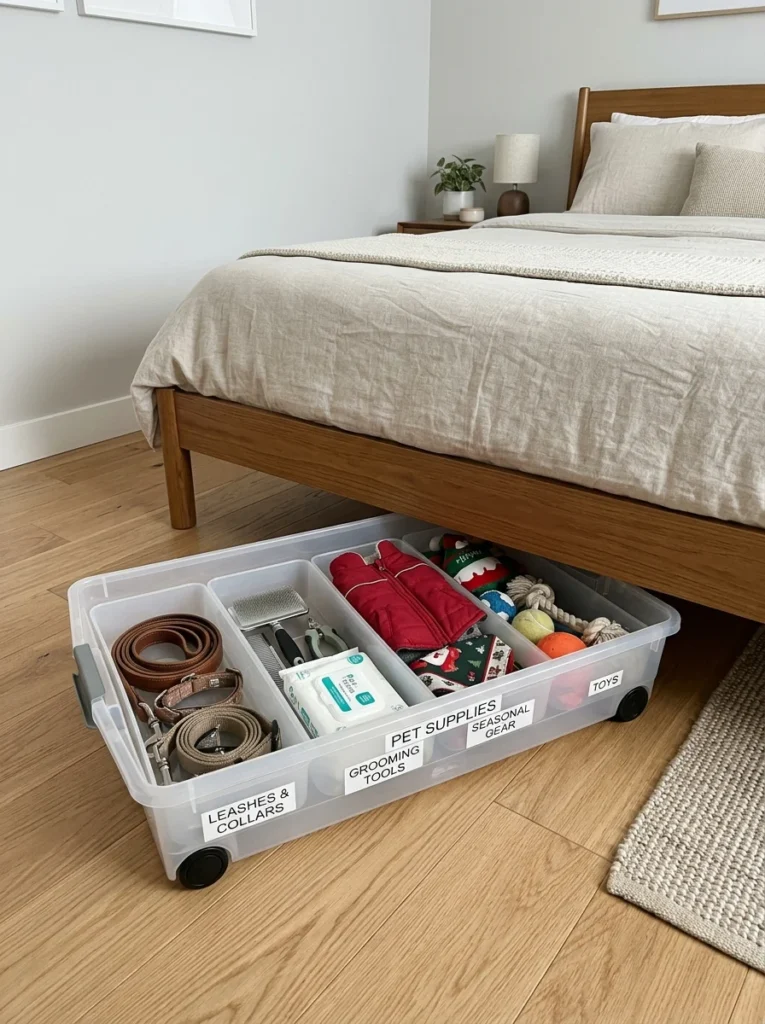
For pet owners with limited storage elsewhere in their home, dedicating one under-bed container specifically to pet supplies, extra leashes, grooming tools, seasonal pet accessories, keeps these items organized and out of the way while remaining reasonably accessible whenever actually needed. A friend uses exactly this solution for her dog’s less frequently used supplies, keeping daily essentials like the leash and regular food elsewhere but storing seasonal items like a winter coat or specialized grooming tools in this dedicated under-bed container instead. I’d recommend this specifically for pet owners in smaller homes or apartments without a dedicated mudroom or pet supply closet, since under-bed storage genuinely provides a useful overflow solution for this particular category of household items that don’t always have an obvious dedicated storage spot elsewhere. This works particularly well combined with the labeling system mentioned earlier, ensuring you can quickly identify and retrieve the correct seasonal pet item without needing to search through multiple containers during whatever specific situation actually requires it.
21. Choose Breathable Storage for Leather Items
For leather bags, jackets, or shoes, choosing breathable fabric storage rather than fully sealed plastic bins allows some air circulation that helps prevent the material from developing mildew or an unpleasant musty smell that can develop when leather is stored in a completely airtight environment for an extended period. I learned this specifically after a disappointing experience with a leather bag stored in a sealed plastic bin, discovering a faint but persistent musty smell when I eventually retrieved it after several months of storage. I’d recommend breathable cotton or canvas storage bags specifically for any leather items in your under-bed storage rotation, reserving the fully sealed plastic options for textiles and other materials less prone to this particular moisture and ventilation-related concern. This consideration matters more in genuinely humid climates or poorly ventilated bedrooms specifically, where the risk of this kind of moisture-related damage during extended storage is meaningfully higher than it might be in a drier climate or a bedroom with better overall airflow and ventilation.
22. Add Silica Gel Packets for Moisture Control
Including silica gel packets within your under-bed storage containers, particularly for items stored for extended periods without regular access, helps absorb ambient moisture that could otherwise contribute to mildew, musty odors, or general dampness developing within an enclosed storage environment over time. I add a few packets to each of my longer-term storage bins specifically for this reason, replacing them periodically as the silica gel gradually becomes saturated and less effective at continuing to absorb additional moisture from the enclosed space. I’d recommend this specifically for storage bins that remain closed and largely undisturbed for several months at a stretch, seasonal decorations, off-season bedding, rather than bins you’re accessing and opening more regularly, since more frequent opening naturally provides some passive ventilation that reduces this particular moisture concern somewhat on its own. This is a genuinely inexpensive addition to any longer-term storage setup, and I’d recommend it as a near-universal recommendation for anyone storing items beneath their bed for extended periods, particularly in climates with meaningful humidity or in bedrooms without much natural airflow.
23. Use Under-Bed Storage for Emergency Supplies
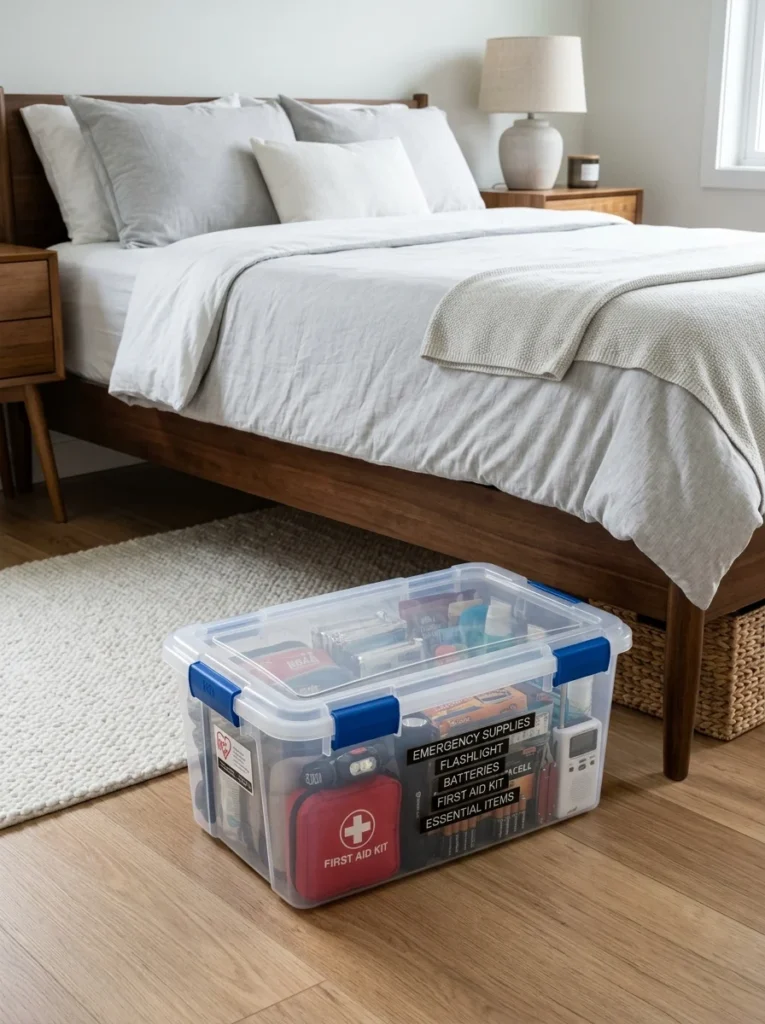
Rather than tucking emergency preparedness supplies, a first aid kit, flashlights, backup batteries, into a hard-to-reach closet or garage, keeping a dedicated container specifically beneath your bed ensures these items remain genuinely accessible during an actual emergency, when you might not have the time or ability to search through a less convenient storage location elsewhere in your home. I keep a dedicated emergency bin specifically for this purpose, clearly labeled and positioned for genuinely easy access, prioritizing that immediate availability over some of the other organizational considerations that apply to less time-sensitive storage categories elsewhere on this list. I’d recommend this specifically as a near-essential use of at least one under-bed storage container, given how directly relevant a bedroom’s proximity is to where you’d actually be during many emergency scenarios, particularly overnight situations where quick access to emergency supplies genuinely matters most. This container’s contents deserve periodic checking specifically, confirming batteries haven’t expired and any perishable emergency supplies remain current, treating this particular storage category with more regular maintenance attention than some of the less time-sensitive items stored elsewhere beneath your bed.
24. Store Wrapping Paper and Gift Supplies Flat
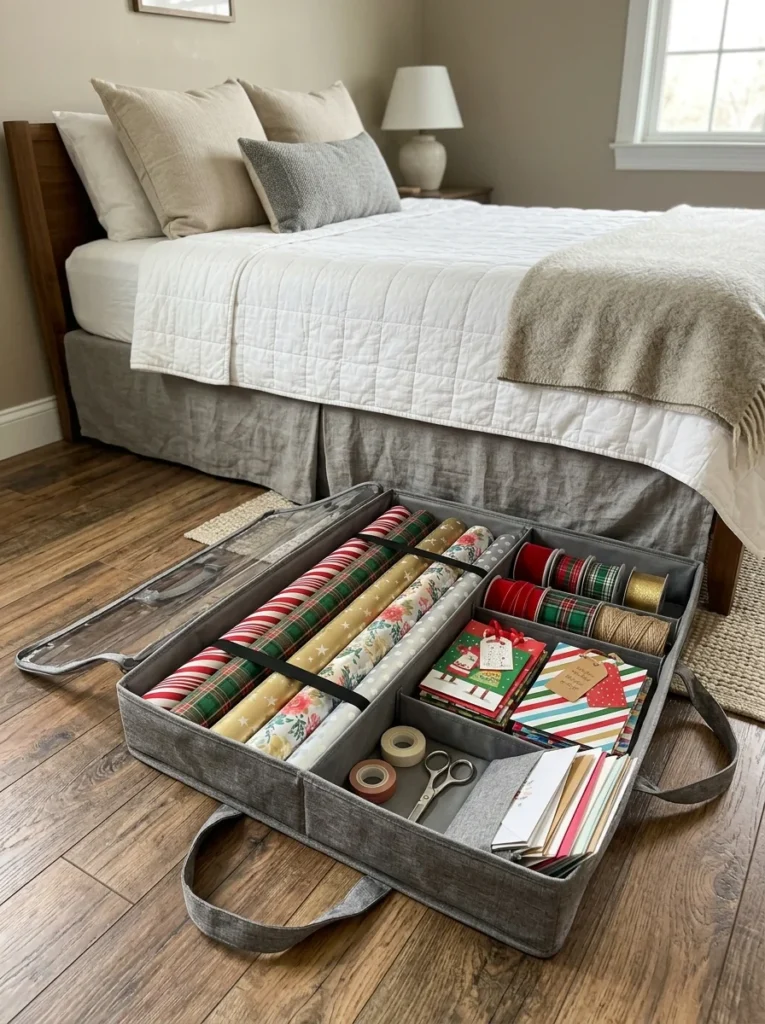
Long, flat under-bed storage specifically designed to accommodate rolls of wrapping paper, ribbon, and gift bags keeps this often awkwardly shaped holiday and gift-giving category organized and protected without requiring the taller, more substantial storage space these bulky rolls might otherwise demand elsewhere in a closet or garage. I use a specifically designed flat gift-wrap organizer for exactly this purpose, and having all my wrapping supplies contained and easily accessible beneath my guest room bed has genuinely simplified the process of quickly wrapping a gift compared to my previous system of loose rolls propped in various closet corners throughout the house. I’d recommend this specifically designed style of storage over a generic flat bin for this particular category, since gift-wrap organizers typically include specific compartments and dividers designed around the unique shape and length of wrapping paper rolls, providing better organization than a general-purpose container not specifically designed for this particular item’s unusual dimensions. This works particularly well positioned beneath a guest room or less frequently used bedroom, since gift-wrapping supplies typically aren’t needed on a genuinely daily basis, making that room’s slightly reduced everyday accessibility a reasonable tradeoff for this specific storage category.
25. Consider a Storage Ottoman Bed Base Alternative
For a genuinely different approach beyond a traditional frame, an upholstered ottoman-style bed base, which lifts entirely to reveal storage space underneath similar to the lift-top frame mentioned earlier but with a softer, fully upholstered exterior aesthetic, combines substantial storage capacity with a considerably more plush, hotel-like visual appearance compared to a more utilitarian storage frame. A friend chose this style specifically for her primary bedroom, appreciating both the genuine storage capacity and how the fully upholstered base contributes to her room’s overall soft, luxurious aesthetic in a way that a purely functional storage frame with visible drawers wouldn’t achieve in quite the same way. This represents a similar investment level to the lift-top storage frame mentioned earlier, and the choice between these two specific styles really comes down to personal aesthetic preference, since both provide comparable overall storage capacity through a similar lifting mechanism. I’d recommend this specifically for anyone prioritizing a softer, more plush bedroom aesthetic alongside genuine storage function, while the more visibly mechanical lift-top frame might better suit a bedroom leaning toward a cleaner, more modern overall design direction instead.
26. Rotate Seasonal Items to Maximize Year-Round Efficiency
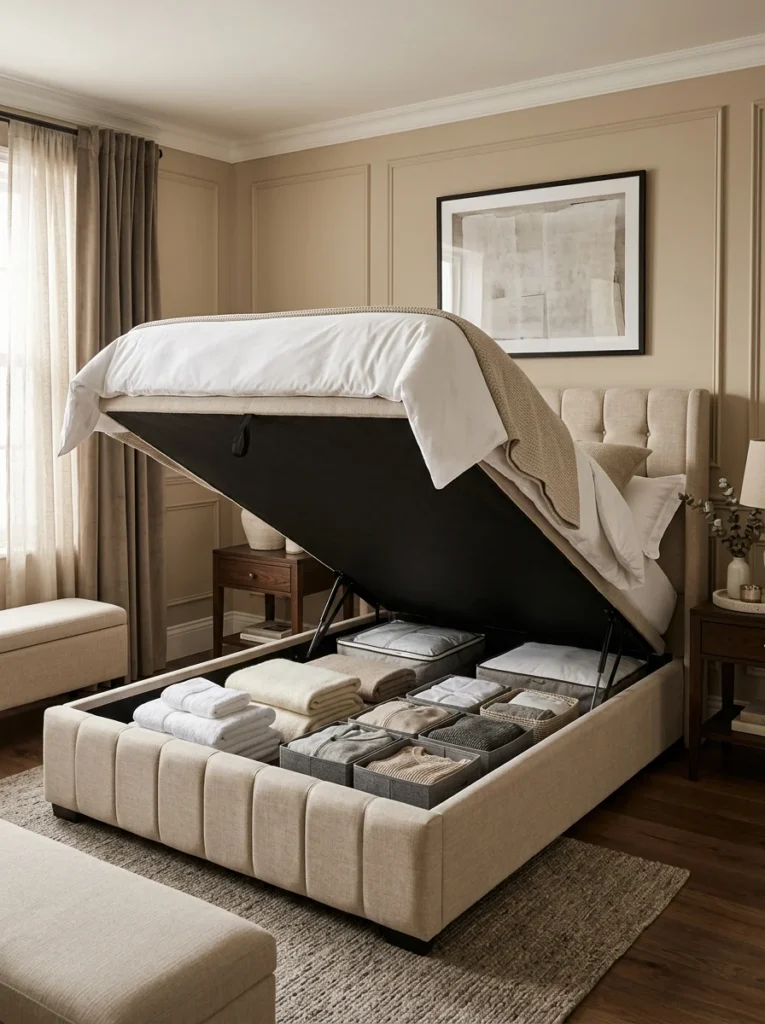
Rather than treating your under-bed storage as a completely static arrangement, actively rotating contents seasonally, swapping winter clothing for summer items and vice versa, ensures your limited under-bed capacity is always holding what you actually need soonest rather than items that could reasonably be stored elsewhere for the majority of the year. I do exactly this twice yearly, swapping my under-bed storage contents between warm and cold weather clothing specifically, which means the space beneath my bed is always working as efficiently as possible for whatever season is actually current rather than permanently dedicated to items I only need access to for a few months out of the entire year. I’d recommend building this rotation into an existing seasonal routine you already maintain, perhaps alongside a broader closet changeover, rather than treating it as an entirely separate task requiring its own dedicated time and mental effort to remember and actually execute consistently. This approach genuinely maximizes the value of your limited under-bed square footage, ensuring that space is always working as hard as possible for your current, actual needs rather than sitting partially dedicated to items irrelevant to the present season.
27. Keep an Inventory List for Larger Systems
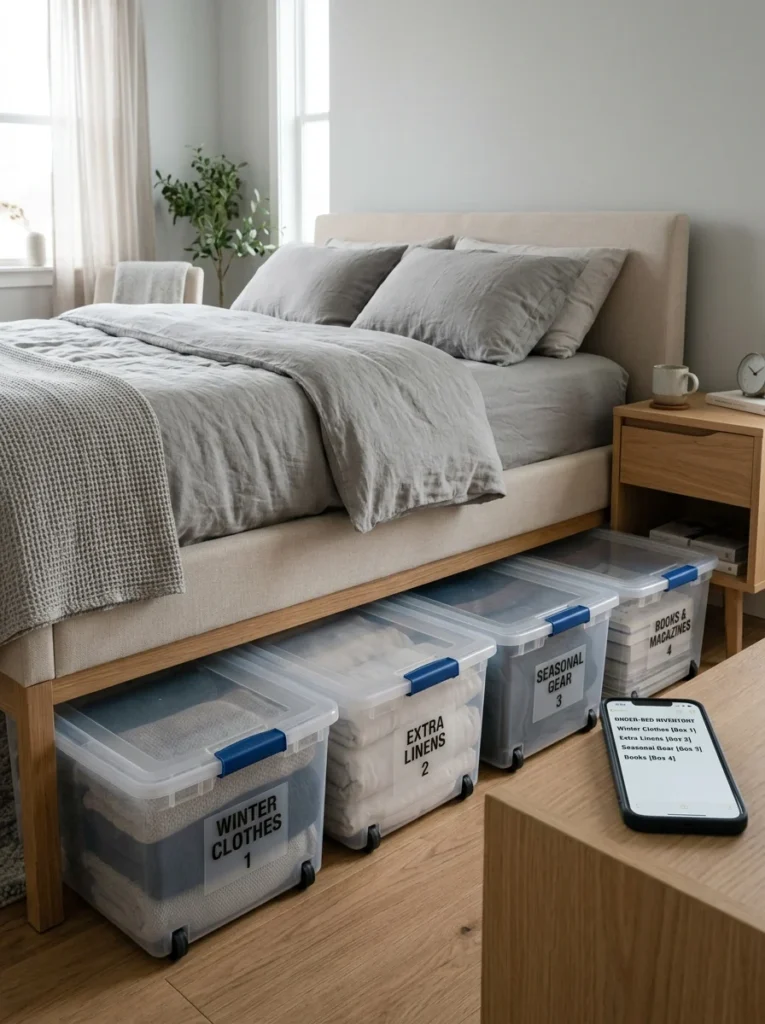
For anyone with a genuinely extensive under-bed storage system spanning multiple bins and categories, keeping a simple written or digital inventory list of what’s stored where saves considerable time compared to relying purely on memory or labels alone, particularly for items you access infrequently enough that you might otherwise forget exactly which specific bin holds what you’re currently searching for. I keep a simple note on my phone listing each bin’s general contents specifically for this purpose, updating it whenever I add or remove anything significant, and that small habit has genuinely saved me from unnecessary searching through multiple bins on several occasions when I needed to locate something I hadn’t accessed in a while. I’d recommend this specifically for anyone with more than four or five separate storage containers beneath their bed, since a smaller system with just one or two bins generally doesn’t require this level of additional tracking, while a more extensive system genuinely benefits from this simple additional organizational layer beyond labeling alone. This system pairs particularly well with the labeling idea mentioned earlier, since your written inventory can reference the same category labels already visible on each individual bin.
28. Periodically Reassess What Genuinely Belongs There
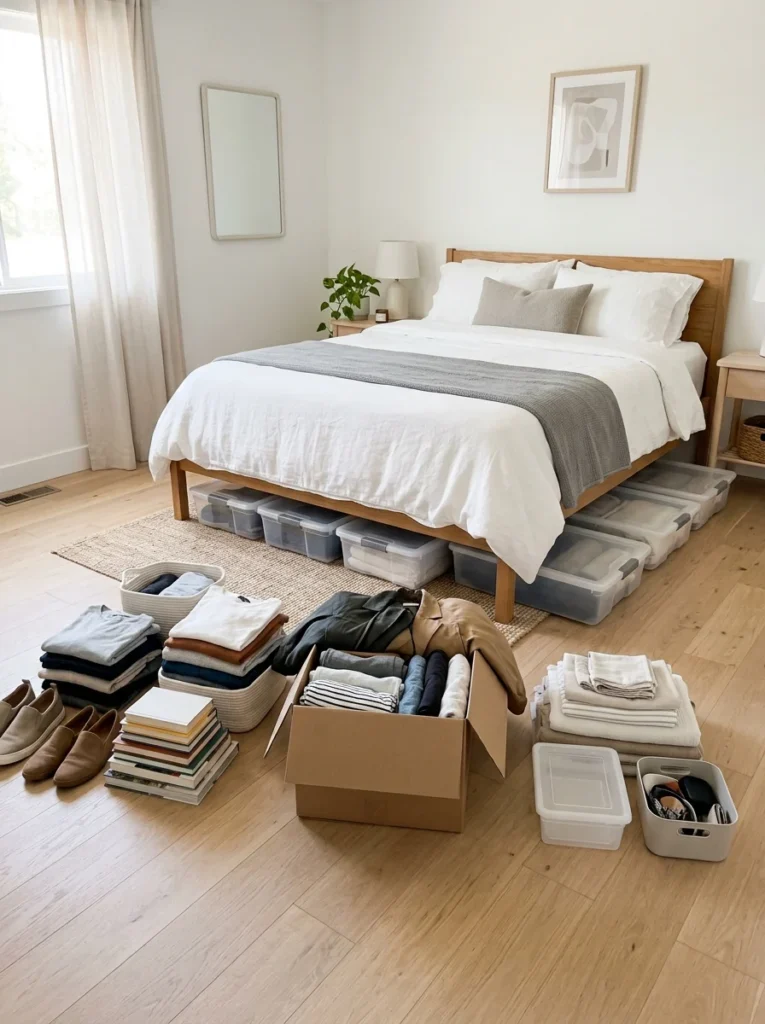
The final piece of advice applies to under-bed storage just as it does to any other storage system throughout a home, periodically reassessing whether everything currently stored beneath your bed still genuinely belongs there, rather than letting this often out-of-sight, out-of-mind space slowly accumulate items you’ve simply forgotten about or no longer actually need. I do a genuine review of my own under-bed storage roughly once a year, honestly evaluating whether each bin’s contents still serve an actual purpose or whether some items have simply been sitting there unused and unnecessary for far longer than I’d initially realized. I’d recommend building this same periodic reassessment into your own household’s broader seasonal organizing routine, treating under-bed storage with the same ongoing attention you’d naturally give to a closet or garage, rather than assuming that once something is tucked away beneath your bed, it’s permanently settled and never worth reconsidering again. This final habit is really what prevents this genuinely valuable storage space from gradually sliding back into the same disorganized, forgotten state that made it feel so overwhelming and inaccessible before you first took the time to organize it properly in the first place.
Final Thoughts
Looking back at that chaotic mix of unidentifiable items that used to live beneath my bed, purely because that space had never been treated as an actual system worth organizing, it’s genuinely remarkable how much functional storage capacity was sitting there unused for years before I finally addressed it properly. Between all 28 of these ideas, the underlying theme is really that under-bed storage, precisely because it’s so easily out of sight and therefore out of mind, rewards intentional organization more than almost any other storage space throughout a typical home, since a small amount of upfront planning prevents it from sliding back into disorganized chaos the way mine had for so many years.
If your own under-bed space is still living in that same chaotic, unsystematic state, I’d suggest starting with the clearance measurement covered in the very first idea before purchasing any specific storage solution, since that single step determines which of the remaining 27 ideas will actually work within your own bed frame’s particular constraints. From there, choose just one or two categories to organize first, seasonal clothing, shoes, whatever feels like your most pressing current need, rather than attempting to overhaul the entire space at once, building toward the same kind of genuinely functional, easily navigated system that eventually replaced my own years of chaotic, unidentifiable under-bed clutter.