
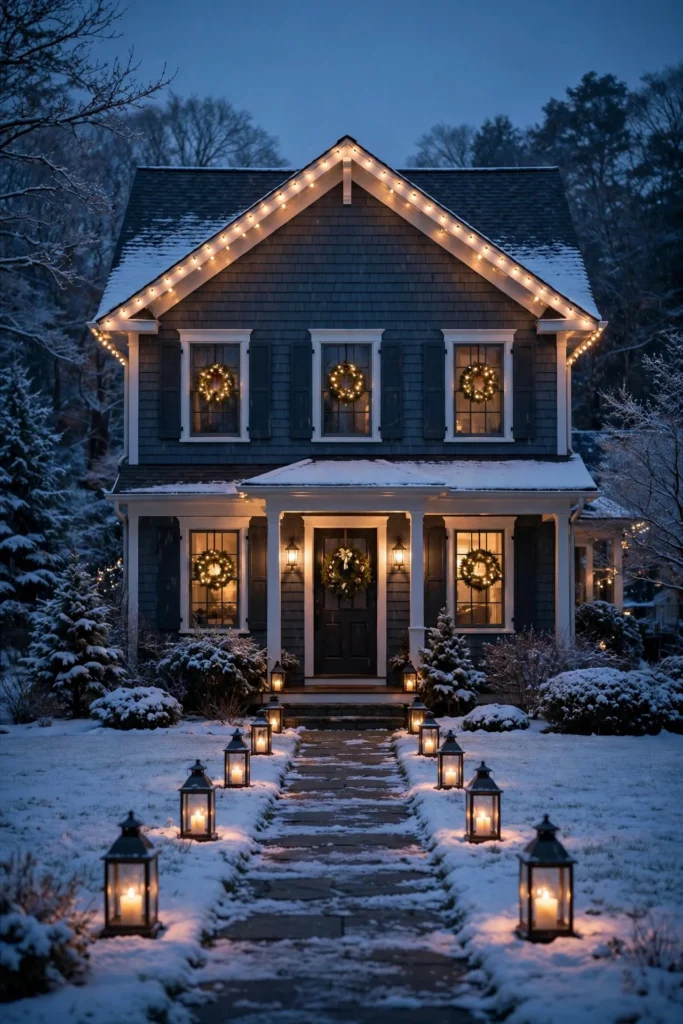
There’s a particular magic to a house glowing against a dark December evening — and you don’t need a professional crew or a second mortgage to pull it off. Outdoor Christmas lights are one of the highest-impact decorations you can do, because the whole street gets to enjoy them. The difference between “tasteful and glowing” and “tangled mess” usually comes down to planning, not budget.
Below are 15 outdoor Christmas light ideas for every skill level, from a simple lit wreath to a full roofline display. Most take an afternoon, many cost less than a takeout dinner, and every one includes the practical details — spacing, bulb counts, timers — that make the difference between a display you love and one you dread taking down.
1. A Clean Roofline in Warm White
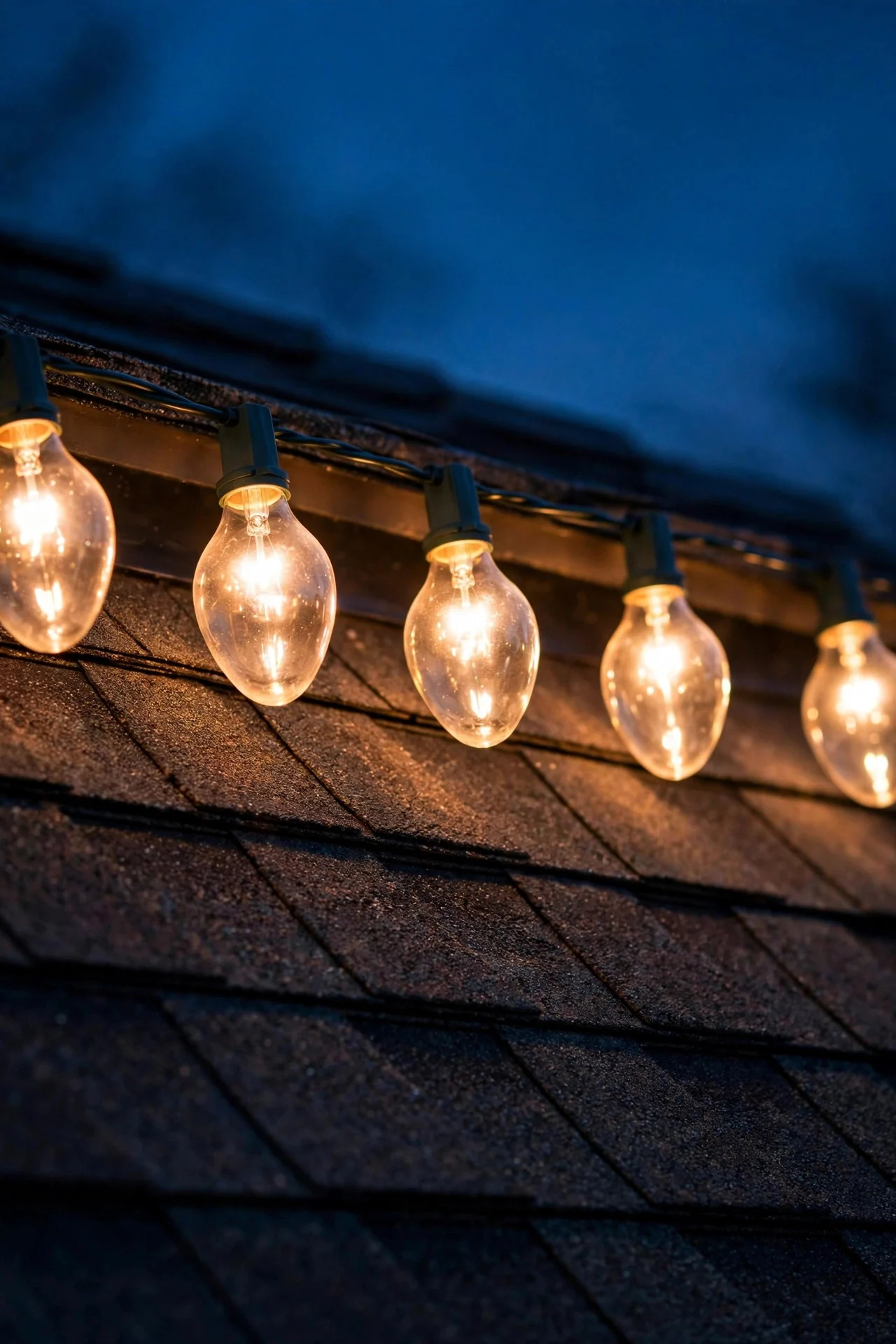
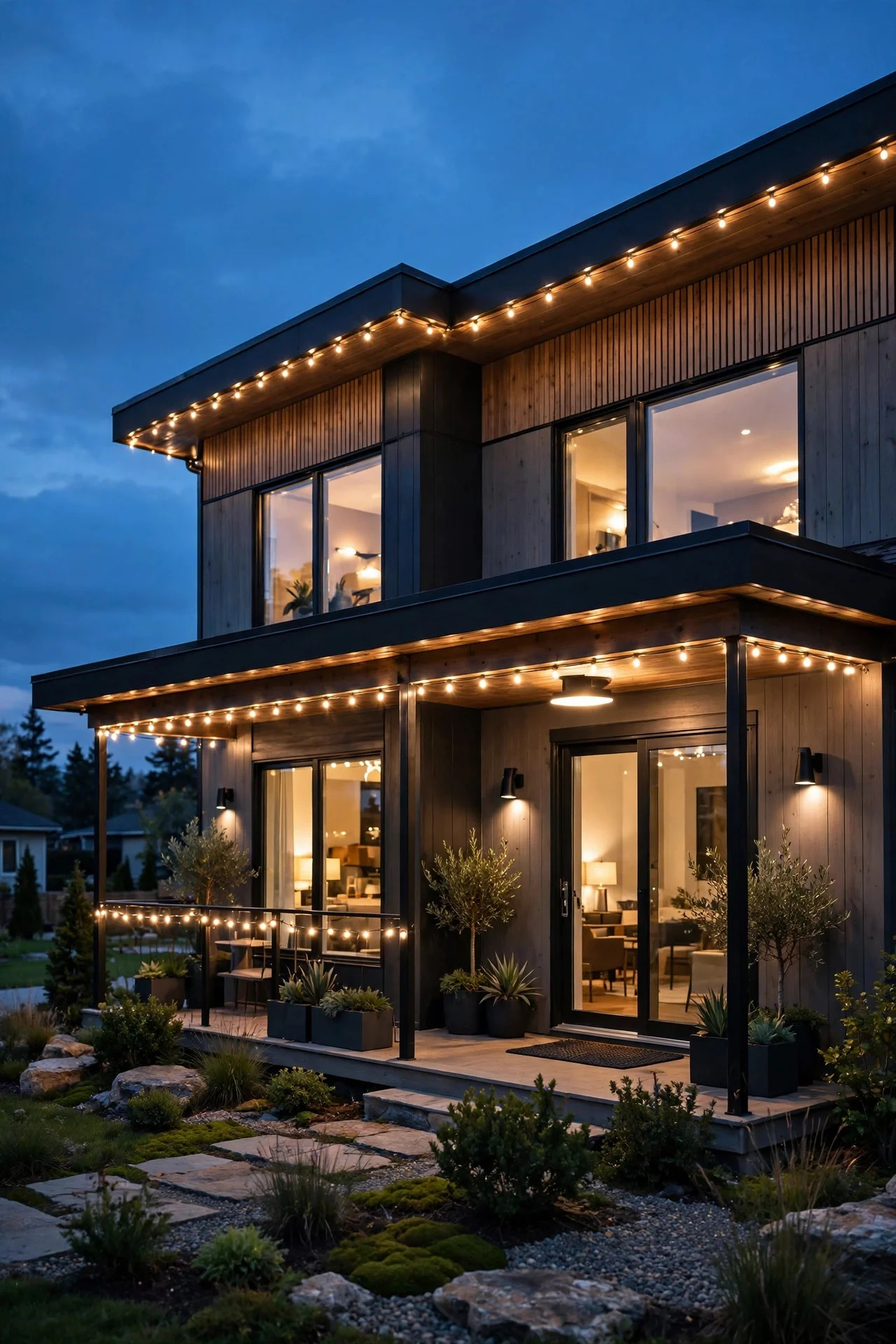
The roofline is the single most flattering place to hang outdoor lights, because it outlines your home’s shape like a drawing. Stick to warm white (2700K) C9 bulbs — they’re the classic big-bulb look that reads “Christmas card,” not “amusement park.” Space them about 12 inches apart with all-in-one clips that grip the shingle or gutter edge without nails.
Measure your roofline before buying: most strands come in 25-foot lengths, and you’ll want a few extra feet for the peaks. Work from an outdoor-rated extension cord near your outlet, and hang lights with the bulbs pointing down for the crispest line.
Try this: Put the roofline on a dusk-to-dawn timer plug (about $12) so it glows every evening without you touching a switch.
2. Icicle Lights Along the Eaves
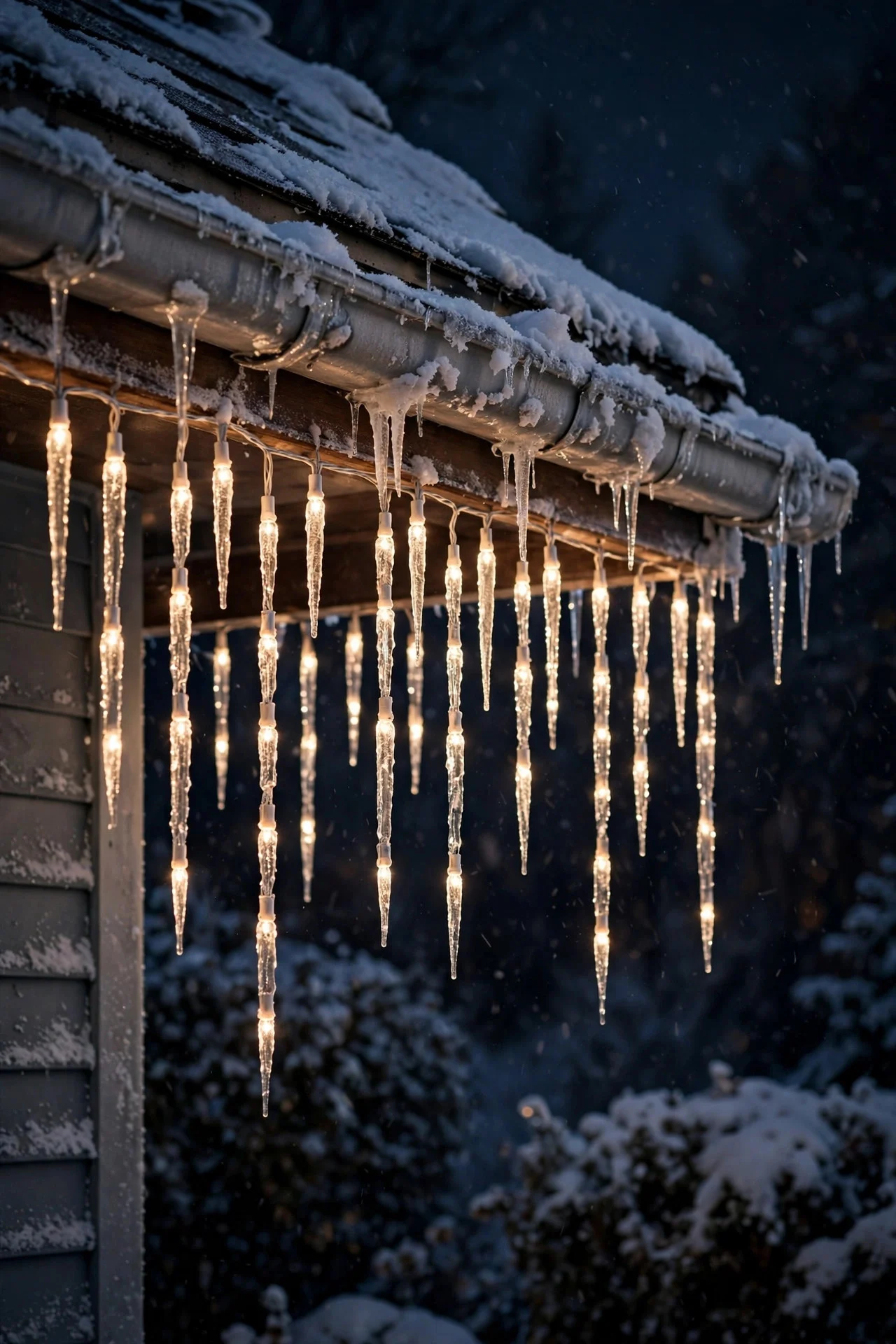
Icicle lights are the easiest way to make a plain eave look finished. The trick is buying strands with staggered drop lengths — 12, 18, and 24 inches mixed — instead of uniform drops, which look flat and artificial. Hang them so the longest drops clear the gutter by a few inches.
One strand per 10 to 12 feet of eave is about right, and icicles look best on straight runs: garage fronts, porch beams, fence tops. If your icicles pool light unevenly, you’ve hung the strand upside down — the drops should hang free, not rest on the gutter.
Try this: Layer icicle lights over your roofline string for depth — the two together look far more expensive than either alone.
3. Lit Wreaths on Every Front Window
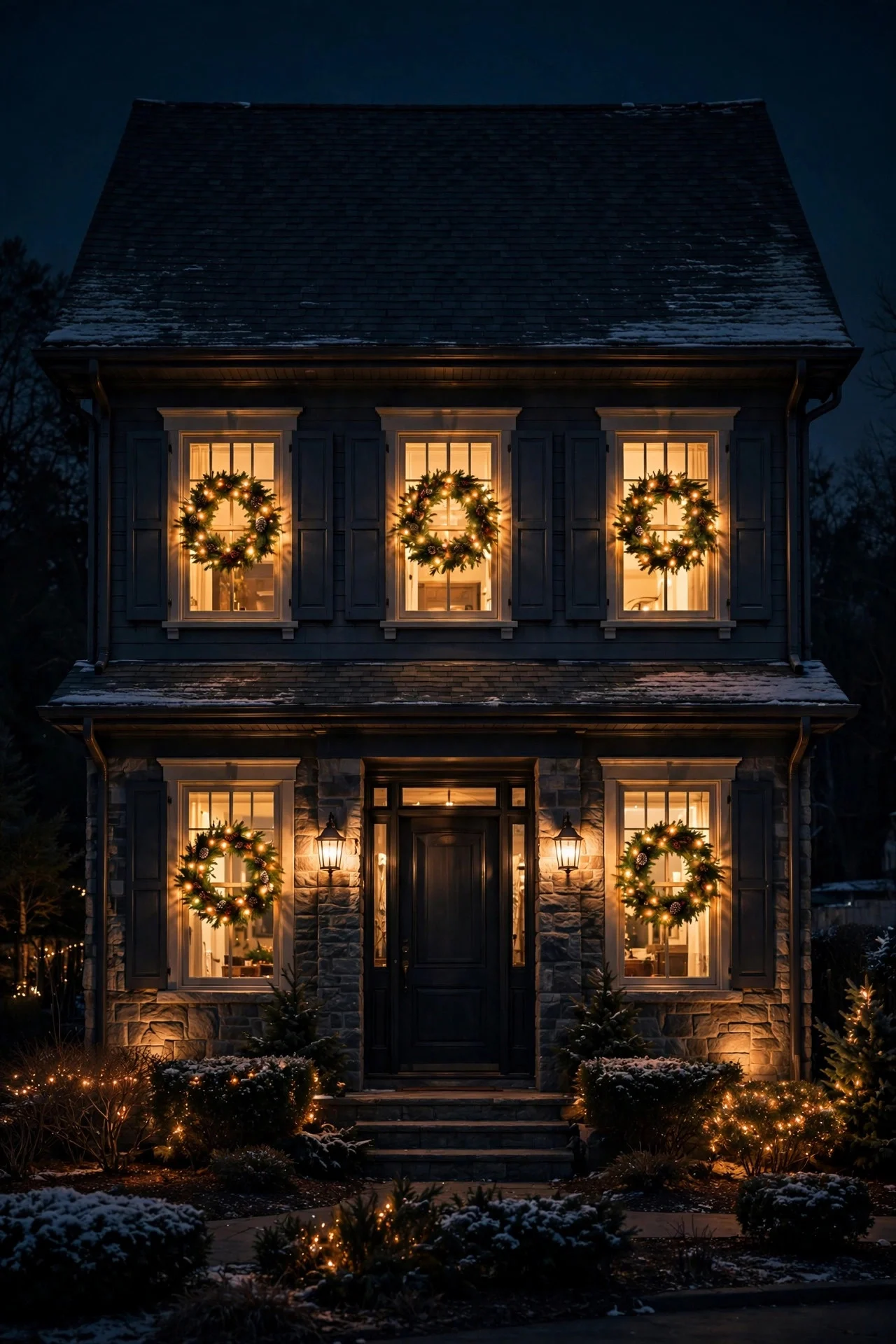
A wreath with warm mini-lights on each front-facing window is the fastest way to make the whole facade feel dressed. You don’t need big wreaths — 24-inch pre-lit ones read beautifully from the street. Hang them centered with a wide ribbon looped over the sash so nothing damages the frame.
Consistency matters more than size here. Four matching wreaths beat one giant statement piece every time. Battery-operated sets with built-in timers save you from running cords to every window — set them once for six hours each evening.
Try this: Add one lit wreath to the inside of the front door too, so the glow greets you when you come home.
4. Solar Pathway Markers
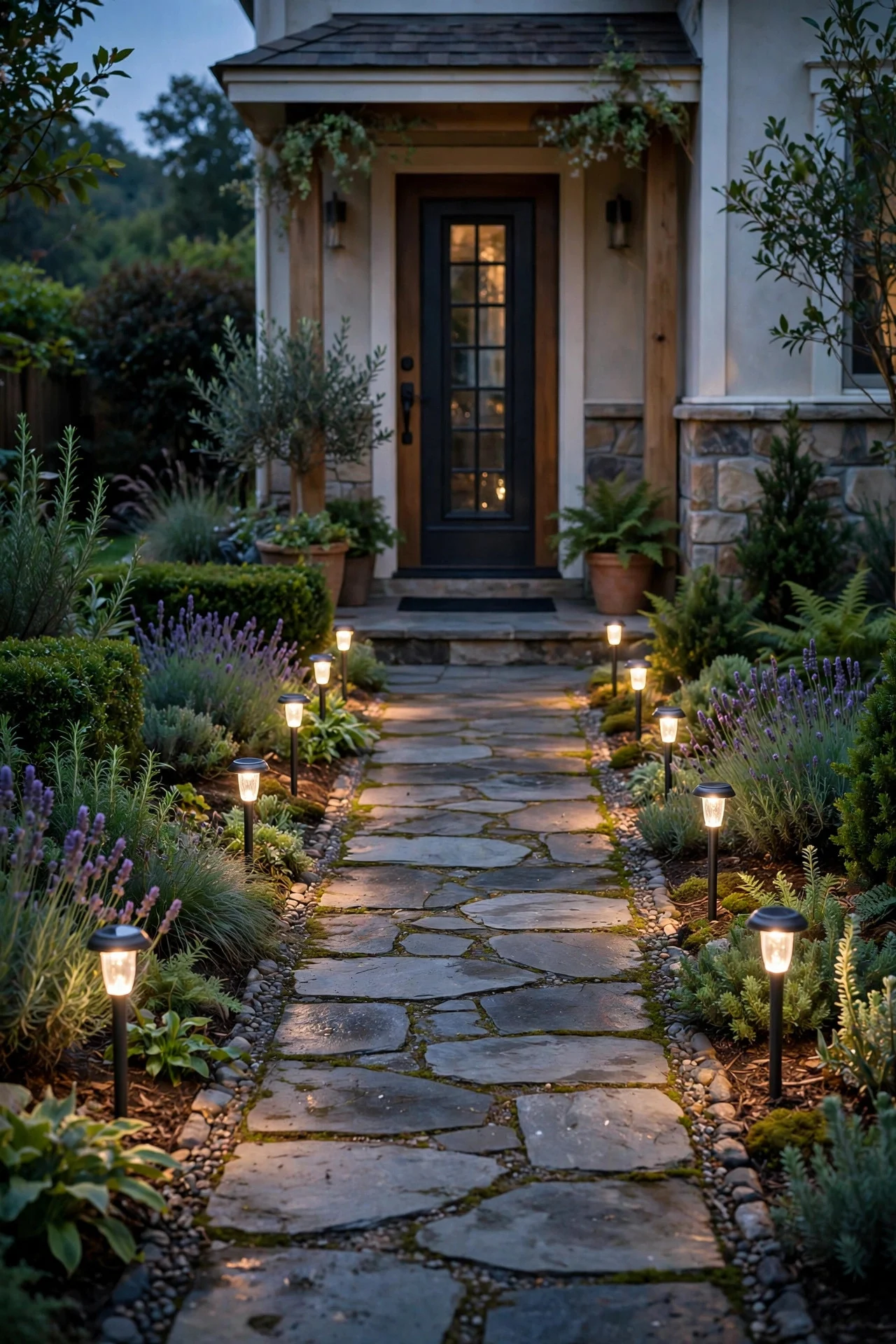
Stake lights along your walkway do double duty: they guide guests safely to your door and frame your whole display from the ground up. Solar versions have gotten genuinely good — look for ones with warm-white LEDs and a full day of charge, which most manage even in December’s weak sun.
Space them 6 to 8 feet apart and keep them in a straight, even line; wobbly spacing is what makes path lights look cheap. Push the stake fully in so the head sits 8 to 10 inches off the ground — high enough to clear snow, low enough to feel intentional.
Try this: Swap the cool-white bulbs many solar stakes ship with for warm-white ones — the color temperature is everything.
5. The Spiral-Wrapped Tree
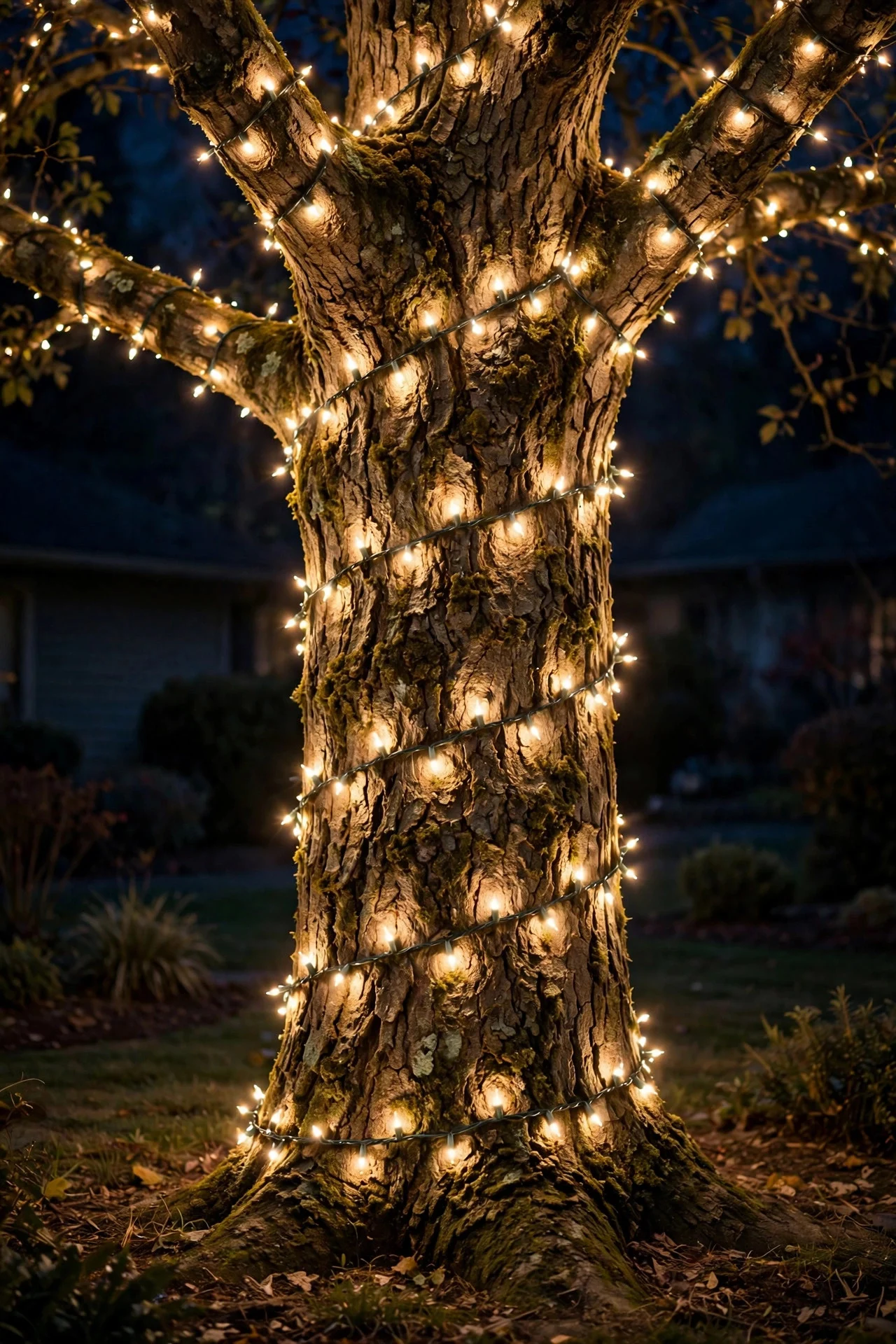
Wrapping a front-yard tree trunk and branches in lights is the most dramatic single move on this list. The rule of thumb: about 100 mini-lights per foot of trunk height for a full look, or half that for something airier. Start at the base, spiral upward with 4-to-6-inch spacing between wraps, and continue into the lowest branches.
Use one continuous strand per section rather than daisy-chaining a dozen short ones — fewer plugs, fewer failures. And wrap in daylight. I know that sounds obvious, but every year someone ends up doing this with a headlamp, and it shows.
Try this: Wrap just the trunk and first branch tier, leaving the canopy dark — the contrast looks sculptural and saves you half the lights.
6. Net Lights Over Shrubs
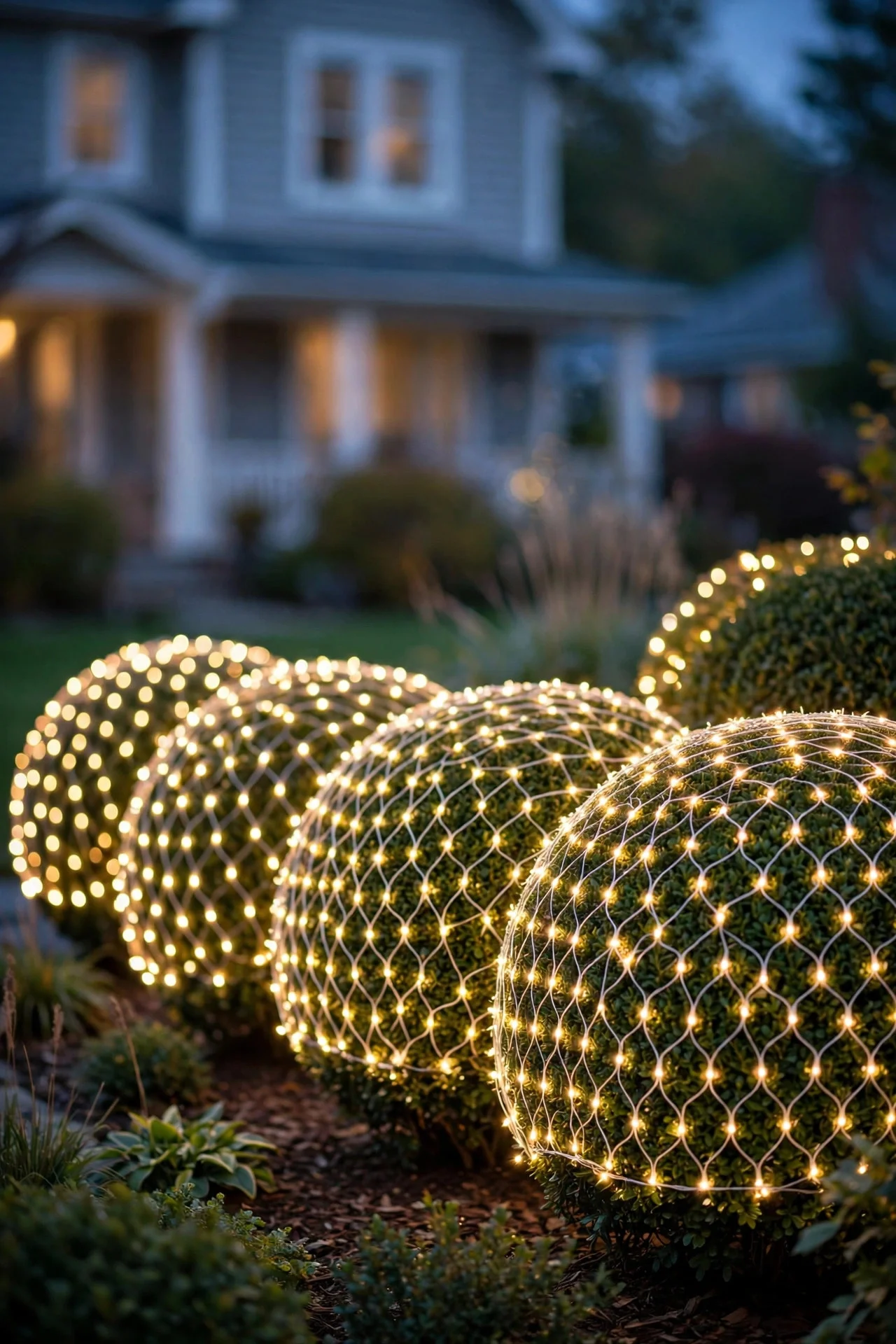
Net lights are the cheat code for bushes and hedges: a 4×6-foot net draped over a shrub gives you perfectly even coverage in about ninety seconds. No winding, no bare patches, no ladders. They were designed for exactly this job, and it shows.
Buy nets sized to your shrubs — measure the bush’s height and width, then choose a net that drapes to the ground on all sides. Connect multiple nets with the built-in end connectors, and hide the plugs under the foliage. One net per shrub, done.
Try this: Lay the net over the shrub like a tablecloth from the top down, not wrapped around — gravity does the spacing for you.
7. A Light Projector for Instant Coverage
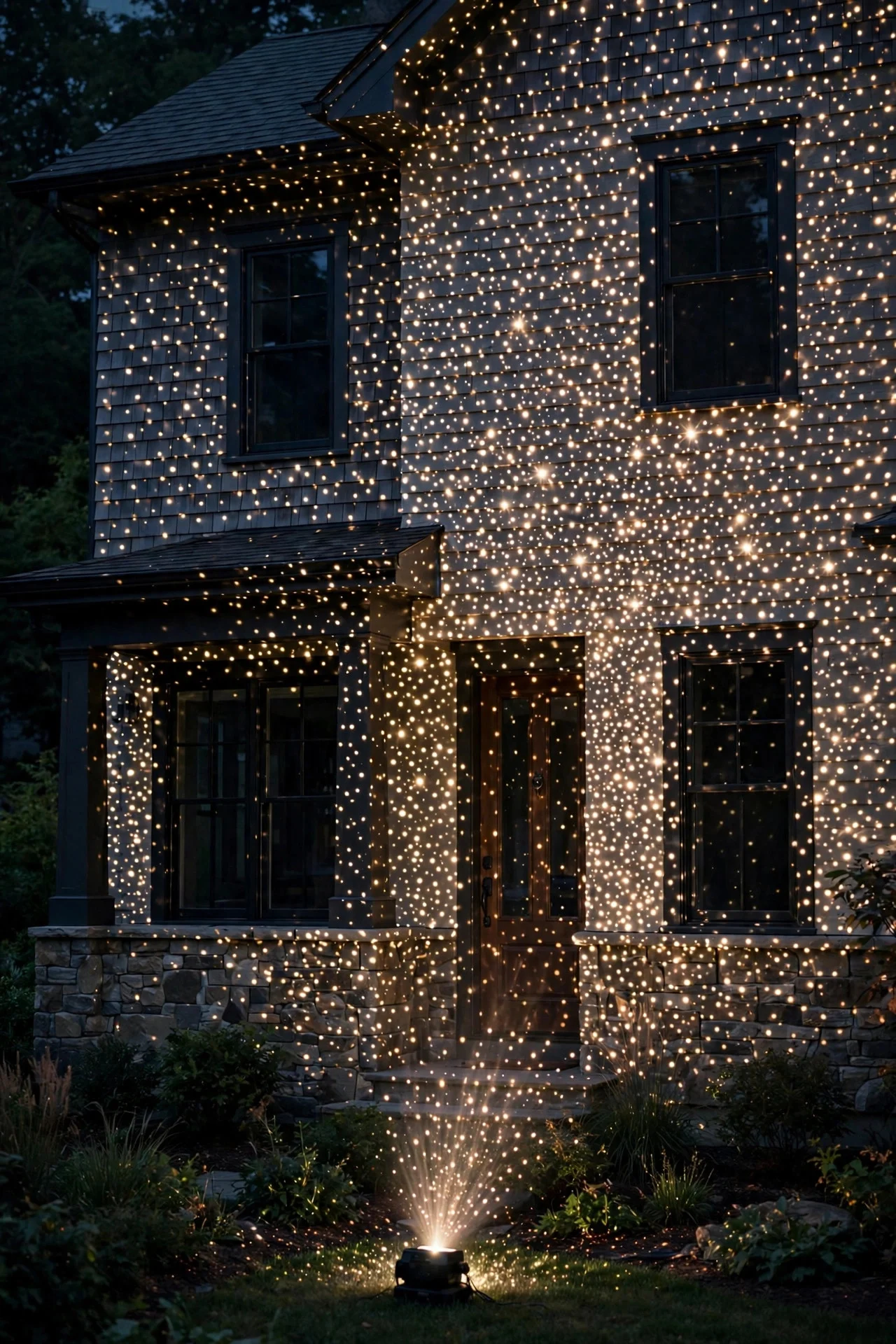
Not ready to climb ladders? A stake-mounted light projector throws thousands of pinpoints across your whole house front from the ground. Setup takes five minutes: stake it 15 to 25 feet from the house, angle it up, plug it in. It’s the highest impact-per-minute option on this list.
Be honest about the look, though — projectors read as dots of light, not the warm glow of real strings. They work best as an addition (house walls, tall trees) rather than the whole show. Choose warm-white over multicolor for a classier result, and pick one with a built-in timer.
Try this: Aim a projector at a bare deciduous tree — the moving dots through branches look like falling snow.
8. Smart Lights You Control From the Couch
App-controlled outdoor lights have quietly become worth it. Set schedules, dim the brightness, switch from warm white to color for New Year’s — all without going outside in the cold. A smart outdoor plug ($15 to $25) makes any existing lights “smart” without replacing a single bulb.
The real win is scenes: a soft warm-white for most of December, then a festive color mode for Christmas Eve, all on a schedule. If you buy smart string lights themselves, check the IP rating — IP44 or higher handles rain and snow without complaint.
Try this: Start with one smart plug on your main display — you’ll know within a week whether you want the whole system.
9. Electric Candles in Every Window
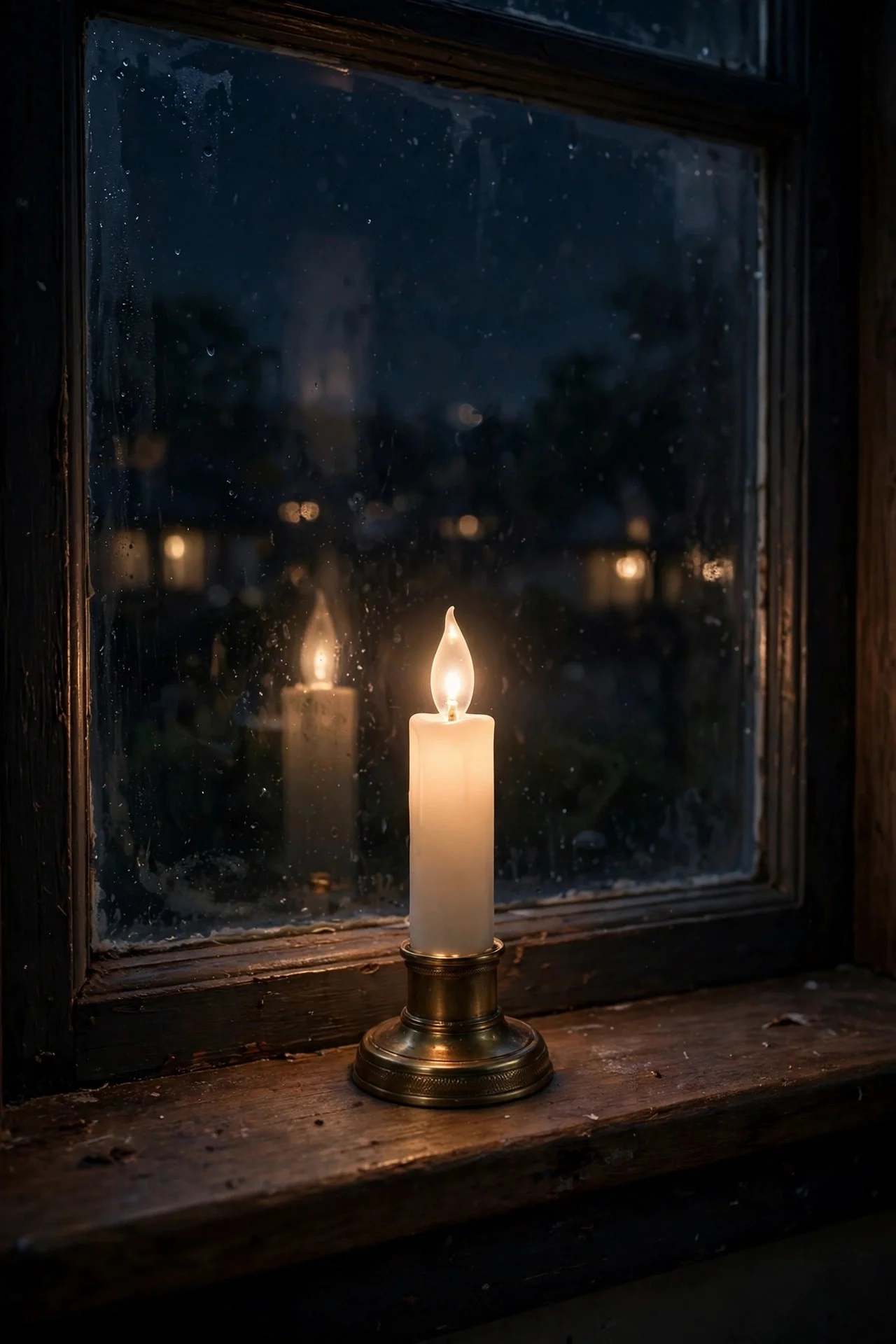
The Colonial Williamsburg look — a single glowing candle in each window — is timeless for a reason. Modern electric window candles with built-in dusk sensors turn themselves on every evening, and they read as elegant from both inside and outside the house.
Consistency is everything: same candle, same height, centered in every street-facing window. The classic placement is 6 to 8 inches back from the glass on the sill. Brass or aged-bronze bases look best; skip anything with glitter or painted designs.
Try this: Add a simple evergreen wreath ring around each candle base — candle plus wreath is the full historic look.
10. Lanterns Lining the Walkway
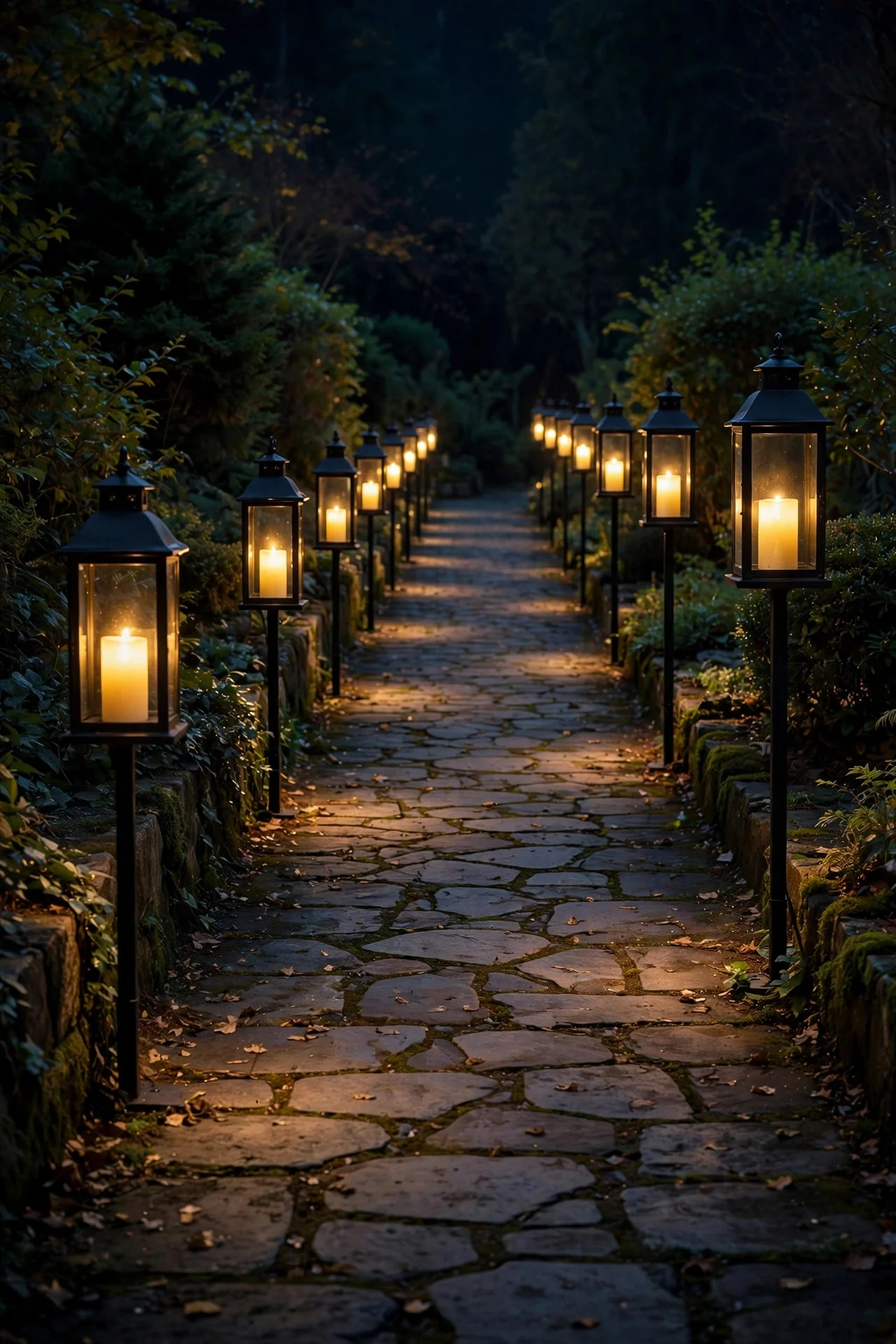
For a softer alternative to stake lights, line your walkway with lanterns holding LED pillar candles. The glow is warmer and more scattered than path markers — less airport runway, more enchanted garden. Space them 4 to 6 feet apart, alternating sides for a natural rhythm.
Weight them down: a handful of sand or a flat stone inside each lantern keeps December wind from redecorating your yard. Tall lanterns (18 inches plus) survive snow better than short ones, and glass panels protect the flame from gusts.
Try this: Cluster three lanterns of different heights at the walkway’s start instead of a straight line — it looks designed, not installed.
11. Lit Garland on Railings and Columns
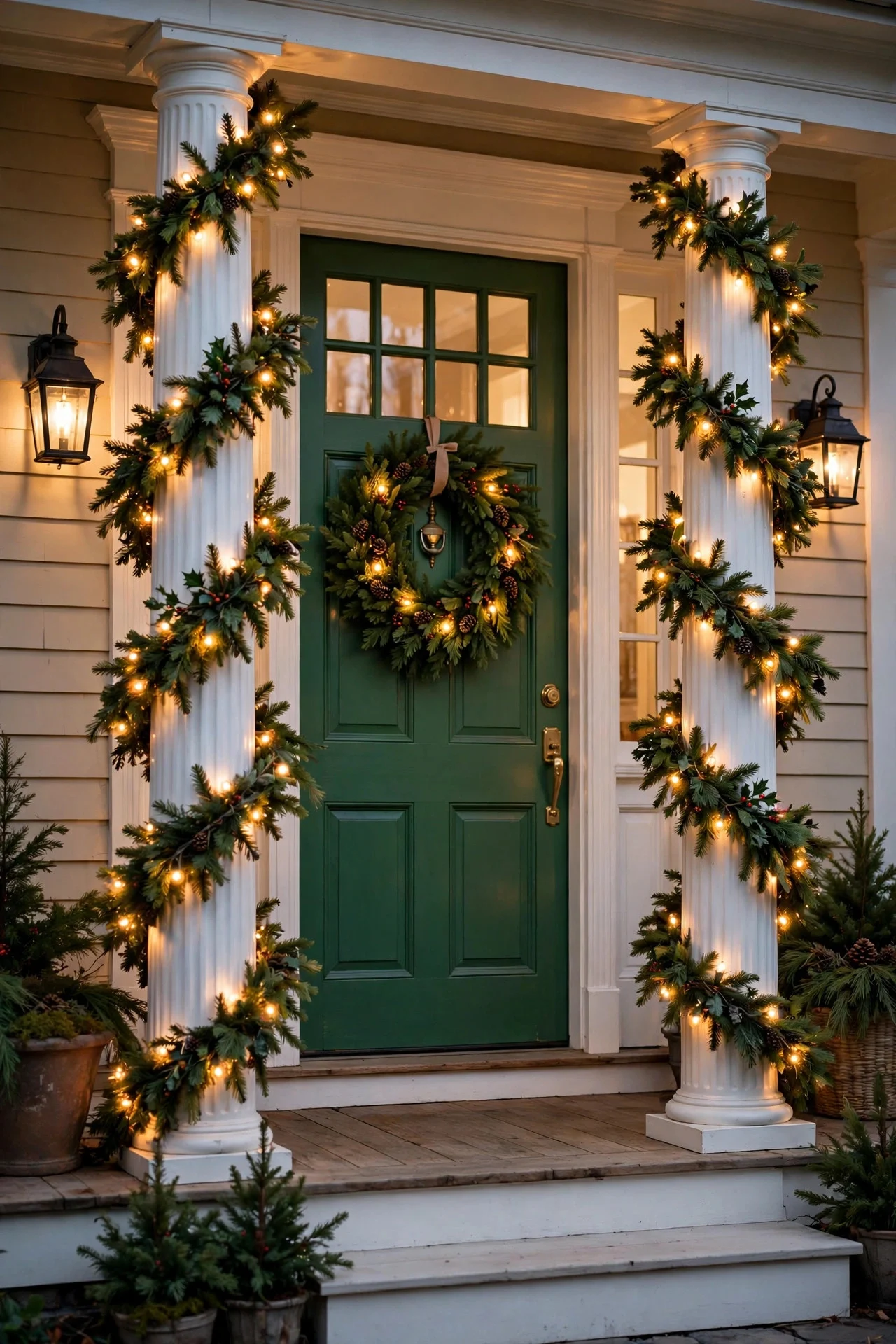
Porch railings and columns are made for garland. Wrap (don’t drape) garland around each column in a loose spiral, securing with floral wire every foot, then weave a light strand through on the ground first — same rule as the staircase. For railings, lay the garland along the top rail and wire it down every 18 inches.
A 9-foot garland covers one standard column with a graceful spiral; railings need roughly one 9-foot garland per 6 feet of rail. This frames your front door beautifully and makes the porch feel like an extension of the decorated interior.
Try this: Add a big bow where each column meets the porch roof — it marks the “top” and looks finished.
12. Glowing Spheres in the Yard
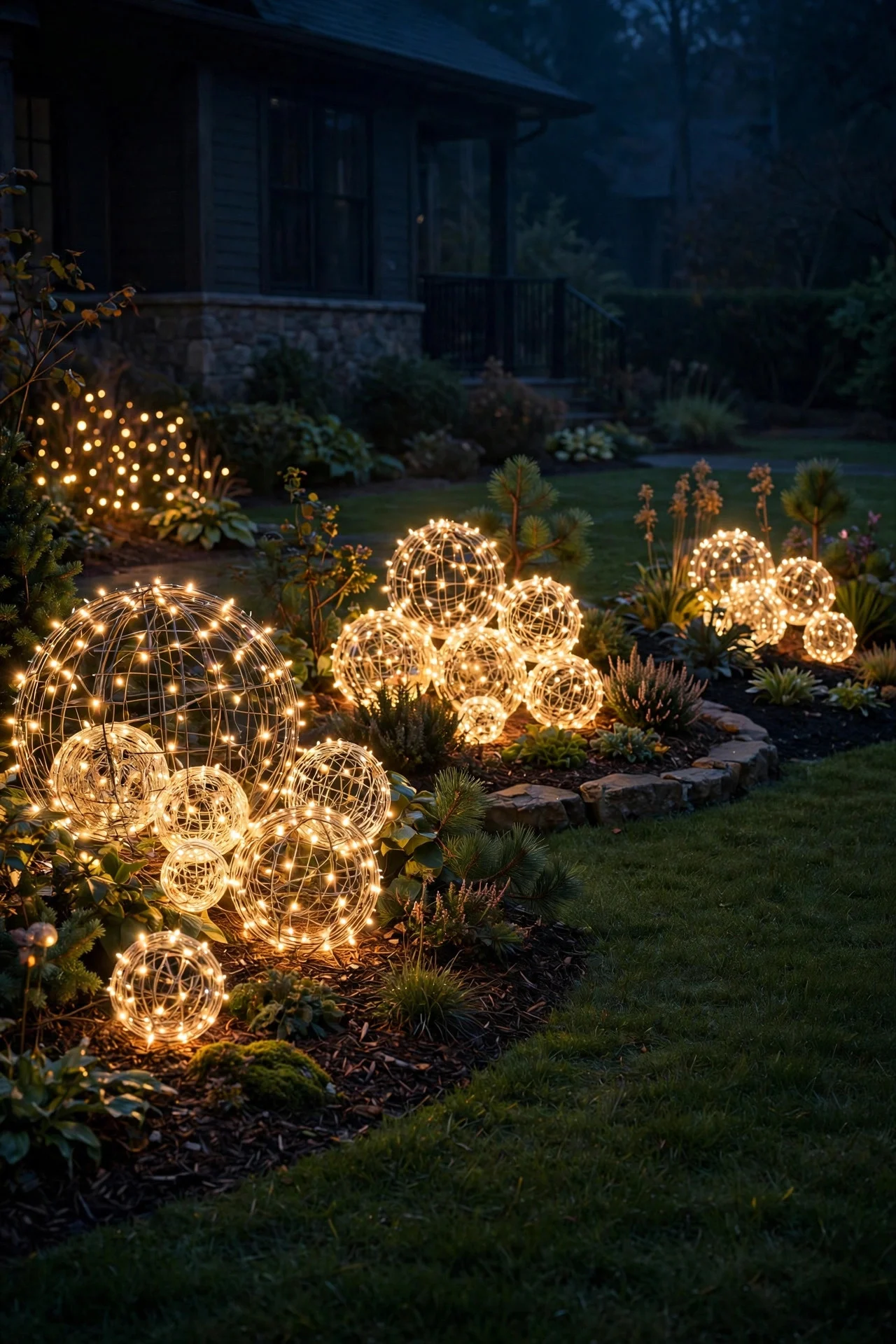
Lighted spheres — wire or vine balls wrapped in mini-lights — scattered across the lawn look like fallen stars. You can buy them pre-lit or DIY: wrap a wire hanging basket frame with a 100-light strand, and you’ve got a glowing orb for about $10.
Group them in odd numbers (three or five) at varying sizes rather than spacing them evenly — clusters look organic, rows look like a runway. Nestle them into garden beds or at the base of trees, and run the cords along the ground secured with landscape staples.
Try this: Hang one large sphere from a tree branch like a floating moon — unexpected and beautiful.
13. A Star on the Gable Peak
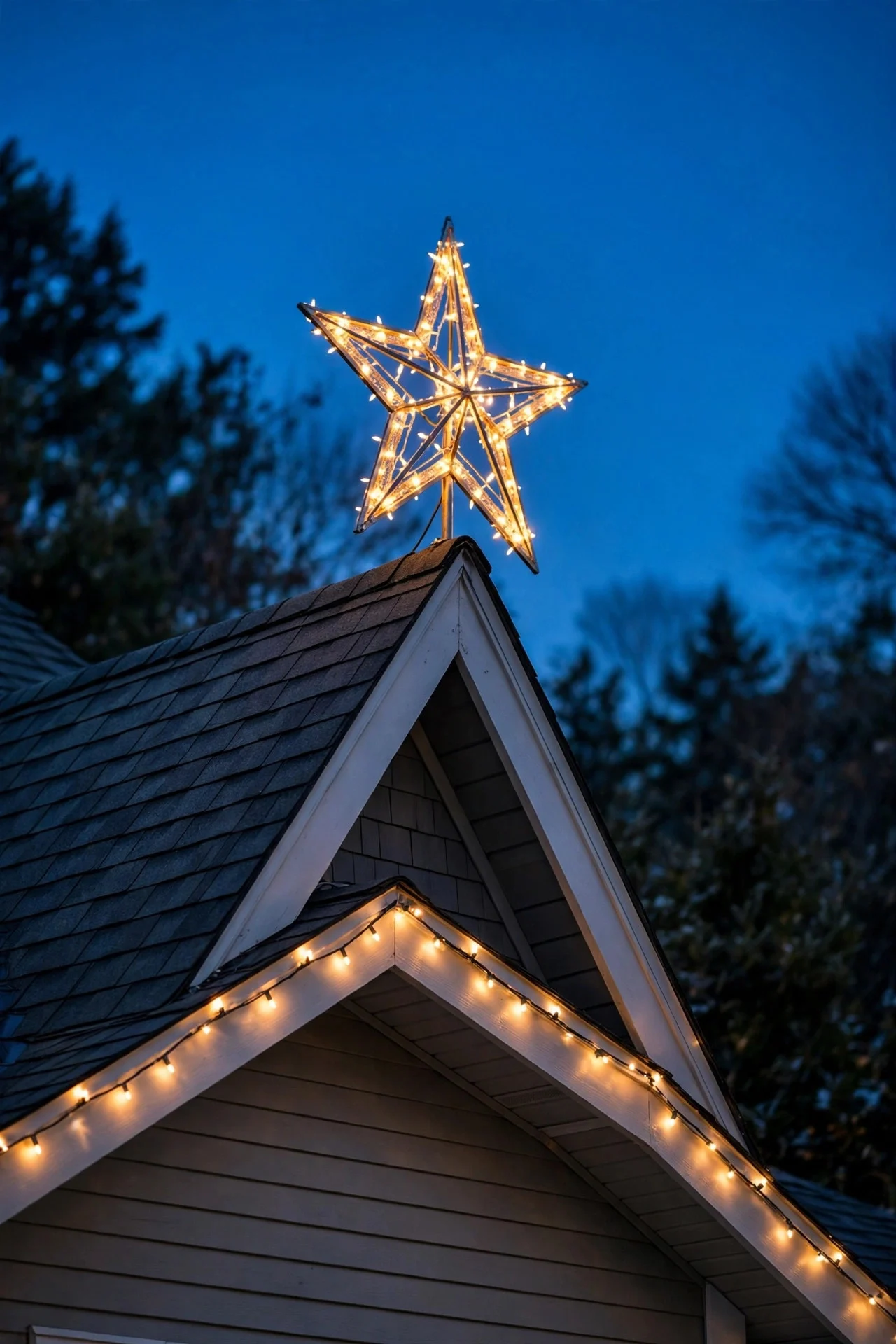
One lit star or snowflake mounted on the gable peak is the exclamation point of a roofline display. It draws the eye up and gives the whole house a focal point. Pre-lit metal stars (24 to 36 inches) mount with a simple bracket or heavy-duty outdoor hooks.
Keep it to one — a single star is classic, three is a theme park. Warm white matches a warm-white roofline; if your roofline is multicolor, match that instead. Check that it’s rated for wind; December gables are no joke.
Try this: Put the star on its own timer, set 15 minutes later than the rest — a little “ta-da” moment each evening.
14. Curtain Lights on the Porch or Fence
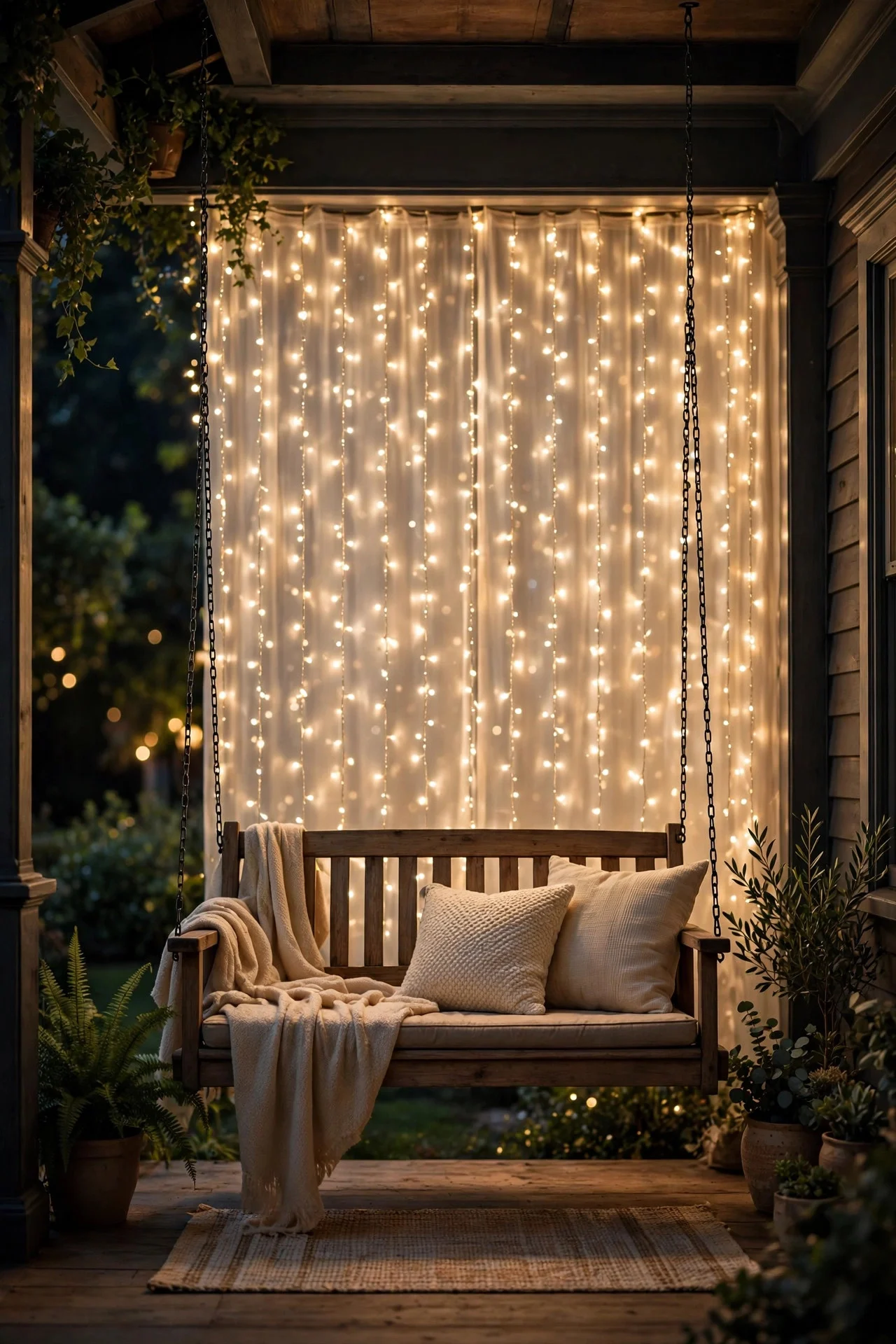
Curtain lights — strands that hang vertically from a top wire — turn a porch backdrop or fence into a wall of light. Hang the top strand taut (a wire or the porch beam itself), then let the drops fall evenly. A 10×10-foot curtain needs a flat, unobstructed surface to look its best.
This is the move for houses without great rooflines: ranches, porches with deep overhangs, fenced front yards. Behind a porch swing or seating area, a light curtain creates the coziest outdoor room imaginable. Secure the bottom drops so wind doesn’t tangle them.
Try this: Layer sheer outdoor curtains in front of the lights — the fabric diffuses the glow into something dreamy.
15. Automate It and Keep It Safe
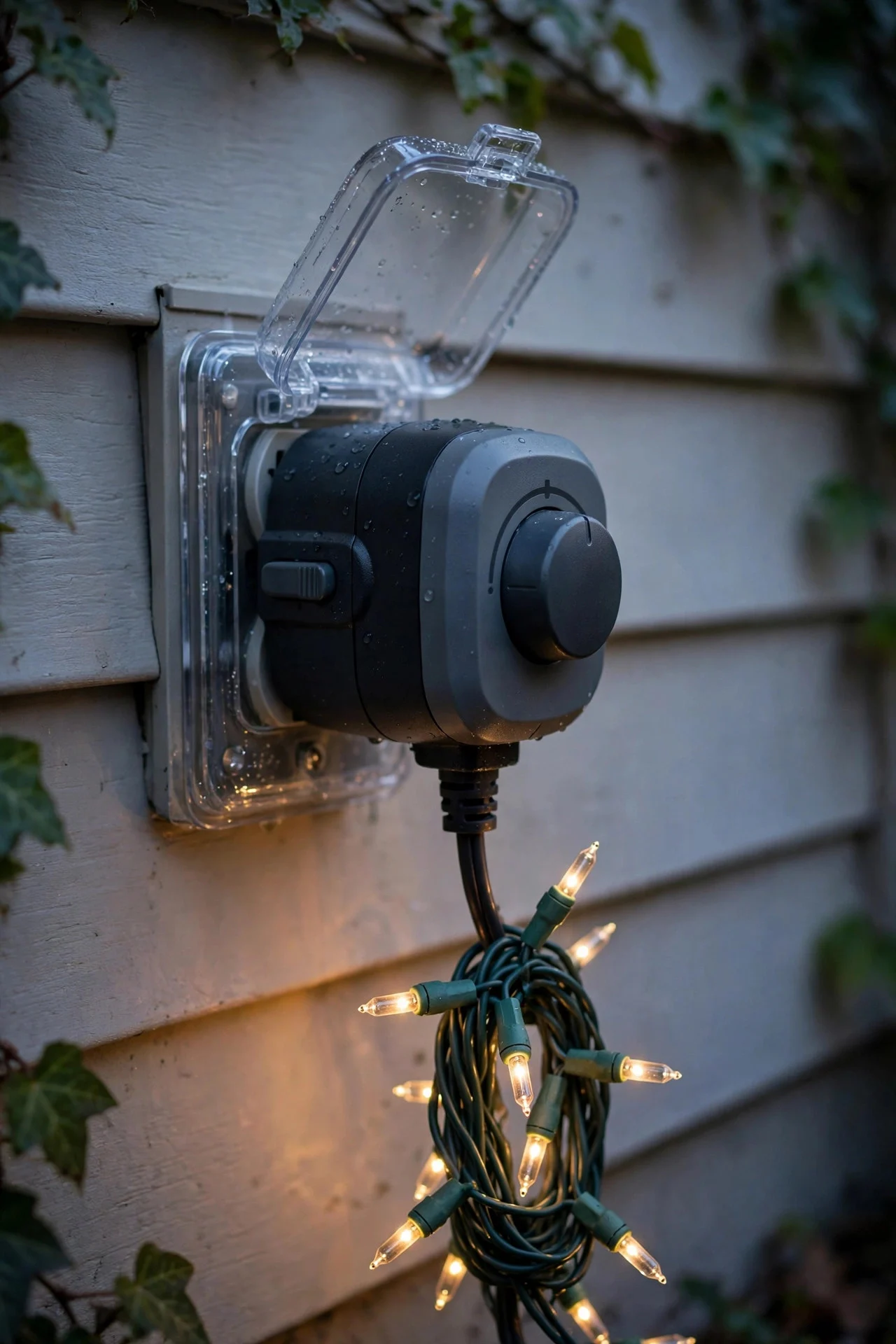
The least glamorous idea is the most important: put everything on timers or smart plugs, and check your electrical safety. Outdoor lights must be outdoor-rated (look for the UL tag), plugged into GFCI outlets, with connections kept off the ground and out of puddles. Never exceed the strand’s max connectable limit — usually 3 to 5 strands for LEDs.
A single heavy-duty outdoor timer ($12 to $20) at the outlet can run your whole display on a dusk-to-dawn schedule. And take a photo of your plug layout before you bury it in mulch — future-you, troubleshooting in the dark, will be grateful.
Try this: Do a full test run the weekend before Thanksgiving — finding a dead strand in daylight beats finding it on December 20th.
Frequently Asked Questions
How many lights do I need for the outside of my house?
For a roofline, measure in feet and buy strands to match plus 10% extra. As a rough guide: 100 mini-lights per 6 to 8 feet of roofline, 100 lights per foot of tree-trunk height, and one 4×6-foot net per medium shrub. It’s always better to have one strand too many than to come up short mid-project.
When should I put up outdoor Christmas lights?
Most people hang lights the weekend after Thanksgiving, but there’s no rule against early November — just don’t turn them on until after Thanksgiving if your neighborhood cares about such things. Take them down by mid-January; lights left up into February read as forgotten, not festive.
Are LED Christmas lights really better than incandescent?
For outdoor use, yes — and it’s not close. LEDs use about 90% less energy, stay cool to the touch, and you can connect far more strands end-to-end. Warm-white LEDs have closed the quality gap with incandescents; just check the color temperature (2700K) before buying.
How do I hang lights without damaging my house?
Use plastic all-in-one clips designed for shingles or gutters — they grip without nails, staples, or holes. For brick or siding, outdoor-rated adhesive hooks work on smooth surfaces. Never use a staple gun on light strands; one nicked wire can kill a whole run or worse.
Final Thoughts
Great outdoor Christmas lights aren’t about having the most — they’re about having a plan. Pick two or three ideas from this list that suit your house, measure before you buy, and hang everything in daylight. A simple warm-white roofline with a lit wreath and glowing walkway will outshine a chaotic yard full of inflatables every single time.
Start small this year if you’re new to it. You can always add the tree wrap or the gable star next December — and honestly, half the fun is building the display year after year until the neighbors start timing their evening walks to your street.