
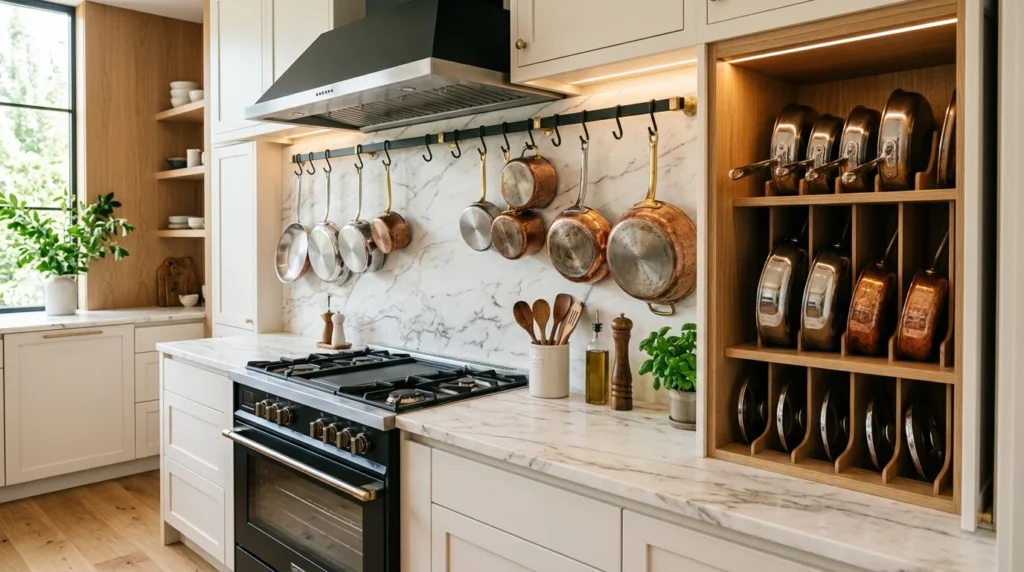
For longer than I’d like to admit, my pots and pans lived in a single deep lower cabinet, nested together in a way that meant retrieving my favorite sauté pan required first removing three other pots stacked on top of it, then somehow fitting them all back afterward without the whole tower toppling over. It was the kind of daily friction I’d just accepted as normal, the way you sometimes stop noticing an ongoing annoyance simply because it’s been there so long, until a friend visiting for dinner watched me perform this entire cabinet excavation and asked, genuinely puzzled, why I didn’t just hang them instead. That one offhand comment sent me down a real research process, and the eventual system I landed on changed something I’d genuinely stopped questioning as just an unavoidable part of cooking dinner.
If your own pots and pans are living in that same nested, excavate-to-retrieve chaos, here are 24 storage solutions, each explained in detail, based on what I ultimately implemented in my own kitchen and what I’ve seen work well elsewhere since. I’ll also answer some of the specific questions people ask most often about this exact problem, since a few practical concerns come up again and again regardless of which particular solution someone’s actually considering.
1. Install a Wall-Mounted Pot Rack
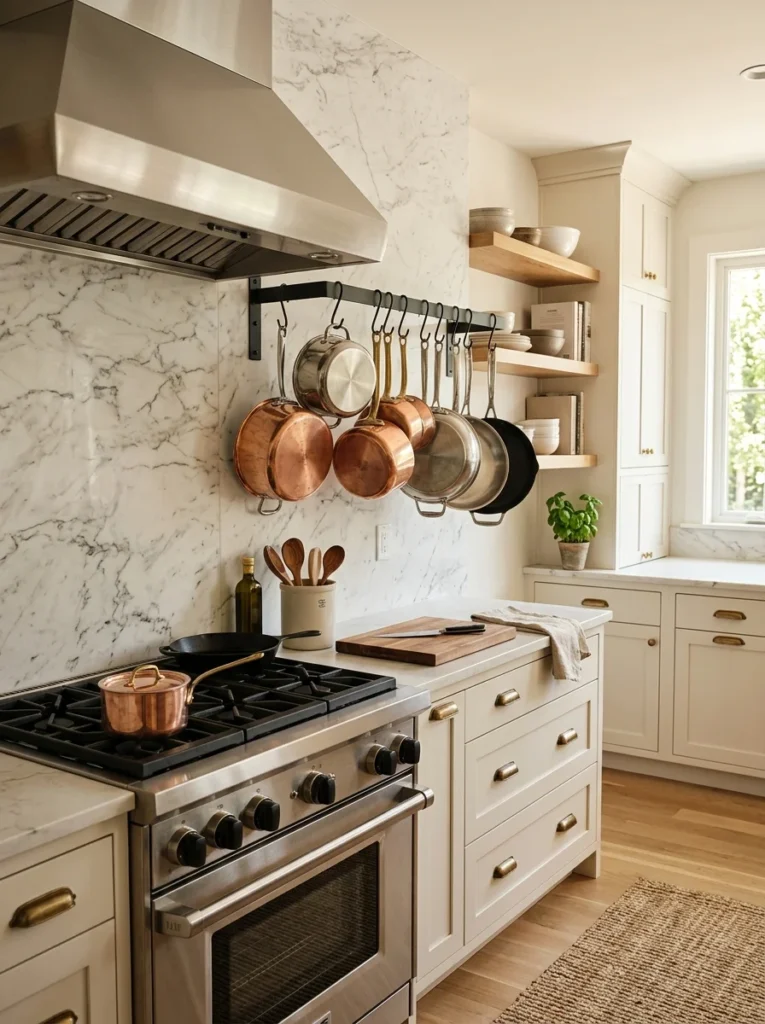
A wall-mounted rack, positioned above your stove or along an adjacent open wall, hangs your most-used pots and pans in immediate reach, eliminating the excavation problem entirely by giving each piece its own visible, individually accessible hook rather than a nested stack requiring disassembly. I installed exactly this above my own stove, and being able to simply lift my most-used sauté pan directly off its hook, rather than digging through a cabinet, has genuinely changed how quickly I can actually start cooking on a busy weeknight. A question I hear constantly is whether this style of storage collects grease and dust given its proximity to the stove, and honestly, it does require periodic wiping down more than enclosed cabinet storage would, but I’d say that small maintenance tradeoff is genuinely worth the daily convenience for anyone who cooks regularly enough that quick access actually matters to their routine.
2. Add a Ceiling-Mounted Pot Rack
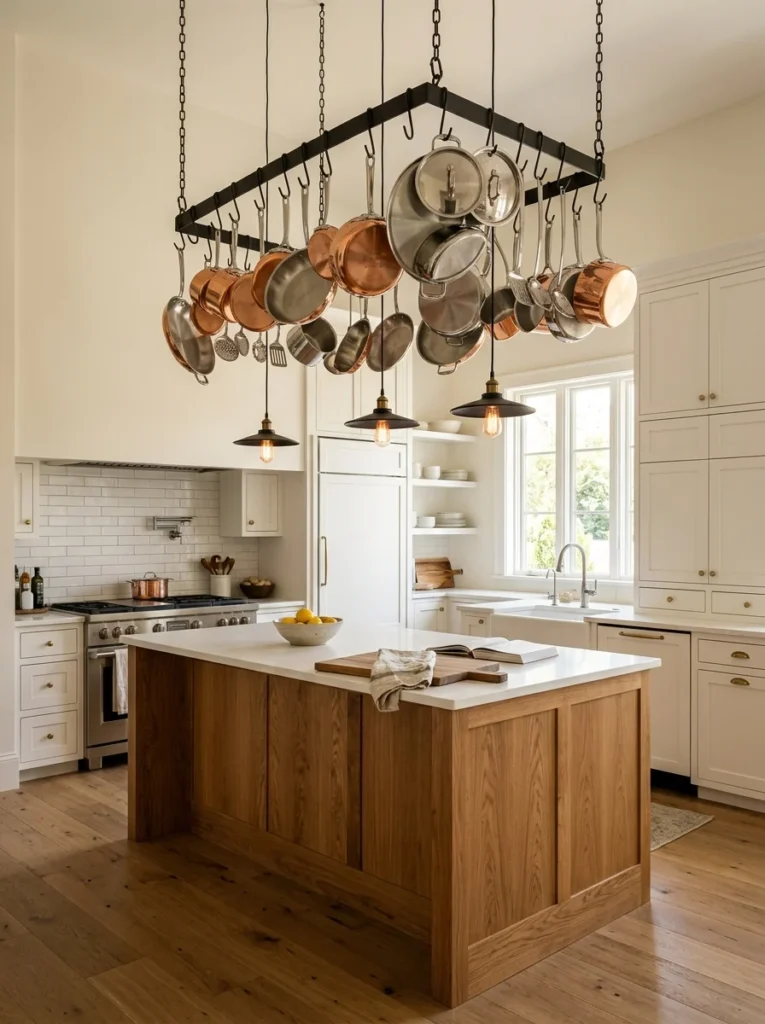
For kitchens with adequate ceiling height and a genuinely large collection, a ceiling-mounted rack suspended above an island or open counter provides even more hanging capacity than a wall-mounted version while adding a distinctive visual feature that functions almost like kitchen decor in its own right. A friend installed this specifically above her kitchen island, and the suspended collection of pots has become one of the room’s genuine focal points, with guests frequently commenting on it during dinner parties. A common question is whether this style of rack works in a kitchen with standard eight-foot ceilings, and I’d recommend measuring your specific clearance carefully first, since a ceiling-mounted rack needs enough vertical drop to hang pots without anyone tall in your household regularly bumping their head, which can genuinely rule this option out in a kitchen with more limited overhead clearance.
3. Use a Pot Lid Organizer
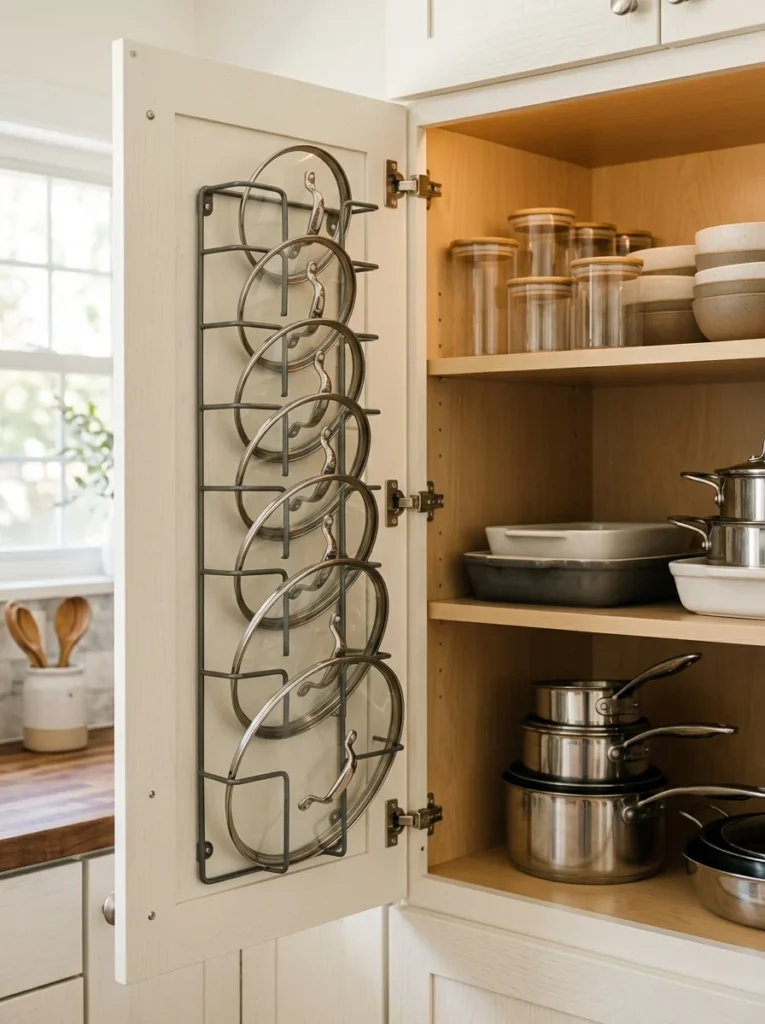
A dedicated vertical organizer specifically for lids, whether mounted inside a cabinet door or standing within a cabinet itself, solves the genuinely common problem of lids sliding around loosely and never quite matching their corresponding pot when you actually need them together. I added a simple wire lid organizer to my cabinet specifically for this purpose, and being able to slide out exactly the lid I need without an accompanying avalanche of mismatched others has eliminated one of my most consistent daily kitchen frustrations. A frequent question is whether lids genuinely need their own separate organizer or whether nesting them with their matching pots works just as well, and I’d say separate lid storage generally works better specifically because lids and pots aren’t always used together, sometimes you need the pot without the lid or vice versa, and separate storage lets you access either independently rather than needing to always retrieve both together as a fixed unit.
4. Install a Pull-Out Drawer System
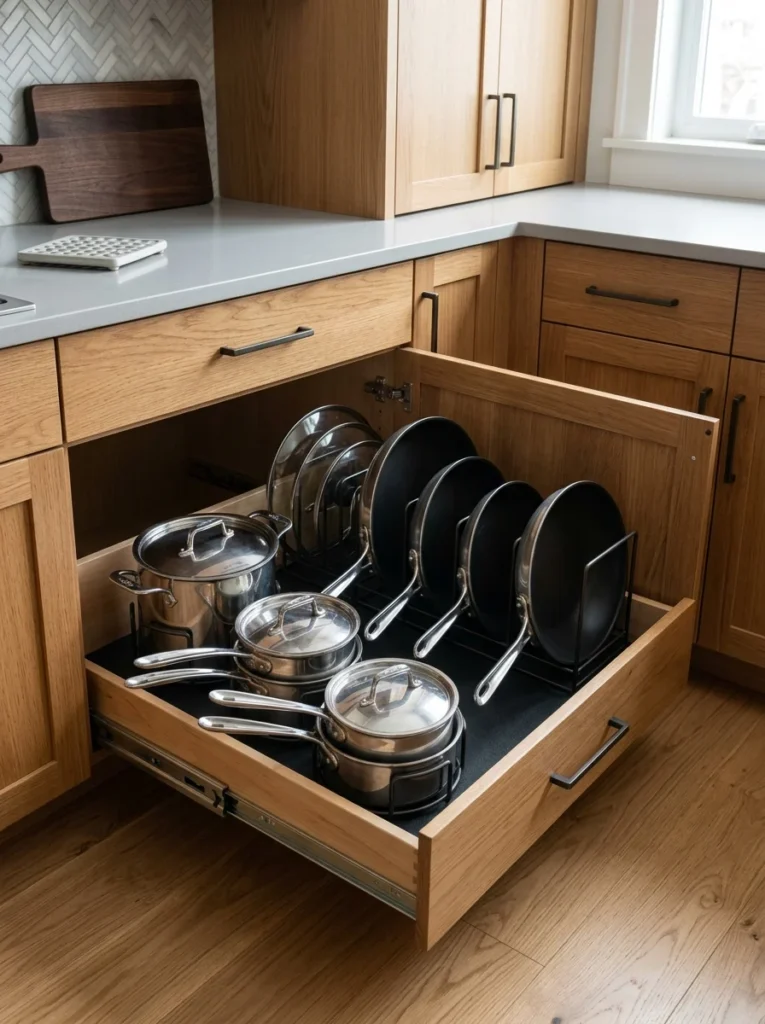
Retrofitting a lower cabinet with a pull-out drawer, rather than relying on a fixed shelf you reach into blindly, lets you see and access your entire pot and pan collection at once by fully extending the drawer, eliminating the need to remove items from the front just to reach whatever’s stored toward the back. I had this installed in my own kitchen during a broader reorganization, and the ability to see my entire collection laid out at once has genuinely eliminated the forgotten-pot-in-the-back problem that plagued my previous fixed-shelf system for years. A question I hear often is whether this is worth the installation cost compared to simpler organizational additions, and I’d say yes specifically for anyone with a genuinely deep lower cabinet, since the depth that makes fixed shelving so frustrating to access is exactly what a pull-out drawer addresses most directly and effectively.
5. Use Vertical Dividers for Standing Storage
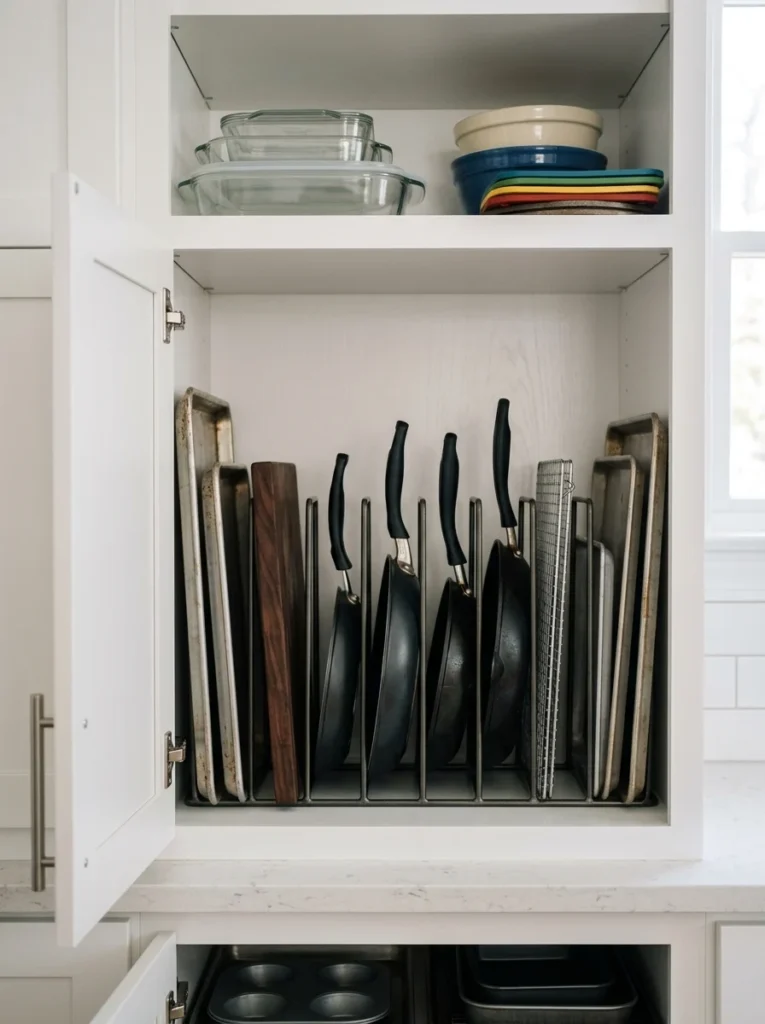
Rather than stacking pots and pans horizontally, vertical dividers installed within a cabinet let you store each piece standing on its edge, sliding in and out individually without disturbing the others, similar in concept to how a dish rack organizes plates but scaled up for cookware. I use vertical dividers specifically for my baking sheets and larger flat pans, and being able to slide out exactly the one I need without an accompanying clatter of everything else has genuinely reduced both the noise and the frustration of my previous stacked system. A common question is whether this works well for pots with handles, given their less uniformly flat shape compared to baking sheets, and I’d say this solution genuinely works best for flatter items specifically, skillets, baking sheets, cutting boards, while deeper pots with taller sides and prominent handles often fit better in one of the other storage solutions on this list instead.
6. Nest Pots by Size With Protective Padding
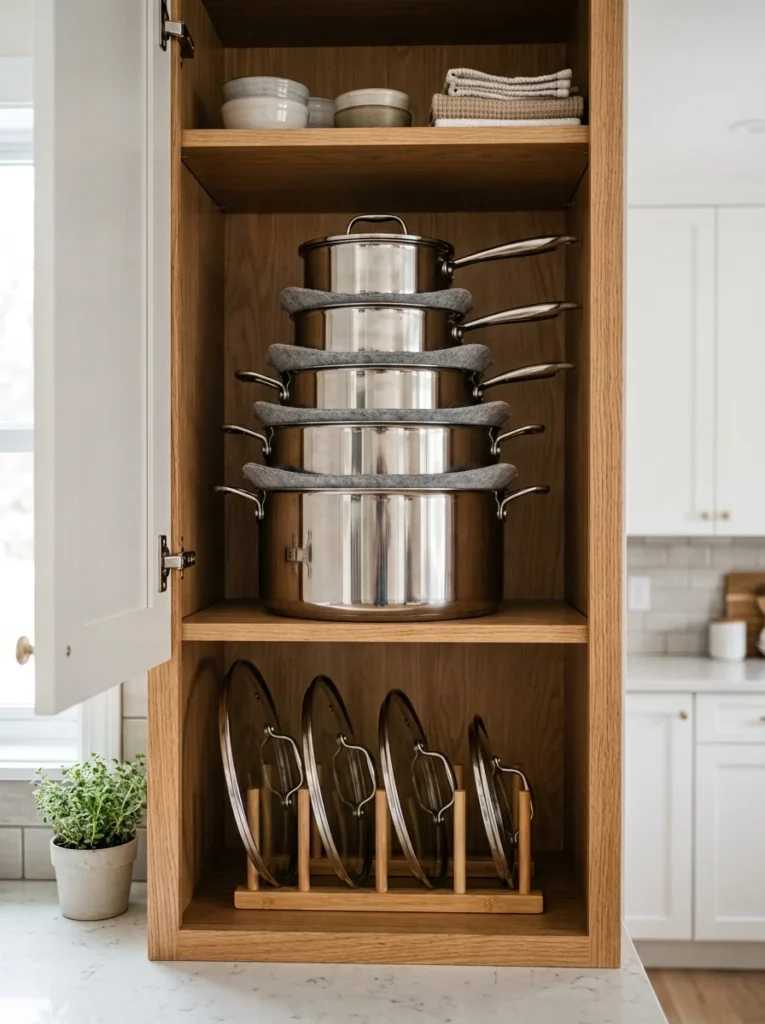
For anyone keeping a traditional nested storage system rather than switching entirely to hanging or vertical solutions, adding thin protective padding, felt liners or simple cloth, between nested pots prevents the scratching and scuffing that occurs when metal surfaces rub directly against each other during storage and retrieval. I added simple felt pot protectors to my remaining nested stack specifically for this reason, and my pans have genuinely stopped developing the fine surface scratches that used to accumulate from years of stacking them directly against each other without any protection. A question I hear is whether these liners actually make a meaningful difference or whether they’re more of a nice-to-have than a genuine necessity, and I’d say for anyone with a genuinely valuable or nonstick collection specifically, this small addition meaningfully protects that investment, while a more basic, inexpensive cookware collection might not justify the additional cost and effort as strongly.
7. Add a Corner Cabinet Lazy Susan for Pots
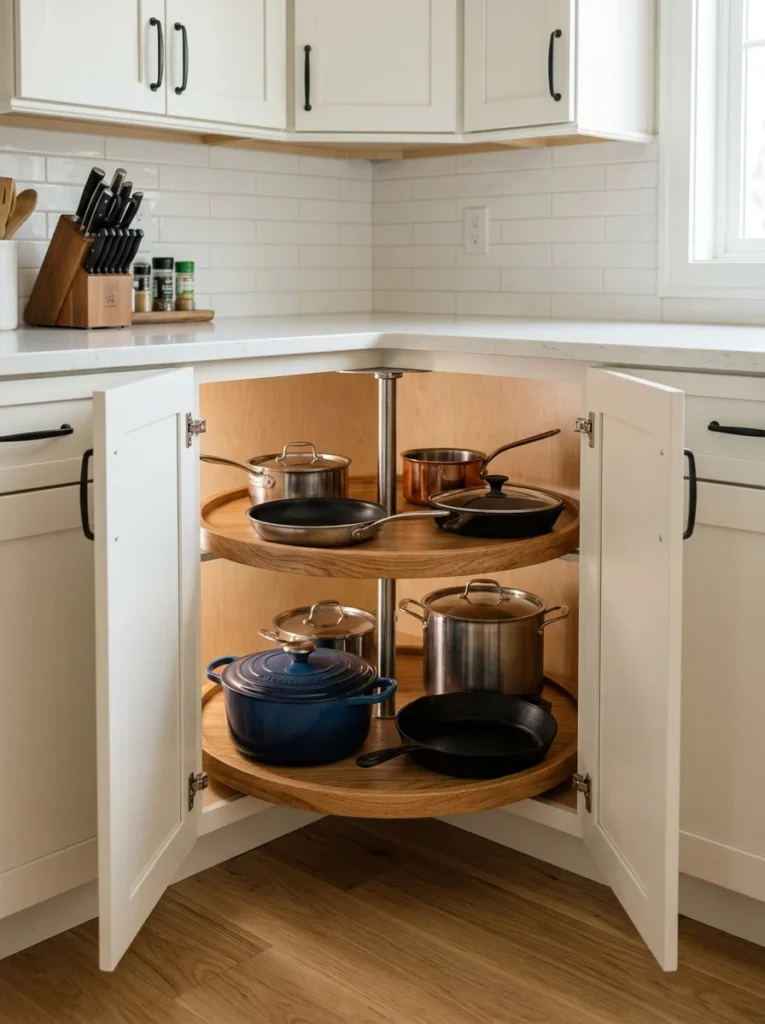
Installing a rotating lazy Susan specifically within a corner cabinet dedicated to pot storage addresses that awkward, hard-to-reach corner space directly, letting you spin the entire collection into view rather than reaching blindly into a difficult, deep corner where items easily get lost or forgotten. I use exactly this solution for my own corner cabinet, and being able to simply rotate until I find the specific pot I need has transformed what used to be my most frustrating cabinet into one of my more functional storage spaces. A frequent question is whether a lazy Susan can handle the genuine weight of heavier cast iron or stainless steel cookware, and I’d recommend checking the specific weight rating carefully before loading it up with your heaviest pieces, since some lighter-duty lazy Susan mechanisms aren’t rated for genuinely substantial cookware weight and may not rotate smoothly or could even fail under that heavier load over time.
8. Use a Freestanding Pot Rack for Kitchens Without Wall Space
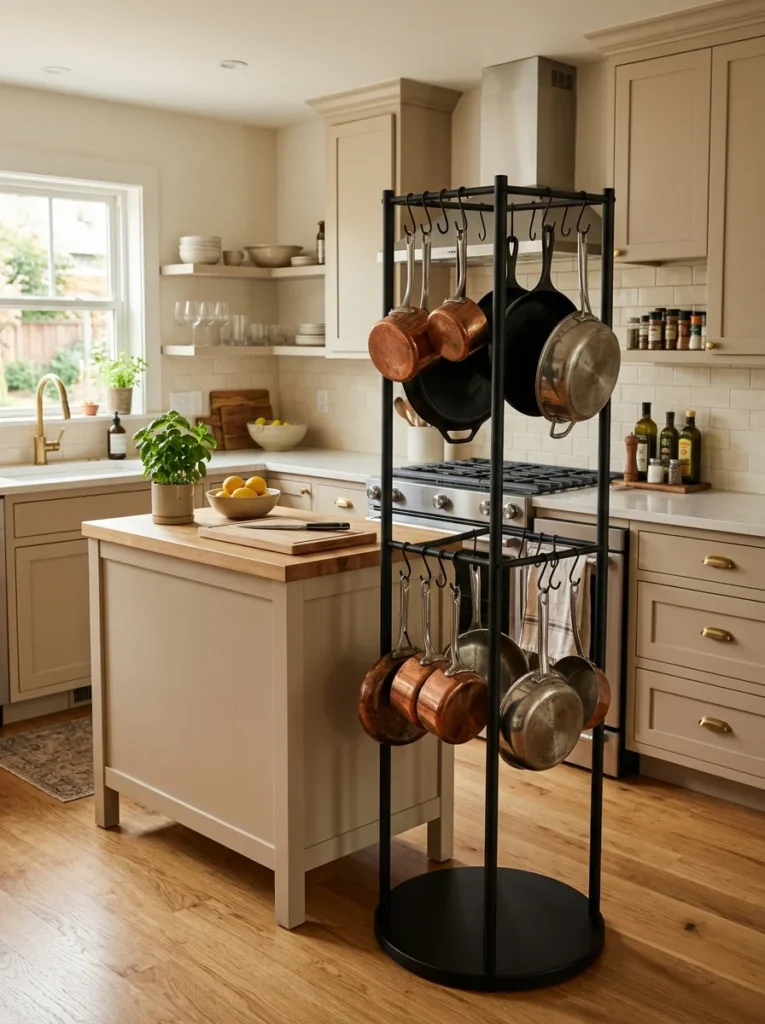
For kitchens where wall or ceiling mounting isn’t feasible, whether due to rental restrictions or simply a lack of appropriate wall space, a freestanding pot rack provides similar hanging accessibility while remaining a movable piece of furniture rather than a permanent installation. A friend renting her current apartment uses exactly this solution, and the freestanding rack gives her the same quick-access hanging storage benefit without requiring any permanent modification to walls she doesn’t own. A common question here is whether freestanding racks feel genuinely stable or whether they tend to wobble once loaded with a full pot collection, and I’d recommend choosing a rack with a wide, weighted base specifically designed for this purpose, since a narrower or lighter base can genuinely become unstable once loaded with the weight of several full-sized pots and pans hanging from it.
9. Store Cast Iron Separately From Other Cookware
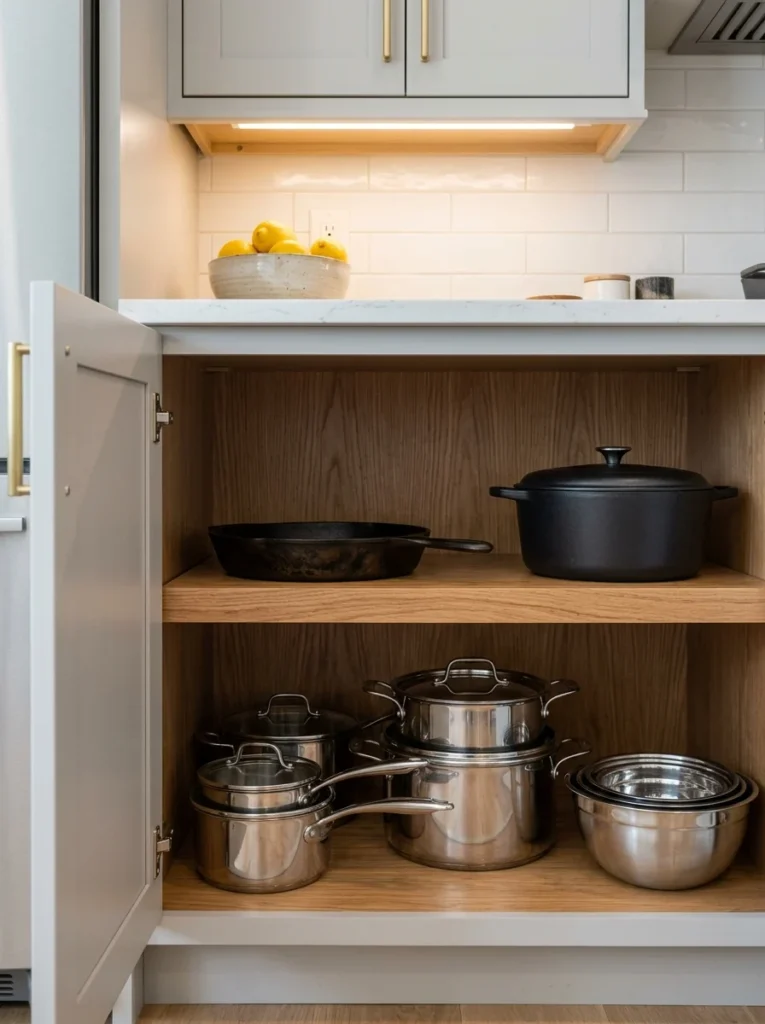
Given cast iron’s specific seasoning maintenance needs and considerable weight, storing it in its own dedicated section, separate from lighter stainless steel or nonstick pieces, prevents the scratching risk that comes from stacking a heavy cast iron piece directly against more delicate nonstick surfaces. I keep my cast iron skillet on its own dedicated lower shelf specifically for this reason, both to protect my other cookware from potential scratching and to keep the cast iron itself easily accessible given how frequently I actually reach for it. A question I hear often is whether cast iron genuinely needs different storage conditions compared to other cookware, and I’d say the main consideration is moisture rather than storage location itself, cast iron should be stored genuinely dry to prevent rust, which matters more than the specific shelf or cabinet you choose, though keeping it separate from delicate nonstick surfaces remains a good practice regardless of that moisture consideration.
10. Add Hooks Beneath Open Shelving
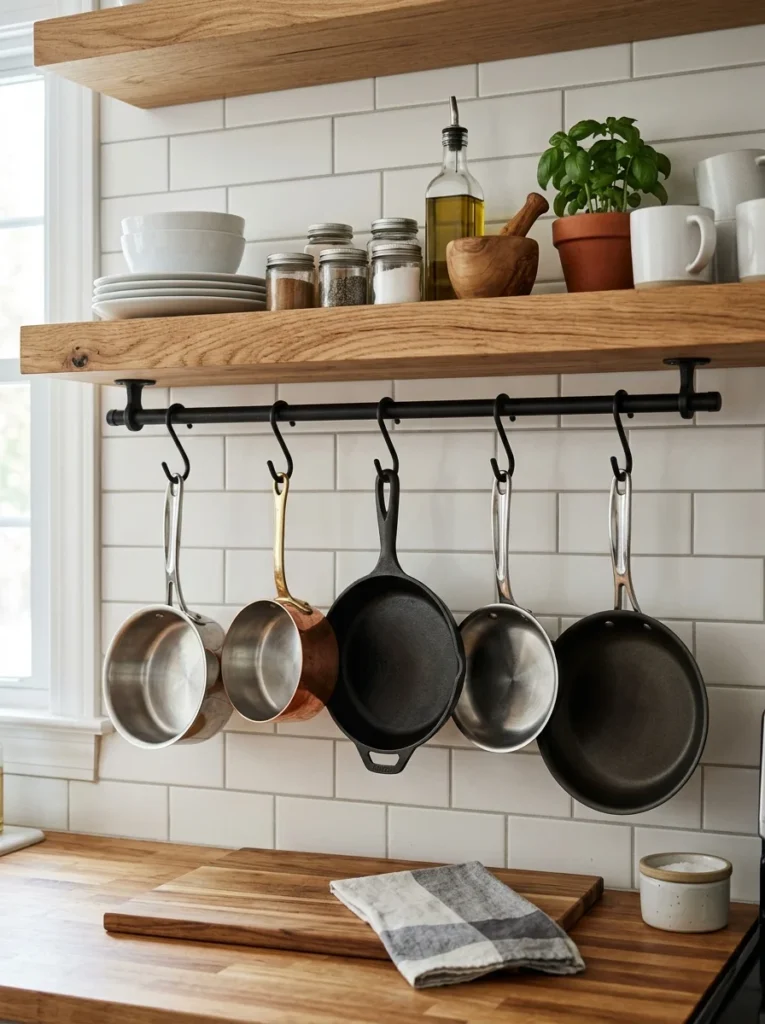
If your kitchen includes open shelving, mounting small hooks along the underside of an existing shelf provides additional hanging capacity for smaller pots or utensils without requiring any separate installation project beyond simply adding hardware to a shelf you already have in place. I added hooks beneath my open shelving specifically for my smaller saucepans, and this addition genuinely increased my hanging storage capacity without needing any new furniture or a dedicated rack installation project. A frequent question is whether this adds meaningful capacity or whether it’s more of a minor supplementary solution, and I’d say it genuinely depends on your existing shelf’s depth and how much clearance exists beneath it, a shelf with generous clearance can accommodate several genuinely useful hooks, while a shelf mounted close to the counter below may only have room for one or two smaller items before running out of usable vertical space.
11. Use a Deep Drawer With Custom Dividers
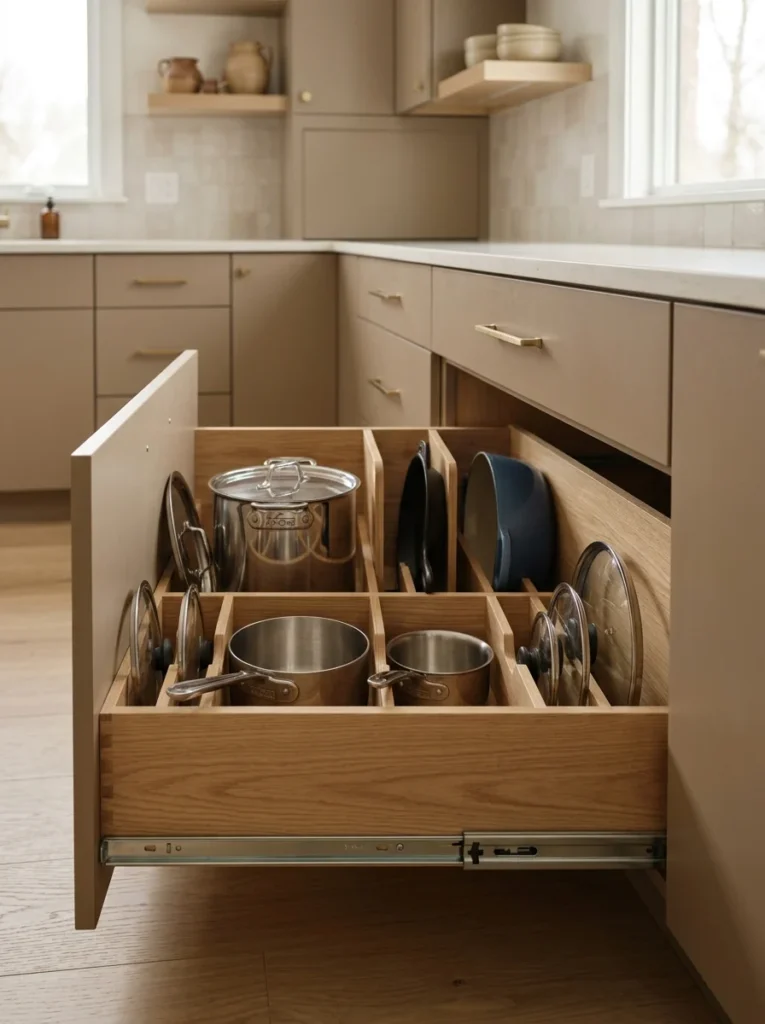
Rather than a standard cabinet, a genuinely deep drawer fitted with custom dividers specifically sized to your particular pot collection creates dedicated slots for each piece, preventing the sliding and clattering that occurs in an undivided, open drawer space. A friend had custom dividers built for her kitchen’s deepest drawer specifically for this purpose, and each pot now has its own defined slot, eliminating the noise and disorganization that previously plagued that same drawer before the dividers were added. This represents a more involved, typically custom carpentry project compared to purchasing pre-made organizational products, and I’d recommend this specifically for anyone already planning a kitchen renovation involving new cabinetry, rather than treating it as a standalone weekend project for an existing drawer that wasn’t originally designed with this level of customization in mind.
12. Hang Pans From a Pegboard Wall
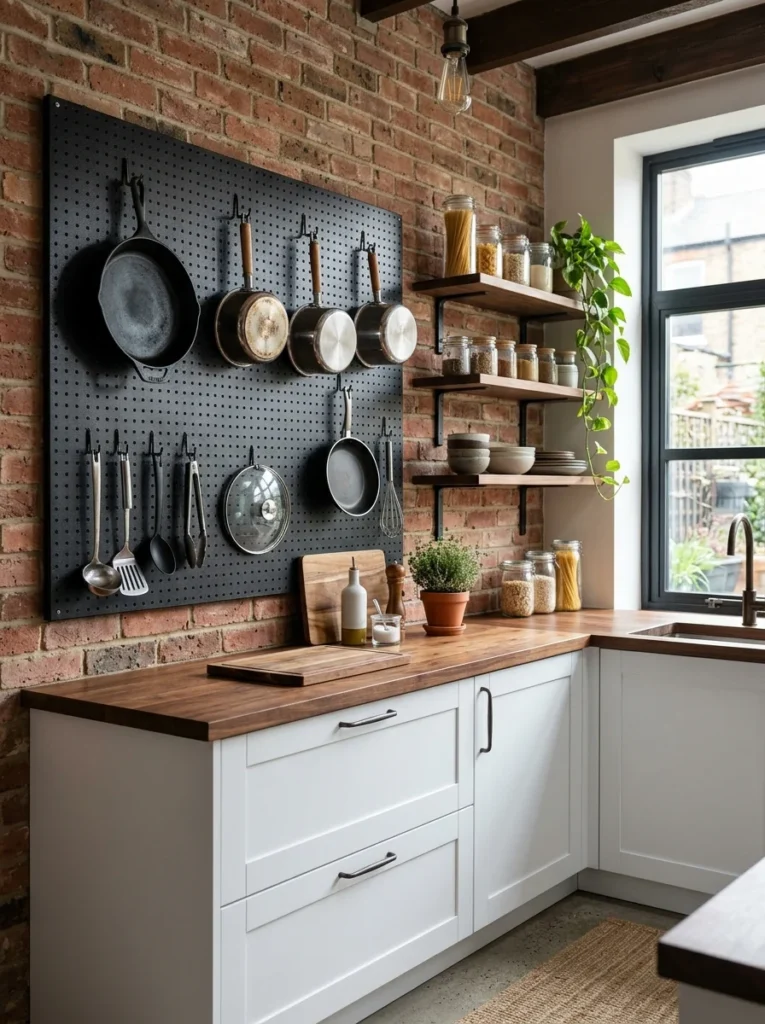
Mounting a pegboard specifically dedicated to pot and pan storage, with sturdy hooks positioned to hold each piece by its handle, offers a genuinely customizable, endlessly reconfigurable hanging system that can be rearranged as your collection changes over time. I installed a small pegboard section specifically for my pans above my counter, and the ability to move hooks around as needed has made this one of the more flexible storage solutions in my kitchen compared to fixed shelving or cabinetry that can’t be easily adjusted later. A common question is whether pegboard hooks can genuinely support the weight of heavier cookware without bending or pulling loose, and I’d recommend choosing pegboard-rated hooks specifically designed for heavier loads rather than the standard, lighter-duty hooks often sold for craft or tool storage purposes, since cookware genuinely demands more robust hardware than some lighter pegboard applications typically require.
13. Store Pans Vertically in a Cabinet Slot
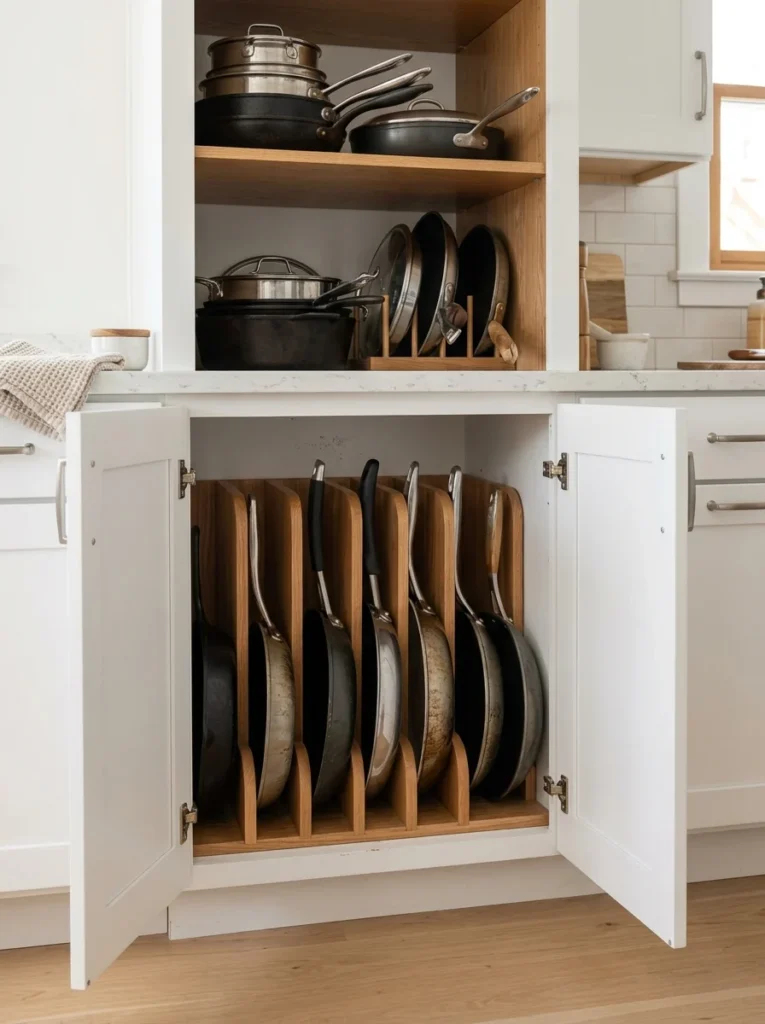
A narrow, dedicated vertical slot within a cabinet, sized specifically for your flat pans and skillets, lets you slide each one in standing upright, similar to how a filing cabinet organizes folders, providing individual access without needing to lift and shift a stack of nested pans just to reach the one at the bottom. I built a simple version of this specifically for my flatter cookware, and being able to pull out exactly the pan I need without disturbing the others has eliminated the previous frustration of my heaviest cast iron piece sitting on top of everything else I actually needed more frequently. A question I hear is how to prevent pans from tipping over within this kind of vertical slot storage, and I’d recommend choosing a slot depth that keeps the pans snugly upright without excessive wobble room, since too loose a fit allows the pans to lean and potentially topple against each other rather than remaining neatly separated and standing.
14. Use Stackable Cookware Designed for Nesting
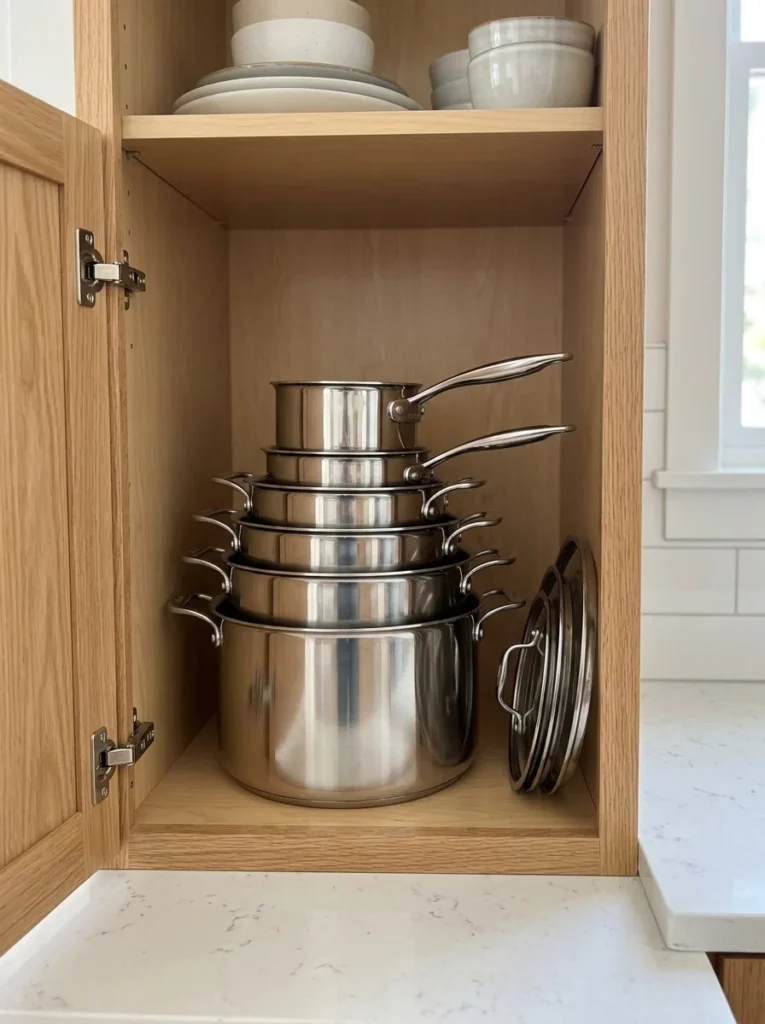
For anyone purchasing new cookware and genuinely prioritizing storage efficiency from the start, choosing a set specifically designed with graduated, nesting-compatible sizing minimizes wasted space compared to a mismatched collection of pots and pans accumulated over years from different sets and brands. I eventually replaced a portion of my own mismatched collection with a genuinely coordinated, nesting-designed set specifically for this reason, and the resulting stack takes up considerably less cabinet space than my previous mismatched pieces ever did stacked together. A frequent question is whether this genuinely justifies replacing perfectly functional existing cookware purely for storage efficiency, and I’d say this makes the most sense specifically when you’re already due for a cookware replacement or upgrade anyway, rather than recommending anyone discard functional pieces purely to gain this particular storage benefit alone.
15. Add a Freestanding Kitchen Cart With Pot Storage
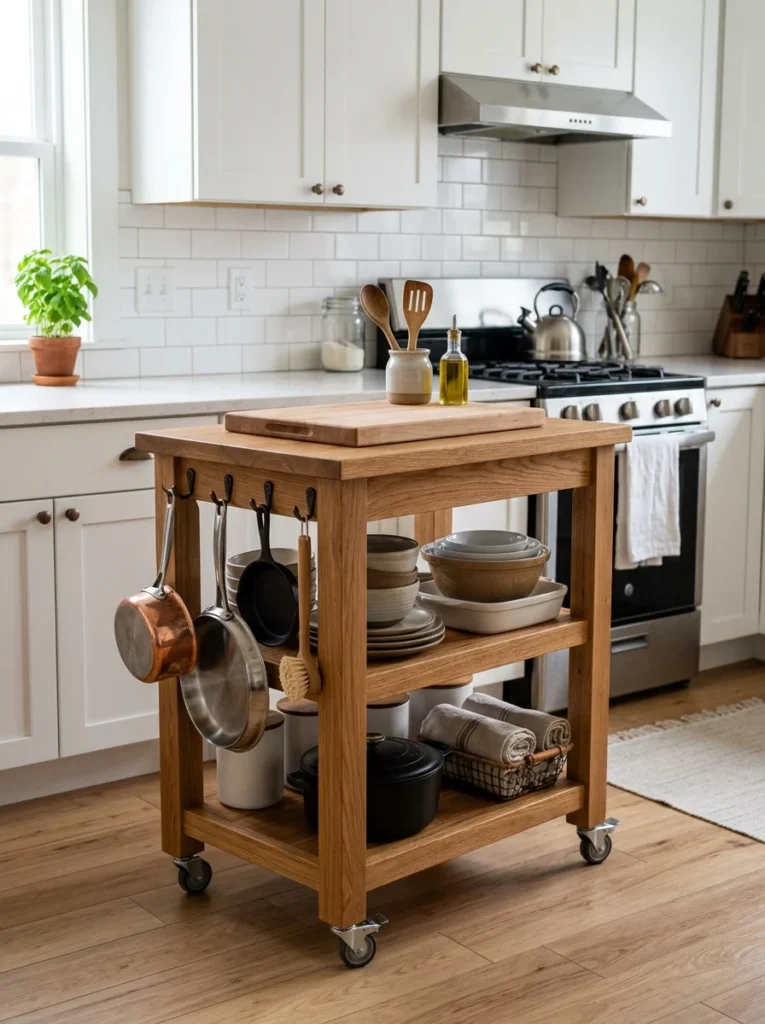
A rolling kitchen cart specifically designed with open shelving or hooks for pot storage provides additional, movable capacity for kitchens that have simply run out of built-in cabinet space, letting you position the cart wherever it’s currently most useful rather than committing to a single fixed location. A friend in a particularly small kitchen uses exactly this solution, and the cart’s mobility means she can position it closer to her stove during actual cooking, then tuck it into a less obtrusive spot the rest of the time. A common question is whether a cart like this creates more clutter than it solves in an already tight kitchen, and I’d say this genuinely depends on your kitchen’s specific layout and whether you have a sensible spot to actually position the cart when it’s not immediately needed, since a cart with no logical parking spot can indeed become just another obstacle rather than a genuine storage solution.
16. Hang Small Pans From a Coffee Mug Rack
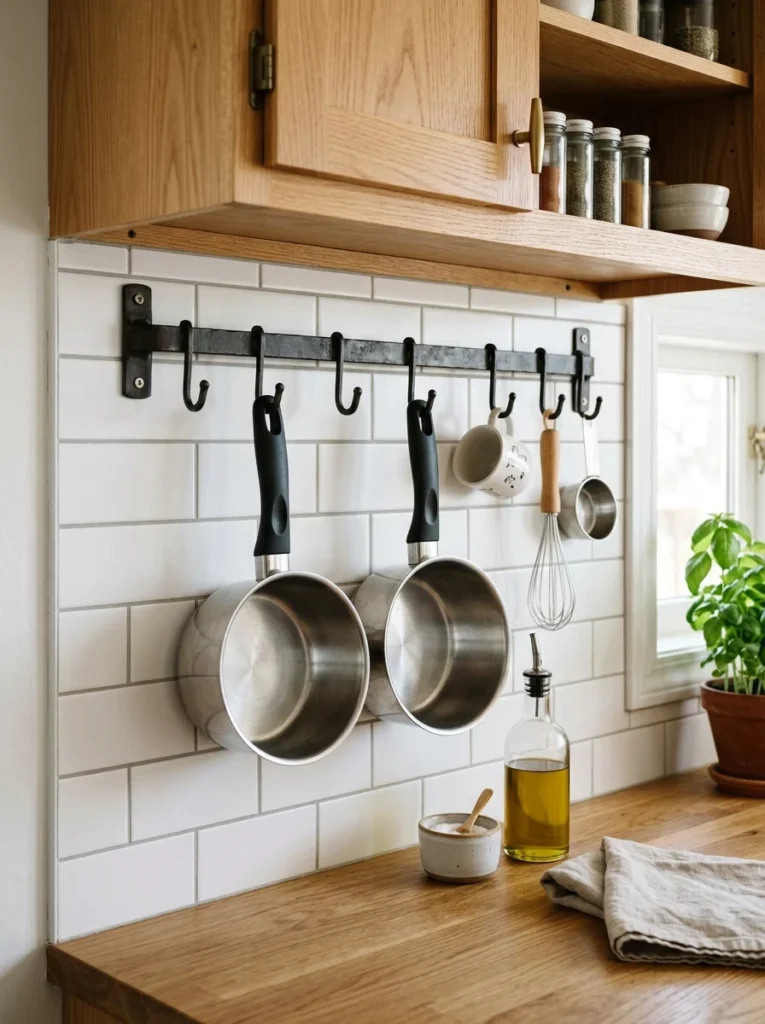
For genuinely small saucepans or pans with a hanging loop built into the handle, a simple mug rack, mounted beneath a cabinet or along a wall, can double as functional pot storage for smaller pieces that don’t require the more substantial hardware a full pot rack typically involves. I use exactly this repurposed solution for my smallest saucepan specifically, and this small, low-cost addition has given that particular piece a genuine dedicated spot rather than getting lost or buried within a larger cabinet alongside bigger cookware. A question I hear is whether this solution genuinely holds up under a pan’s weight compared to the lighter mugs these racks are typically designed for, and I’d recommend checking the rack’s specific weight rating before hanging anything heavier than a genuinely lightweight, smaller pan, since standard mug racks aren’t always built to handle much beyond their originally intended, lighter use case.
17. Use a Dedicated Baking Sheet and Muffin Tin Slot
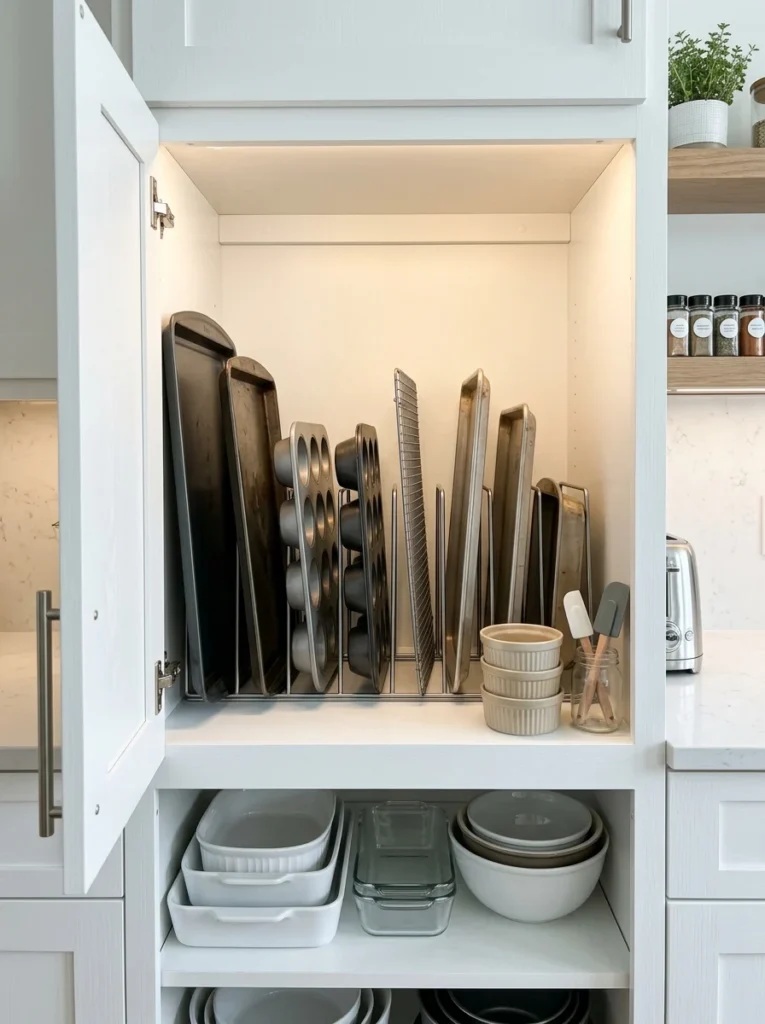
Rather than mixing baking sheets and muffin tins in with your general pot and pan storage, a dedicated vertical slot specifically for these flatter baking items keeps this distinct category organized separately, addressing their somewhat different storage needs compared to rounder, deeper cookware. I built a simple dedicated slot specifically for this baking-focused category, and separating it from my general pot storage has made both categories considerably easier to navigate, since I’m not searching through baking sheets to find a saucepan or vice versa. A frequent question is whether this separate category genuinely needs its own dedicated space or whether it can reasonably share storage with general cookware, and I’d say dedicated separation becomes considerably more valuable specifically for anyone who bakes regularly enough that this category represents a genuinely substantial portion of their overall kitchen storage needs, while occasional bakers might reasonably combine these categories without much practical downside.
18. Add a Utensil Crock Beside Your Stove for Related Tools
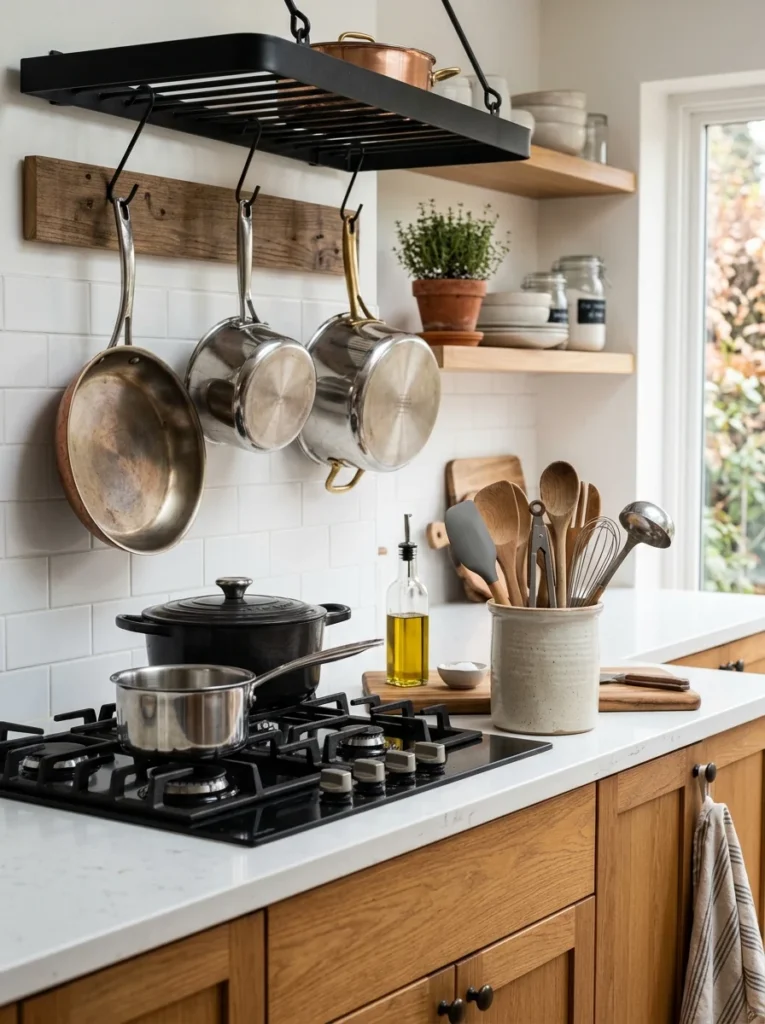
While not pots and pans themselves, keeping a crock of related cooking utensils, spatulas, tongs, a ladle, immediately beside your stove complements your actual cookware storage by ensuring the tools you’ll need alongside a given pot or pan are genuinely close at hand during actual cooking. I keep a simple ceramic crock beside my stove specifically for this purpose, and having these related tools genuinely nearby has streamlined my actual cooking process alongside whichever pot or pan I’ve retrieved from its own dedicated storage elsewhere. A common question is whether this crock should hold every utensil you own or just a curated selection, and I’d genuinely recommend curating this specifically to your most-used daily tools, storing less frequently needed specialty utensils in a drawer elsewhere, since an overstuffed crock becomes just as frustrating to search through as any other poorly organized storage space.
19. Use a Slide-Out Cutting Board and Pan Combo Slot
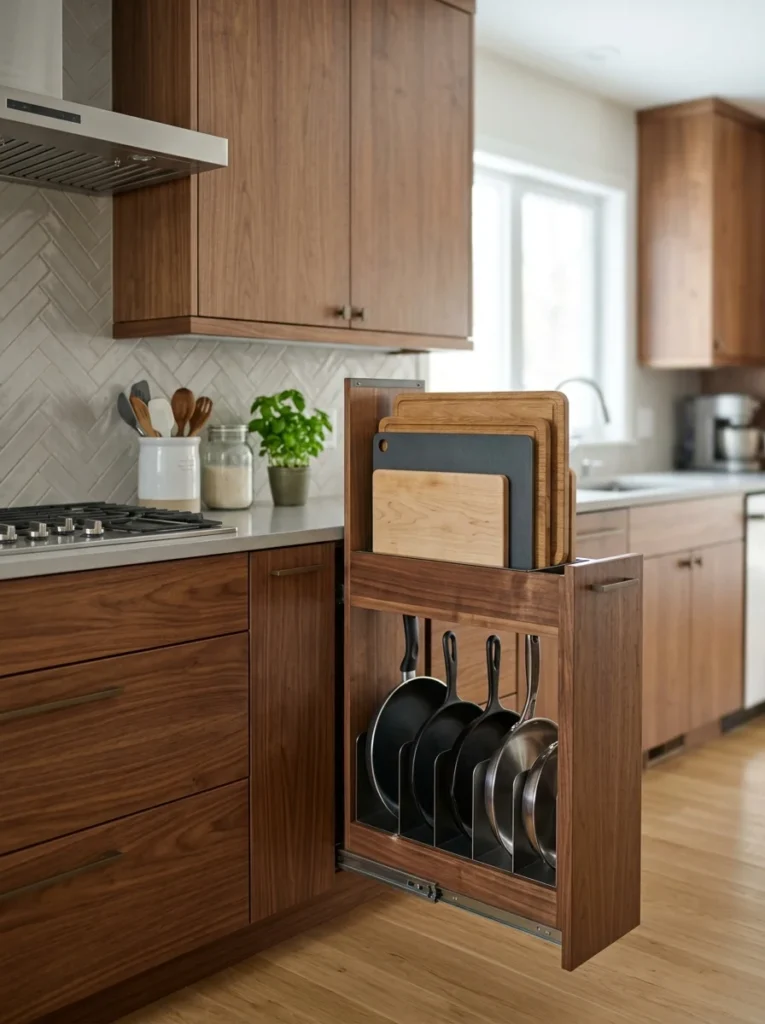
A combined vertical slot specifically designed to hold both cutting boards and flat pans together addresses two related but distinct storage categories within a single organizational solution, making efficient use of cabinet space that might otherwise require two entirely separate storage projects. I combined these two categories within one vertical slot specifically, and the shared storage space has genuinely worked well since both categories share a similar flat profile that fits comfortably within the same style of divider system. A question I hear is whether mixing these two categories creates confusion or clutter compared to keeping them fully separate, and I’d say combining them works fine specifically because both are relatively infrequent, deliberate retrievals rather than items you’re grabbing multiple times during a single cooking session, unlike your more frequently used pots and pans that benefit from their own more immediately accessible, dedicated storage.
20. Store Specialty Pans in Less Prime Cabinet Space
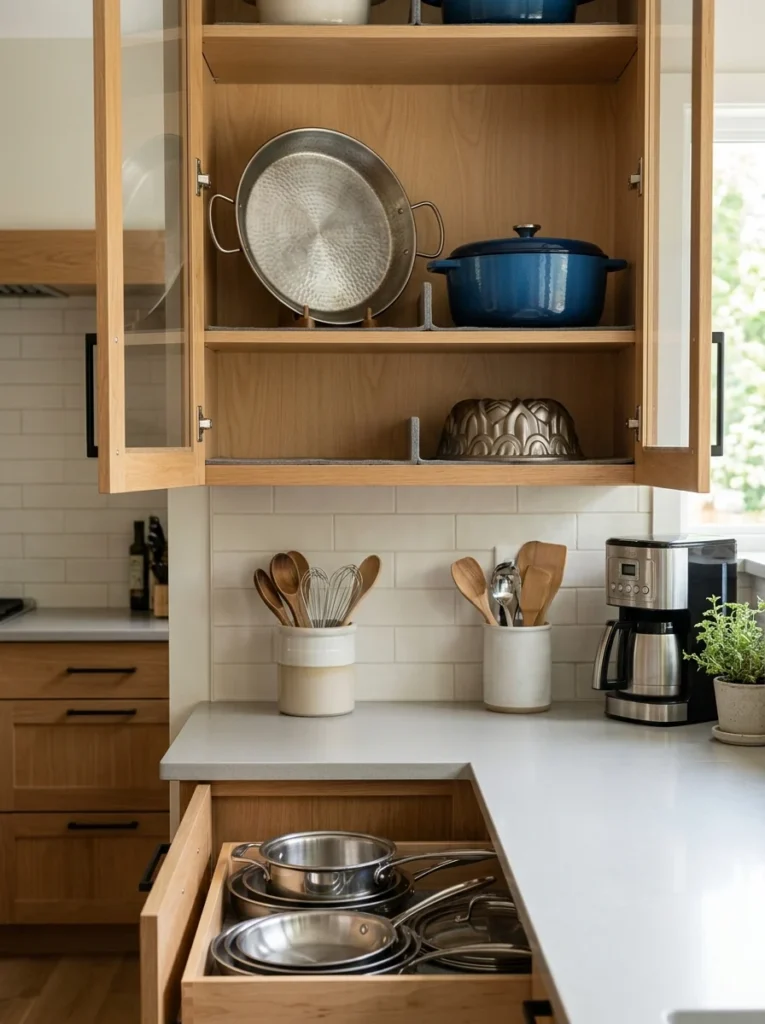
Specialty items used only occasionally, a paella pan, a specific size of Dutch oven you rarely reach for, belong in your kitchen’s less convenient storage locations, freeing your most accessible prime cabinet and hanging space specifically for the pots and pans you genuinely use on a regular, near-daily basis. I moved my own specialty pieces to a higher, less convenient cabinet specifically for this reason, reserving my more accessible storage exclusively for daily essentials, and this reorganization alone made a genuinely noticeable difference in how efficiently my kitchen functions during regular, everyday cooking. A frequent question is how to honestly determine which pieces qualify as “specialty” versus genuinely regular use, and I’d recommend tracking your actual cooking for a couple of weeks, noting which pots and pans you reach for repeatedly versus which sit untouched, rather than relying purely on assumption or how frequently you imagine you use a given piece without actually verifying that assumption against your real habits.
21. Add a Magnetic Strip for Small Metal Cookware Lids
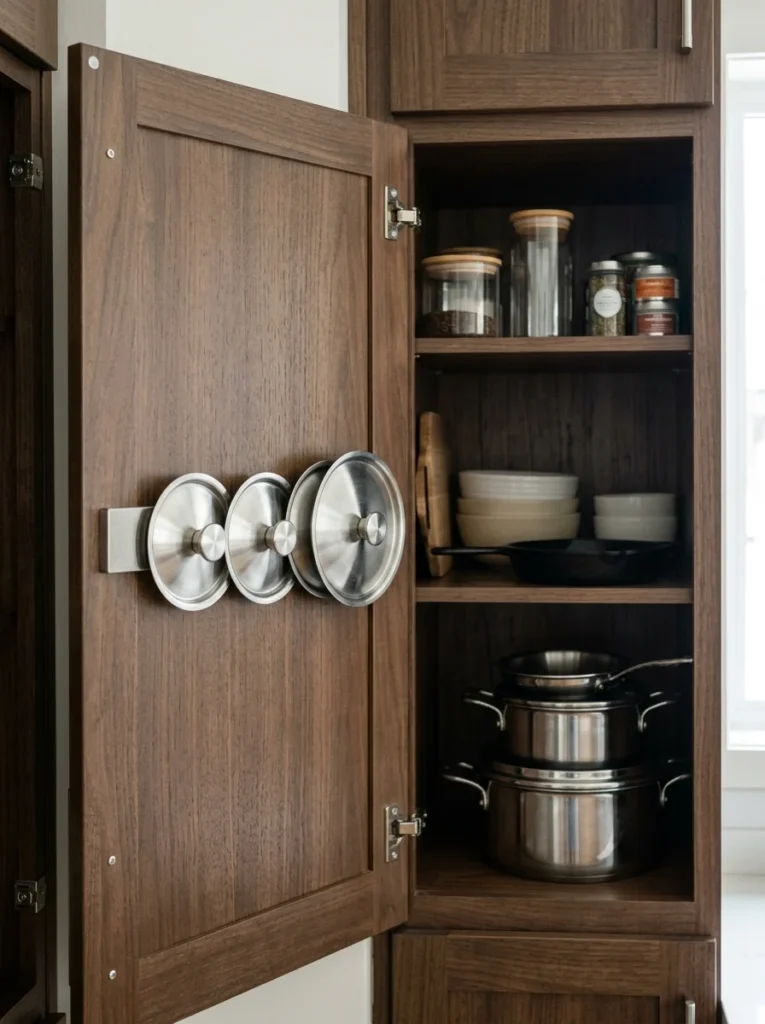
Similar in concept to a magnetic knife strip, a magnetic strip mounted inside a cabinet door can hold small metal pot lids with a magnetic-compatible knob, providing another option specifically for lid organization beyond the vertical rack mentioned earlier. A friend uses this solution specifically for her smaller saucepan lids, and the magnetic hold keeps them genuinely secure and visible on the inside of her cabinet door rather than needing separate rack storage taking up additional interior cabinet space. A question I hear is whether this works for all lid types or only certain ones, and I’d say this specifically requires lids with a metal, magnetic-compatible knob or handle, ruling out lids with plastic or glass knobs that won’t actually adhere to a magnetic strip regardless of how strong the magnet itself might be.
22. Use Tension Rods as a Budget Divider Solution
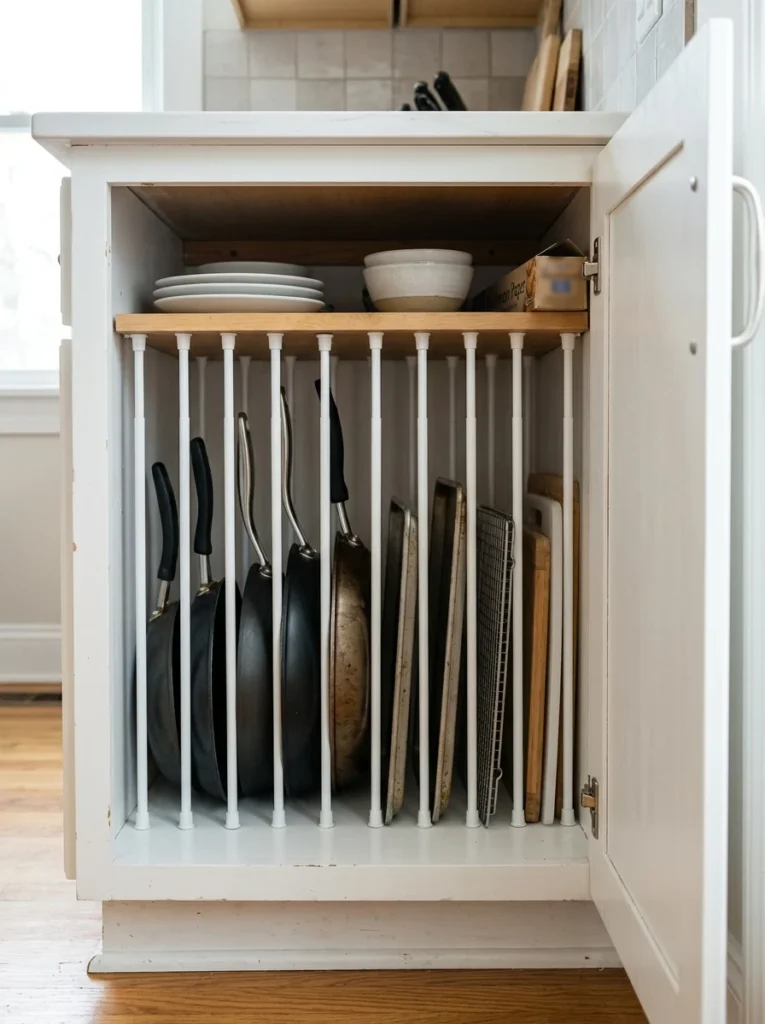
For anyone wanting to test vertical pan storage before investing in purpose-built dividers, a simple tension rod installed within a cabinet, positioned to create rough vertical sections, achieves a similar basic organizational effect at a fraction of the cost of dedicated divider hardware. I used exactly this budget approach in a previous apartment before eventually upgrading to proper dividers, and the tension rod solution genuinely solved the same basic sliding, stacking problem in the meantime without requiring any real investment beyond an inexpensive rod. A common question is whether this budget approach holds up as well as purpose-built dividers over time, and honestly, it provides a genuinely useful basic function but doesn’t offer quite the same structural support or precise fit that dedicated, properly sized dividers provide, making it a reasonable starting point rather than necessarily a permanent, long-term solution for a genuinely large or heavy collection.
23. Add Labels for Shared or Larger Households
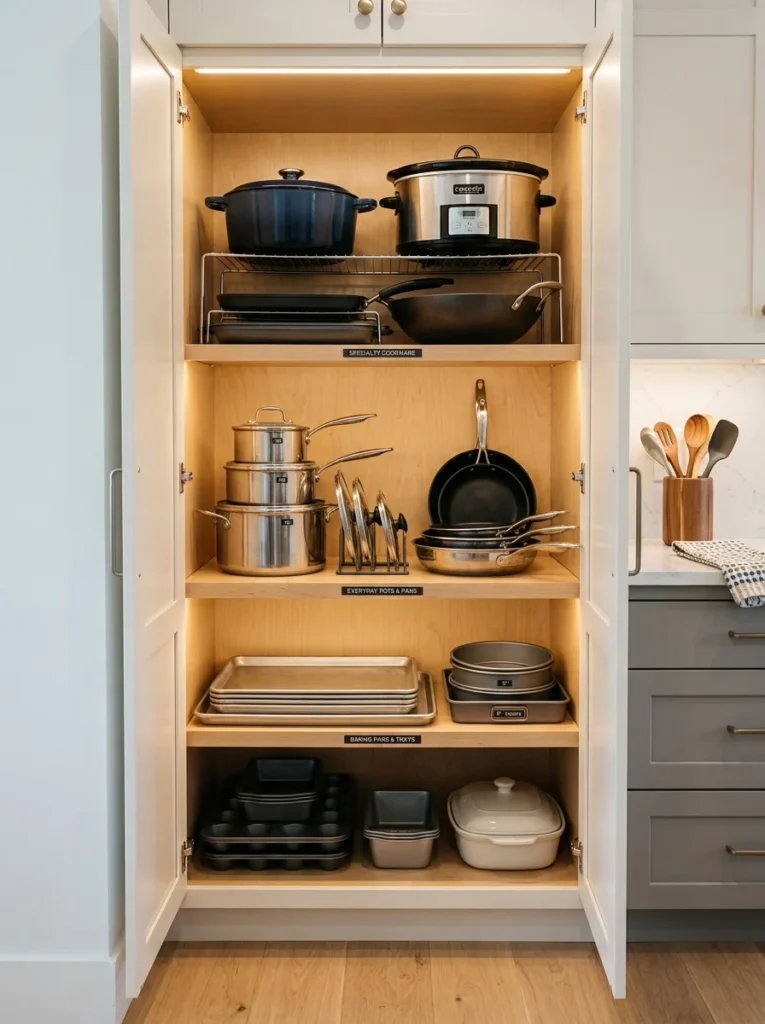
In households where multiple people cook and share kitchen space, adding simple labels to cabinet shelves or drawers, “everyday pots,” “baking pans,” “specialty items,” helps everyone maintain the same organizational system consistently rather than items gradually drifting back into disorganized, mismatched placement as different people put things away according to their own individual assumptions. We added simple labels specifically for this reason once our household grew to include a roommate who genuinely wasn’t familiar with my particular organizational logic, and the labels have meaningfully reduced the drift back toward disorganization that happened whenever someone unfamiliar with the system put dishes away without any clear guidance. A frequent question is whether labels feel unnecessary in a smaller household where only one or two people are actually doing the putting away, and I’d say labels matter considerably less in that specific situation, becoming more valuable specifically as more people share responsibility for maintaining a consistent system across a larger or more variable household.
24. Reassess Your System as Your Cooking Habits Change
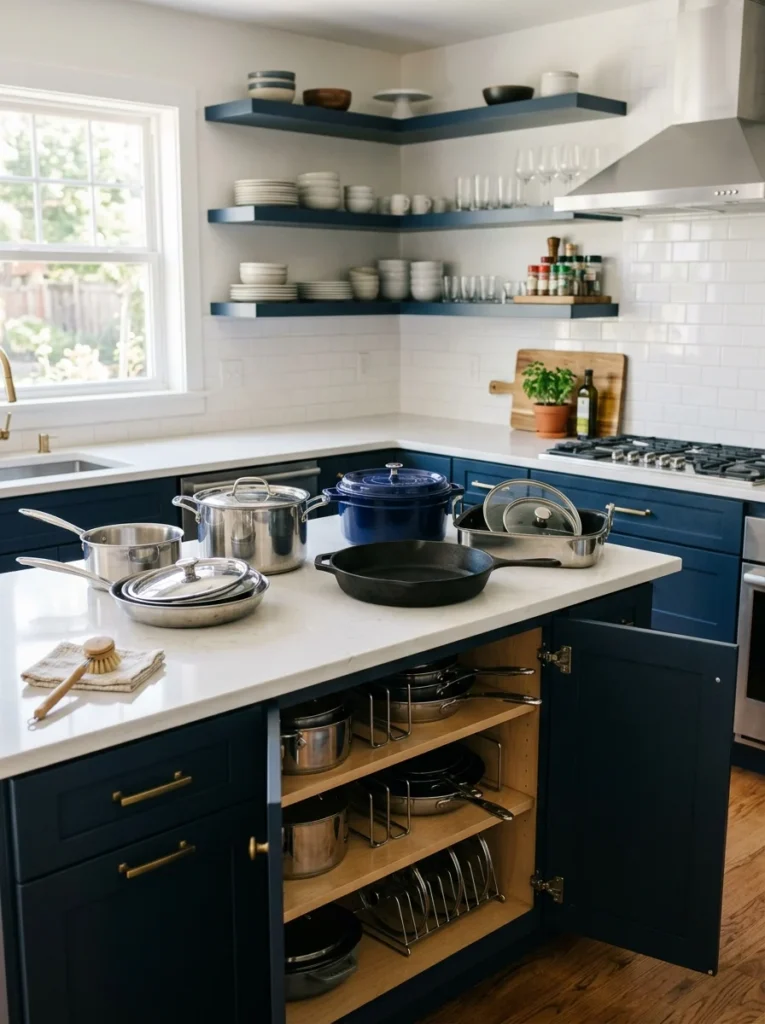
The final piece of advice is recognizing that even a genuinely well-planned pot and pan storage system benefits from periodic reassessment, since cooking habits naturally shift over time, a new hobby, a dietary change, a growing family, in ways that can gradually make an initially well-suited system less effective without you necessarily noticing that drift happening. I do a genuine review of my own cookware storage roughly once a year, honestly evaluating whether my current organization still matches how I’m actually cooking, since my habits have genuinely shifted somewhat since my original reorganization project. A common question is how to know when it’s genuinely time for this kind of reassessment versus simply tolerating a minor ongoing annoyance, and I’d say if you notice yourself repeatedly reaching past or around a particular storage arrangement to get to what you actually need on a regular basis, that’s usually a clear enough sign the system has drifted out of alignment with your real, current cooking habits and deserves another look.
Final Thoughts
Looking back at that single deep cabinet requiring a full excavation every time I needed my favorite pan, genuinely accepted as normal until a friend’s simple, puzzled question finally made me question it, it’s remarkable how much a real storage system changed something I’d stopped even noticing as an ongoing daily frustration. Between all 24 of these ideas, the underlying theme is really that pot and pan storage rewards matching your specific system to your actual cooking habits and collection, rather than defaulting to whatever arrangement your kitchen’s cabinets happened to suggest when you first moved in.
If your own cookware is still living in that same nested, excavate-to-retrieve chaos, I’d suggest starting with whichever solution most directly addresses your single biggest current frustration, hanging storage if lid retrieval is your main issue, a lazy Susan if it’s your corner cabinet, rather than trying to overhaul your entire kitchen’s storage simultaneously. From there, layer in additional solutions gradually, the same way my own kitchen’s system eventually came together, until reaching for a pot stops being something you dread and simply becomes an easy, unremarkable part of getting dinner started.