
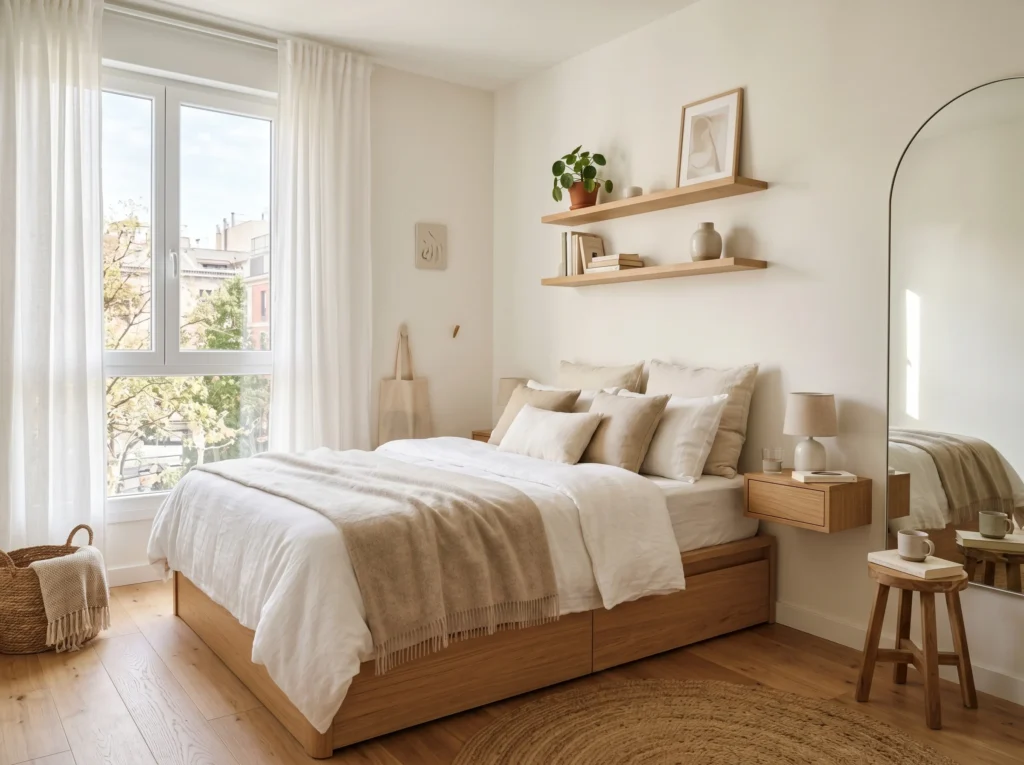
A small bedroom can feel frustrating — tight, cluttered, and impossible to style without making it look even more cramped. But the truth is, room size matters far less than most people think. What actually determines how a bedroom feels is color, light, furniture choice, and layout. Get those four things right, and even the smallest bedroom can feel calm, spacious, and beautifully designed.
Interior designers work with small spaces every day, and they rely on a consistent set of principles that create the illusion of space without knocking down any walls or spending a fortune. These 18 practical ideas bring those same principles directly into your home. Whether you are working with a spare room, a studio bedroom, or a childhood room that never quite grew up, these strategies will transform the way your space looks and feels.
Start with one idea, apply it, and notice the difference. Then keep going.
1. Choose Light Colors for Your Walls
Color is the single most powerful tool you have in a small bedroom, and it costs very little to change. Light colors — soft whites, pale greys, warm creams, and muted sage greens — reflect natural and artificial light back into the room rather than absorbing it. This reflection makes the walls appear to push outward visually, giving the room a more open, airy feel.
Dark colors do the opposite. They absorb light and draw walls inward, making a small room feel enclosed and heavy. This does not mean dark colors are always wrong — but in a genuinely small bedroom, light walls are almost always the better starting point.
The best wall colors for small bedrooms include soft white with warm undertones, light greige (grey-beige), pale sage green, and dusty blue. Avoid bright white with cool undertones, which can feel harsh and clinical rather than open and inviting.
Paint your ceiling in the same color as your walls or one shade lighter. This removes the hard visual line between wall and ceiling, making the room feel taller and more continuous.
2. Use a Monochromatic Color Scheme
A monochromatic scheme means using different tones of the same color throughout the room — walls, bedding, curtains, and furniture in a family of shades rather than competing colors. This approach removes visual noise and creates a seamless, flowing space that feels much larger than it is.
For example, a bedroom with soft cream walls, ivory bedding, warm white curtains, and natural wood furniture all reads as one cohesive palette. The eye moves smoothly around the room without stopping on contrasting elements, which creates a sense of calm and openness.
This does not mean the room has to be boring. Texture is what keeps a monochromatic space interesting — linen bedding, a woven rug, a velvet cushion, and a wood headboard all in the same color family create enormous visual richness without any clash or clutter.
3. Place the Bed Against the Main Wall
Bed placement is a layout decision that affects everything else in the room. In a small bedroom, the most efficient placement is almost always against the longest or main wall, centered if possible. This frees up the maximum amount of floor space on either side and allows clear walkways around the room.
Placing the bed in the center of the room or at an angle might look interesting in design magazines, but in a small space it wastes floor area that is already limited. Against the wall, with bedside tables on both sides if space allows, creates a balanced and functional layout that makes the room feel deliberately designed rather than just squeezed.
Avoid placing the bed directly opposite the door — this is called the “coffin position” in some design traditions and can create an unsettling feeling when lying in bed. If your room forces this arrangement, a solid footboard or a bench at the foot of the bed can help buffer the sight line from the doorway.
4. Invest in a Storage Bed
In a small bedroom, every piece of furniture needs to earn its place by doing more than one job. A storage bed — one with drawers underneath or a lift-up base that reveals a hidden compartment — replaces several pieces of separate storage furniture and keeps the floor and walls cleaner and more open.
The space under a bed is typically the largest single storage area in a bedroom. A standard bed leaves this space unorganized, filled with dust and random items in boxes. A proper storage bed turns that same space into clean, accessible drawers or deep lift-up storage for seasonal items, extra bedding, and anything else you want out of sight.
Ottoman beds with hydraulic lift mechanisms offer the most storage volume. Divan beds with side drawers offer easier daily access. Either option dramatically reduces the need for additional wardrobes or chests of drawers, which directly reduces visual clutter in a small room.
5. Choose Furniture with Legs
Furniture that sits directly on the floor feels heavy and anchored in place. Furniture raised on legs allows the eye to see the floor beneath it, which creates a sense of continuity and openness throughout the room.
A bed with visible legs, a bedside table on slim tapered legs, and a chair or bench elevated off the floor all contribute to a lighter, airier feeling. The floor appears larger because more of it is visible, even though the actual floor area has not changed.
This principle applies to wardrobes and dressers too, though it is harder to find freestanding storage pieces with this feature. Where possible, choose pieces that sit slightly elevated or opt for wall-mounted options that leave the floor completely clear.
6. Use Tall Furniture to Draw the Eye Upward
Vertical lines trick the eye into perceiving more height, which makes any room feel larger. In a small bedroom, choose furniture that is taller rather than wider wherever possible. A tall wardrobe that reaches close to the ceiling uses the same floor footprint as a short one but delivers far more storage and directs attention upward.
Tall headboards, floor-to-ceiling curtains, and vertical artwork all serve the same function. They create visual lines that lead the eye from floor to ceiling, emphasizing height and making the room feel more expansive.
Floor-to-ceiling curtains hung close to the ceiling (not just above the window frame) are one of the most affordable ways to apply this principle immediately. They make windows look larger, ceilings look taller, and rooms feel significantly more elegant.
7. Mount Bedside Lighting on the Wall
Bedside tables take up floor and surface space that is at a premium in a small bedroom. Wall-mounted bedside lamps or sconces eliminate the need for table lamps entirely, freeing up surface space for your phone, a glass of water, or a book without any additional clutter.
Wall-mounted lighting also places the light source at exactly the right height for reading without requiring a table beneath it. This opens up the option of using smaller, slimmer bedside tables — or even eliminating them in favor of a small floating shelf, which takes up even less visual space.
Plug-in wall sconces that do not require any electrical work are widely available and easy to install with just a picture hook or a simple screw. They offer the same clean look as hardwired sconces with none of the renovation cost.
8. Add a Large Mirror
Mirrors are the most well-known trick in the small space design toolkit, and they remain on this list because they genuinely work. A large mirror reflects light, reflects the room back on itself, and creates a visual depth that makes the space feel like it continues beyond the wall.
The key word is large. A small decorative mirror adds visual interest but does not create the spatial expansion effect. A mirror that is at least 24 by 36 inches, or ideally larger, is what actually changes how a room feels.
Placement matters too. A mirror positioned to reflect natural light from a window is most effective — it essentially duplicates the light source. A mirror on a wall adjacent to a window reflects the brightest part of the room and amplifies it throughout the space.
Full-length mirrors leaning against a wall, mirror-fronted wardrobe doors, and large framed wall mirrors are all excellent options depending on your space and style.
9. Use Floating Shelves Instead of Bulky Bookcases
A freestanding bookcase or shelving unit in a small bedroom takes up valuable floor space and adds visual bulk. Floating shelves mounted directly to the wall offer the same storage and display capacity with zero floor footprint.
Wall-mounted shelves also draw the eye upward and make use of the vertical space above furniture that is typically wasted. A row of floating shelves above the bed, beside the window, or along an empty wall adds significant storage for books, plants, and decorative items without making the room feel smaller.
Keep floating shelf styling intentional and edited. A shelf with a few carefully chosen items looks designed and spacious. A shelf overloaded with random objects looks cluttered and adds visual noise that makes a small room feel more cramped.
10. Replace Heavy Curtains with Light Fabric
Window treatments have a significant impact on how much light enters a room and how spacious it feels. Heavy, dark curtains in a small bedroom absorb light and make the room feel darker and smaller even when they are open.
Light, sheer curtains or linen-weave panels in a soft neutral color allow natural light to filter through even when closed, keeping the room bright throughout the day. When open, they frame the window without drawing attention away from the space itself.
If you need blackout curtains for sleep, consider a double rod system — a sheer curtain layer for daytime and a blackout layer behind it for night. This gives you light control without sacrificing the airy daytime feel of the room.
11. Declutter Aggressively and Regularly
No design trick works as well as decluttering. A small bedroom with only the items it needs — a bed, essential storage, one or two decorative pieces, and nothing more — always feels larger than a small bedroom filled with things that have no clear place.
The most common sources of clutter in small bedrooms are clothing that does not fit in the wardrobe, random items that belong in other rooms, excess decorative objects, and things stored “temporarily” that never get moved. Each of these categories needs to be addressed honestly.
The rule of thumb for small bedrooms is that every item in the room should either be used regularly, be actively loved as a decorative piece, or be stored completely out of sight. Anything that does not meet one of these three criteria is clutter and should be removed.
12. Use Under-Bed Storage Boxes Properly
If you have a standard bed without built-in storage, flat under-bed storage containers are an effective way to use the space without compromising the look of the room. The key is to use containers that fit the space properly and to keep them organized rather than just sliding random items underneath.
Flat boxes with lids are better than open containers because they protect contents from dust and keep the space looking intentional. Labels on each container mean you can find what you need without pulling everything out.
Use under-bed storage for items that are not needed daily — seasonal clothing, spare bedding, off-season shoes. Do not use the space as a general dumping area, as this defeats the organizational purpose and creates a visual mess when seen from across the room.
13. Keep Furniture to a Minimum
In a small bedroom, the temptation is often to add furniture to solve storage problems — another chest of drawers here, a small armchair there, a bench at the foot of the bed. But every additional piece of furniture in a small room reduces the open floor space that makes the room feel livable.
Be ruthless about which furniture pieces are truly necessary. A bed is essential. Bedside storage of some kind is important. A wardrobe or closet is needed. Everything beyond that should be evaluated critically before it enters the room.
Often, choosing one better piece of furniture — a storage bed that replaces both a standard bed and a separate chest of drawers, for example — achieves better results than adding multiple smaller pieces.
14. Choose a Rug That Is the Right Size
A rug that is too small in a bedroom is one of the most common decorating mistakes, and it makes rooms look awkward and even smaller. A small rug floating in the center of the room under only the coffee table equivalent — in a bedroom’s case, just the foot of the bed — looks disconnected and highlights how little floor space there is.
The right approach in a small bedroom is to use a rug that extends at least 18 to 24 inches beyond both sides of the bed. This grounds the bed within a larger visual zone and makes the floor area feel intentional and generous.
If a large rug is not in the budget, the second-best option is to use two matching runners — one on each side of the bed. This creates symmetry and comfort where it matters most without requiring a large investment.
15. Use One Large Piece of Artwork Instead of Many Small Ones
Multiple small artworks, prints, and frames scattered across bedroom walls create visual busyness that makes a small room feel chaotic and cluttered. One large piece of artwork — or a single well-curated gallery wall treated as one cohesive unit — has the opposite effect.
A large artwork above the headboard acts as an anchor for the entire room, draws the eye to one clear focal point, and gives the walls a sense of scale that actually makes the room feel bigger rather than smaller.
Choose artwork that fits the color palette of the room. A piece that introduces a completely different color creates visual conflict; a piece that echoes the colors already in the bedding, curtains, or rug ties the room together cohesively.
16. Add Plants Strategically
Plants bring life, warmth, and natural texture to a small bedroom without taking up significant space. The key is choosing the right size and placement — not filling every surface with small pots, which adds clutter.
One or two well-chosen plants make far more impact than a collection of small ones. A tall floor plant in a corner adds vertical interest and fills an otherwise dead space. A trailing plant on a floating shelf adds movement and texture. A small succulent or cactus on a bedside table adds a natural touch without visual weight.
Choose plants that thrive in bedroom conditions — lower light and consistent indoor temperature. Pothos, snake plants, peace lilies, and ZZ plants are all low-maintenance options that look beautiful and improve air quality.
17. Maximize Natural Light in Every Way Possible
Natural light makes any space feel larger, fresher, and more inviting. In a small bedroom, maximizing every source of natural light available is one of the most effective strategies you have.
Keep windows unobstructed by furniture. Do not place a wardrobe or tall shelving unit directly in front of or immediately beside a window. Trim or remove outdoor plants or bushes that block light from entering the window. Clean windows regularly — dirty glass noticeably reduces the amount of light that comes through.
Inside the room, place reflective surfaces — mirrors, metallic accessories, glass objects — near windows to catch and distribute natural light further into the space. Light-colored walls and ceilings amplify the effect by bouncing the light around rather than absorbing it.
18. Keep Surfaces Clear and Intentional
The final principle that ties all of the above together is surface discipline. Every surface in a small bedroom — the bedside table, the dresser top, the windowsill, the shelves — needs to be kept intentional and edited. Surfaces covered in unrelated objects, half-used products, random items, and general accumulation are the fastest way to make a small room feel disorganized and cramped.
The rule for small bedroom surfaces is simple: keep only what you use daily or what you genuinely love as a decorative object on display. Everything else should be stored in a drawer, behind a cabinet door, or removed from the room entirely.
When surfaces are clear and intentional, the room breathes. It looks larger, calmer, and more considered. Combined with the other 17 ideas in this guide, intentional surfaces are the finishing touch that makes a small bedroom feel like a space you genuinely enjoy spending time in.
Conclusion
Decorating a small bedroom well is not about having the right size room — it is about making the right decisions within the room you have. Light colors that reflect and open up the space, furniture that works harder by offering storage, vertical lines that draw the eye upward, mirrors that multiply light and depth, and disciplined editing that keeps every surface and corner intentional — these are the principles that turn small bedrooms from frustrating spaces into genuinely beautiful ones.
You do not need to apply all 18 ideas at once. Start with the changes that require the least investment — color, decluttering, furniture arrangement, and surface editing cost almost nothing but make an immediate and noticeable difference. Layer in the other ideas over time as your budget and energy allow.
A small bedroom handled well is often more beautiful and more restful than a large one handled carelessly. The constraint of limited space, approached with the right strategies, produces rooms that feel considered, calm, and complete.