
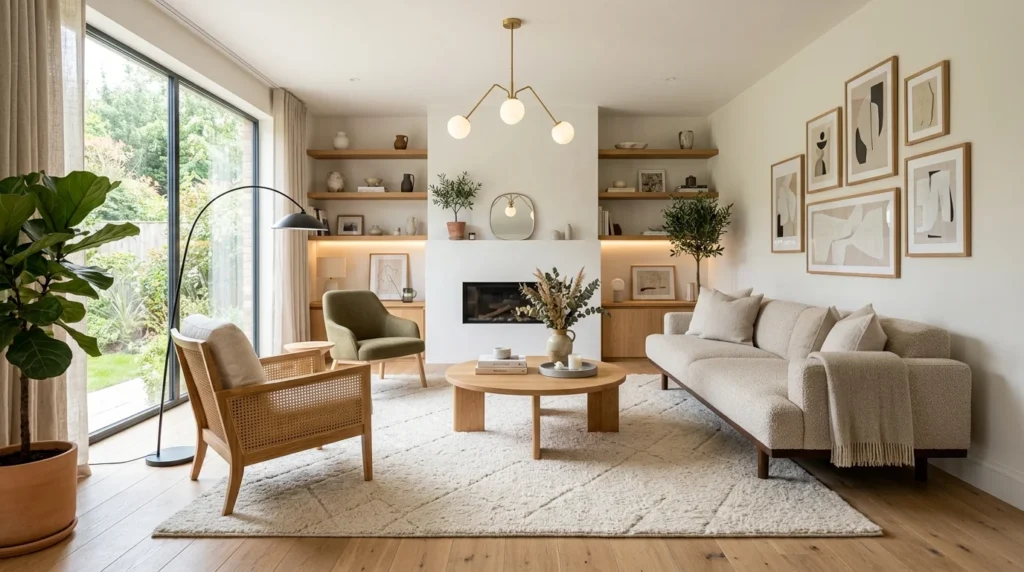
Furniture arrangement is the decision that determines how a living room actually feels to live in — more than the color on the walls, more than the quality of the sofa, and more than the amount of money spent on decorating. A beautifully furnished room with poorly arranged furniture feels awkward, uncomfortable, and difficult to use. The same furniture arranged correctly feels spacious, welcoming, and effortlessly functional.
Most people arrange their living room furniture once — when they first move in — and never change it again, even when the arrangement is not working well. The sofa goes against the longest wall because that seems like the obvious place for it. The television goes on the opposite wall. Everything else fills in around these two decisions. The result is a room that functions adequately but rarely feels as good as it could.
The truth about furniture arrangement is that there is almost always a better configuration than the one most people default to, and finding it does not require buying anything new. Rearranging existing furniture costs nothing and can transform how a room feels entirely. Understanding the principles behind good furniture arrangement gives you the knowledge to find the best configuration for your specific room — whatever shape it is, whatever furniture you have, and whatever way you use the space.
This guide covers the seven most effective living room furniture layouts used across the full range of room shapes and sizes. Each layout includes the principles behind it, the situations it suits best, and the specific guidance needed to execute it well. Before the layouts, two foundational concepts — the focal point and traffic flow — establish the framework that every good arrangement is built on.
Two Concepts Every Good Layout Depends On
The Focal Point
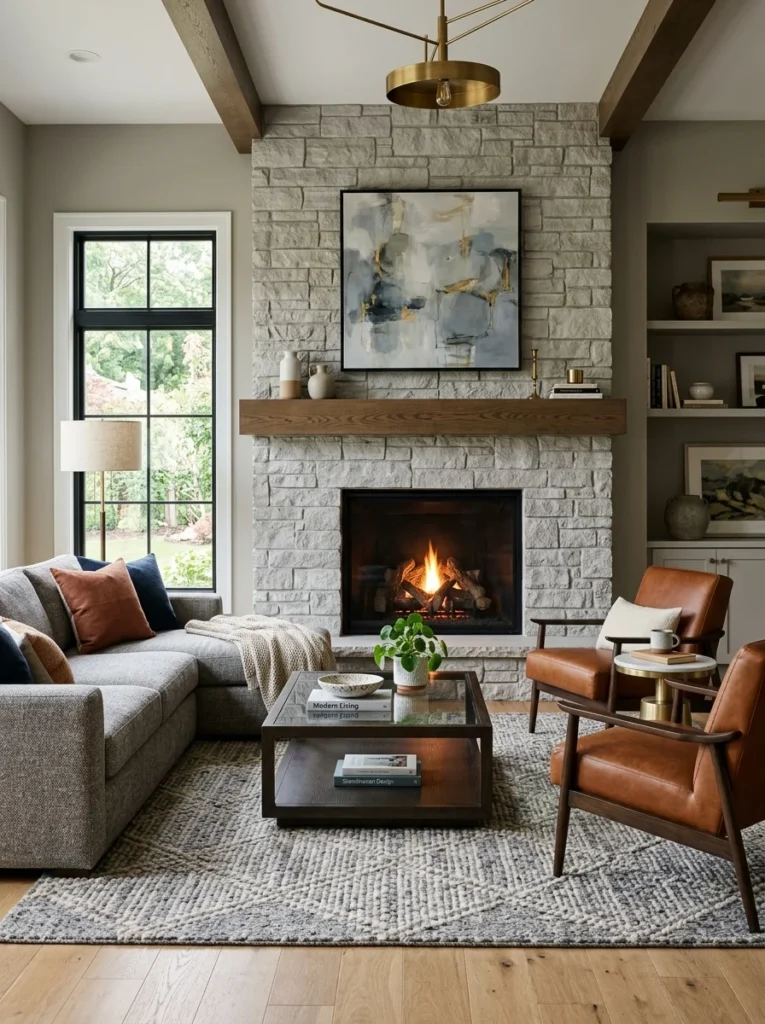
Every well-arranged living room is organized around a focal point — a single dominant visual element that anchors the room and provides the primary reference point for furniture placement. All seating in the room should face toward or be angled toward the focal point, creating a sense of orientation and intention that makes the room feel purposefully arranged rather than randomly assembled.
The focal point in most living rooms is one of three things. In homes with a fireplace, the fireplace is almost always the natural focal point — it is architectural, fixed, and visually dominant. In homes without a fireplace, the television is typically the focal point, particularly in rooms where watching television is the primary activity. In rooms where television is less central, a large window with a significant view, a piece of statement artwork, or a beautiful piece of furniture can serve as the focal point.
The first step in planning any living room furniture arrangement is to identify the focal point. Every layout decision that follows should be made in relation to it.
Traffic Flow
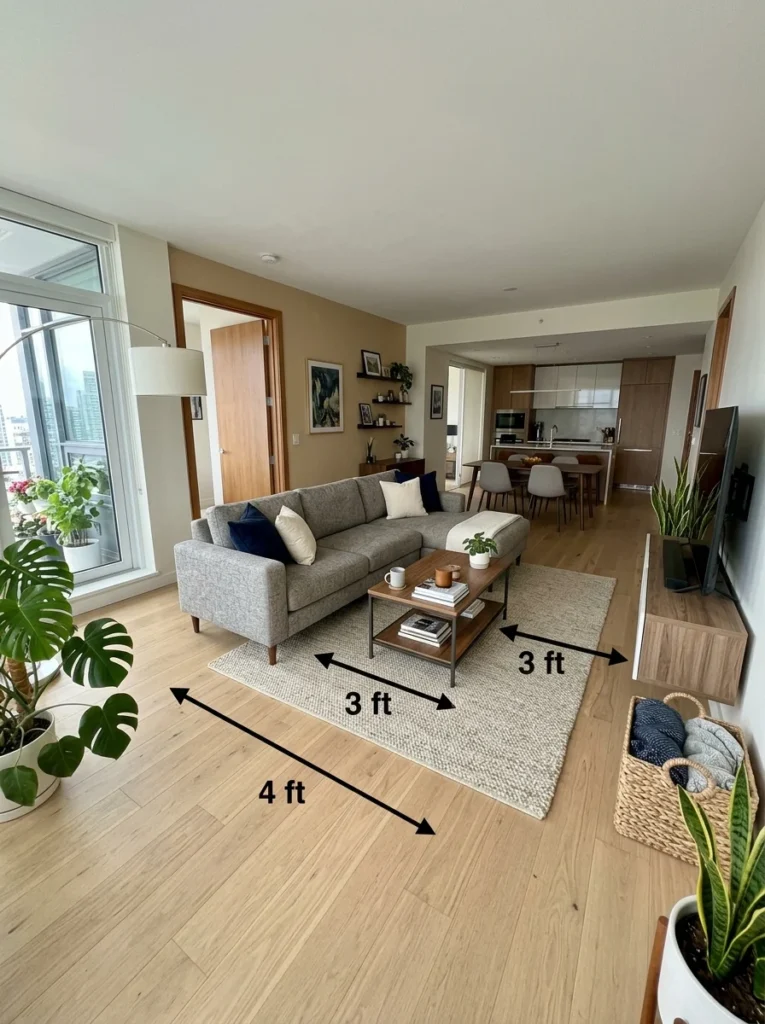
Traffic flow refers to the paths people take to move through and around the living room — from the door to the sofa, from the sofa to the kitchen, from one seating area to another. A furniture arrangement that blocks or interrupts these natural paths creates a room that feels frustrating to navigate and forces people to squeeze past furniture constantly.
The minimum clearance for comfortable movement through a living room is 30 to 36 inches — approximately the width of a person’s shoulders plus a small buffer on each side. Major traffic routes through the room need at least this much clear floor space. The path from the main entrance to the most frequently used seating, the path between the living room and the kitchen or dining room, and the path to the television if it is in a specific location all need this clearance.
A simple test for traffic flow is to walk through your planned arrangement — or your current arrangement — at normal speed along every route you regularly take through the room. Any point where movement feels tight, where you naturally turn sideways, or where you have to navigate carefully rather than walk freely indicates a clearance problem that the arrangement needs to address.
With these two concepts established, the seven layouts follow.
Layout 1: The Conversation Layout
What It Is
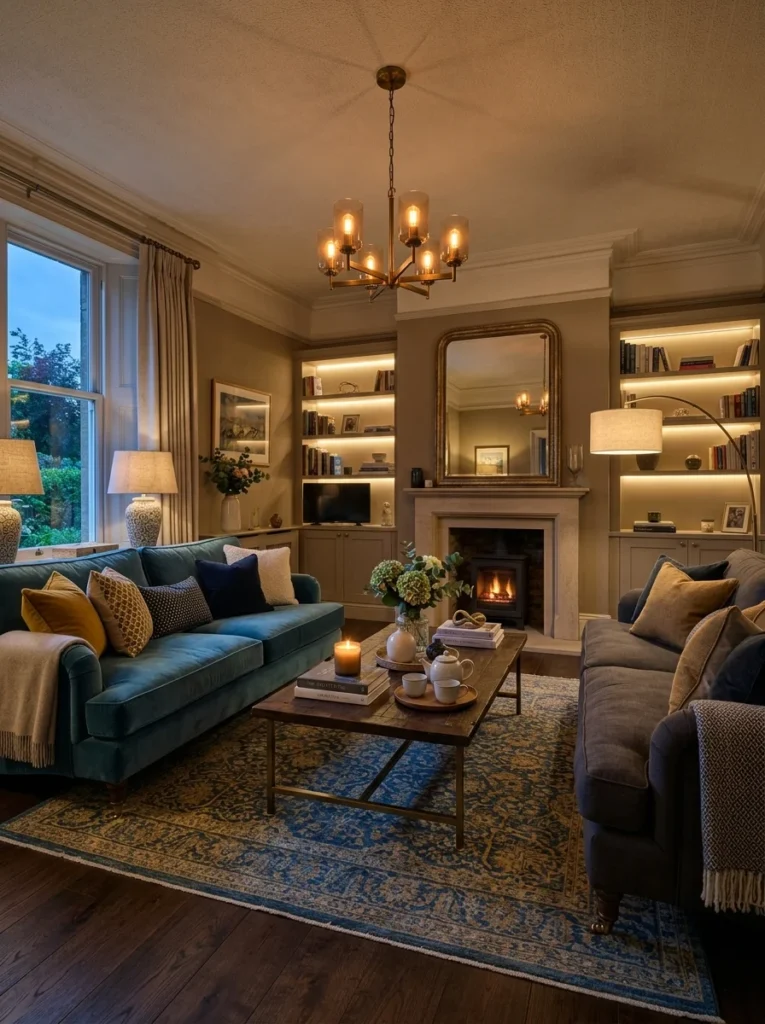
The conversation layout positions two sofas or a sofa and two chairs facing each other across a central coffee table, with all seating oriented toward the center of the arrangement rather than toward a focal point on the wall. The arrangement creates an enclosed social zone that prioritizes face-to-face interaction and conversation over television viewing or individual activities.
How It Works
In a conversation layout, the seating pieces face inward — toward each other and toward the shared center of the arrangement — rather than outward toward a wall. The coffee table occupies the center of the arrangement, within comfortable reach of all seating positions. Side tables are placed at the ends of the sofas or beside the chairs for drinks and small items.
The enclosed nature of the conversation layout creates a room within a room — a clearly defined social zone that feels intimate and purposeful. When people sit in a conversation layout, they are naturally oriented toward each other, which makes interaction easier and more comfortable than seating that requires turning sideways to speak with someone.
The arrangement works best with a symmetrical or near-symmetrical seating configuration. Two identical sofas facing each other across a coffee table is the most formal and most visually balanced version. A sofa facing two chairs across a coffee table is slightly less formal and works well when the room needs the flexibility of individual seating positions that can be moved more easily than a second sofa.
Best Situations for This Layout
The conversation layout is best suited to larger living rooms where there is sufficient space for two substantial seating pieces facing each other without the room feeling overwhelmed by furniture. It also works well in households where the living room is used primarily as a social space — for entertaining, for family conversation, for gatherings — rather than as a television-focused room.
It suits formal living rooms and sitting rooms that are separate from the main television room in larger homes. In these spaces, the absence of a dominant television as the focal point makes the inward-facing conversation arrangement the most natural and functional configuration.
Execution Tips
The coffee table in a conversation layout should be proportional to the seating arrangement — long enough to be accessible from all seating positions and positioned close enough that a drink placed on it can be reached without leaning forward uncomfortably. The ideal distance between the front edge of a sofa and the nearest edge of the coffee table is 14 to 18 inches.
In a large room, a conversation layout can float freely in the center of the space without any furniture touching the walls. This central floating arrangement is one of the most elegant configurations a large living room can have, and it leaves the perimeter of the room free for additional furniture — a console table, a bookcase, an additional chair — without crowding the central seating zone.
Layout 2: The L-Shape Layout
What It Is
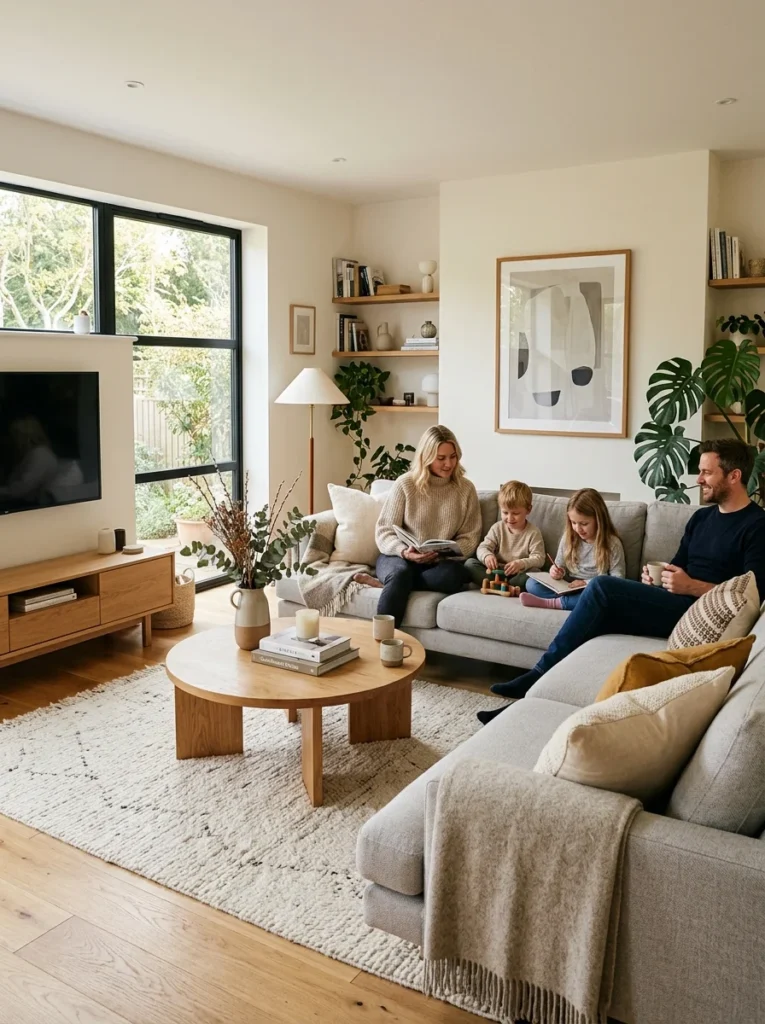
The L-shape layout uses an L-shaped sofa — a sofa with a chaise extension on one end — or a combination of a standard sofa and a loveseat or chaise arranged at a right angle to each other. The resulting L configuration creates a natural gathering corner that feels casual, relaxed, and suited to everyday living.
How It Works
The two arms of the L meet at a corner, which creates an enclosed area that naturally contains the seating zone. The coffee table sits within the opening of the L — the space bounded on two sides by the seating — and is accessible from most seating positions. The open side of the L faces the focal point, whether that is a television, a fireplace, or a window.
The L-shape is one of the most practical configurations for rooms where the living room is used for a variety of activities simultaneously — some family members watching television while others read, a parent watching children play while having a conversation with another adult. The different arms of the L provide distinct seating positions that suit different activities without any seat being poorly positioned relative to the rest of the room.
Best Situations for This Layout
The L-shape layout works well in medium to large living rooms where there is enough space to accommodate two seating pieces at a right angle without blocking traffic flow. It suits open-plan spaces particularly well because the L configuration creates a clearly defined living zone within the larger open area without requiring walls to contain it.
It is the most popular layout for family living rooms because it maximizes seating capacity while maintaining a casual, comfortable feeling. The combination of a large sofa on one arm and a loveseat or chaise on the other provides seating for four to six people in an arrangement that feels relaxed rather than formal.
Execution Tips
The orientation of the L is the key decision in this layout. The corner of the L — where the two arms meet — should be positioned away from the focal point, with the open side of the L facing toward it. This ensures that both arms of the L have a reasonable view of the focal point rather than one arm facing away from it.
An area rug placed to anchor the L-shape arrangement is particularly important in this layout because the L creates a clearly defined zone that benefits from a visual boundary at floor level. The rug should extend beneath the front legs of all seating pieces and be large enough that the coffee table sits comfortably within it.
Layout 3: The Symmetrical Layout
What It Is
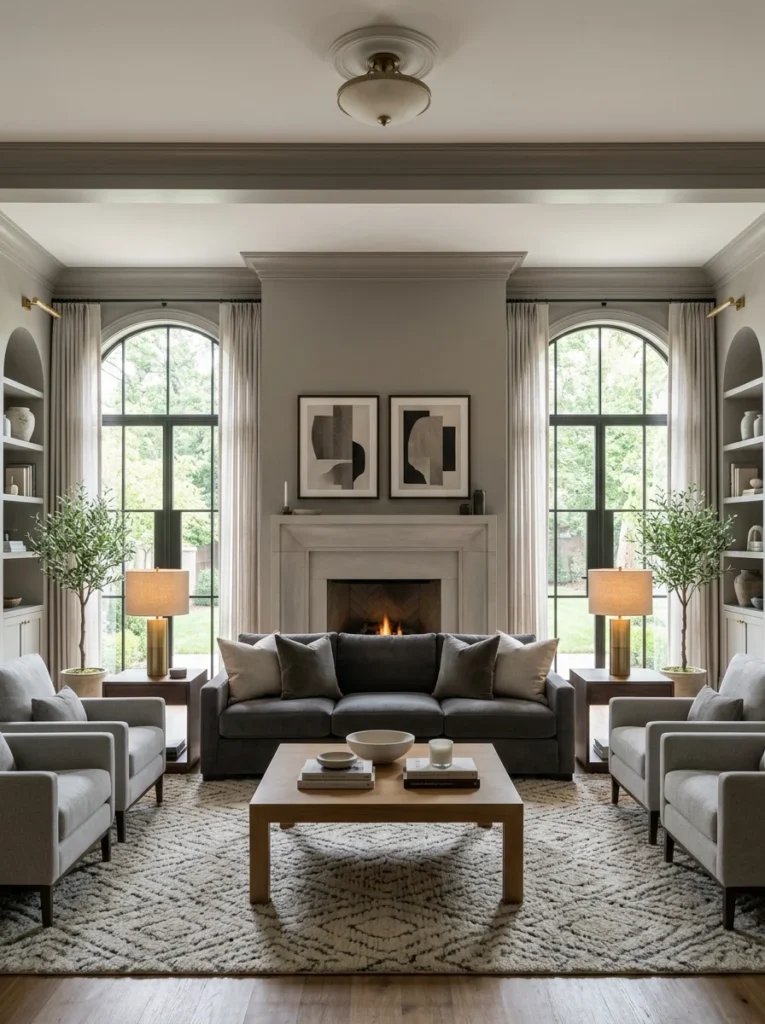
The symmetrical layout arranges furniture in a mirrored configuration on either side of a central axis — typically the axis running from the focal point outward into the room. The sofa faces the focal point directly, with matching chairs, side tables, or lamps placed symmetrically on either side. The arrangement is formal, balanced, and visually calm.
How It Works
Symmetry creates order — the eye reads a symmetrical arrangement as intentional and resolved, which produces a feeling of calm and completeness that asymmetrical arrangements rarely achieve. In a living room, symmetry is established by placing identical or near-identical pieces on either side of the central axis, with the primary sofa centered directly in front of the focal point.
The most common symmetrical configuration is a sofa centered on the focal point with a matching chair on each side — either directly alongside the sofa or angled slightly inward at the ends of the coffee table. Side tables and lamps match on both sides. Artwork above the sofa, above the fireplace, or on adjacent walls is centered on the axis.
Best Situations for This Layout
The symmetrical layout works best in rooms with a clearly defined focal point — a fireplace in the center of a wall, a large window, or a television in a fixed central position — that provides the axis around which the symmetry is organized. It suits traditional, classic, and formal living room styles more naturally than contemporary and casual ones, though a symmetrical arrangement executed with modern furniture and minimal styling can look clean and sophisticated.
It is particularly effective in rooms that are already architecturally symmetrical — rooms where windows, doors, and architectural features are positioned with inherent balance — because the furniture arrangement reinforces and completes the room’s natural geometry.
Execution Tips
True symmetry requires commitment — a single asymmetrical element in an otherwise symmetrical arrangement draws attention to itself and disrupts the sense of order. If you choose a symmetrical layout, apply the principle consistently to all elements within the seating zone — matching side tables, matching lamps, matching or complementary chairs.
Symmetry does not require identical pieces. Two chairs in the same style but different colors, or two side tables with the same proportions but different materials, create what designers call imperfect symmetry — balanced in structure but with enough variation to feel curated rather than catalog-matched.
Layout 4: The TV-Focused Layout
What It Is
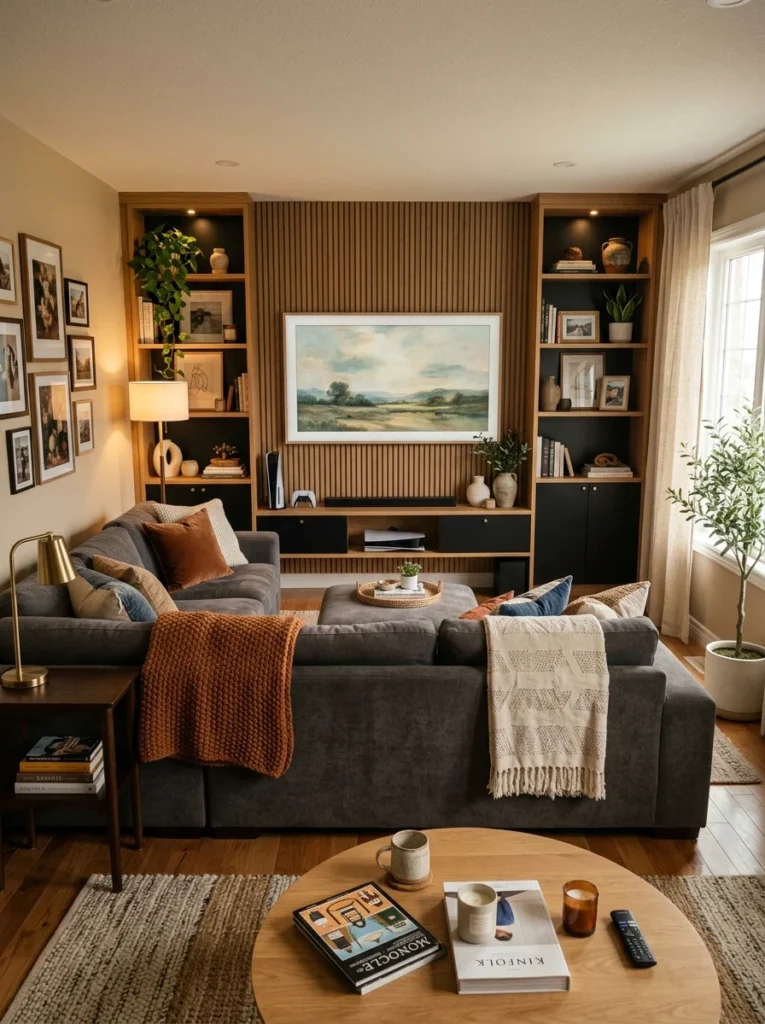
The TV-focused layout arranges all seating to optimize the television viewing experience — appropriate distance from the screen, comfortable viewing angles, and clear sightlines from every seat. It is the most practical layout for rooms where television is the primary activity, and it is also the layout most frequently executed poorly.
How It Works
The primary sofa faces the television directly, perpendicular to the screen. Additional seating — chairs, a loveseat, or a chaise — is positioned on the sides of the primary sofa, angled slightly inward toward the screen so that the viewing angle from those seats remains comfortable. The coffee table sits between the sofa and the television.
The most common mistakes in a TV-focused layout are positioning the television too high, placing seating too far from the screen, and choosing a screen size that is too small for the viewing distance. All three mistakes are addressable with simple adjustments.
Television height is the most frequently miscalculated element. The center of the television screen should be at approximately seated eye level — for most adults sitting on a standard sofa, this is between 42 and 48 inches from the floor. A television mounted high on the wall above a fireplace requires viewers to crane their necks upward, which causes discomfort during extended viewing. The fireplace may be the focal point architecturally, but mounting a television directly above it creates a practical problem that affects viewing comfort every time the television is used.
Viewing Distance Guide
The ideal viewing distance from a television depends on the screen size. For a 55-inch screen, the optimal seating distance is between 7 and 11.5 feet. For a 65-inch screen, the optimal range is 8 to 13.5 feet. For a 75-inch screen, the optimal range is 9.5 to 15.5 feet.
If your current sofa is significantly outside these ranges for your screen size — either too close or too far — adjusting the seating position to bring it within the optimal range will noticeably improve the viewing experience.
Best Situations for This Layout
The TV-focused layout suits any household where television watching, streaming, or gaming is a significant daily activity. It prioritizes practical viewing comfort over formal appearance, which makes it the most honest and functional choice for most family living rooms.
Execution Tips
Avoid placing the television in a corner. A corner-mounted television requires viewers on the main sofa to angle their bodies sideways to watch, which creates discomfort during extended viewing and produces poor sightlines from most seating positions. The television should face the primary seating directly, with the screen parallel to the sofa.
In rooms where the television and the fireplace are on different walls, choose which one will serve as the primary focal point and arrange the seating primarily in relation to that element. Attempting to orient the seating equally toward both typically results in seating that works well for neither.
Layout 5: The Open Plan Layout
What It Is
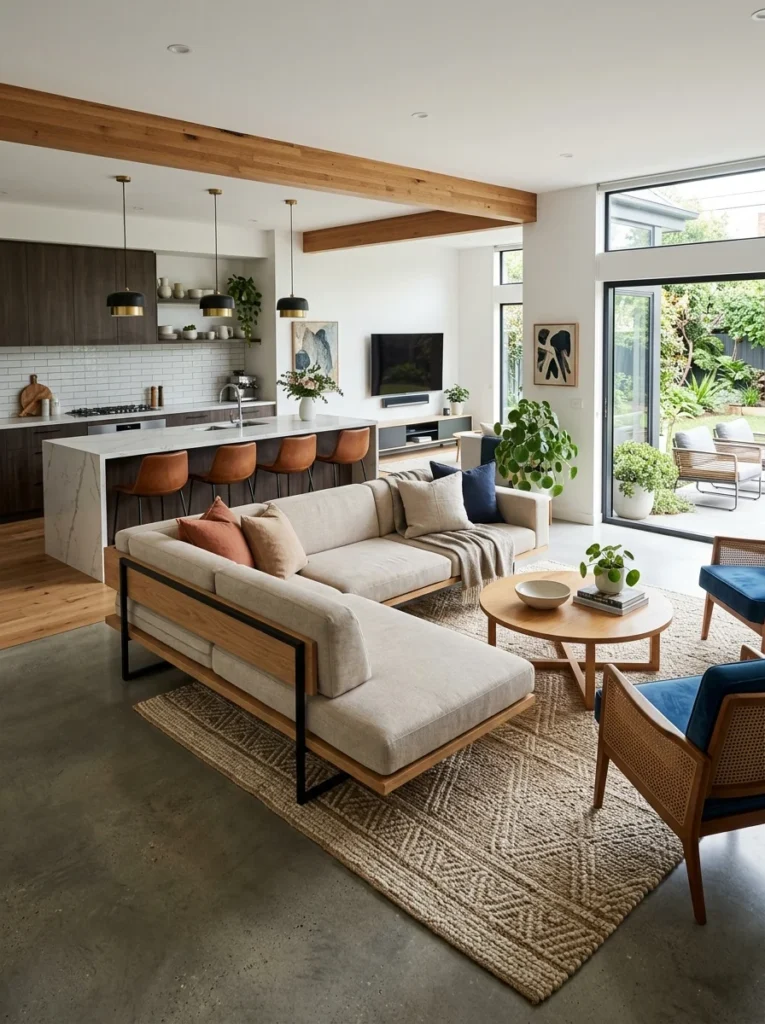
The open plan layout defines the living room zone within a larger open space — typically a combined kitchen, dining, and living area — using furniture arrangement rather than walls to create distinct zones. The challenge is creating a living room that feels contained and purposeful without any physical boundaries separating it from the adjacent spaces.
How It Works
In an open plan space, the living room zone is established primarily through the positioning of the sofa. The back of the sofa — rather than the wall behind it — defines the boundary between the living zone and the adjacent space. A sofa floating in the middle of a large open plan space with its back facing the kitchen or dining area creates a clear visual separation between the living zone and the rest of the space.
An area rug is the second most important element in defining an open plan living zone. A rug large enough to anchor all of the seating furniture — with at least the front legs of every piece resting on it — creates a visual floor boundary that reinforces the zone definition established by the sofa placement.
Best Situations for This Layout
The open plan layout applies to any home where the living area shares a continuous floor space with the kitchen, dining room, or both. It is the dominant living arrangement in contemporary homes and apartments, and the principles it relies on — furniture as room divider, rugs as zone markers — apply across a wide range of space sizes.
Execution Tips
The most common mistake in open plan living arrangements is pushing all the living room furniture against the walls of the space, leaving a large empty floor area in the center. This arrangement makes the living zone feel like it is trying to disappear into the edges of the larger space rather than confidently occupying its own territory within it.
Float the furniture. Pull the sofa away from the wall and into the space, with its back defining the living zone boundary. Group the seating furniture together within the rug area so that it reads as a coherent zone rather than isolated pieces scattered around a large floor area. The open space behind the sofa — between the sofa back and the wall — can hold a console table that provides a visual connection between the living zone and the wall behind it.
Layout 6: The Small Living Room Layout
What It Is
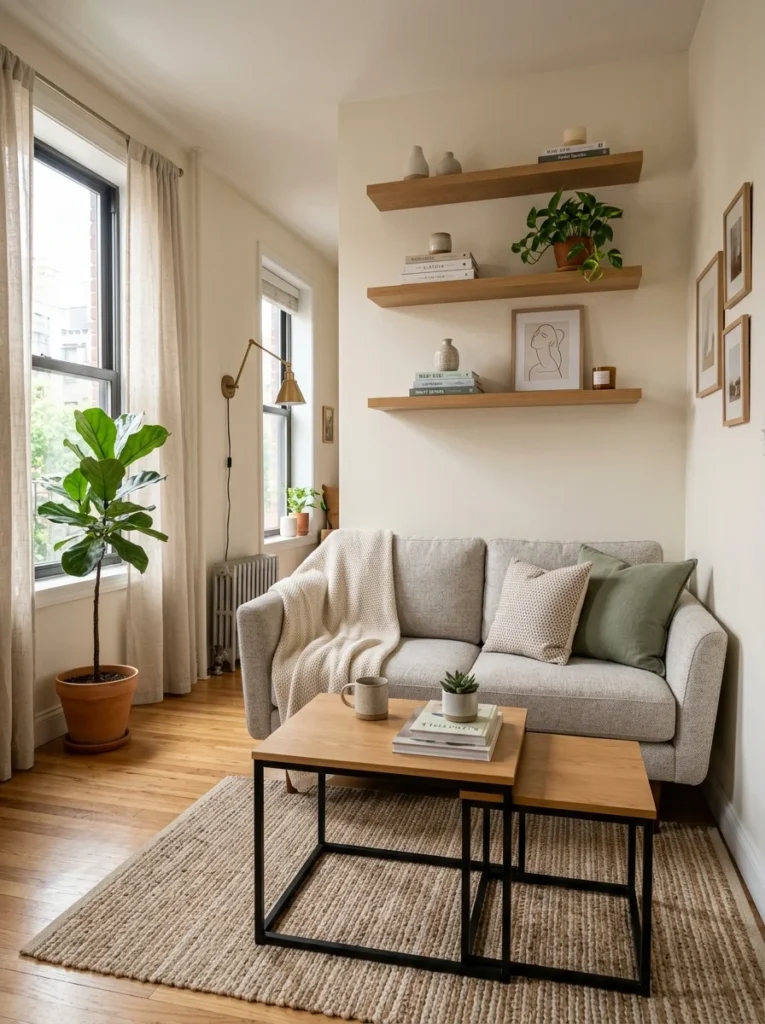
The small living room layout applies specific principles to rooms where the total floor area is limited — typically rooms under 150 square feet — to maximize both the functional and visual space available. In a small living room, every furniture decision has a significant impact on how the room feels, and errors in scale, placement, or quantity are more consequential than in larger rooms.
How It Works
The fundamental principle of small living room furniture arrangement is restraint. Every piece of furniture in a small room reduces the open floor area that makes the room feel livable and spacious. The question to ask about every piece of furniture is not whether it would be useful but whether it is necessary — whether the room functions meaningfully better with it than without it.
A small living room typically needs one sofa or one sofa and one chair — not a sofa, a loveseat, two chairs, and a chaise. The primary sofa should be proportional to the room: a three-seat sofa in a room that is only 10 feet wide overwhelms the space. A two-seat sofa or a compact three-seat sofa with a shallow seat depth allows adequate floor clearance on all sides.
Best Situations for This Layout
This layout applies to any room where square footage is genuinely limited — apartments, starter homes, converted rooms, and secondary sitting rooms in larger houses. The principles of restraint, proportion, and multi-purpose furniture apply across all of these situations.
Execution Tips
Choose a coffee table with a smaller footprint than you think you need. In a small living room, a large coffee table consumes a disproportionate amount of the central floor space and makes movement around the seating area feel restricted. A smaller coffee table, or a pair of smaller nesting tables that can be separated and used independently, provides the necessary surface function without the visual and physical bulk.
Consider eliminating the coffee table entirely and using a single side table or a small tray table instead. The floor space reclaimed by removing the coffee table from a small living room can be significant — enough to make the room feel meaningfully more open and comfortable to move through.
Do not push all furniture against the walls in an attempt to maximize floor space. This approach — counterintuitively — makes small rooms feel smaller, because it spreads furniture around the edges of the room and leaves a large empty void in the center that emphasizes the room’s limited dimensions. Grouping furniture together in the center of the room, even in a small space, creates a more intimate and purposeful arrangement that feels better than furniture lined up against every wall.
Layout 7: The Long Narrow Living Room Layout
What It Is
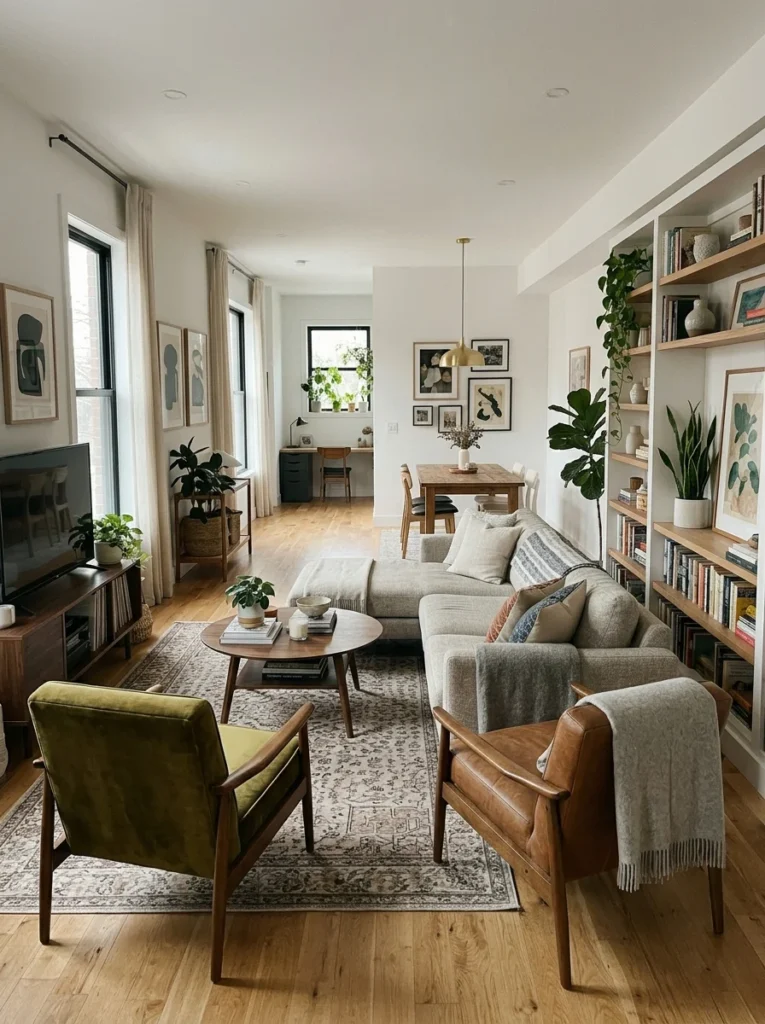
The long narrow living room — a room where the length significantly exceeds the width, typically in a ratio of more than two to one — is the most challenging room shape to arrange furniture in effectively. The proportions of the room work against most standard furniture configurations, and the default approach of placing a sofa against the short wall and everything else in a long line down the room typically produces a result that feels like a corridor rather than a living room.
How It Works
The most effective strategy for a long narrow living room is to divide the space into two distinct functional zones along its length rather than treating it as a single room to be furnished end to end. Two separate seating or activity areas — a primary living zone at one end and a secondary zone at the other — break the corridor feeling by creating multiple centers of activity within the long space.
The primary living zone occupies one end of the room and contains the main sofa, the television or fireplace focal point, the coffee table, and any additional primary seating. The secondary zone occupies the other end and serves a different function — a reading area with a comfortable chair and a floor lamp, a home office corner with a desk, or a games area with a table and chairs. The two zones are separated by an implied boundary — a change in rug, a console table placed perpendicular to the room’s long axis, or simply the gap between the two furniture groupings.
Best Situations for This Layout
The two-zone strategy applies to any living room where the length is significantly greater than the width — a common configuration in period houses, terraced houses, and converted spaces. It is also effective in loft spaces and open plan apartments where a long rectangular footprint needs to be divided into distinct living areas.
Execution Tips
Avoid the most common long narrow room mistake — placing the sofa along the longest wall. This arrangement creates a wide seating piece that runs parallel to the longest dimension of the room, which emphasizes the narrowness rather than counteracting it. Place the sofa perpendicular to the long walls instead — facing across the width of the room rather than along its length. This creates a natural visual break across the room’s width and makes the space feel less like a corridor.
Use rugs to define each zone clearly. A rug under the primary seating zone and a separate rug under the secondary zone give each area its own visual identity within the larger space. Choose rugs that are wide enough to span most of the room’s width — a narrow rug in a narrow room emphasizes the narrowness, while a wide rug visually expands the width.
Place taller furniture — bookcases, floor lamps, plants — along the long walls to draw the eye along the room’s length and create visual interest in the peripheral areas without blocking the central floor space that movement through the room depends on.
How to Test Your Layout Before Moving Anything
Rearranging living room furniture is physically demanding work, and doing it multiple times while experimenting with different configurations is exhausting. Testing layouts before committing to them physically saves significant time and effort.
The simplest method is a floor plan drawn to scale on graph paper. Measure your room accurately — length, width, and the position of every door, window, and fixed feature — and draw the floor plan at a consistent scale. Then cut out paper shapes representing each piece of furniture at the same scale and move them around the floor plan to test different arrangements. This method requires no physical effort and allows rapid experimentation with configurations that would take significant time to test physically.
Several free digital room planning tools — IKEA’s room planner, Roomstyler, and similar applications — allow you to create a three-dimensional model of your room and move furniture within it. These tools take longer to set up than paper planning but provide a more realistic sense of how an arrangement will look from different positions within the room.
Before any final physical rearrangement, use masking tape on the floor to mark out the footprints of the furniture in the planned configuration. Walk through the marked arrangement, sit in the positions where each sofa and chair would be, check all the clearances, and assess the sightlines to the focal point from each seating position. This physical test with no furniture yet moved reveals any practical problems with the arrangement before the heavy lifting begins.
Conclusion
The right furniture arrangement transforms how a living room feels to live in every single day — not occasionally, not when guests come, but every morning, every evening, and every time someone sits down to relax. Getting the arrangement right is worth the time and thought it requires.
Start by identifying your focal point and mapping your traffic flow. Then select the layout from the seven in this guide that best suits your room shape and the way your household uses the living room. Test the arrangement with a scale floor plan before moving anything, and use masking tape on the floor to walk through the configuration physically before committing to the rearrangement.
The best living room arrangement is not the most impressive one or the one that looks best in a photograph. It is the one that makes the room feel natural and comfortable to use every day — where conversation flows easily, where the television is comfortable to watch, where movement through the space is effortless, and where every seat feels like a good place to be.