
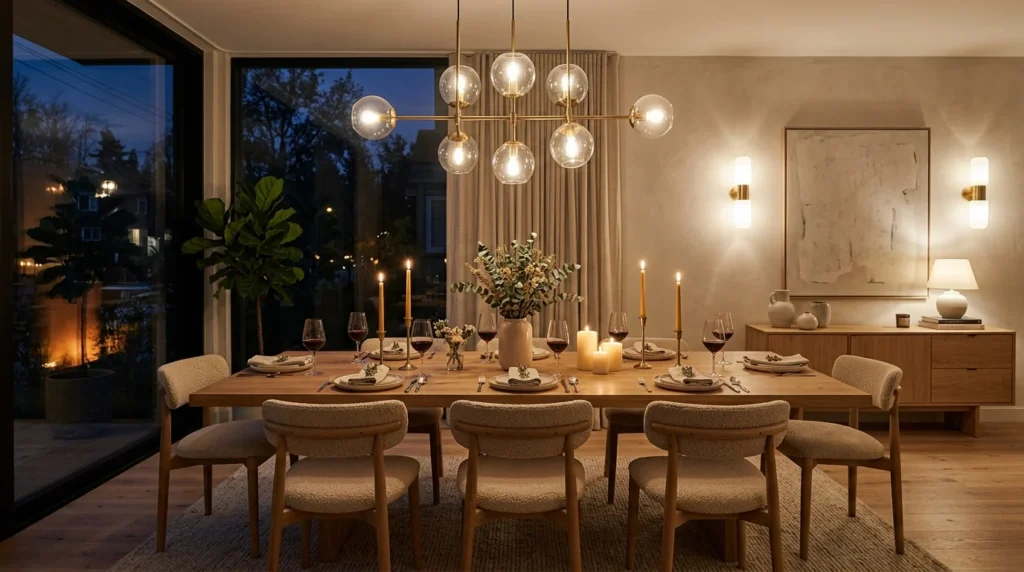
Lighting is the most transformative element in dining room design, and it is consistently the most underestimated. The dining room receives more deliberate design attention in most homes than almost any other space — the table is chosen carefully, the chairs are selected with consideration for both comfort and style, the rug is measured and positioned precisely, the artwork is hung at the correct height — and then the lighting is addressed as an afterthought, with a single ceiling fixture chosen quickly and installed without the same level of thought given to every other element in the room.
The consequence of this imbalance is a dining room that looks correct in daylight photographs but feels wrong in the evening, when it is actually used. A single overhead light fixture illuminating the dining room from directly above casts unflattering downward shadows on the faces of the people seated at the table, makes food look less appetizing than it actually is, creates a flat, uniform brightness across the entire room that eliminates depth and atmosphere, and produces a dining environment that feels more like a canteen than a room designed for the pleasure of shared meals.
The right lighting does the opposite of all of these things simultaneously. It makes food look more appetizing by rendering its colors accurately and warmly. It makes the faces of the people at the table look their best by lighting them from a flattering angle. It creates depth and dimension in the room by illuminating some areas more intensely than others. And it creates an atmosphere — a quality of warmth and intimacy — that makes the dining experience genuinely more enjoyable and more memorable, regardless of what is being served or who is gathered around the table.
This guide covers every aspect of dining room lighting — the primary pendant or chandelier over the table, the supplemental lighting that adds depth and atmosphere, the bulb specifications that make food and faces look their best, and the dimmer switch that is the single most important addition to any dining room lighting system. It also covers the most common dining room lighting mistakes and explains specifically what makes each one a problem and how to avoid it.
Section 1: The Primary Light — Why a Pendant or Chandelier Over the Table Is Non-Negotiable
Every well-designed dining room has a primary light source positioned directly above the dining table. This is not a stylistic preference — it is a functional and aesthetic requirement that defines the dining room as a distinct space within the home and creates the relationship between light and table that is the foundation of good dining room illumination.
A pendant light or chandelier positioned directly above the center of the dining table accomplishes several things simultaneously. It establishes the table as the focal point of the room by marking it with a visual overhead element that draws the eye downward to the table surface. It provides the primary illumination for the activities that take place at the table — eating, conversing, reading, and working. It defines the dining zone within the room with an overhead boundary that is particularly important in open-plan spaces where the dining area shares a continuous floor with the kitchen or living room. And it is itself a significant visual element — often the most striking decorative object in the dining room — that contributes substantially to the room’s overall aesthetic character.
The Height Rule — The Most Frequently Violated Guideline in Dining Room Design
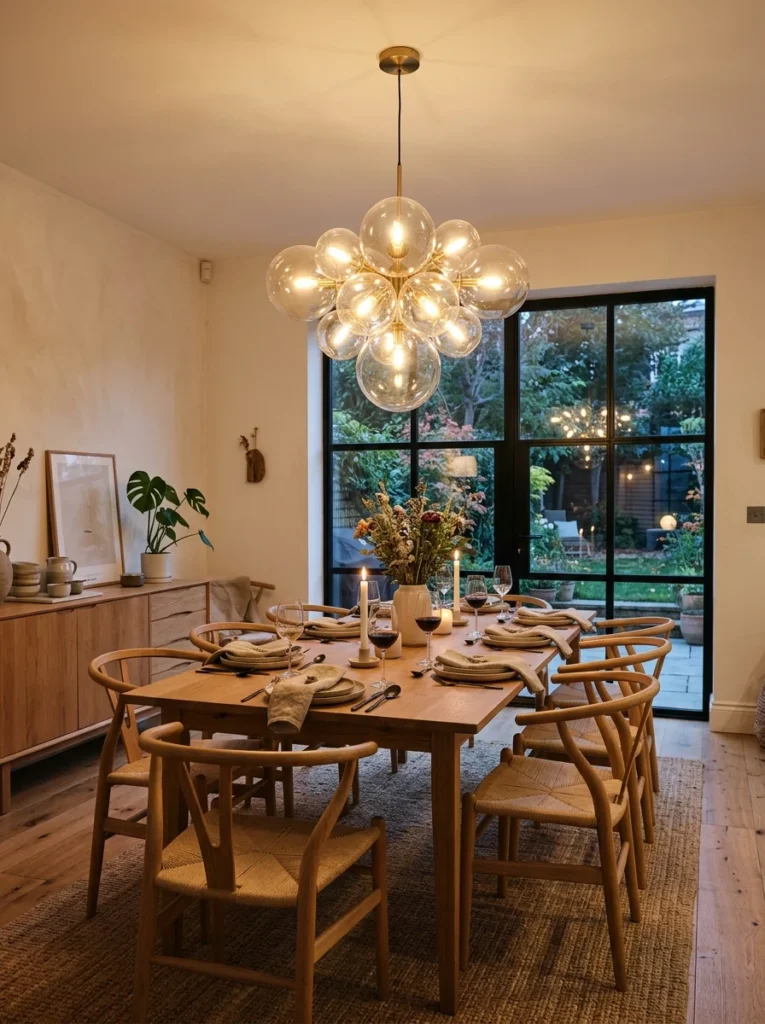
The height at which the pendant or chandelier is hung above the table is the single specification that is most frequently wrong in residential dining rooms, and getting it wrong is the most common source of dining room lighting problems.
The standard rule for pendant and chandelier height above a dining table is that the bottom of the fixture should hang between 30 and 36 inches above the table surface. At this height, the fixture is low enough to provide warm, intimate illumination of the table and the faces of the people seated around it, high enough that no seated person’s sightline is obstructed by the fixture, and proportionally correct in relation to the table and the ceiling above it.
Fixtures hung significantly higher than 36 inches above the table — a common mistake made in an attempt to keep the fixture out of sightlines or to make the room feel more spacious — produce a lighting quality that is flat and distant rather than warm and intimate. The light source is too far from the table surface to create the focused, table-centered illumination that characterizes a well-lit dining room, and the fixture itself looks disconnected from the table below it — floating in the middle of the room without a clear visual relationship to the furniture it is meant to illuminate.
Fixtures hung lower than 30 inches above the table obstruct sightlines across the table — particularly for standing guests who need to look across the table to address someone on the opposite side — and can feel imposing or claustrophobic to people seated close to the fixture’s perimeter.
In rooms with ceilings higher than the standard eight feet, the fixture can be hung slightly higher than 36 inches above the table surface to maintain proportional balance with the greater ceiling height. The general guideline for rooms with ceilings above eight feet is to add three inches of fixture height for every additional foot of ceiling height above eight feet — so a room with a ten-foot ceiling might position the bottom of the fixture 42 inches above the table.
The Width Rule — Proportion Between Fixture and Table
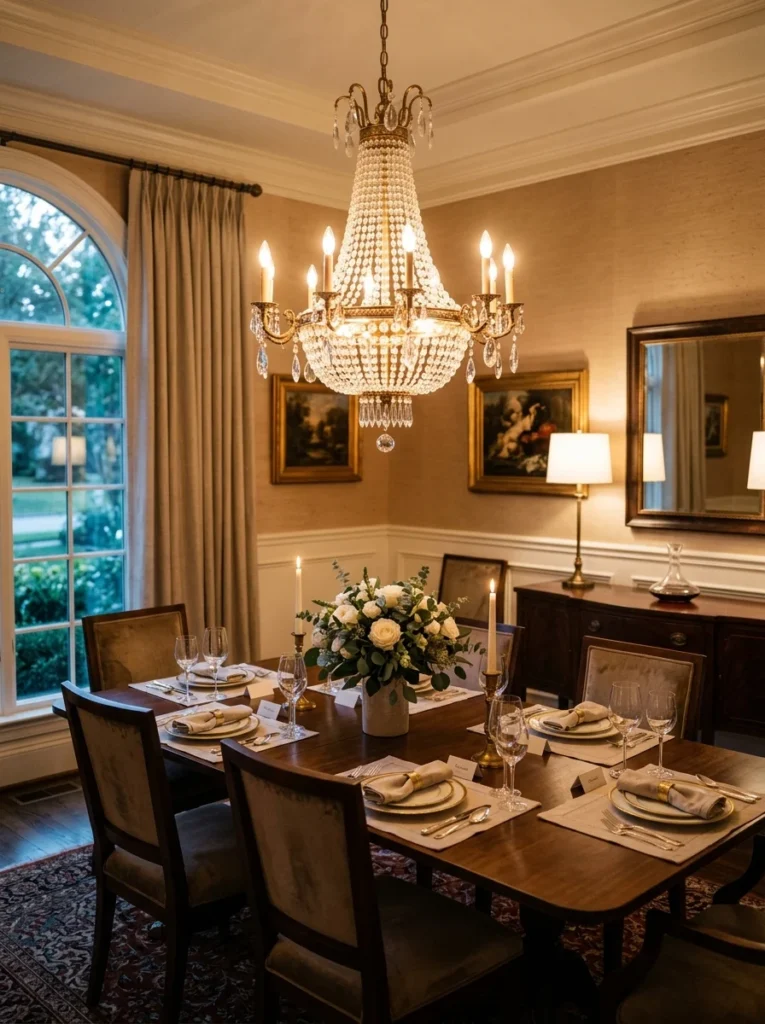
The width of the dining room pendant or chandelier relative to the width of the table is the second most important specification for the primary light, and it is the second most frequently wrong.
The standard proportion guideline is that the diameter of the primary fixture should be between 50 and 75 percent of the table’s width. A fixture within this range looks proportionally balanced in relation to the table below it — neither so small that it looks insignificant and lost above a large table, nor so large that it dominates the table and feels overwhelming within the room.
A 40-inch wide rectangular table — the minimum practical dining table width — suits a pendant fixture of 20 to 30 inches in diameter. A 36-inch round table suits a pendant of 18 to 27 inches in diameter. A 42-inch wide rectangular or oval table suits a pendant of 21 to 31 inches in diameter. A 48-inch wide table suits a pendant of 24 to 36 inches in diameter.
For linear chandeliers and multi-pendant arrangements over rectangular tables, the proportion guideline applies to the total length of the fixture arrangement rather than the diameter of a single fixture. A linear chandelier hung above a 72-inch rectangular table should span approximately 36 to 54 inches of the table’s length, centered on the table’s midpoint.
The Centering Rule — Fixture Above Table, Not Above Room
The pendant or chandelier must be centered above the dining table, not above the geometric center of the room. In many dining rooms, the table is not positioned at the exact center of the room — it may be shifted toward one wall to allow more circulation space on the other side, or positioned to align with a window or architectural feature rather than the room’s center. When this is the case, the fixture must be repositioned to center on the table rather than on the room.
A pendant fixture centered on the room but off-center from the table looks misaligned — the visual relationship between the light above and the table below is the critical one, and misalignment between these two elements is immediately noticeable and visually unsettling. If the electrical outlet for the fixture is positioned at the room’s center rather than above the table’s center, a ceiling canopy that shifts the pendant’s position — or a flexible cable system that allows the pendant to hang off-center from its ceiling point — resolves the misalignment without requiring electrical work.
Section 2: Chandelier and Pendant Styles — Choosing the Right Fixture for Every Dining Room
The range of pendant and chandelier styles available for dining room use is vast, and the right choice depends on the overall aesthetic of the dining room, the height and character of the ceiling, and the visual statement the room is intended to make. The following style categories cover the most widely applicable options and the situations each one suits best.
The Linear Chandelier — The Contemporary Choice for Rectangular Tables
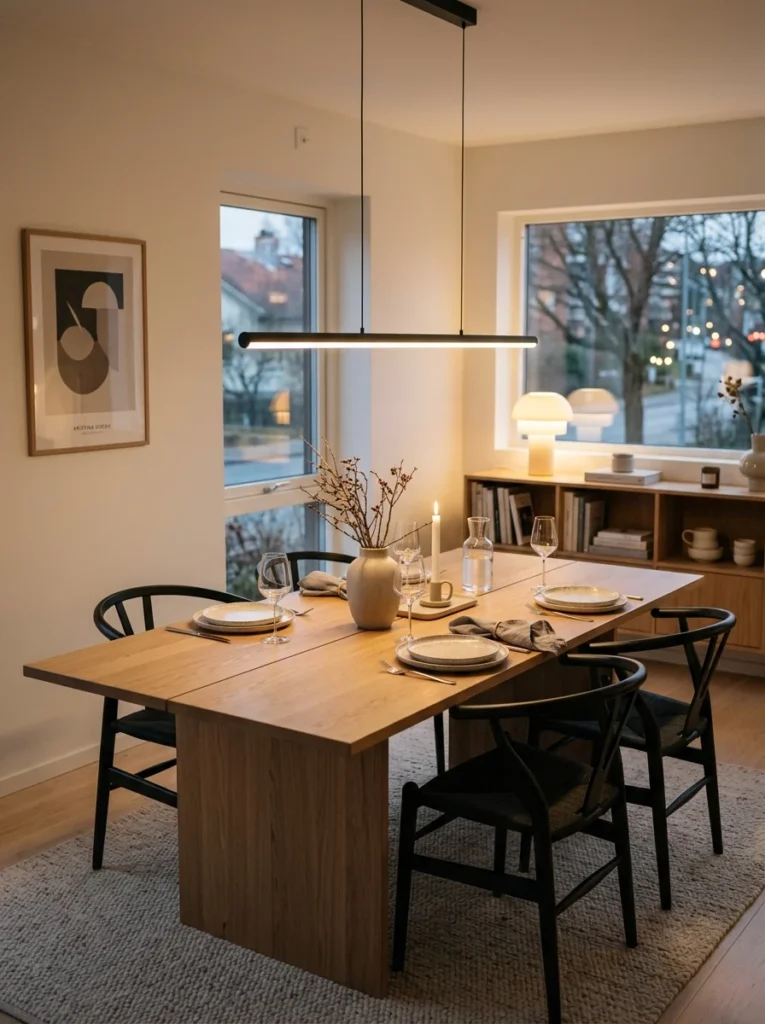
A linear chandelier — a fixture with a horizontal bar or frame from which multiple light sources hang along its length — is the most appropriate and most visually balanced choice for a rectangular dining table. The elongated form of the linear chandelier mirrors the elongated form of the rectangular table below it, creating a visual alignment between the two elements that a round chandelier or single pendant over a rectangular table cannot achieve.
Linear chandeliers are available in a wide range of styles — from minimalist single-bar fixtures with bare Edison bulbs to elaborate branching structures with multiple arms and shades. The style of the linear chandelier should align with the overall aesthetic direction of the dining room. A single black metal bar with exposed bulbs suits industrial, contemporary, and loft-style dining rooms. A natural wood and rattan linear chandelier suits coastal, bohemian, and organic aesthetic dining rooms. A sculptural brass or gold frame suits maximalist, art deco, and globally inspired dining rooms.
The length of a linear chandelier relative to the table is particularly important. A linear chandelier that is significantly shorter than the table leaves large areas of the table without direct overhead illumination, which creates uneven lighting across the table surface. A linear chandelier that extends well beyond the table’s length looks disproportionate and creates light spill into the room that diminishes the focused, table-centered quality of good dining room illumination. A length of approximately two-thirds of the table’s total length — centered on the table’s midpoint — is the most consistently balanced proportion.
The Round Chandelier — The Classic Choice for Round and Square Tables
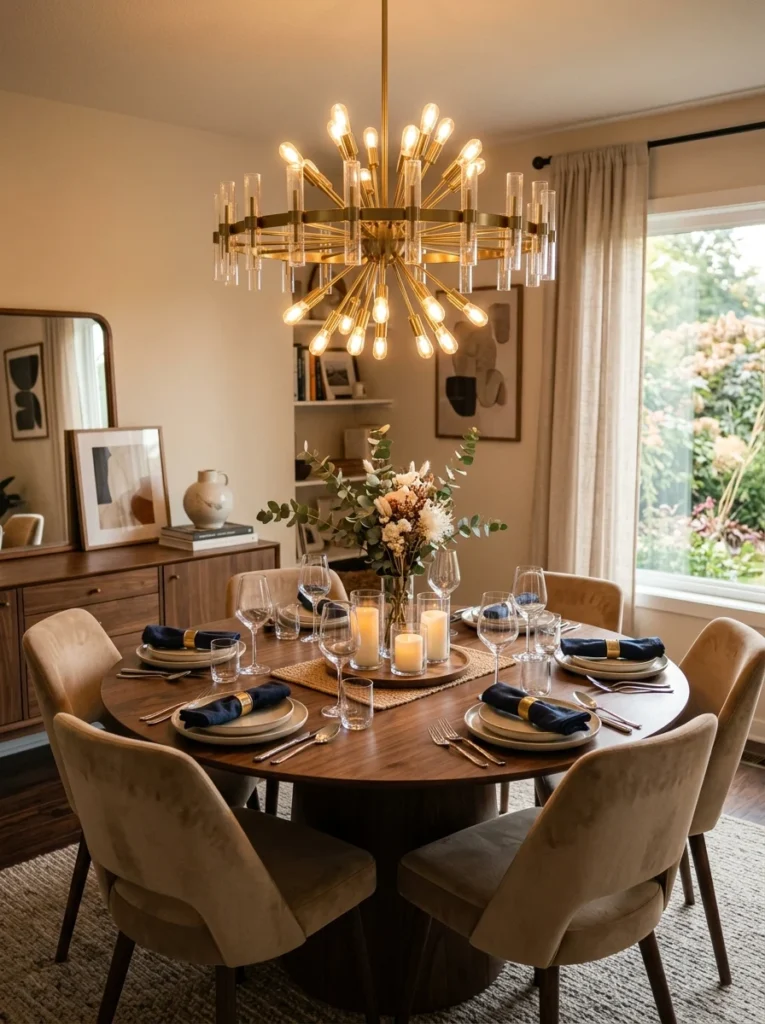
A round chandelier — a fixture with a circular form, either a drum shade, a ring of arms, or a sphere of light sources — is the natural complement to a round or square dining table. The shared circular geometry between a round chandelier and a round table creates a visual harmony that is immediately satisfying and that reinforces the social equality of the round table format — a quality that makes the round chandelier and round table combination one of the most considered and most convivial dining configurations possible.
Round chandeliers range from the most traditional — multi-arm crystal or iron fixtures with individual candelabra-style bulbs — to the most contemporary — single large drum pendants in linen or paper shades, geometric wire sphere chandeliers, and organic woven rattan globe pendants. Each style creates a fundamentally different dining room atmosphere while sharing the round form that suits the table below it.
The Single Pendant — The Minimal and Modern Choice
A single pendant — one pendant light hanging from a single cable or rod, with one light source within a shade or globe — is the most minimal and most contemporary primary light option for a dining room. It suits dining rooms with a deliberate minimal aesthetic, rooms where the table and chairs make a sufficiently strong visual statement that the light fixture is intended to complement rather than compete, and smaller dining tables where a single well-scaled pendant provides adequate illumination without the visual complexity of a multi-arm chandelier.
The most important specification for a single pendant above a dining table is shade diameter — the shade must be large enough to provide illumination across a meaningful proportion of the table’s surface rather than creating a spot of intense light in the center with dimly lit edges. A shade of at least 16 to 20 inches in diameter is generally the minimum for a single pendant above a four-person dining table. For larger tables, a single pendant is typically insufficient as a sole light source regardless of shade size, and a linear arrangement of two or three pendants in a row above the table’s length is more appropriate.
The Cluster Pendant — The Statement Choice
A cluster pendant — a group of multiple pendant lights hung from a central ceiling canopy at varying heights and positions — creates one of the most visually dramatic and most contemporary primary light configurations available for a dining room. The cluster format allows a range of pendant shapes, sizes, and heights to be combined into a single fixture composition that reads as an organic, sculptural installation above the table.
Cluster pendants work best above round and square tables, where the spreading cluster mirrors the spreading form of the table below it and where the absence of a directional axis — which a rectangular table has — allows the cluster to read as appropriately omnidirectional. Above a rectangular table, a cluster pendant is less visually resolved — the asymmetric or radially symmetric cluster sits above the directional table without a clear alignment between the two forms.
The practical consideration of cluster pendants is the complexity of installation — routing multiple cables from a single ceiling point and setting each pendant at the correct height within the cluster requires more planning and more skilled installation than a single pendant or standard chandelier, and the result of a poorly installed cluster is a fixture that looks haphazard rather than intentional.
Section 3: Supplemental Lighting — Creating Depth and Atmosphere Beyond the Primary Fixture
A dining room illuminated only by the primary pendant or chandelier above the table — with no other light sources — is a dining room with a flat, one-dimensional illumination quality. The table and the faces around it are lit, but the surrounding room falls into relative darkness that makes the dining zone feel isolated rather than contained, and that eliminates the sense of depth and dimension that multiple light sources create.
Supplemental lighting — additional light sources positioned around the room beyond the primary fixture — creates the layered illumination quality that distinguishes a genuinely well-lit dining room from one that is merely adequately lit.
Wall Sconces — Adding Depth and Warmth at Eye Level
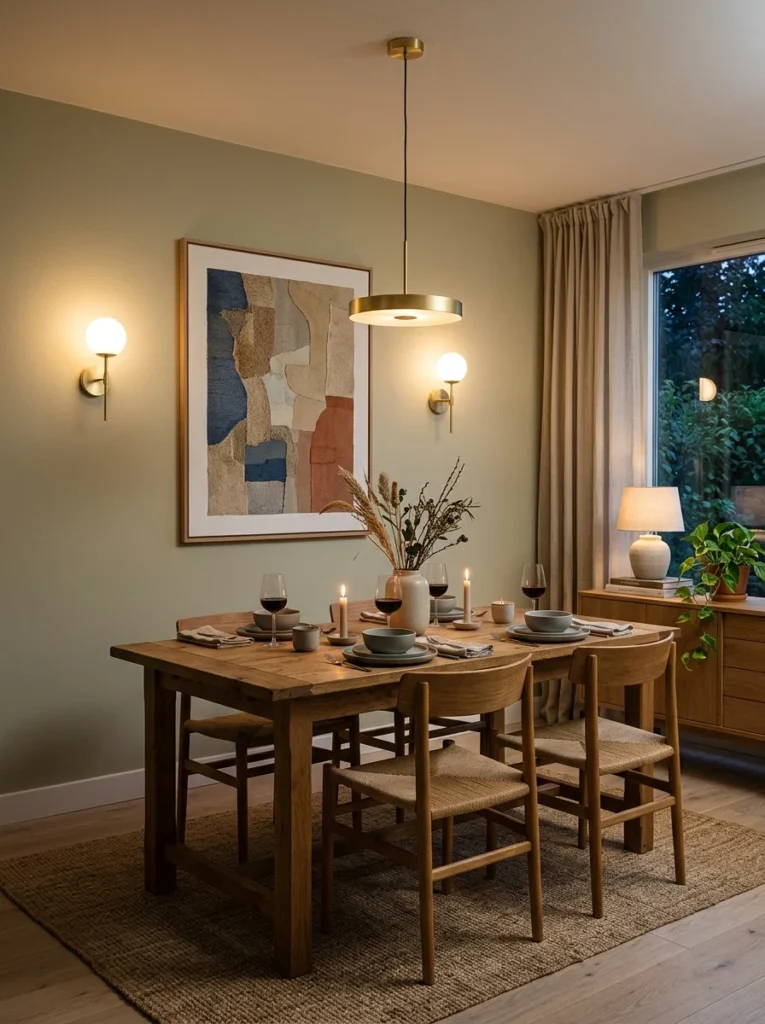
Wall sconces — light fixtures mounted directly on the dining room walls — provide illumination at a height that is between the floor and the ceiling, which creates a level of light in the room that the ceiling fixture and floor-level lamps cannot reach. This mid-level illumination adds depth and dimension to the room by creating multiple illumination sources at different heights, which the eye reads as a richer, more complex and more attractive lighting environment than a single-source room.
In a dining room, wall sconces are most effective on the walls flanking the dining table — the walls to the left and right of the table as seen from the room’s primary viewing angle. Positioned at approximately eye level for a standing adult — 60 to 65 inches from the floor — sconces on these walls illuminate the dining zone from the sides, which adds a flattering quality to the faces of the people seated at the table that the downward light of the ceiling fixture cannot provide.
Wall sconces in a dining room do not need to provide strong illumination — they are supplemental lights that contribute atmosphere and depth rather than task illumination. Low-wattage bulbs, frosted glass shades that diffuse light softly, and small fixtures with a warm, indirect quality are all appropriate for dining room sconces.
A Buffet Lamp or Sideboard Lamp — Light at the Serving Level
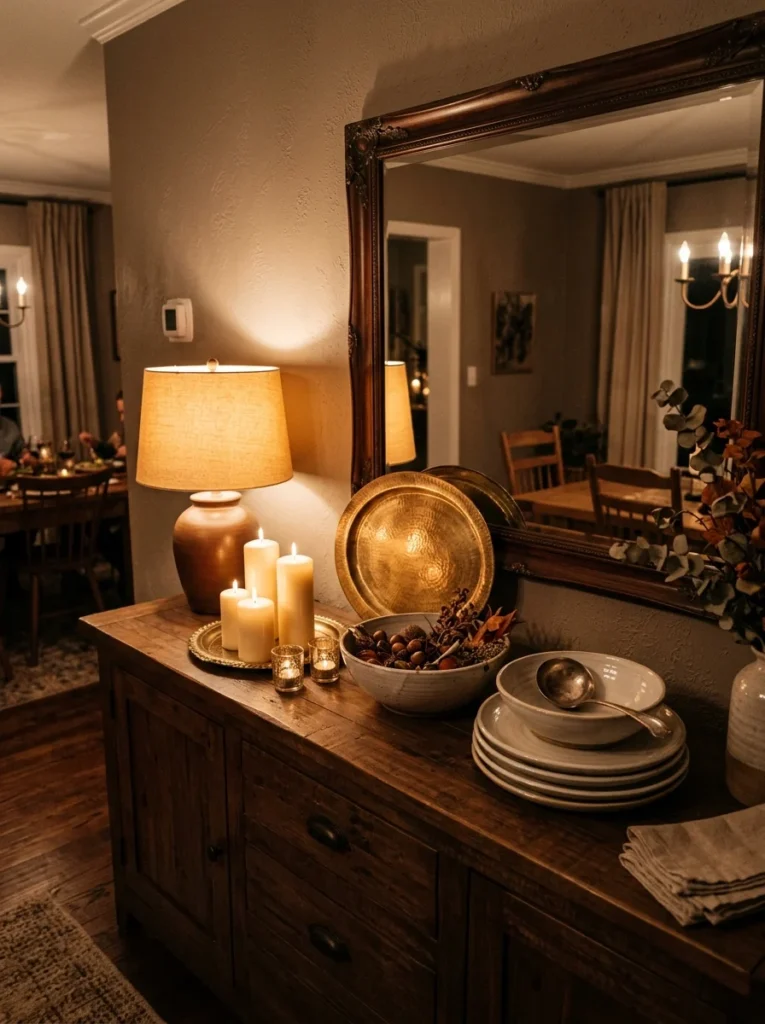
Many dining rooms include a buffet, sideboard, or console table positioned against one wall — a surface used for serving dishes, storing tableware, and displaying decorative objects. A lamp placed on this surface — a table lamp of appropriate scale for the buffet or sideboard below it — adds a warm, low light source at the serving level of the room that contributes significantly to the dining room’s overall atmosphere.
A lamp on the buffet or sideboard serves a practical function during serving — it illuminates the serving dishes and makes identifying and selecting food easier than relying on the table pendant alone — and an atmospheric function throughout the meal, providing a warm point of light at the perimeter of the room that creates depth and interest beyond the primary illuminated zone of the table.
The scale of the buffet lamp should be proportional to the surface it sits on — a lamp that is too small for a large sideboard looks insignificant and lost, while one that is too large for a small console dominates the surface and creates a visual imbalance. A lamp height of 24 to 32 inches is appropriate for most dining room buffet surfaces, with the shade diameter scaled proportionally to the lamp height.
Candlelight — The Oldest and Most Effective Dining Room Atmosphere Tool
Candles on the dining table are the most direct and most effective atmospheric enhancement available for any dining room, at any price point and in any decorating style. The warm, flickering quality of candlelight creates a dining atmosphere that no electric light source fully replicates — the movement of the flame, the warm orange-amber color of the light, and the intimate scale of candle illumination all contribute to a quality of warmth and conviviality that electric lighting approaches but never quite achieves.
Candles are most effective on the dining table when they are positioned at a height that does not obstruct the sightlines across the table — candles that are too tall create a visual barrier between diners on opposite sides. Tapered candles in candlesticks of moderate height — 8 to 12 inches of total height including the candlestick and the candle above it — are below the sightline of most seated adults and create a warm, intimate illumination at the level of the table surface without obstruction.
Battery-operated flameless candles have improved significantly in their quality of light simulation and offer a practical alternative in households where open flames are a safety concern — whether due to young children, pets, or proximity to other flammable elements on the table surface. The best flameless candles flicker in a pattern that closely resembles a real flame and produce a warm amber light that approaches the quality of genuine candlelight.
Section 4: Bulb Selection — The Specification That Makes Everything Else Work or Fail
The choice of bulb in every dining room light fixture is the specification that determines whether all the carefully chosen fixtures produce the warm, flattering, food-enhancing illumination that good dining room lighting requires — or whether they produce a harsh, unflattering, flat illumination that undermines every other lighting decision in the room.
Color Temperature — The Single Most Important Bulb Specification
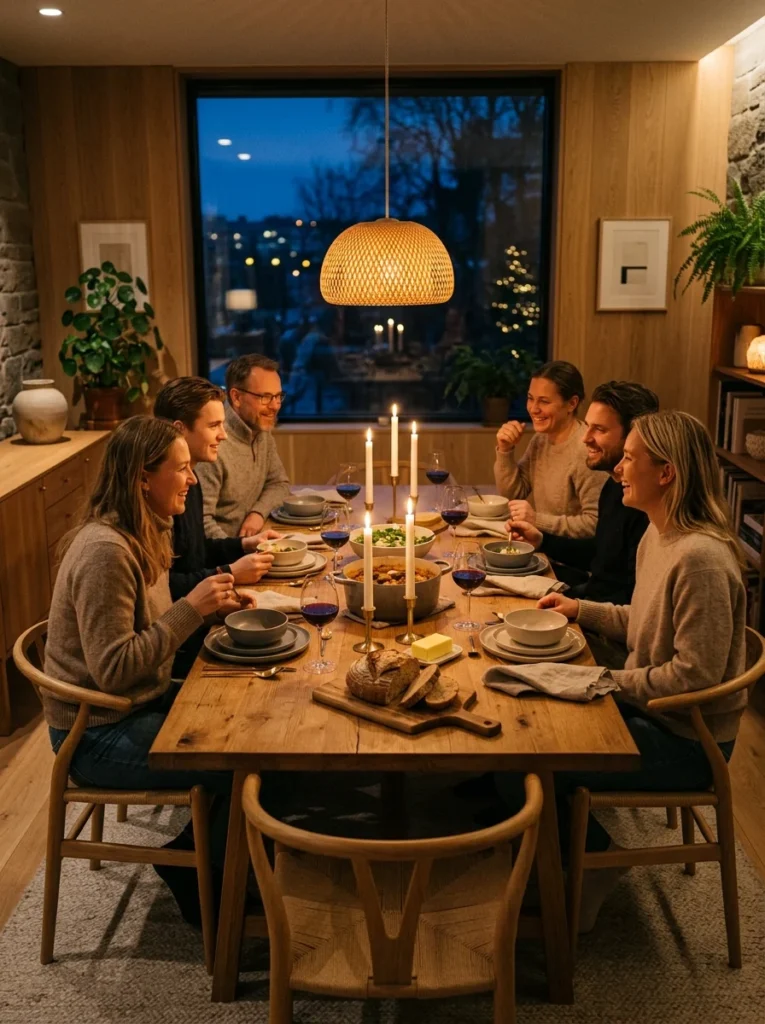
Color temperature is the measurement of the warmth or coolness of a light source, expressed in Kelvin. Lower Kelvin values produce warmer, more amber-toned light. Higher Kelvin values produce cooler, more blue-toned light.
For a dining room, the correct color temperature range is 2700 to 3000 Kelvin — the warm white range that produces the amber-toned, flattering light associated with candlelight, incandescent bulbs, and the most welcoming residential lighting environments. At 2700 Kelvin, the light has a warm, golden quality that makes food colors appear rich and appetizing, skin tones look warm and healthy, and the dining room atmosphere feel intimate and convivial.
At 4000 Kelvin — the cool white range commonly used in offices, retail spaces, and kitchens — the light has a bluish, clinical quality that is appropriate for task-focused environments but entirely wrong for a dining room. Cool white light makes food colors appear washed out and less appetizing, skin tones look pallid and unflattering, and the dining environment feel more like a workplace cafeteria than a room designed for the pleasure of shared meals.
The difference between a dining room lit with 2700 Kelvin warm white bulbs and one lit with 4000 Kelvin cool white bulbs is dramatic and immediately perceptible — not a subtle difference that requires careful attention to notice, but a fundamental change in the entire character and atmosphere of the room. If a dining room feels cold, clinical, or unwelcoming despite good furniture choices and careful decoration, the bulb color temperature is almost certainly the problem.
CRI — The Specification That Makes Food Look Its Best

The Color Rendering Index, or CRI, measures how accurately a light source renders the colors of the objects it illuminates relative to natural daylight. A CRI of 100 is perfect — the light renders all colors exactly as they appear in natural daylight. A CRI of 80 is the minimum generally considered acceptable for residential lighting. A CRI of 90 or above renders colors with a richness and accuracy that makes a meaningful visible difference to the quality of a dining room’s illumination.
In a dining room context, high CRI illumination makes food look significantly more appetizing than low CRI light. A bowl of fresh salad, a plate of roasted vegetables, or a glass of red wine all appear more vibrant, more richly colored, and more visually appealing under high CRI light than under the same color temperature light with a lower CRI. The difference is not subtle — a 90+ CRI warm white bulb in the dining room pendant produces a food presentation quality that approaches the quality of natural daylight, while a 80 CRI bulb of the same color temperature produces a noticeably flatter and less appealing rendering of the same food.
When purchasing LED bulbs for dining room fixtures, choose bulbs with a CRI of 90 or above and a color temperature of 2700 to 3000 Kelvin. Both specifications should be on the packaging of any quality LED bulb. The small additional cost of high CRI bulbs over standard CRI equivalents is insignificant relative to the difference they make to the dining room’s illumination quality.
Section 5: The Dimmer Switch — The Single Most Important Addition to Any Dining Room
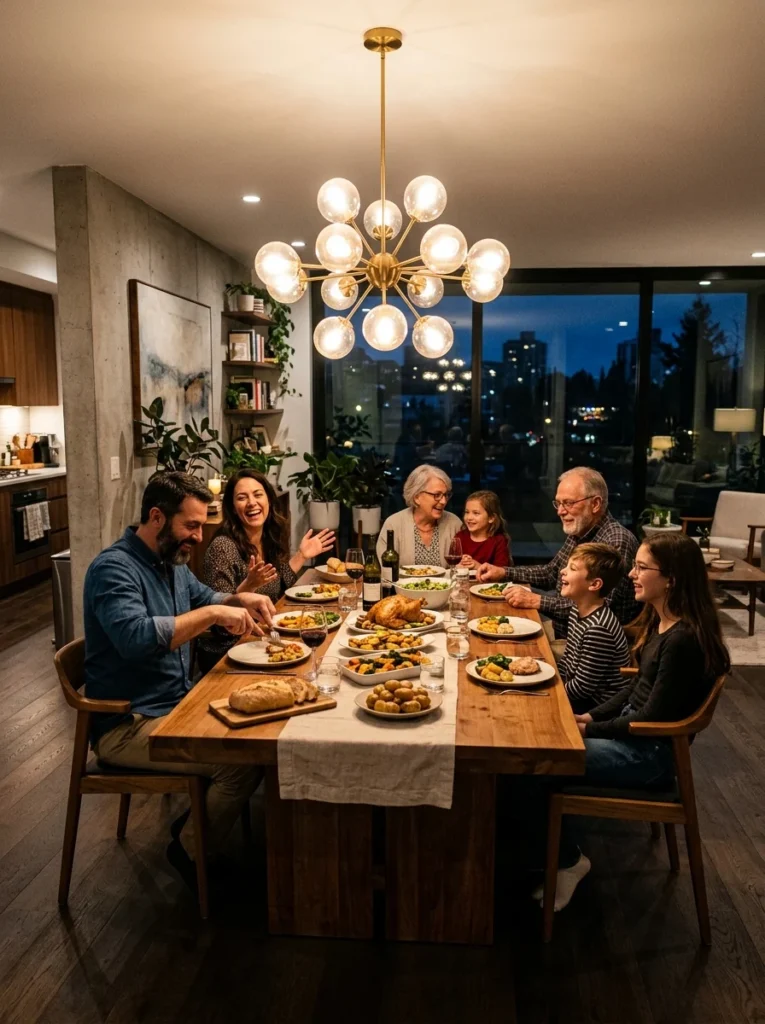
If there is one dining room lighting addition that delivers more improvement per dollar spent than any other — more than upgrading the chandelier, more than adding wall sconces, more than replacing every bulb — it is the installation of a dimmer switch on the primary dining room lighting circuit.
A dimmer switch allows the intensity of the dining room’s primary light to be adjusted across the full range from fully bright to a barely perceptible glow. This range of adjustment transforms the dining room’s ability to serve different functions at different times of day and for different occasions.
At full brightness, the dining room is appropriate for daytime meals, homework sessions, and any activity at the dining table that benefits from strong, clear illumination. At medium brightness — approximately 60 to 70 percent of maximum — the room has the warm, comfortable illumination appropriate for a relaxed family dinner. At low brightness — 30 to 40 percent of maximum — the primary fixture provides a warm, ambient background glow that suits a formal dinner party where the candlelight on the table provides the primary illumination and the dimmed ceiling fixture provides just enough ambient light to make the room visible without competing with the atmospheric quality of the candles.
The transformation from a dining room with fixed-brightness lighting to one with dimmer-controlled lighting is one of the most significant dining room improvements available, and it produces the most immediate and most consistently appreciated result of any lighting upgrade. Every person who uses the dining room for an evening meal with the light dimmed appropriately — rather than at full canteen-style brightness — experiences the difference immediately and understands intuitively why the dimmer switch is so valuable.
Dimmer Compatibility — What to Check Before Installing
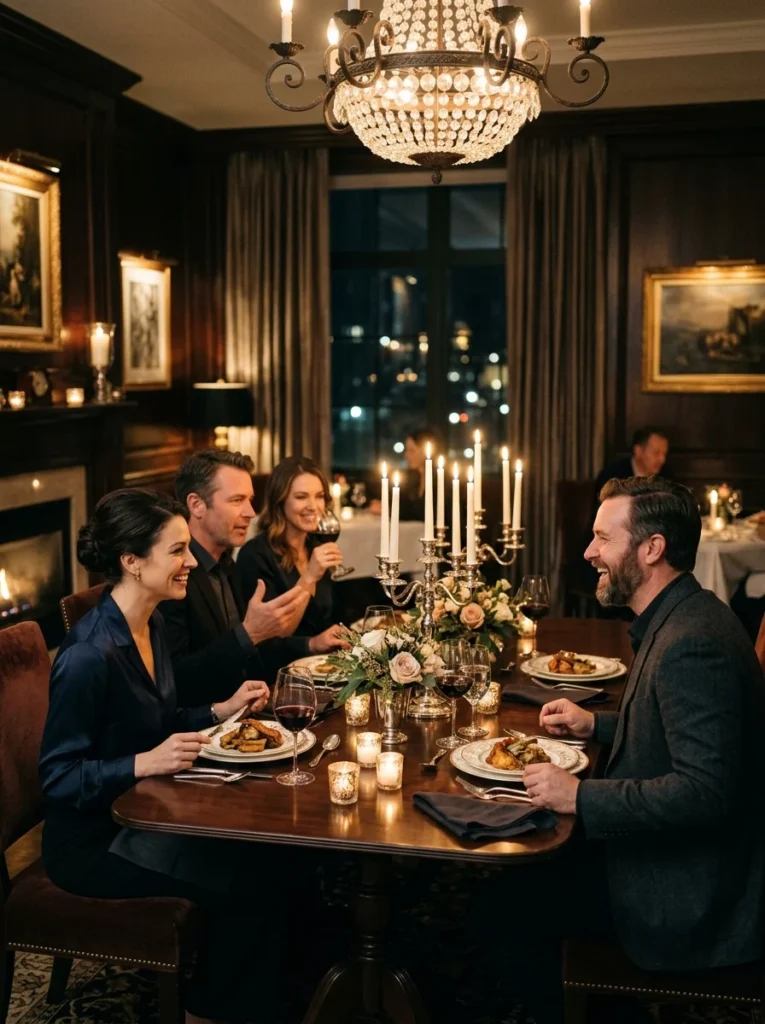
Not all LED bulbs are compatible with all dimmer switches, and using an incompatible combination produces results that range from mildly annoying — flickering at low brightness levels — to functionally problematic — humming, buzzing, and bulbs that do not dim smoothly across the full range.
When installing a dimmer switch for a dining room with LED bulbs, choose a dimmer switch specifically rated for LED use — the packaging of any modern dimmer switch indicates its LED compatibility — and choose LED bulbs specifically rated as dimmable. Both specifications are necessary for smooth, flicker-free dimming across the full range. Using a dimmable bulb with a non-LED dimmer switch, or using a non-dimmable LED bulb with any dimmer switch, produces the flickering and buzzing problems that discourage the use of the dimmer and defeat its purpose.
Section 6: The Most Common Dining Room Lighting Mistakes
Mistake 1: The Fixture Is Too Small
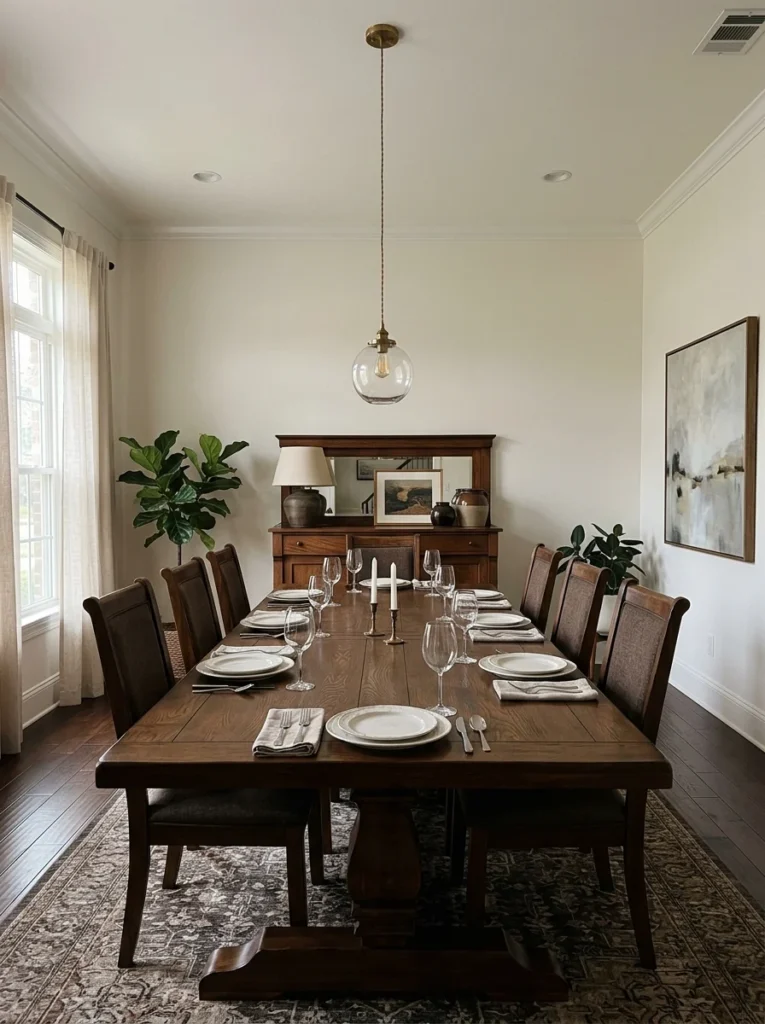
A dining room pendant or chandelier that is too small for the table below it — whether in diameter relative to the table width or in overall scale relative to the room — is one of the most common and most visually disappointing dining room lighting mistakes. A small fixture above a large table looks tentative and underscaled, fails to adequately illuminate the full table surface, and misses the opportunity to make the visual statement that a well-chosen, properly scaled dining room fixture should make.
The fix: use the 50 to 75 percent width proportion guideline when selecting the fixture diameter relative to the table width, and do not compromise on scale in an attempt to choose a “safer” or less imposing fixture. A dining room chandelier or pendant should make a confident visual statement — a fixture that is too small makes the opposite statement.
Mistake 2: The Fixture Is Hung Too High
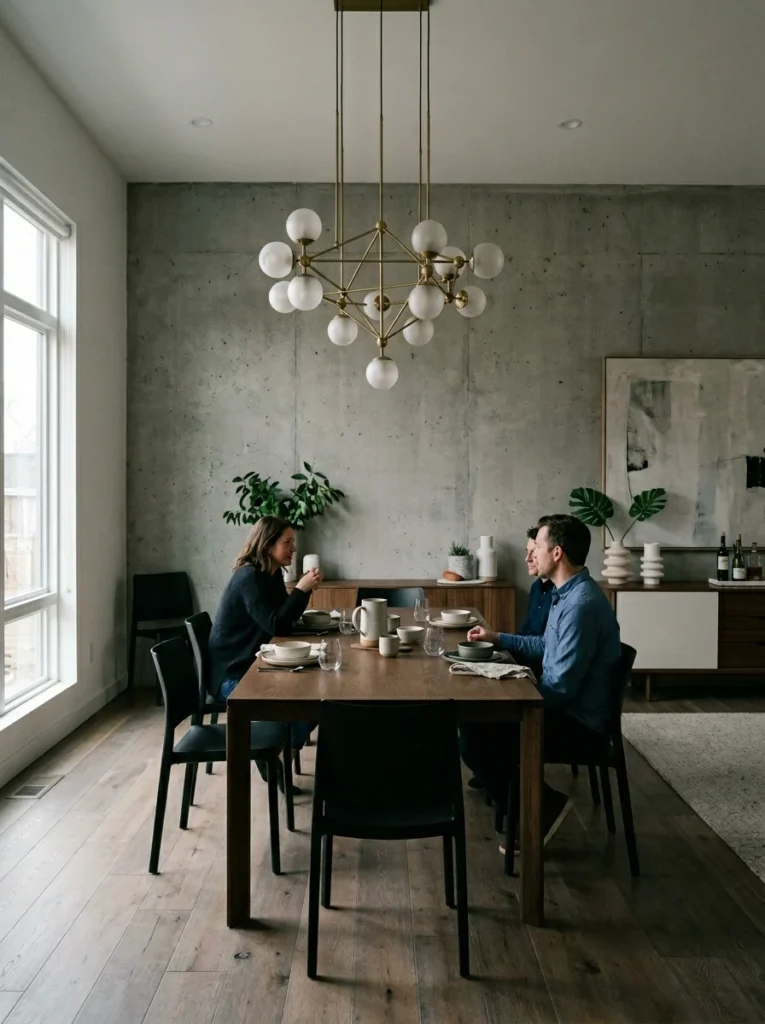
A fixture hung significantly higher than 36 inches above the table surface produces flat, distant illumination that fails to create the warm, table-centered atmosphere that dining room lighting is designed to achieve. The fixture also looks disconnected from the table — a ceiling element that happens to be in the vicinity of the dining area rather than a dedicated light source positioned specifically to illuminate the table.
The fix: hang the bottom of the fixture at 30 to 36 inches above the table surface. If the existing electrical connection point is in the wrong position for this height with the current cable or rod length, the pendant cable or rod can be shortened, a longer cable can be added, or a ceiling canopy with a cable adjustment mechanism can be used to set the correct hanging height from an existing electrical connection.
Mistake 3: The Fixture Is Not Centered on the Table
A pendant or chandelier centered on the room but offset from the table — or a fixture that was correctly centered when a previous table was in position but is now misaligned with the current table — creates a visual misalignment that is immediately apparent and that makes the dining room look poorly planned.
The fix: always center the fixture on the table rather than on the room. If the electrical connection is not above the table’s center, a swag hook — a ceiling hook that redirects the pendant cable from the electrical connection to the correct position above the table center — resolves the misalignment without electrical work. For a permanent solution, an electrician can relocate the electrical connection to the correct position above the table center.
Mistake 4: Using Cool White Bulbs
Cool white bulbs — 4000 Kelvin and above — in a dining room are the most consistent cause of a dining room that feels clinical, unwelcoming, and visually unappealing despite correct fixture choices and careful decoration. Cool light makes food look unappetizing, makes skin tones look unhealthy, and eliminates the warmth and intimacy that dining room lighting is specifically designed to create.
The fix: replace every bulb in every dining room fixture with a warm white LED bulb of 2700 to 3000 Kelvin and a CRI of 90 or above. This is the single most impactful and most affordable lighting improvement available for any dining room and the one that produces the most immediate and most noticeable result.
Mistake 5: No Supplemental Lighting Beyond the Primary Fixture
A dining room illuminated only by the primary pendant or chandelier — with no wall sconces, no buffet lamp, no candles, and no other light source — lacks the layered, multi-source illumination quality that creates depth and atmosphere. The single-source room is flat and one-dimensional regardless of how well-chosen the primary fixture is.
The fix: add at least one supplemental light source to the dining room — wall sconces on the flanking walls, a lamp on the buffet or sideboard, or candles on the table. Each additional source adds a layer of light that the primary fixture cannot provide alone, creating the depth and warmth that characterize a genuinely well-lit dining room.
Mistake 6: No Dimmer Switch
A dining room without a dimmer switch is a dining room that can only operate at one brightness level — the level at which the switch was left when it was last turned on. This limitation prevents the dining room from adapting to the different illumination needs of different meals, different times of day, and different occasions — a constraint that is felt every time the dining room is used for an evening meal where lower, more atmospheric lighting would be appropriate.
The fix: install a dimmer switch on every lighting circuit in the dining room. The cost is modest, the installation is straightforward for a qualified electrician, and the quality-of-life improvement in the dining room is immediate and permanent.
Conclusion
Dining room lighting is not a secondary consideration in the design of a dining room — it is one of the primary determinants of how the room feels to spend time in, how the food served within it looks, and how the experience of gathering around the table is remembered.
The framework for getting dining room lighting right is straightforward. Choose a pendant or chandelier that is the correct scale for the table — 50 to 75 percent of the table’s width — and hang it at the correct height — 30 to 36 inches above the table surface, centered precisely on the table’s midpoint. Specify warm white bulbs with a color temperature of 2700 to 3000 Kelvin and a CRI of 90 or above in every fixture. Add supplemental lighting from wall sconces, a buffet lamp, and candles on the table. Install a dimmer switch on every lighting circuit in the room.
These decisions, applied consistently and in the correct order, transform the dining room from a space that is merely functional into one that is genuinely beautiful — a room that makes every meal an occasion, every gathering a pleasure, and every evening spent around the table a memory worth making.