
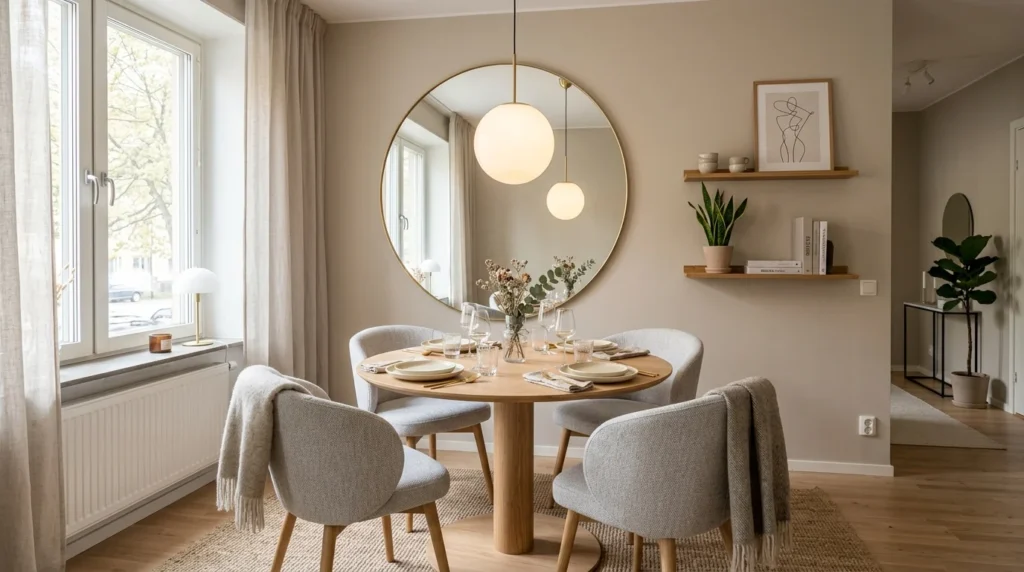
A small dining room presents a design challenge that is genuinely different from the challenges presented by other small rooms in the home. A small bedroom can be made to feel larger through careful furniture choice and visual tricks. A small living room can be opened up through arrangement and color. But a small dining room has a specific functional requirement — it must seat a defined number of people comfortably around a table — that cannot be addressed through visual sleight of hand alone. The people need to fit. The chairs need to pull out. The food needs to be served and cleared. These are physical requirements that place real constraints on what is possible.
Within those constraints, however, there is significantly more design flexibility than most people working with a small dining room realize. The assumption that a small dining room means a compromised dining room — one where functionality is acceptable but style is sacrificed — is wrong. Some of the most beautiful and most character-filled dining rooms in contemporary design are small ones, precisely because the constraint of limited space forces the kind of deliberate, focused decision-making that produces rooms with genuine personality rather than rooms that simply accumulate whatever furniture fits.
This guide covers every aspect of creating a stylish, functional dining room in a limited space — from the table and chair choices that maximize seating without consuming unnecessary floor area, through the visual expansion techniques that make the room feel larger than it is, to the lighting, storage, and styling decisions that give a small dining room the quality and character that larger rooms often lack. Every idea has been selected for its applicability in genuinely limited spaces and its ability to produce results that are both practically functional and visually impressive.
Section 1: Choosing the Right Table for a Small Dining Room
The table is the most space-critical decision in any dining room, and in a small dining room it is the decision that determines whether the room works or does not work. Too large a table and the room is permanently congested, with chairs that cannot be pulled out without hitting a wall and movement around the room that requires sideways maneuvering at every turn. The right table and the room functions comfortably, with adequate clearance on all sides and a floor plan that feels considered rather than forced.
The Round Table — The Best Choice for Most Small Dining Rooms
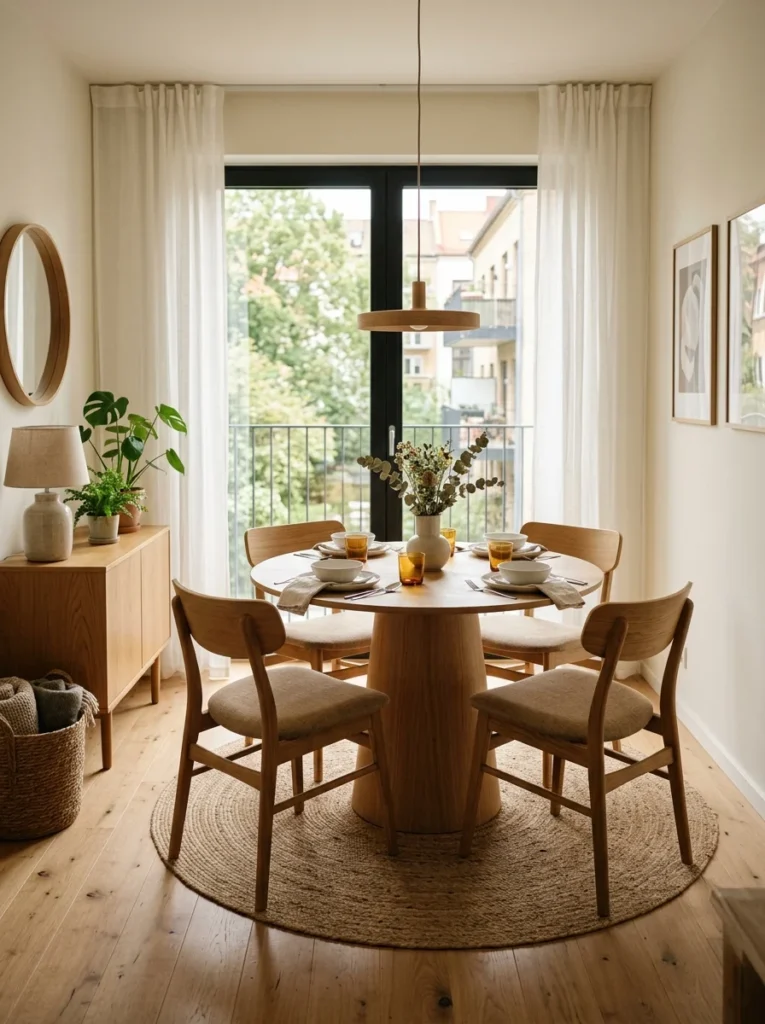
A round table is the single best table choice for most small dining rooms, and the reasons are both practical and spatial. Practically, a round table with a pedestal base — a single central column rather than four corner legs — allows chairs to be placed at any position around the table without any leg obstruction, which maximizes the number of people that can be seated comfortably and allows chairs to be tucked fully under the table when not in use. Spatially, a round table eliminates the corner zones of a rectangular table — the areas occupied by table but not by any seated diner — which means a round table seats the same number of people as a rectangular table in a smaller floor footprint.
A round table of 36 inches in diameter requires a room width of at least 9 feet to allow the minimum 36-inch clearance on two sides for chairs to be pulled out and people to move around the table. A round table of 42 inches in diameter requires approximately 9.5 feet. A round table of 48 inches in diameter — suitable for four to six people — requires approximately 10 feet of room width in the tightest dimension.
In a room that is narrower than these minimums, the round table can be positioned asymmetrically — closer to one wall — to maximize the clearance on the side most frequently used for seating and movement, accepting tighter clearance on the wall side where chairs are less frequently pulled out.
The Drop-Leaf Table — The Genius Solution for Very Tight Spaces
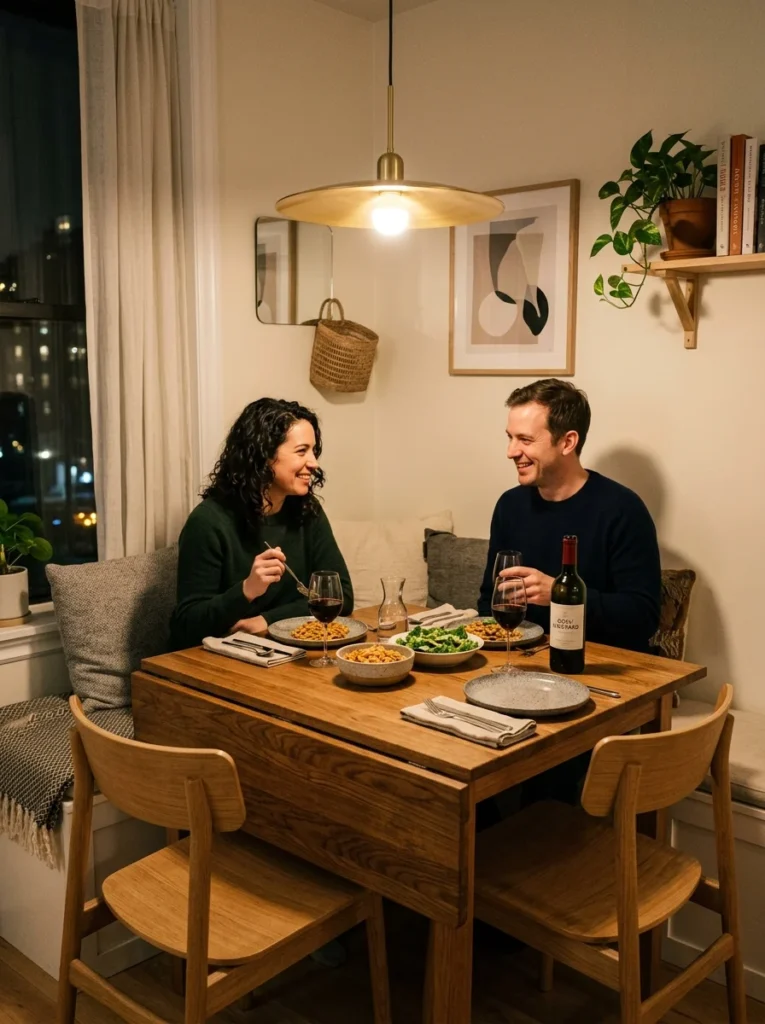
A drop-leaf table is a table with one or two hinged leaf sections that fold down to hang vertically against the table’s sides when not in use, and fold out horizontally to extend the table’s usable surface when needed. In its collapsed configuration — with both leaves down — a drop-leaf table can have a width of as little as 12 to 16 inches, occupying minimal floor space. In its fully extended configuration — with both leaves raised — the same table provides a full dining surface for four to six people.
This transformative range between compact storage configuration and full dining configuration makes the drop-leaf table the most space-efficient dining table available for genuinely small dining rooms and kitchen dining areas. A drop-leaf table stored against a wall with both leaves down occupies only the space of a narrow console table. The same table with both leaves extended provides a generous dining surface without requiring any additional furniture purchase.
The practical consideration of drop-leaf tables is the support mechanism for the raised leaves. Gate-leg supports — additional legs that swing out from the table’s central structure to support the raised leaf — provide the most stable support and the most flexible positioning for diners, as the gate legs can be positioned at any point along the table’s edge. Fixed bracket supports are less flexible but more visually clean, and suit drop-leaf tables used in positions where the raised leaf will always be supported from the same direction.
The Wall-Mounted Fold-Down Table — The Ultimate Space-Saving Solution
A wall-mounted fold-down table — a table surface hinged to the wall that folds flat against the wall when not in use and folds out horizontally to provide a dining surface when needed — occupies literally zero floor space when folded, making it the ultimate dining solution for the smallest possible dining areas.
In its folded position, a wall-mounted table is flush with the wall surface, occupying only the depth of the table surface itself — typically 1 to 2 inches — against the wall. In its extended position, it provides a surface that can seat two to four people depending on its dimensions, supported either by fold-down legs or by a fold-out bracket mechanism built into the wall mounting.
Wall-mounted fold-down tables are most appropriate for studio apartments, kitchen alcoves, and spaces where a dining area must exist but where the space simply cannot accommodate any permanently floor-occupying furniture. They are less appropriate for households where the dining table is used multiple times daily for extended periods — the fold-down and fold-up operation, while straightforward, adds friction to the dining routine that a permanently positioned table avoids.
The Extendable Table for Small Dining Rooms
An extendable table — one that operates at a compact base size for daily use and extends to a larger surface for occasional entertaining — is an excellent solution for small dining rooms where the daily household size is small but occasional gatherings require more seating capacity.
For a small dining room, the key specification of an extendable table is its base size rather than its extended size. The base size is what the table occupies in the room every day — the extended size is needed only occasionally. An extendable round table that is 36 inches in diameter at its base configuration and extends to 48 or 60 inches with one or two leaves provides the minimum floor footprint for daily use and the capacity for larger gatherings without requiring a permanently large table in a room that does not comfortably accommodate one.
The quality of the extension mechanism is particularly important in small dining rooms where the table is positioned close to walls and other furniture, because a stiff or imprecise mechanism is more difficult to operate in a tight space than in a room with generous clearance on all sides.
Section 2: Chair and Seating Alternatives — Beyond the Standard Dining Chair
The standard dining chair — four legs, a seat, a back, arms or no arms — is the default seating choice for dining rooms of every size, but in a small dining room it is not always the best choice. Alternative seating formats can seat more people in the same floor footprint, reduce the visual weight of the seating zone, or allow seating to be stored more compactly when not in use.
The Bench — More Seating in Less Space
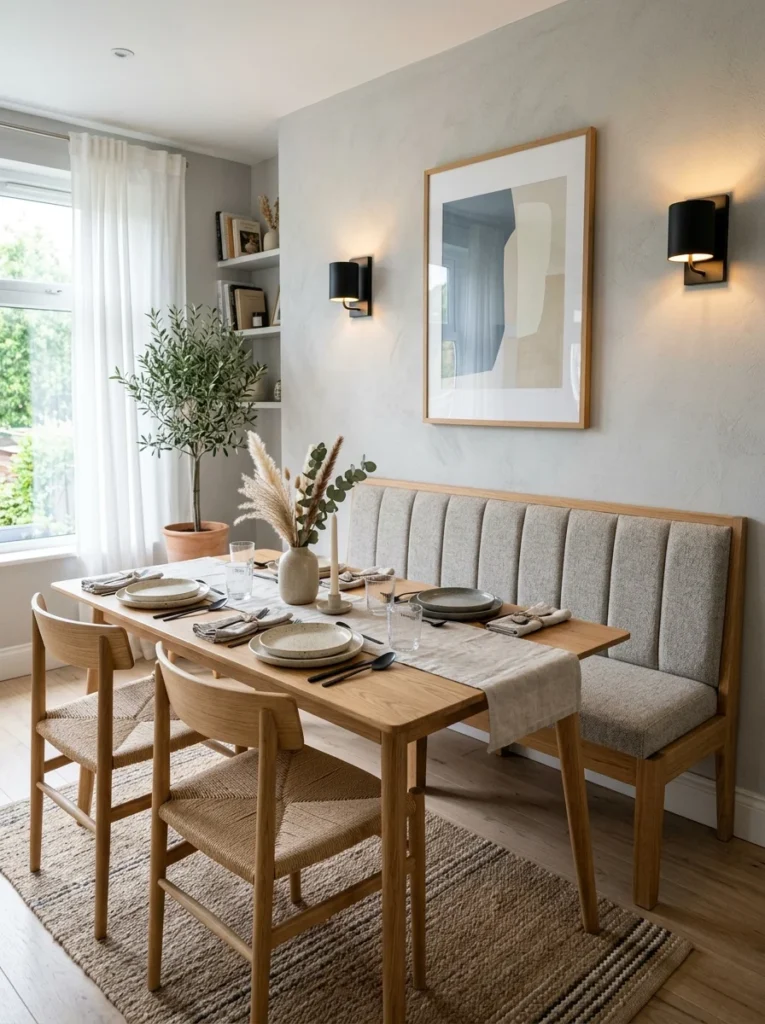
A dining bench along one or both long sides of a rectangular table seats more people per linear foot of table length than individual chairs, because the bench allows people to sit closer together without the space-consuming structure of individual chair frames between them. A bench also tucks fully under the table when not in use, eliminating the floor footprint of the seating entirely in the tucked position. Individual dining chairs project out from the table even when pushed in, occupying floor space that a tucked bench does not.
The most space-efficient configuration for a small dining room with a rectangular table is a bench along the wall side of the table — positioned between the table and the wall — with individual chairs on the room side of the table. The bench can be positioned flush with the wall, or even built into the wall as a banquette, which eliminates the need for the bench to be pulled out from the wall for seating access. The individual chairs on the room side can be tucked fully under the table when the table is not in use, minimizing the total floor footprint of the dining furniture in the room.
The Banquette — Built-In Seating That Maximizes Every Inch
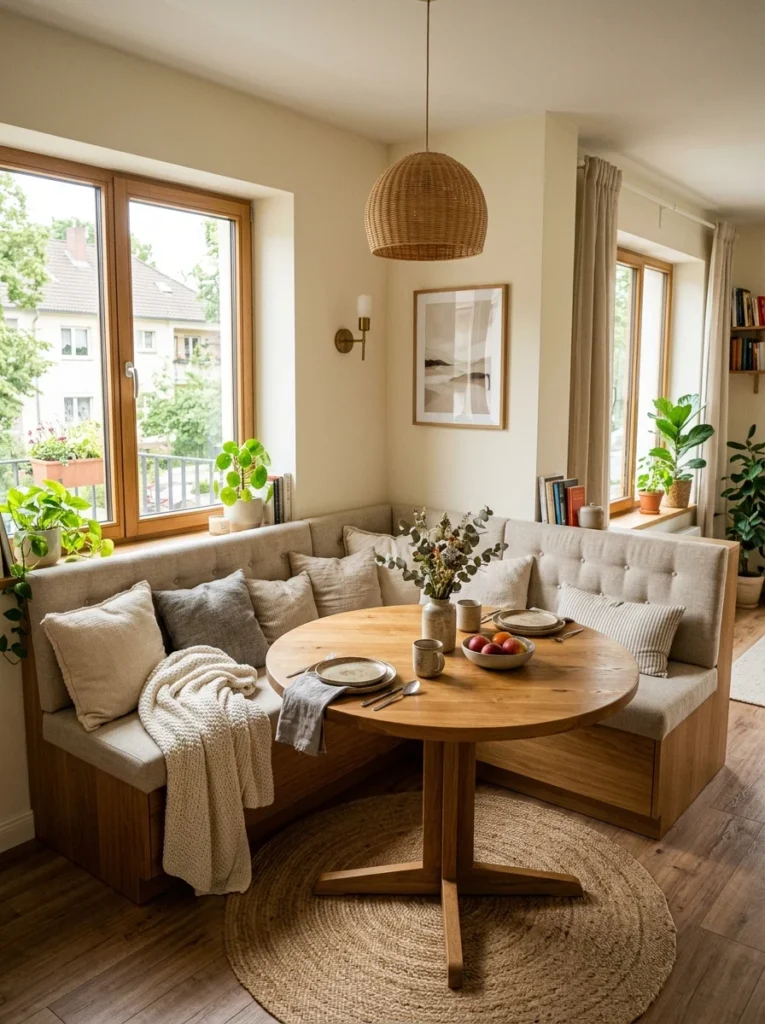
A banquette — a built-in bench seat integrated into the wall or into a corner of the dining room — is the most space-efficient seating solution available for a small dining area. By eliminating the separate furniture of a freestanding bench or individual chairs on the wall side of the table, a banquette allows the table to be positioned significantly closer to the wall than any freestanding seating arrangement can accommodate, which reduces the total floor area required by the dining setup.
A corner banquette — an L-shaped built-in bench that wraps around two adjacent walls — is the most extreme version of this principle. A corner banquette with a round or square table positioned in the corner seats four to six people in a floor footprint that a standard rectangular table and four chairs could not accommodate. The corner, which would otherwise be wasted space in a small dining room — too small for a sideboard, too tight for a chair — becomes the most productive seating zone in the room.
Banquette seating can incorporate storage within the bench structure — a hinged bench top that lifts to reveal storage space within the bench frame provides additional storage capacity that a small dining room often lacks. This storage is appropriately used for dining accessories — placemats, napkins, serving items, and occasional tableware — that are used at the dining table and benefit from being stored nearby.
Stackable and Foldable Chairs — Seating That Disappears When Not Needed
Stackable chairs — chairs designed to stack vertically for compact storage — allow the dining room to accommodate more chairs than the room can comfortably hold in its standard configuration. The four chairs used for daily dining are positioned at the table, while additional chairs are stacked in a corner or stored in an adjacent room and retrieved when a larger gathering requires extra seating. This approach allows a small dining room to serve both a daily household of four and an occasional gathering of eight without permanently compromising the room’s floor space.
Foldable chairs — chairs that fold flat for storage — are the most compact storage option for supplemental dining seating. A foldable chair stored flat against a wall, in a closet, or under a bed occupies minimal space and can be retrieved and set up quickly when additional seating is needed. The limitation of foldable chairs is their visual quality — most foldable chairs have a utilitarian appearance that suits casual dining situations but is less appropriate for formal gatherings. The range of well-designed foldable chairs has improved significantly, and some contemporary designs are attractive enough to use as primary dining chairs in casual dining environments.
Section 3: Visual Expansion Techniques for Small Dining Rooms
Beyond the furniture choices that physically reduce the floor footprint of the dining setup, a range of visual techniques make a small dining room feel larger than its actual dimensions. These techniques work by creating visual cues that the brain interprets as indicators of space — reflective surfaces, light colors, unobstructed sightlines, and visual continuity between elements — rather than by changing the room’s physical dimensions.
The Mirror — The Most Powerful Single Intervention
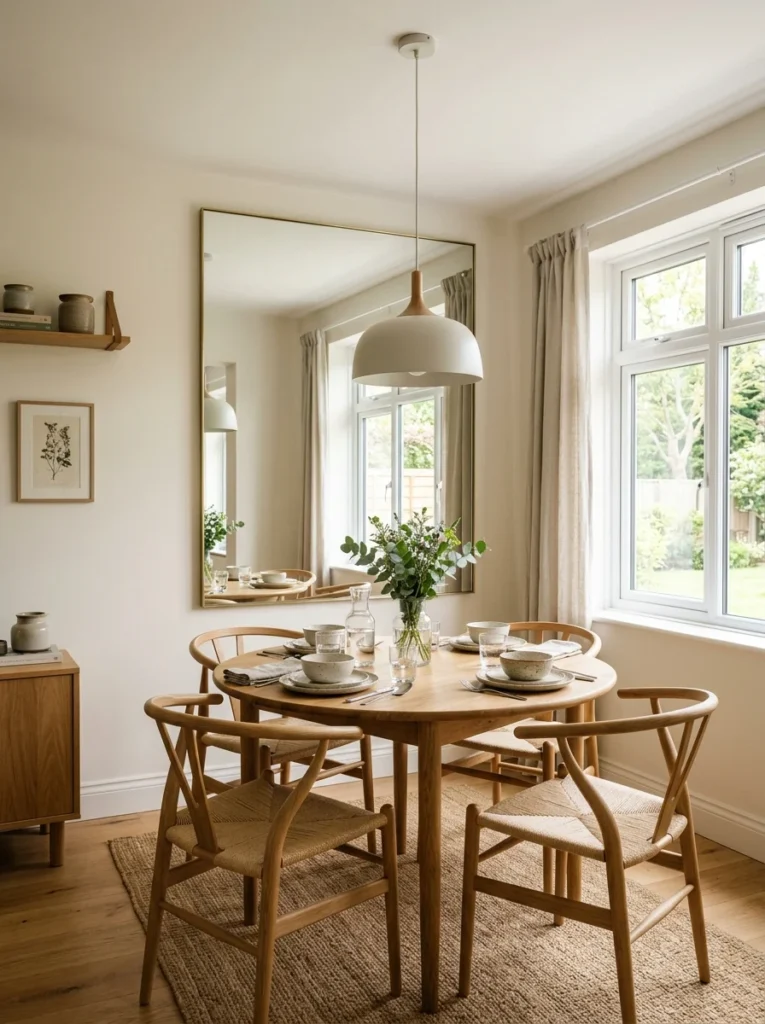
A large mirror on one wall of the dining room is the single most effective visual expansion technique available, and its effect in a small dining room is dramatic rather than subtle. A mirror reflects the room back on itself, creating the visual impression that the room continues beyond the wall surface — that the dining room is twice as deep as it actually is. The reflected image includes the light from the windows, the warmth of the pendant fixture, and the depth of the furniture arrangement, all of which contribute to the expanded spatial impression.
The most effective mirror placement in a small dining room is on the wall directly opposite the main window or the primary light source. In this position, the mirror reflects the maximum amount of light and the deepest view of the room, creating the most convincing and most impressive expansion effect. A mirror on the wall beside the window reflects less light and a narrower view of the room, producing a less effective spatial expansion.
The mirror should be as large as the wall it occupies can accommodate — a mirror that fills most of the wall from approximately chair-back height to ceiling height creates the strongest expansion effect. A small decorative mirror on the dining room wall adds a reflective surface but does not create the spatial expansion that a genuinely large mirror produces.
Light Colors — Walls That Recede Rather Than Advance
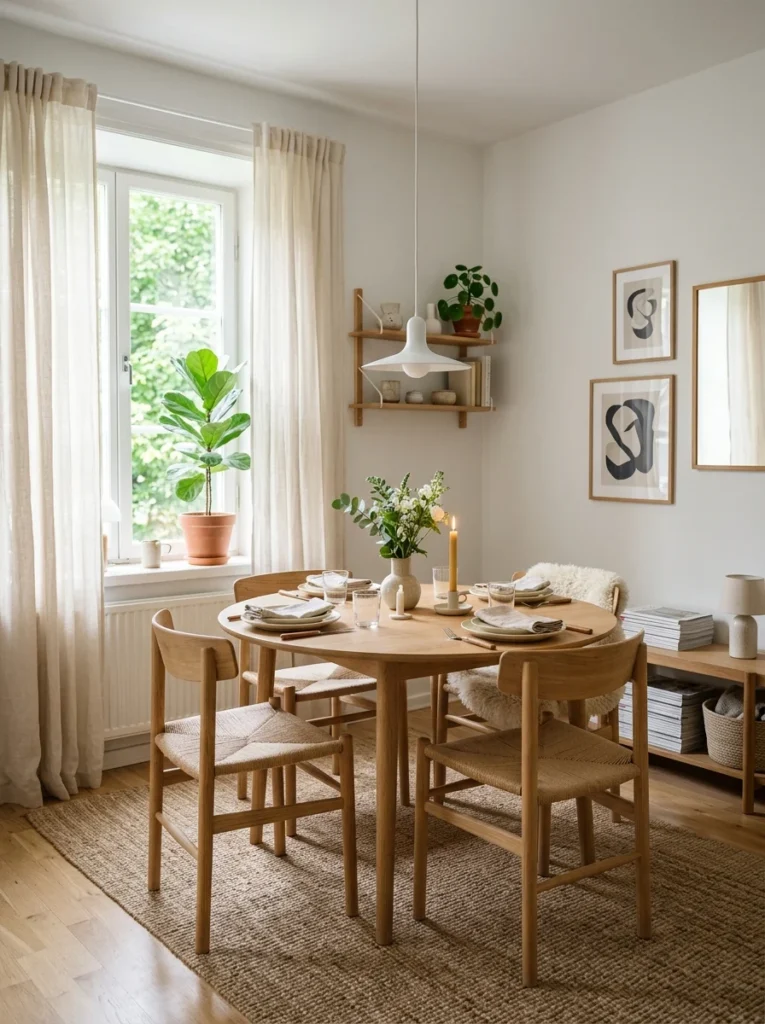
Light wall colors — soft whites, pale greys, warm creams, and muted sage greens — make the walls of a small dining room appear to recede slightly from the viewer, which creates a visual impression of more space than a room with darker walls. Dark colors advance — they appear to bring the walls closer to the center of the room, which reduces the perceived spatial volume. Light colors recede — they appear to push the walls slightly further away, which increases the perceived spatial volume.
In a small dining room, light wall colors are not the only option — a small dining room with dark, richly colored walls can be beautiful and atmospheric if the other elements of the design support the dark palette — but they are the safest option for maximizing the perception of space when space is the primary concern.
The ceiling color in a small dining room affects the perception of ceiling height as profoundly as the wall color affects the perception of floor area. A ceiling painted the same color as the walls — or one shade lighter — removes the hard visual boundary between wall and ceiling, which makes the room feel taller and more continuous. A ceiling painted in a contrasting color — typically a stark white against colored walls — creates a visible horizontal line around the top of the room that emphasizes the ceiling height and can make a room with a low ceiling feel more confined.
Glass and Transparency — Furniture That Does Not Visually Occupy Its Space
A glass dining table — a table with a transparent or translucent top rather than an opaque one — is one of the most effective visual lightening techniques available for a small dining room. The glass top allows the eye to travel through the table surface to the floor below, which means the table does not appear to occupy its footprint in the way that an opaque table does. The floor visible through the table reads as continuous floor rather than as table-covered floor, which makes the room feel larger.
The same principle applies to dining chairs with transparent or open structures — chairs with clear acrylic backs and seats, chairs with open metal frames, or chairs with minimal structures that allow the wall and floor behind them to remain visible. Each of these chair types reduces the visual mass of the seating zone in a way that a solidly upholstered chair cannot, contributing to an overall dining room impression that is lighter, more open, and less cluttered.
Unobstructed Floors — The Most Undervalued Visual Expansion Tool
The amount of floor visible in a dining room has a significant effect on how large the room feels. A dining room where the floor is largely obscured — by a large rug under the dining furniture, by additional furniture pieces around the perimeter, or by items stored on the floor — feels smaller than the same room with a largely visible floor. The visible floor reads as usable, open space, which contributes to the perception of spatial generosity.
In a small dining room, keeping the floor as visible and as unobstructed as possible is one of the most effective spatial expansion strategies available. This means reconsidering the rug under the dining furniture — in a very small dining room, no rug at all may produce a more spacious feeling than even a well-sized rug — and being disciplined about keeping additional furniture and stored items off the floor.
If a rug is desired in the small dining room for warmth and texture, choose one that is sized precisely to the dining furniture footprint rather than one that extends significantly beyond the chairs. A rug that extends to the walls of a small dining room covers most of the floor and eliminates the visual benefit of visible floor space.
Section 4: Lighting for a Small Dining Room
The lighting principles covered in the previous article in this series — the pendant over the table, warm white bulbs, a dimmer switch — apply equally to small dining rooms. Within those principles, there are specific considerations that are particularly relevant when the room is small.
Scale the Fixture Correctly — The Small Room Risk
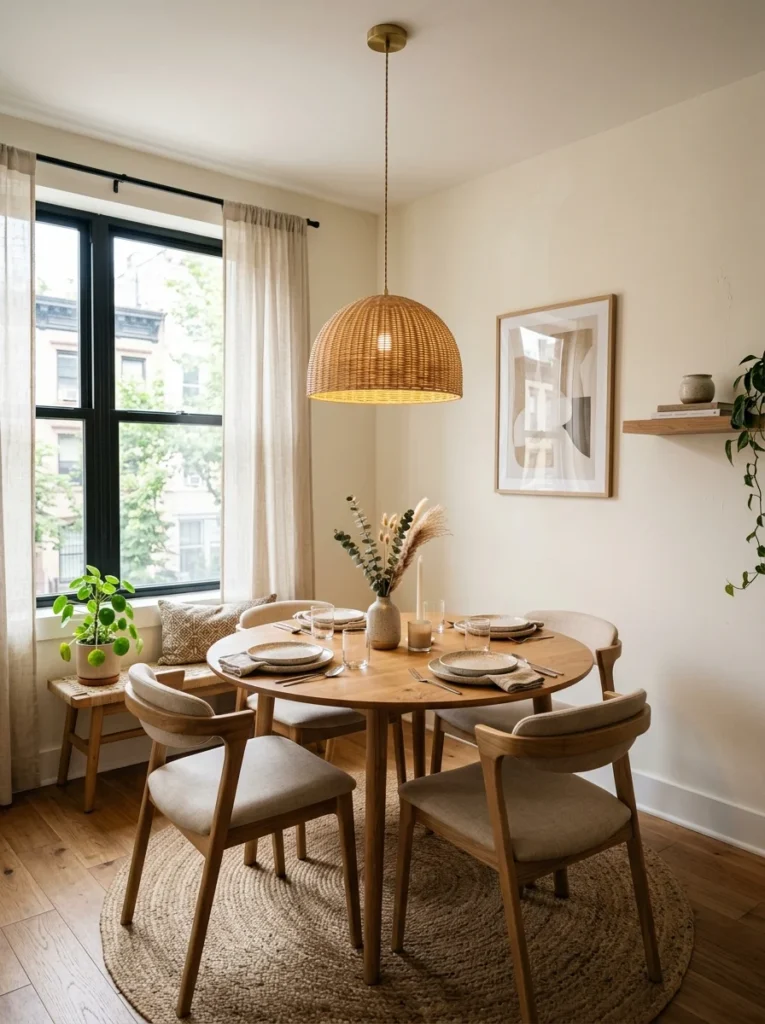
The most common dining room lighting mistake in small rooms is choosing a fixture that is too large for the space. A large chandelier — one chosen for a standard-sized dining room — placed above a small dining table in a small room creates a visual imbalance that makes the room feel dominated by the fixture rather than simply lit by it. The chandelier becomes the room’s primary visual element, overwhelming the table, the chairs, and the walls and giving the room a cramped, top-heavy feeling.
In a small dining room, choose a fixture that is scaled to the table rather than to the room’s impression of importance. Apply the 50 to 75 percent width proportion rule relative to the table — not relative to the aspirations for how the room should feel. A correctly scaled fixture that suits the table creates a balanced, composed dining room. An oversized fixture that was chosen to make the small room feel more significant creates visual confusion.
Single Pendants and Minimal Fixtures
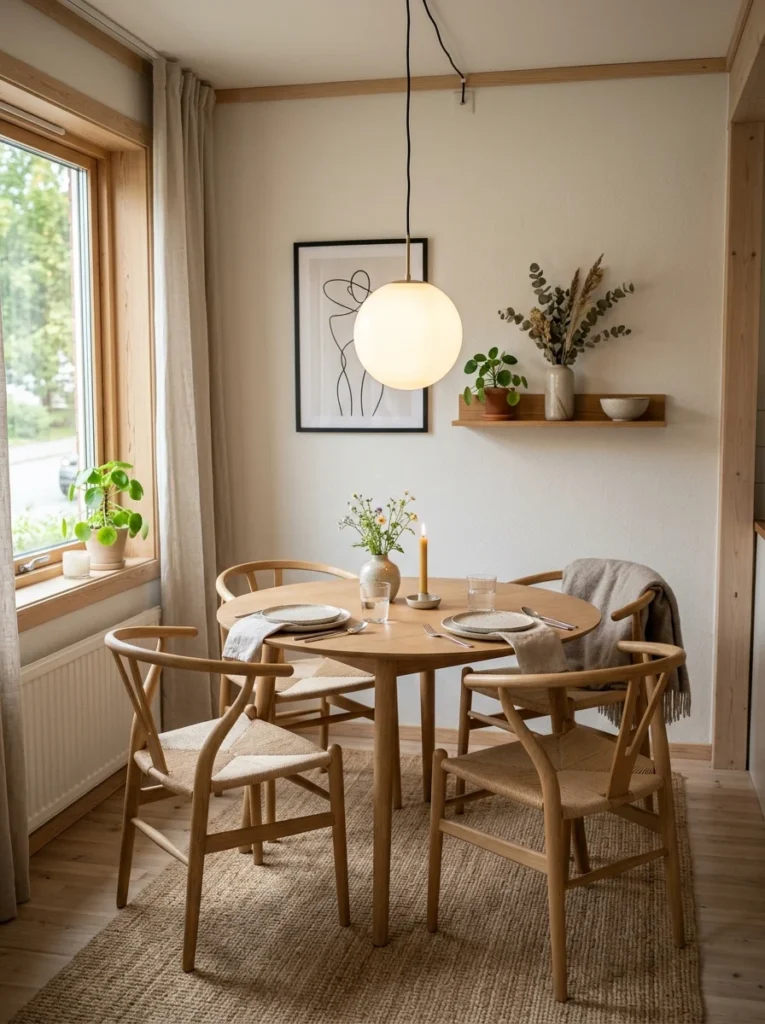
A single pendant with a clean, minimal design suits small dining rooms better than elaborate multi-arm chandeliers or complex cluster arrangements, because the visual simplicity of a single pendant does not compete with the limited visual space of the room. A minimal pendant — a single shade or globe in a form that is visually quiet and materials that complement the room’s palette — provides the necessary overhead illumination without adding visual complexity that the small room does not have space to absorb.
Wall Sconces in Small Dining Rooms
Wall sconces in a small dining room need to be chosen with particular attention to their projection from the wall. A sconce that projects significantly from the wall surface reduces the clearance around the dining furniture and can obstruct movement around the table in a room where clearance is already tight. Flush-mounted or semi-flush wall sconces — fixtures that sit close to the wall surface rather than projecting into the room — provide the atmospheric supplemental lighting benefit of wall sconces without the physical intrusion into the room’s limited floor clearance.
Section 5: Storage in a Small Dining Room
A small dining room has limited space for the storage furniture — sideboards, buffets, display cabinets — that larger dining rooms accommodate easily. The storage needs of the dining room — tableware, serving pieces, linens, and dining accessories — do not reduce in proportion to the room’s size, which means small dining rooms need creative solutions for fitting adequate storage into limited available space.
Wall-Mounted Shelves Instead of Bulky Sideboards
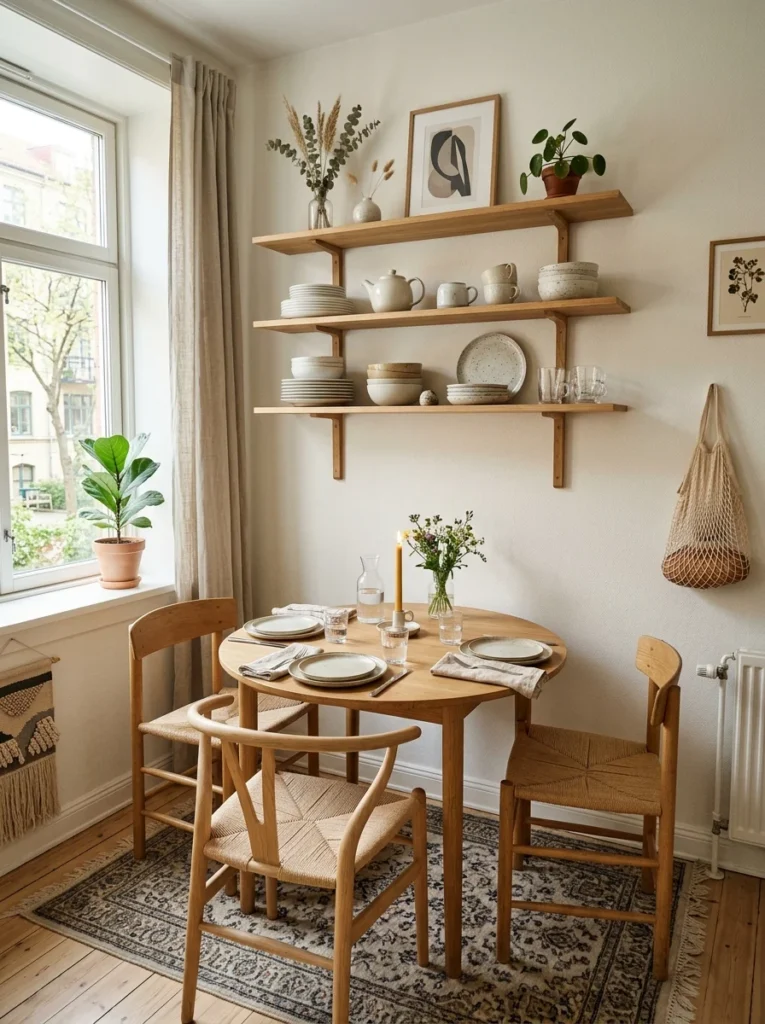
A large freestanding sideboard or buffet in a small dining room occupies a significant proportion of the room’s floor area and wall length, leaving less space for furniture clearance around the table and making the room feel more congested. Wall-mounted shelves — floating shelves installed directly on the wall at sideboard height — provide the same surface area for serving and display with no floor footprint.
A run of floating shelves at approximately 30 to 36 inches from the floor — sideboard height — along one wall of the small dining room creates a serving and display surface that is accessible during meals, visible from the table, and styled with the decorative objects, tableware, and accessories that give the dining room its character. The wall beneath the shelves remains open floor space, which contributes to the room’s sense of openness.
Above the serving-height shelves, an additional run of higher shelves provides enclosed display and storage for tableware, glassware, and dining accessories that are used occasionally rather than displayed permanently. This two-level shelf arrangement — serving height below, display storage above — replicates the function of a full-height display cabinet in a format that takes no floor space.
The Narrow Console as Sideboard Alternative
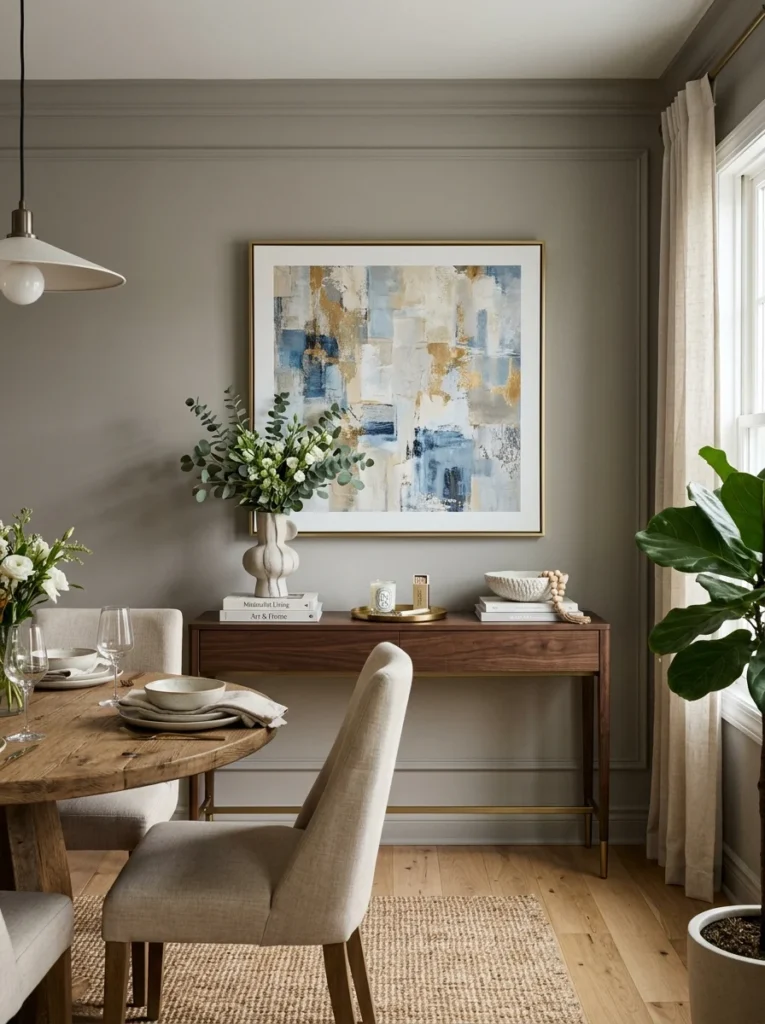
A narrow console table — a table with a depth of 12 to 16 inches rather than the 18 to 24 inches of a standard sideboard — provides a serving and display surface with significantly less floor projection than a standard sideboard. In a small dining room where every inch of clearance around the dining table matters, the difference between a 16-inch deep console and a 22-inch deep sideboard can be the difference between comfortable movement around the room and constantly having to negotiate past furniture.
A narrow console styled as a dining room sideboard — with serving pieces on the surface, storage baskets or small drawers below, and artwork or a mirror above — performs every visual and practical function of a sideboard in a format that is dramatically more space-efficient.
Multi-Purpose Furniture — Dining Tables With Storage
In a very small dining room where even a console table represents too much floor space, multi-purpose dining furniture — a dining table with storage incorporated into its structure — provides storage capacity without any additional furniture footprint. A dining table with drawers built into the apron — the frame beneath the table top — provides accessible storage for placemats, napkins, and dining accessories directly within the table structure. A dining table with a shelf below the table surface — supported on the table legs — provides a second level of storage and display within the table’s footprint.
Section 6: Styling a Small Dining Room — Making It Beautiful
The styling of a small dining room — the decorative choices that give the room its personality and character beyond its functional furniture — is where the opportunity to make a small room genuinely beautiful is most fully realized. A small dining room styled with deliberate attention to scale, proportion, and visual coherence can be significantly more impressive and more characterful than a larger room styled without the same care.
One Statement Piece
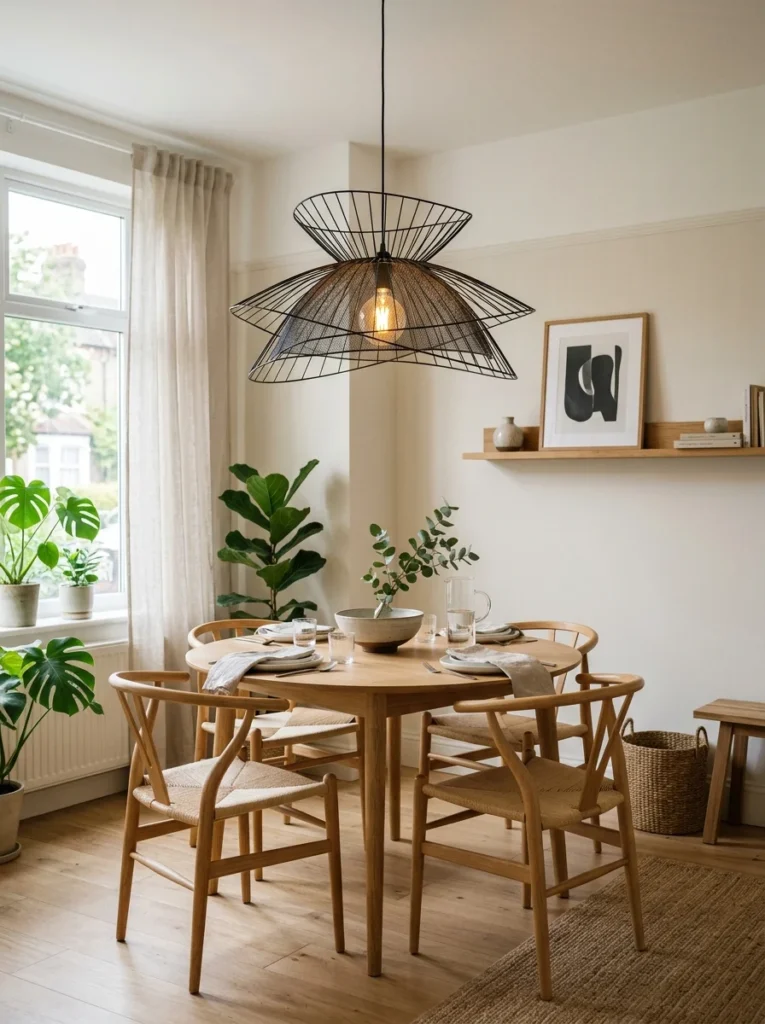
Every small room benefits from having one element that makes a confident visual statement — a single piece that is deliberately impressive and that gives the room a clear focal point around which the other, quieter elements are organized. In a small dining room, the statement piece is most often the pendant light fixture above the table, the mirror on the wall, or a piece of artwork that anchors the primary wall.
Choosing one element to make a confident statement — and keeping every other element quiet and subordinate to it — is the design principle that produces small rooms of genuine quality. The alternative — attempting to make every element in the room visually interesting — produces small rooms that feel cluttered and visually busy, where the limited space is overwhelmed by competing focal points.
Table Styling That Suits the Scale
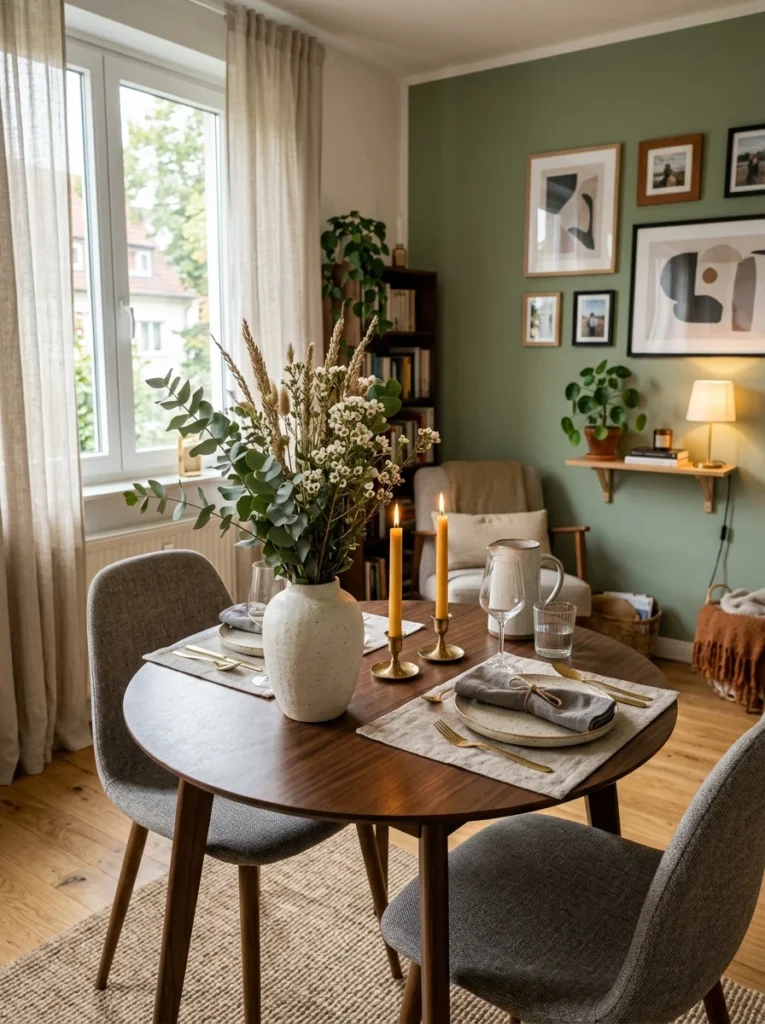
The dining table surface in a small dining room needs to be styled in proportion to the table’s size. A large centerpiece arrangement — a tall vase of flowers, an elaborate candle arrangement, an oversized decorative object — on a small dining table overwhelms the table surface and makes the room feel more crowded. A small, considered centerpiece — a single low vase with a few stems, two or three small candles on a simple tray, a small plant in a simple pot — suits the scale of a small table and adds decoration without dominating.
The general principle is that centerpieces and table decorations in a small dining room should be lower and simpler than in a larger room. Low arrangements allow sightlines across the table to remain unobstructed, which maintains the convivial quality of the small dining table and prevents the room from feeling visually compressed.
Artwork Scaled to the Wall
Artwork in a small dining room should be scaled to the wall it occupies rather than chosen for its impressive size in isolation. A single large artwork — one that fills most of the available wall space above a console table or chair-rail height — creates a bold, confident statement that makes the room feel designed rather than assembled. Multiple small artworks arranged in a gallery wall can also work well in a small dining room if the gallery is treated as a single composed element rather than as a collection of individual pieces.
The guideline for artwork height in a dining room — as in any room — is that the center of the artwork should be at approximately 57 to 60 inches from the floor when the artwork is viewed from a standing position. In a dining room where the artwork will often be viewed from a seated position, centering the artwork slightly lower — 54 to 57 inches from the floor — provides a more comfortable viewing angle for diners.
Plants in a Small Dining Room
A plant in a small dining room adds the natural warmth, color, and organic quality that makes a room feel genuinely inhabited rather than merely decorated. In a small room where floor space is at a premium, the most appropriate plant positions are on the console or sideboard surface, on a floating shelf, on a windowsill, or hanging from the ceiling in a minimal hanging planter.
A tall floor plant — a fiddle leaf fig, a snake plant, or a similar vertically proportioned plant — in the corner of a small dining room draws the eye upward and makes the ceiling feel higher, contributing both a natural element and a vertical visual line that benefits the room’s proportional perception. The corner position for a tall plant uses a zone of the room that is otherwise difficult to furnish and contributes a natural focal point that suits the intimate quality of a small dining room.
Conclusion
A small dining room handled well is not a compromise — it is a room with a specific design challenge that, when met with the right furniture choices, visual expansion techniques, lighting decisions, and styling approach, produces a space of genuine quality and genuine beauty.
The furniture decisions matter most: a round or drop-leaf table that seats the required number of people without consuming unnecessary floor area, seating alternatives — benches, banquettes, stackable chairs — that maximize seating capacity in a minimal footprint, and storage solutions that provide adequate dining room function without the bulk of full-size sideboards and display cabinets.
The visual techniques support the furniture decisions: a large mirror that doubles the room’s apparent depth, light colors that make the walls recede, transparent or minimal furniture that allows the floor to remain visible, and disciplined styling that gives the room one confident statement rather than competing focal points.
The result is a small dining room that feels significantly larger than its measured dimensions, that functions comfortably for every daily meal and every occasional gathering, and that has the character and the quality of a room that was designed with care rather than furnished by default.