
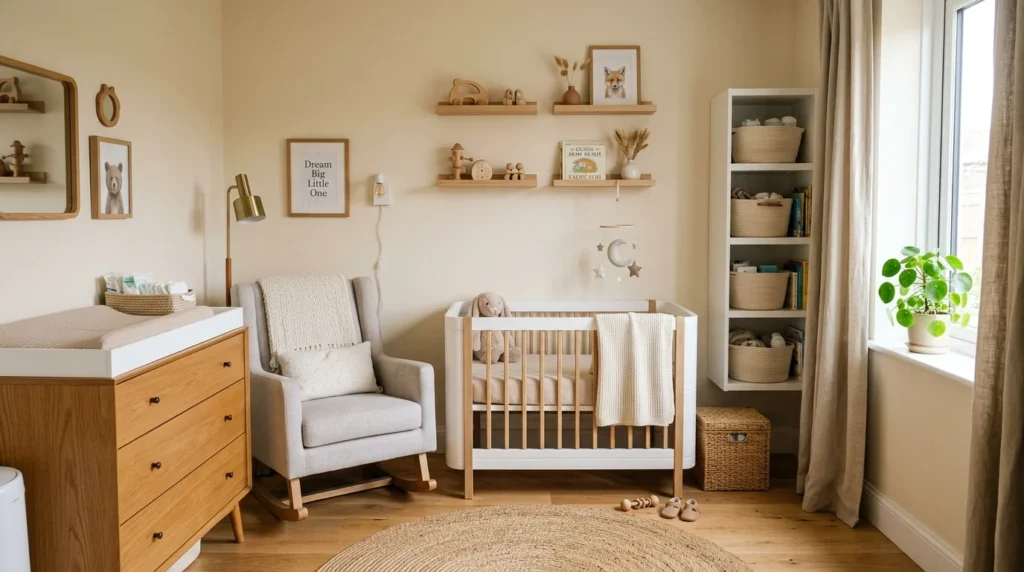
The small nursery is one of the most common and most practically challenging design situations that new parents face. The ideal nursery — a spacious, beautifully appointed room with generous floor space for a full-size crib, a dedicated changing area, a comfortable nursing corner, ample storage for a rapidly expanding wardrobe of infant clothing, and enough open floor for a play mat — is simply not available in many homes. A small spare bedroom, a converted study, a box room at the end of the hallway, or in some cases a partitioned section of a larger room is what the family has to work with, and the challenge is making it function as a nursery without compromising either the baby’s safety and comfort or the parents’ ability to care for the baby efficiently in the space.
The good news is that a small nursery, designed with clarity about what a baby genuinely needs in the first months and years of life, can function as well as a larger one. Babies are small. Their actual space requirements — the crib they sleep in, the surface on which they are changed, the chair from which they are fed — are physically modest. The challenge is not that the baby requires more space than a small room can provide. The challenge is that the equipment associated with infant care — the crib, the changing station, the nursing chair, the storage for clothing and accessories — has a physical footprint that accumulates quickly and can overwhelm a small room if every item is chosen at standard size and every zone is allocated standard proportions.
The solution to the small nursery challenge is not to make every item smaller — some things cannot be smaller without compromising function — but to be deliberately selective about what goes in the room, deliberately strategic about how every item is sized relative to the room’s specific dimensions, and deliberately creative about using the vertical space and the overlooked surfaces that small rooms almost always offer more of than their floor area suggests.
This guide covers every aspect of designing a functional, beautiful nursery in a limited space — from the furniture choices that reduce floor footprint without reducing essential function, through the layout strategies that make the most of every available square foot, to the visual techniques that make the room feel larger than it is and the storage solutions that provide adequate capacity without consuming floor space the room cannot spare.
Section 1: Start With What a Baby Actually Needs
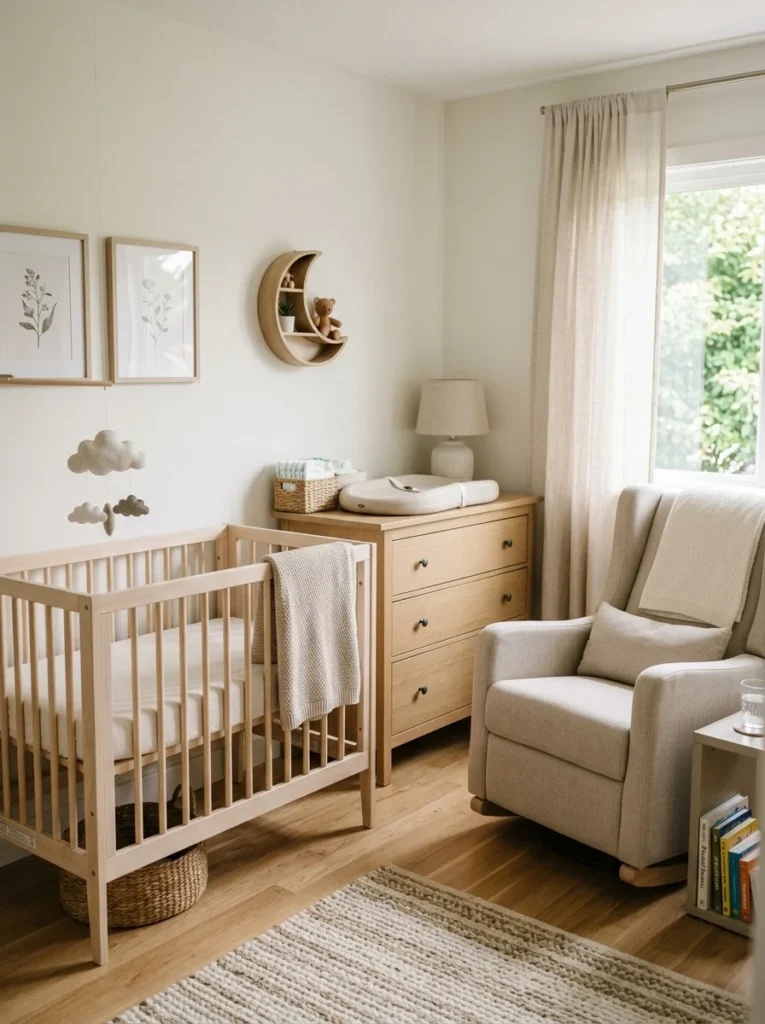
The most effective first step in designing a small nursery is establishing with clarity what the nursery genuinely needs to contain, as distinct from what nursery culture suggests it should contain. The gap between these two things is significant, and the items in the second category that are not in the first are the items that most consistently consume the floor space a small nursery cannot afford.
A baby genuinely needs a safe sleep surface. A surface on which to be changed. A seat from which to be fed and settled. Storage for clothing, nappies, and the accessories of infant care. Appropriate lighting for daytime activities and nighttime care. Adequate warmth and temperature control. Everything else — the additional decorative furniture, the specialty nursery pieces, the extensive toy storage for toys the baby cannot yet play with, the display furniture for items the baby cannot yet appreciate — is optional and can be deferred, scaled down, or eliminated without any reduction in the quality of care the baby receives.
This clarity about genuine necessity does not mean the nursery has to be sparse or cheerless — it means that every piece of furniture and every design decision is evaluated against the standard of genuine need before it is included in a room where space is limited. Items that serve a genuine function earn their floor footprint. Items that do not serve a genuine function — regardless of how beautiful they are or how standard they seem for a nursery — do not.
Applying this evaluation to a list of standard nursery furniture items produces a hierarchy that guides every sizing and placement decision that follows.
The crib or sleep surface is non-negotiable — the baby needs a safe place to sleep that meets current safety standards. The changing station is non-negotiable — nappy changes happen multiple times daily and require a safe, appropriately equipped surface. The nursing or feeding chair is highly recommended — not strictly non-negotiable in the sense that feeding can take place elsewhere, but practically important enough for nighttime care that its absence creates a meaningful quality-of-life reduction for parents. Storage for infant clothing and care items is non-negotiable — the items exist and need somewhere to live. Dedicated hanging space for clothing is useful if available. A play mat for tummy time and floor play is useful and physically very compact when not in use. Everything beyond these items is optional.
Section 2: The Crib — Sizing and Placement in a Small Room
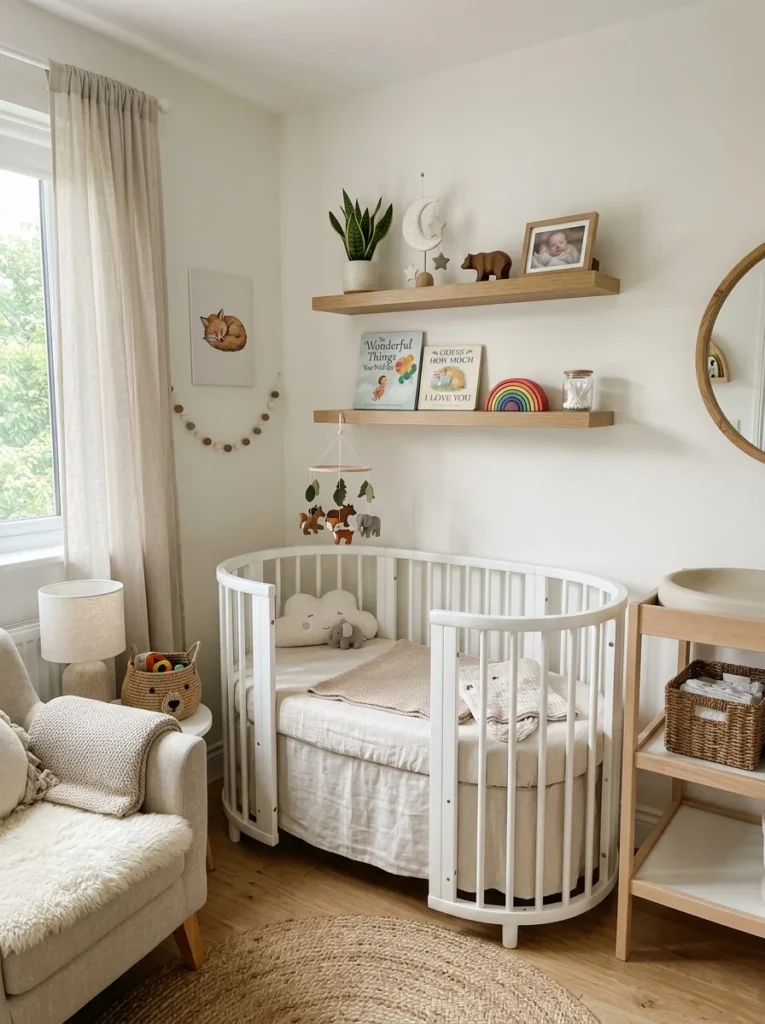
Mini Crib Versus Standard Crib — The Fundamental Sizing Decision
A standard full-size crib has external dimensions of approximately 54 by 30 inches — a floor footprint of roughly 11.25 square feet. A mini crib has external dimensions of approximately 38 by 24 inches — a floor footprint of roughly 6.3 square feet. The difference of approximately five square feet between a standard crib and a mini crib is significant in a small room — it is the difference between a room that fits all the essential nursery functions comfortably and one where every other piece of furniture is a compromise.
For a small nursery, the choice between a standard and a mini crib depends on three factors: the available floor space, the expected duration of crib use, and whether the mini crib offers conversion options that extend its useful life.
In terms of floor space, a mini crib is the appropriate choice for any nursery where the standard crib’s footprint — plus the required 24-inch clearance on the sides from which access will be needed — leaves insufficient room for the changing station, the nursing chair, and the storage the room also needs. The mini crib’s smaller footprint makes these other elements possible without compromising the room’s ability to function.
In terms of duration of use, a standard full-size crib can typically be used from birth until the child transitions to a toddler bed — usually between eighteen months and three years depending on the child. A mini crib has a shorter useful life in most cases — babies generally outgrow mini cribs between approximately twelve and eighteen months, depending on the individual baby’s size and mobility. Some convertible mini cribs extend this timeline by converting to a small toddler bed, which is worth investigating when selecting the specific mini crib model.
For households where the nursery will be used for subsequent children, the mini crib’s shorter useful life for each individual child is less of a concern — the crib will be reused by the next baby at whatever age it was retired from the first child’s use.
Convertible Mini Cribs — Do They Exist and Are They Worth It
Convertible mini cribs do exist, though they are less widely available than convertible full-size cribs. A convertible mini crib converts — using additional parts typically sold separately — from a mini crib configuration to a small toddler bed configuration, extending the piece’s useful life beyond the typical mini crib timeline.
Whether a convertible mini crib is worth the additional cost relative to a standard mini crib depends on the specific conversion options available for the model in question and on the family’s plans for the nursery room. If the nursery room will remain the child’s bedroom beyond the crib stage, a convertible mini crib that transitions to a toddler bed extends the useful life of the investment. If the nursery room will be reorganized significantly when the child transitions out of a crib — as often happens when a second baby’s arrival prompts a bedroom reshuffle — the convertible feature may be less valuable.
Crib Placement in a Small Room — The Rules That Cannot Be Broken
The safety requirements for crib placement discussed in the first article of this series — away from windows, away from heating sources, away from cords and strings — apply equally in a small room and cannot be compromised for space reasons. A small room does not create an exception to the requirement that the crib be positioned away from window blind cords; it creates the obligation to choose cordless window coverings so that the crib can be positioned where it otherwise needs to be.
Within the constraints of the safety requirements, the crib placement strategy for a small room prioritizes the following considerations.
Position the crib against the longest wall if possible — the longest wall provides the greatest linear run for the crib footprint, which leaves more of the room’s width for the other essential elements. In a room where the longest wall has a window, the crib needs to be positioned along the wall but not directly under or beside the window — a position with a foot or two of wall space beside the window, rather than centered on the window, often works.
Consider the door swing when positioning the crib — a crib positioned where the door opening arc passes over it creates a safety hazard and a practical problem. The crib should be positioned so that the door swings freely without reaching any part of the crib structure.
Leave adequate access on the side of the crib from which the baby will most frequently be picked up and laid down — typically the side facing into the room rather than the wall side. An access clearance of at least 18 to 24 inches on this side allows the parent to reach into the crib without compromising their posture or balance in a way that risks dropping the baby.
Section 3: The Changing Station — Dual-Purpose Solutions for Small Rooms
The dedicated changing table — a purpose-built surface at adult standing height used exclusively for nappy changes — is the least space-efficient nursery furniture option for a small room. It occupies a floor footprint of approximately 18 by 36 inches for its standard size and serves only one function: nappy changing. When the nappy stage ends — typically between two and three years — the changing table becomes a piece of furniture that needs to be repurposed or removed, with no secondary function to justify its continued presence.
For a small nursery, the changing station should be integrated into a piece of furniture that serves an additional function beyond nappy changing.
The Dresser With Changing Topper
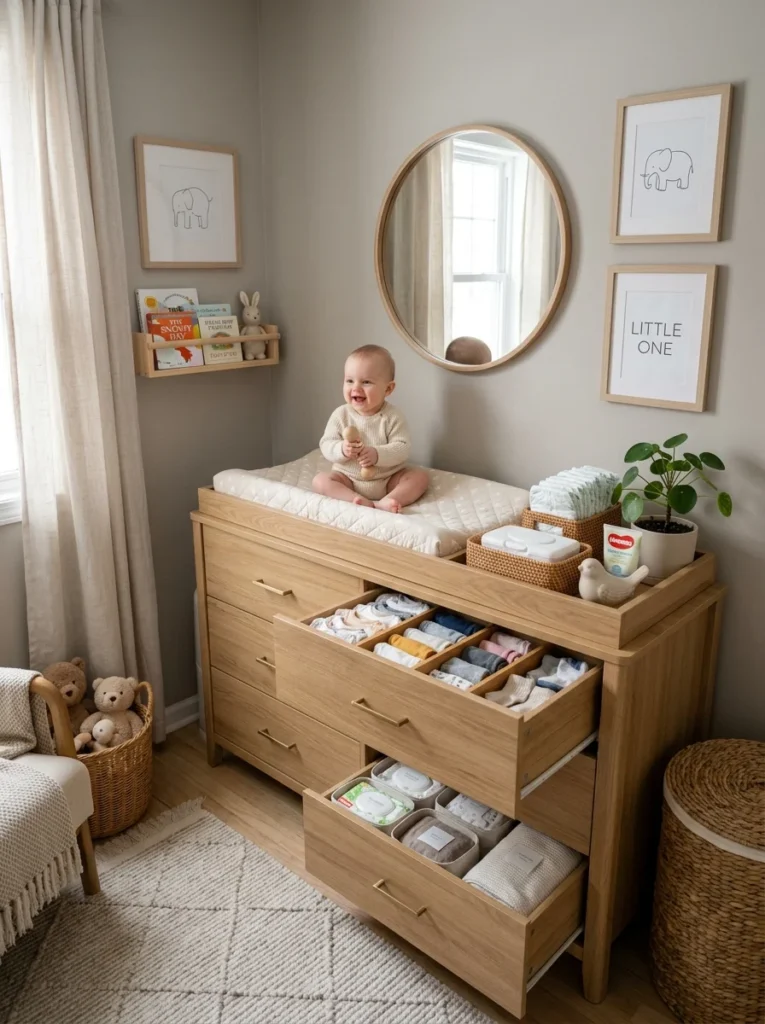
A dresser with a changing topper — a standard chest of drawers with a padded changing pad secured on top — provides both the changing station function and the primary clothing storage function in the floor footprint of a single piece of furniture. The drawers below the changing surface store infant clothing organized by type and size. The changing surface on top provides the dedicated nappy-changing station. When the nappy stage ends, the changing pad is removed and the dresser continues serving its clothing storage function for the child’s growing wardrobe.
This dual-purpose configuration is the most space-efficient changing station solution for a small nursery, and it is also one of the most practical — having the infant’s clothing immediately beneath the changing surface means that a fresh outfit can be retrieved while the baby is on the changing surface without leaving the immediate area.
The changing pad used on top of a dresser should be secured — either through a non-slip mat between the pad and the dresser surface, or through straps that attach the pad to the dresser edge — so that it does not shift during nappy changes. The dresser itself must be anchored to the wall regardless of the changing station configuration.
The Wall-Mounted Fold-Down Changing Table
A wall-mounted fold-down changing table — a changing surface hinged to the wall that folds flat against the wall when not in use and folds out horizontally to provide a changing surface when needed — is the most space-efficient dedicated changing station available. In its folded position, it occupies only the depth of the changing surface — typically two to four inches — against the wall. In its extended position, it provides a full-size changing surface at adult standing height.
This format is particularly useful in very small nurseries where even the footprint of a compact dresser creates clearance problems. The fold-down changing table, combined with a separate freestanding storage solution for infant clothing — a compact wardrobe, a freestanding shelving unit, or storage elsewhere in the house — provides the changing function with the absolute minimum of permanent floor space commitment.
The wall-mounted fold-down changing table requires a wall that can support the weight of a changing baby — approximately 25 to 30 pounds — at a distance from the wall equal to the table’s depth. Installation requires mounting into wall studs or using appropriate wall anchors, and the installation quality is a genuine safety concern — the table must be absolutely secure against the forces of an active baby on the changing surface.
Section 4: The Nursing Chair — Compact Options for Small Rooms
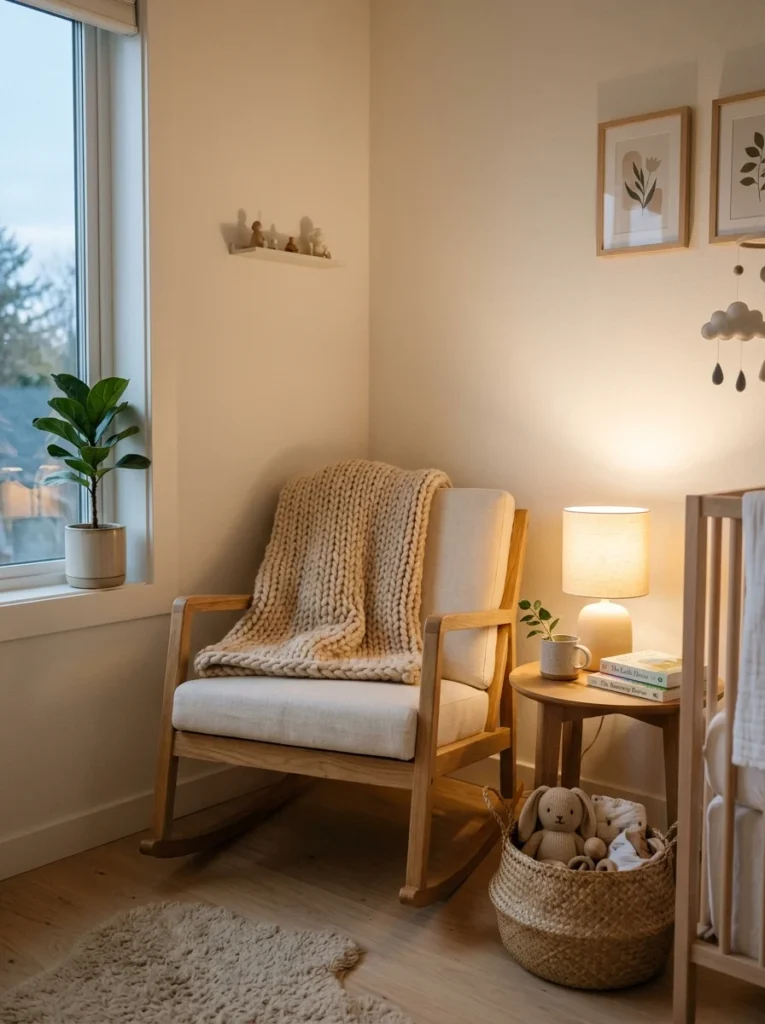
The nursing or feeding chair is the one piece of nursery furniture that most clearly resists size reduction — a chair that is too small for the parent to sit comfortably during feeding and settling sessions, or one that lacks adequate back and arm support, creates physical discomfort during what are already the most demanding hours of new parenthood. The chair’s size needs to be appropriate for the adult who will use it, not just for the room it fits in.
That said, there is significant variation in the floor footprint of feeding chairs that are equally appropriate in terms of adult comfort and function. The standard glider — with a wide seat, generous armrests, and a full-size ottoman — has a combined floor footprint that can exceed 20 square feet. A compact glider with a narrower seat, trimmer armrests, and a smaller or no ottoman has a floor footprint of 12 to 15 square feet. A compact rocking chair with a minimal frame but adequate comfort has a floor footprint of eight to ten square feet. An armchair without a rocking or gliding mechanism has a floor footprint of six to eight square feet.
For a small nursery where the floor area is genuinely limited, a compact rocking chair or a standard armchair — chosen for comfort rather than for nursery-specific gliding function — is often the most appropriate choice. The gliding function of a standard glider is helpful for settling a baby but not strictly necessary — a rocking or swaying motion from any chair achieves the same settling effect with a smaller footprint.
If the nursing chair absolutely must be excluded from the nursery due to space constraints — in a very small room where including it genuinely leaves no adequate clearance for the other essential elements — a comfortable chair in the adjacent room, positioned as close as practical to the nursery doorway, can serve the feeding and settling function with a slightly longer path to and from the crib.
Section 5: Vertical Storage — The Small Nursery’s Greatest Ally
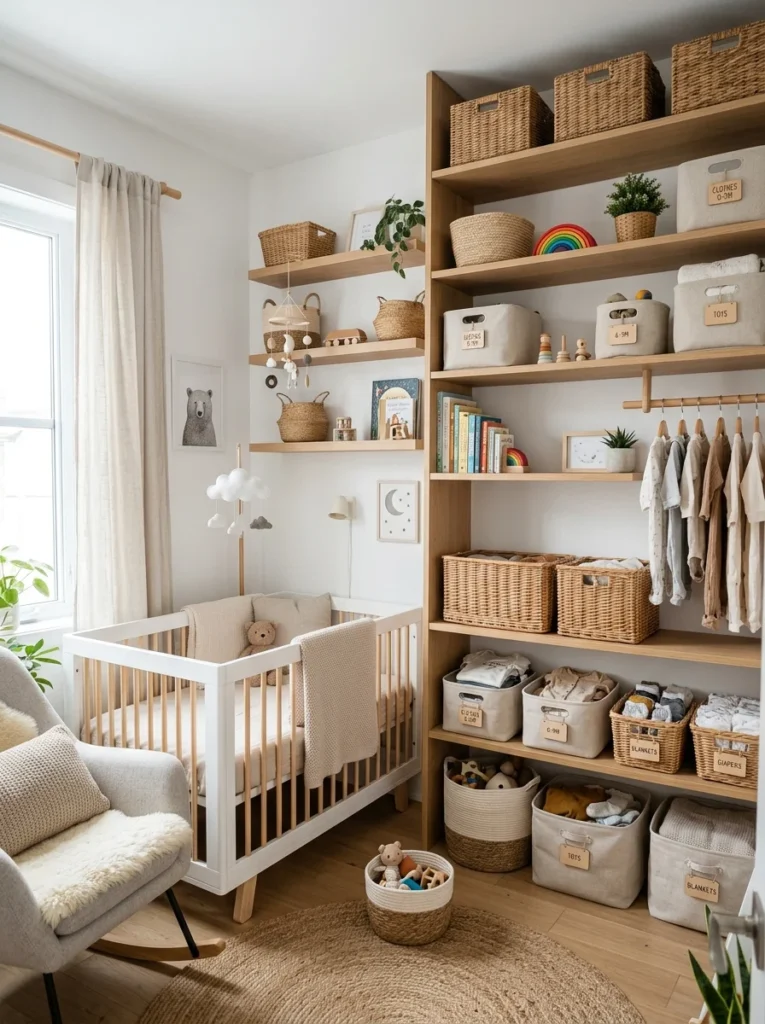
In a small nursery where floor space is limited, vertical space is the primary storage resource. The wall area above the standard furniture height — above the dresser, above the crib height on adjacent walls, above the door, from floor to ceiling on available wall sections — represents a significant storage volume that a small nursery can access without consuming any additional floor area.
Floor-to-Ceiling Shelving
A floor-to-ceiling shelving unit — whether a freestanding bookcase that reaches the ceiling or a wall-mounted shelving system that runs from baseboard to ceiling — provides the maximum storage volume per unit of floor space of any storage solution. A single shelving unit 36 inches wide and reaching the full ceiling height of a standard room — approximately 96 to 108 inches — provides a storage surface area of approximately 25 to 30 square feet on four to six shelves, accessible from a floor footprint of only three square feet.
This ratio of storage volume to floor footprint makes floor-to-ceiling shelving the most efficient storage format available for a small nursery, and it suits the nursery function well — infant clothing is small and light enough to store on open shelves, nappy supplies and care accessories are similarly compact, books and soft toys that will be introduced as the baby grows are appropriate open shelf items, and decorative accessories that give the nursery its character sit naturally on the upper shelves that are visible from across the room.
The shelving should be anchored to the wall — both freestanding bookcases and wall-mounted shelving systems need to be secured against tip-over risk. Items stored on the upper shelves — beyond the reach of a child who is walking and exploring — can be heavier and more decorative. Items stored on the lower shelves — which will be accessible to a mobile child within the first year — should be safe to handle and free of small parts or sharp edges.
Wall-Mounted Organizers Above the Changing Station
The wall directly above the changing station — above the dresser or above the fold-down table — is a prime location for wall-mounted organizational storage that keeps nappy changing supplies within arm’s reach of the changing surface without consuming any dresser surface area or floor space.
A wall-mounted organizer with pockets or small compartments holds nappies, wipes, nappy cream, cotton wool, and the other small supplies that need to be immediately accessible during a nappy change. Positioned at a height that is easily reached by a standing adult but not by the baby on the changing surface, this organizer functions as the changing station’s supply station — keeping everything needed for a nappy change at hand without the risk of the baby reaching the supplies.
Hooks on the Back of the Door
The back of the nursery door is a flat vertical surface that is frequently left completely unused and that provides meaningful additional storage in a small room. A row of hooks mounted on the back of the door at appropriate heights holds changing bags, baby carriers, muslin cloths, spare outfits for daytime use, bath towels, and other items that need to be accessible but have no other natural storage position in the nursery.
A hook rail rather than individual hooks — a strip with multiple hooks at regular intervals — maximizes the storage density of the door back while maintaining a neat, organized appearance. The hook rail should be mounted at a height that allows the door to close fully without the hooks contacting the adjacent wall or door frame when the door swings.
Section 6: Visual Expansion Techniques for the Small Nursery
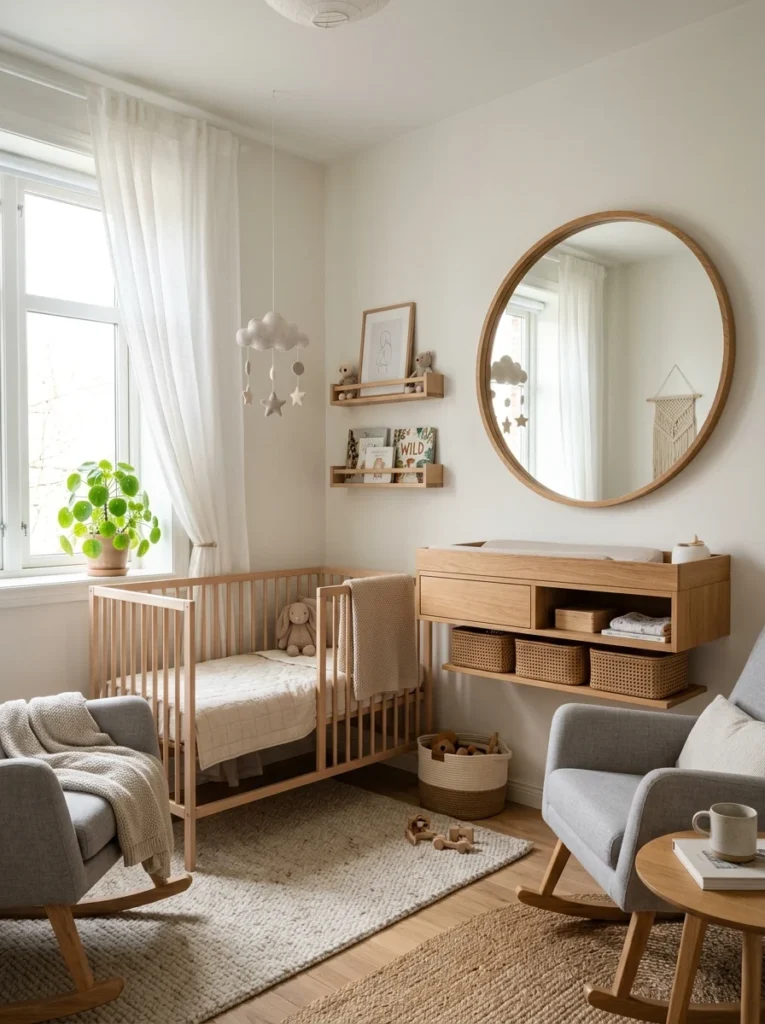
Beyond the physical furniture and storage decisions, a range of visual techniques make a small nursery feel larger than its actual dimensions — not by physically changing the room but by changing how the brain perceives it.
Light Colors That Reflect Rather Than Absorb
The wall color of a small nursery has a more significant effect on how the room feels spatially than in a larger room, because in a small room the walls are closer and their color is more dominant in the visual field. Light colors — warm whites, pale creams, soft sage greens, and muted pale tones — reflect light back into the room, making the walls appear to recede slightly from the center. Dark colors absorb light and appear to advance, making the walls feel closer than they are.
For a small nursery, light wall colors are the most reliably space-enhancing choice. The ceiling should be painted the same color as the walls or one shade lighter — removing the hard visual line between wall and ceiling makes the room feel taller and more continuous.
Large Mirrors
A large mirror on one wall of a small nursery creates the visual impression that the room continues beyond the wall surface — that the nursery is larger than its physical dimensions. The mirror reflects the room’s light, its furniture arrangement, and the view of the other walls, all of which the eye partially reads as real space rather than reflected space.
In a nursery, a large mirror needs to be mounted securely on the wall — not leaning against the wall, where a developing baby or toddler could pull it down. A full-length mirror mounted flat on the wall beside the wardrobe or behind the door is both a practical dressing mirror and a spatial expansion tool. The mirror should be mounted at a height and position where the baby in the crib cannot reach it and where the reflection does not directly face the crib — a mirror that reflects directly back to the crib can disturb infant sleep in some cases, as the moving reflection of the baby can attract attention.
Sheer Curtains That Maximize Natural Light
A small nursery with generous natural light feels significantly larger than the same room with inadequate light. Sheer curtains or light-filtering window coverings — as distinct from blackout curtains, which are essential for sleep times but not needed during daytime hours — allow maximum natural light into the room during the day, making it feel bright, airy, and more spacious.
The solution for a nursery that needs both blackout provision for sleep and light admission during the day is a layered window treatment — a blackout roller blind mounted inside the window recess for sleep times, with a sheer curtain or light-filtering panel in front for daytime use. The blackout blind provides complete darkness during naps and nighttime. The sheer curtain, when the blind is raised, allows natural light into the room without exposing the baby to direct sunlight.
Floating Furniture That Reveals the Floor
Furniture that sits on visible legs — or furniture that is wall-mounted with no floor contact — reveals more of the floor surface than furniture with concealed legs or solid base panels. A greater proportion of visible floor makes the room feel larger because the eye reads the visible floor as usable, open space.
A wall-mounted floating shelf rather than a freestanding bookcase, a dresser on slim tapered legs rather than a dresser with a full solid base, and a crib with visible legs rather than a crib with a low, concealed base panel all contribute to a small nursery that feels more open and more spacious than the same room furnished with heavy, floor-hugging pieces.
Section 7: Organization Systems That Prevent Small-Room Clutter
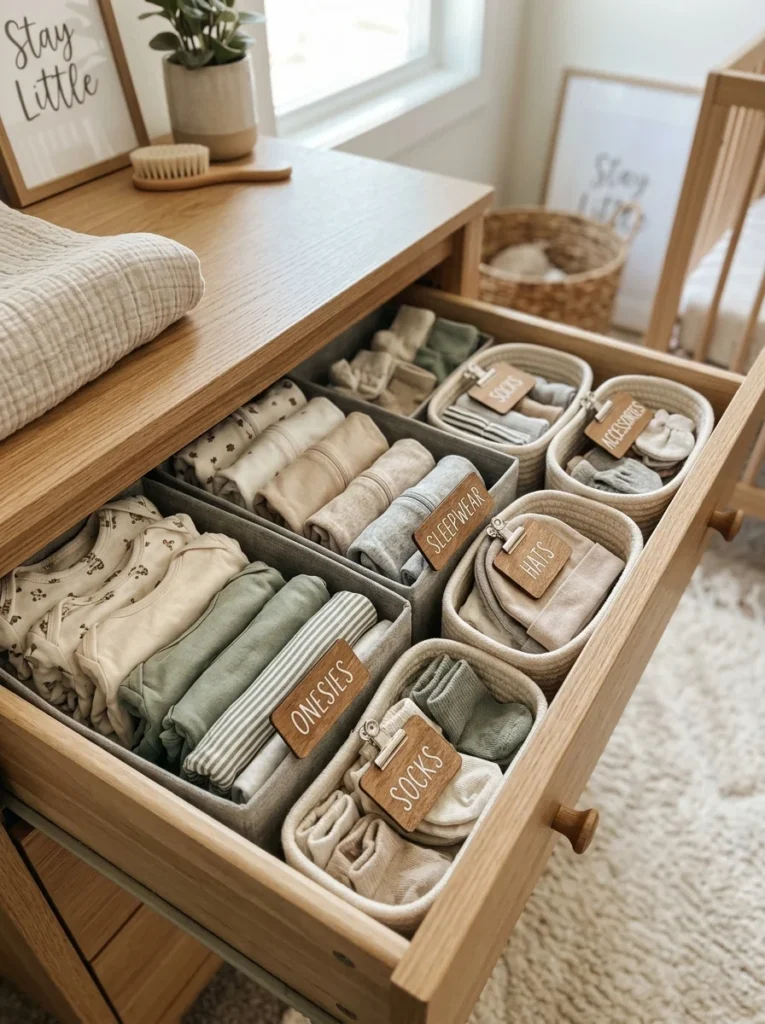
In a small nursery, clutter has a more damaging effect on the room’s functionality and visual quality than in a larger room — there is less visual space to absorb disorder, and the consequences of items being misplaced or lacking a designated home are immediately and persistently visible. A clear, consistent organization system is essential for maintaining a small nursery in the condition that makes it work well.
Drawer Dividers for Infant Clothing
Infant clothing is small enough that without organization it quickly becomes a chaotic pile in any drawer — a pile in which finding a specific item requires emptying the drawer and searching through everything it contains. Drawer dividers — either purpose-made dividers or simple folded cardboard sections — divide each drawer into compartments that hold specific categories of clothing in a visible, organized format.
The most useful categorization for infant clothing drawers is by type — onesies in one section, sleepers in another, trousers in another, tops in another — rather than by outfit. This allows the parent to assemble an outfit from the drawer’s contents without pulling everything out to find what is needed.
The KonMari folding method — folding clothing into small, self-standing rectangles that stand upright in the drawer rather than lying flat in stacked piles — is particularly suited to infant clothing organization in small nurseries. Upright-folded clothing is visible from above when the drawer is opened, every item is accessible without disturbing others, and the drawer holds significantly more items in a visible, organized format than the same drawer with flat-stacked clothing.
The One-In-One-Out Principle for Infant Clothing
Infant clothing grows — babies receive gifts, parents purchase items in larger sizes as the baby grows, and the accumulated wardrobe of a baby at six months is typically significantly larger than the nursery’s storage was planned for when the room was first set up. In a small nursery with limited storage, the one-in-one-out principle — for every new item of clothing that enters the nursery, a too-small or outgrown item leaves — prevents the wardrobe from outgrowing the storage capacity.
Outgrown infant clothing that is in good condition can be stored outside the nursery in labeled boxes by size, donated immediately, or passed on to friends and family expecting a baby. Having a clear destination for outgrown items — and acting on that destination promptly rather than accumulating bags of too-small clothing in the nursery — is essential for maintaining the storage organization of a small nursery over time.
Labeled Storage for Every Category
Every basket, bin, and storage container in the small nursery should be labeled with its specific contents. In a room with limited storage where every container is doing a specific organizational job, labels communicate the system to everyone who uses the room — both parents, any supporting family members, and eventually the child as language develops — and prevent items from being placed in the wrong location through habit or convenience.
Labels should be simple and clear — a handwritten label on a piece of card or a printed label is sufficient. The label format matters less than the consistency of labeling — every container labeled, every label visible from the room’s primary viewing angle, and every label accurate to the current contents.
Section 8: Making a Very Small Space Feel Like a Nursery
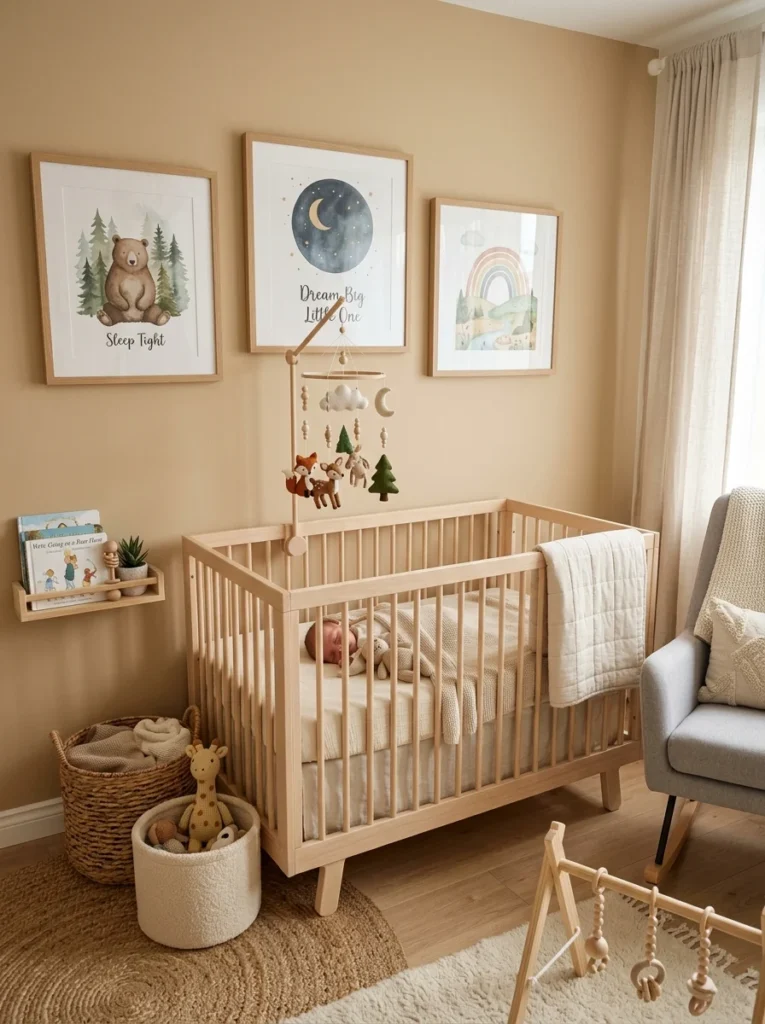
The final element of a successful small nursery is the one that transforms it from a functional room into a nursery — the decorative and atmospheric details that give the room its character and create the environment of warmth and care that a baby deserves to grow up in.
In a small nursery where the furniture takes up most of the available space and the storage consumes most of the available wall area, the decorative elements need to be chosen with particular selectivity. Every decorative addition to a small room makes it slightly busier visually, and the cumulative effect of too many decorative elements in a small nursery is a room that feels cluttered and overwhelming rather than warm and welcoming. The principle is not to avoid decoration but to choose it with particular deliberateness — one or two well-chosen decorative elements that contribute genuinely to the room’s character are more effective than a collection of many smaller ones.
The Primary Decorative Focal Point
Every nursery benefits from one primary decorative element — a single visual focal point that gives the room its character and around which the other decorative decisions are organized. In a small nursery, this one element is even more important than in a larger one, because a single well-chosen focal point creates a strong impression without consuming the visual space that multiple smaller decorations would.
The primary decorative focal point in a nursery is most commonly placed on the wall behind the crib — the wall that is most visible when entering the room and that frames the primary piece of nursery furniture. This wall is the appropriate location for the room’s most significant decorative investment.
Appropriate focal point options for the wall behind the crib in a small nursery include a single large piece of artwork or a framed print that spans most of the wall above the crib, a painted mural or feature wall treatment in a color or pattern that suits the nursery’s overall palette, a gallery of three to five carefully chosen and consistently framed small prints arranged as a cohesive unit, or a decorative wall hanging — a macramé piece, a fabric banner, or a woven textile — that adds texture and warmth.
The Mobile — Decorative and Developmentally Appropriate
A mobile above the crib is the most purely nursery-specific decorative element available and one of the most practically valuable — a visually interesting mobile provides developmental stimulation for an infant who spends significant time lying in the crib and gazing upward, and a gently moving mobile can assist in settling.
In a small nursery where the decorative budget and the visual space are both limited, a beautiful mobile serves double duty — it is simultaneously a decorative element and a developmentally appropriate infant accessory. The mobile should be mounted securely from the ceiling or from a sturdy floor-standing mobile arm, positioned above the crib but out of the infant’s reach, and removed from above the crib when the infant begins to push up on hands and knees — typically around five months — when the risk of the baby reaching the mobile increases.
Plants and Natural Elements
A small plant — a pothos on a high shelf, a small succulent on the windowsill, a dried botanical arrangement in a simple ceramic vase on the dresser top — introduces natural warmth and color into the nursery without consuming any floor space. In a small nursery where the decorative palette needs to be managed carefully, a single plant or botanical element is the most effective natural addition available — it provides organic color and texture without competing with the room’s primary decorative focal point.
Conclusion
A small nursery designed with honesty about what a baby genuinely needs, clarity about which furniture choices serve those needs most efficiently in limited space, and deliberateness about every square foot of floor area and every inch of wall space can function as well as any larger nursery and be every bit as beautiful.
The key decisions that determine whether a small nursery works are the crib size and placement, the dual-purpose changing station, the compact nursing chair, the vertical storage that replaces floor-consuming furniture, the visual techniques that make the room feel larger, and the selective, disciplined decoration that gives the room warmth and character without overwhelming its limited visual space.
These decisions, made in the correct sequence and applied with the care they deserve, produce a small nursery that does everything a nursery needs to do — keeps the baby safe, makes nighttime care manageable, provides adequate storage for everything infant care requires, and creates an environment of warmth and beauty that the whole family can feel proud of and comfortable in.
The room is small. The love that goes into preparing it, and the life that unfolds within it, is not.