
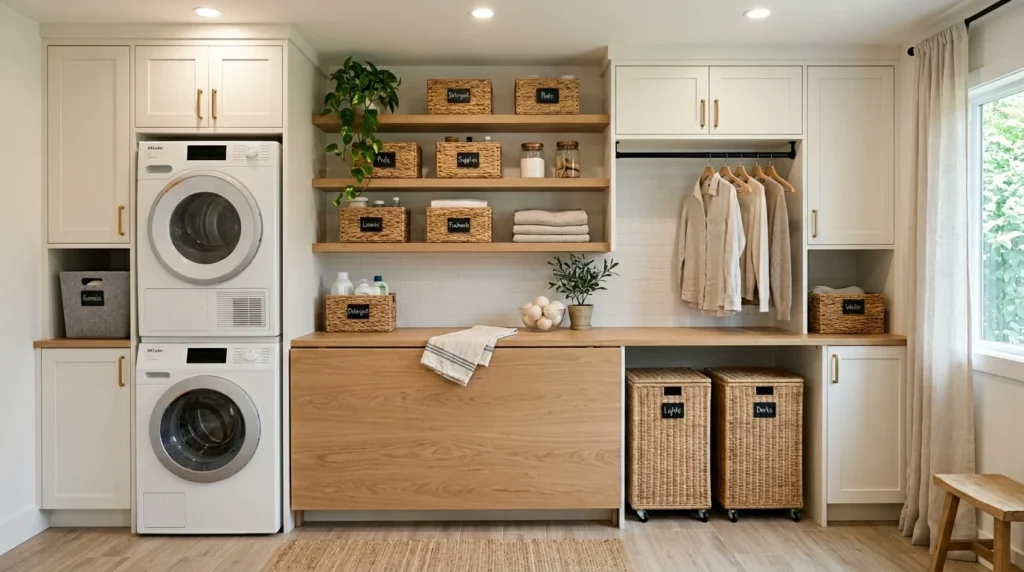
Laundry is one of the most universally disliked household chores, and the laundry room is one of the most consistently neglected spaces in the home. The two facts are not unrelated. A laundry room that is disorganized, cramped, poorly lit, and lacking a clear system for every stage of the laundry process makes the already unappealing task of doing laundry significantly more difficult and more time-consuming than it needs to be. A laundry room that is well organized, clearly laid out, adequately equipped, and designed around how laundry is actually done makes the same task more manageable — not enjoyable, perhaps, but manageable in a way that a disorganized room never achieves.
The difference between a laundry room that works and one that does not is almost entirely a matter of organization. The physical dimensions of the room, the quality of the appliances, and the budget available for improvements are all secondary to the question of whether the room has been organized around the actual process of doing laundry — the sequence of sorting, washing, drying, folding, and putting away that constitutes a complete laundry cycle — rather than simply arranged to fit everything in.
A laundry room organized around the laundry process has a place for dirty laundry before it is washed, a place to add and measure detergent and other laundry products, a place to transfer wet laundry from the washer to the dryer, a place to fold and sort clean laundry after drying, a place to hang items that cannot go in the dryer, and a clear route by which folded laundry leaves the room and is returned to where it belongs in the rest of the house. When every stage of the laundry process has a designated location within the room, the process flows from beginning to end without the friction of searching for products, clearing surfaces, or creating temporary piles of laundry in spaces that were not designed for them.
This guide builds that system from the ground up. It covers the zone structure that organizes the laundry room around the laundry process, the storage solutions that keep every product and accessory in its correct location, the sorting and handling systems that prevent laundry from accumulating in the wrong places, and the maintenance habits that keep the system working once it is established.
The Foundation: Understanding the Three-Zone System
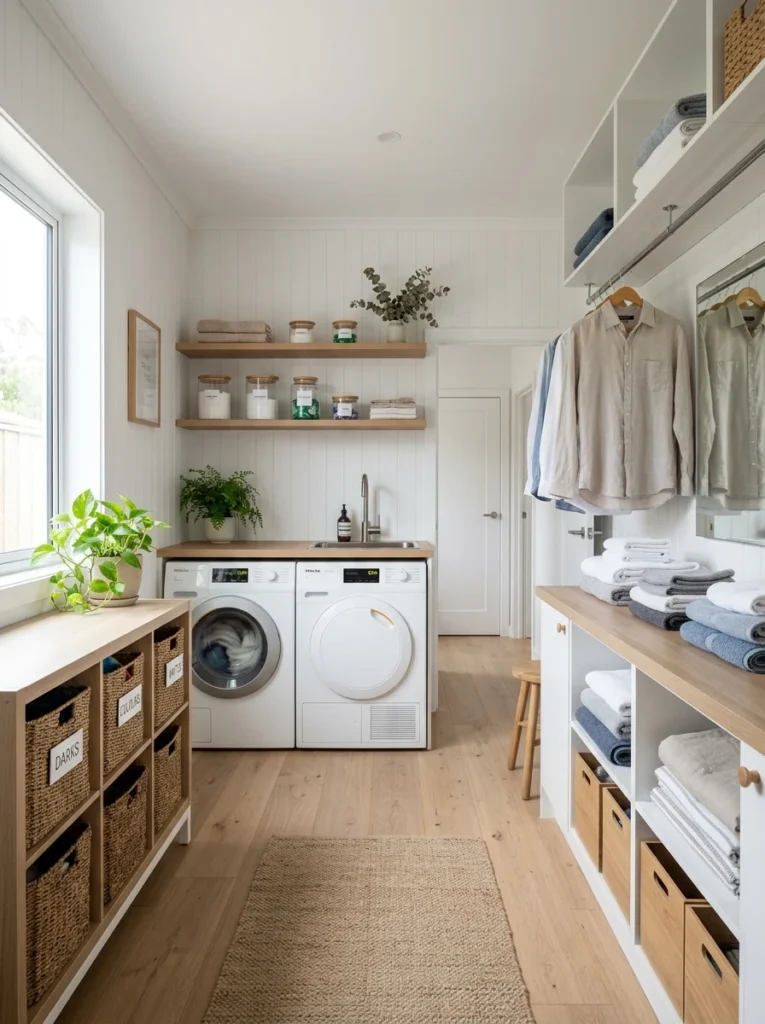
The most effective organizational framework for any laundry room — regardless of its size, its layout, or its appliance configuration — is the three-zone system. This system divides the laundry room into three distinct functional areas that correspond to the three primary stages of the laundry process: the dirty laundry zone, the active washing zone, and the clean laundry zone.
Every decision about where to put things in the laundry room — where to position the hampers, where to store the detergent, where to put the folding surface, where to hang the drying rack — should be made in relation to the zone structure. Items and equipment belong in the zone where they are used, not wherever there happens to be space for them.
Zone One: The Dirty Laundry Zone
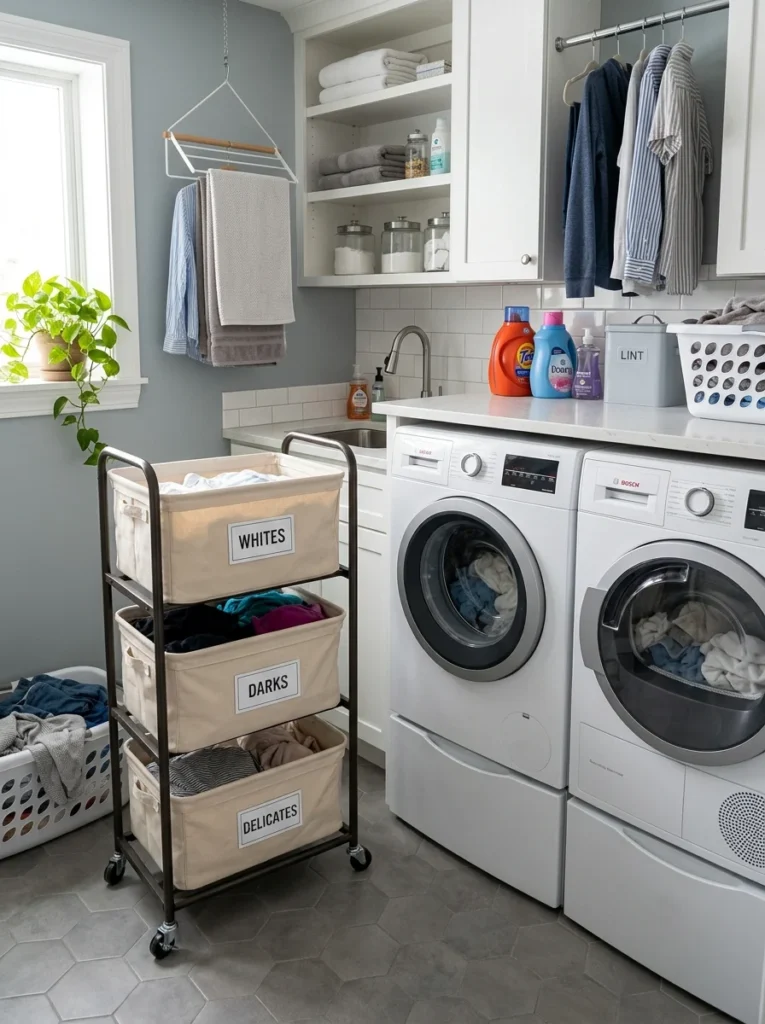
The dirty laundry zone is the area where soiled clothing arrives in the laundry room and waits to be washed. Its primary function is containing dirty laundry in an organized way that makes sorting and loading the washing machine straightforward, and its secondary function is preventing dirty laundry from overflowing onto surfaces, floors, and areas of the room not designated for it.
The dirty laundry zone is ideally positioned near the entrance to the laundry room — the point at which dirty laundry arrives from the rest of the house — and adjacent to the washing machine, which is where the dirty laundry goes next. A dirty laundry zone that requires carrying laundry across the full length of the laundry room to reach the washing machine adds unnecessary steps to the process and makes the laundry room feel less efficient than one where the flow from dirty laundry zone to washing machine is a short, direct movement.
The equipment in the dirty laundry zone consists primarily of sorting hampers — containers that hold dirty laundry separated into the categories that will be washed separately. The number and configuration of sorting hampers depends on the household’s laundry sorting habits, which are covered in detail in the sorting system section below.
Zone Two: The Active Washing Zone
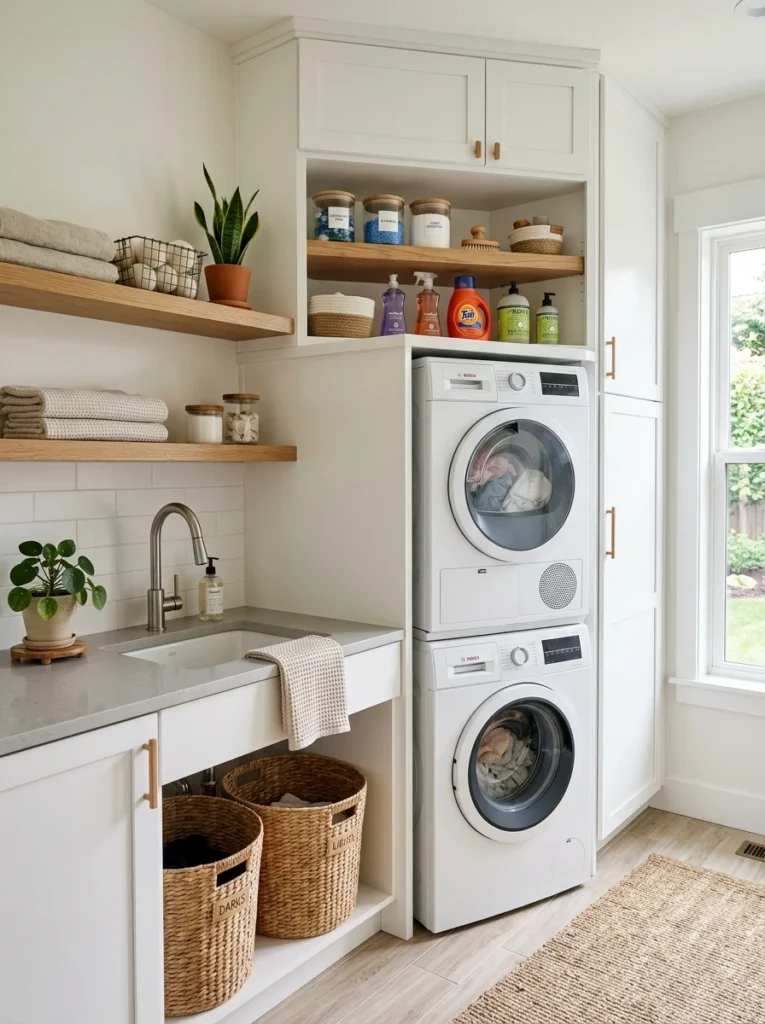
The active washing zone is the area centered on the washing machine and dryer — the appliances that perform the actual cleaning and drying of laundry. This zone is the most fixed in terms of its position within the room, since the appliances cannot be moved without replumbing and electrical work, but it can be organized to make loading, unloading, and operating the machines as efficient as possible.
The active washing zone requires storage for the laundry products used in the washing and drying process — detergent, fabric softener, stain remover, dryer sheets, and similar products — positioned within easy reach of the machines without requiring the user to leave the immediate zone of the appliances to retrieve them. A cabinet above the machines, a shelf at arm height beside the machines, or a countertop surface between or above the machines are all appropriate positions for laundry product storage.
The active washing zone also benefits from a small surface — even a very small one — at a convenient height for sorting wet laundry before transferring it to the dryer, for checking pockets before loading the machine, and for handling individual items that need special treatment before washing. In many laundry rooms, the top of the washing machine or dryer serves this function when no other surface is available, which is adequate for most households.
Zone Three: The Clean Laundry Zone
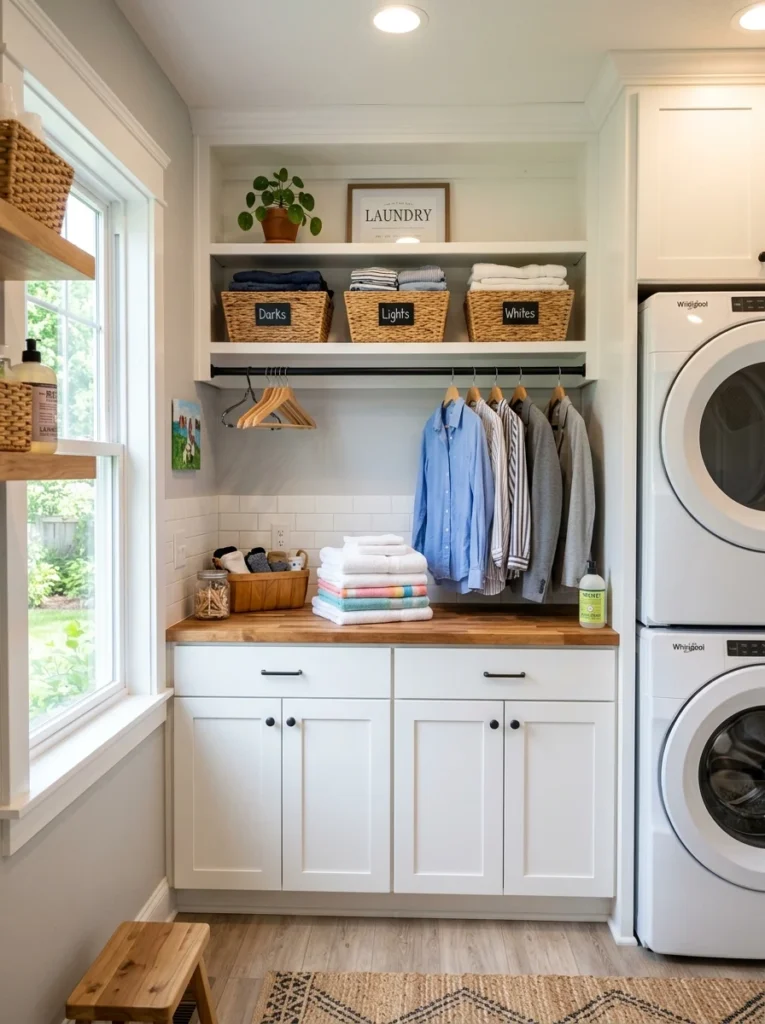
The clean laundry zone is the area where clean, dry laundry is handled after it leaves the dryer — the zone where it is folded, sorted by household member or room, hung on hangers, and prepared for return to the rest of the house. This is the zone that most laundry rooms handle worst, and its inadequacy is usually the primary source of the piles of clean but unfolded laundry that accumulate in laundry rooms and on adjacent surfaces throughout the home.
The clean laundry zone requires a folding surface large enough to fold a full load of laundry without items falling off the edges, adequate lighting to see clothing clearly for folding and sorting, hanging space for items that cannot go in the dryer or that need to be hung immediately after drying to prevent wrinkles, and a system for organizing folded laundry by destination — by household member, by room, or by category — so that it can be efficiently distributed to the rest of the house rather than sitting in a single pile waiting to be sorted later.
Building the Sorting System
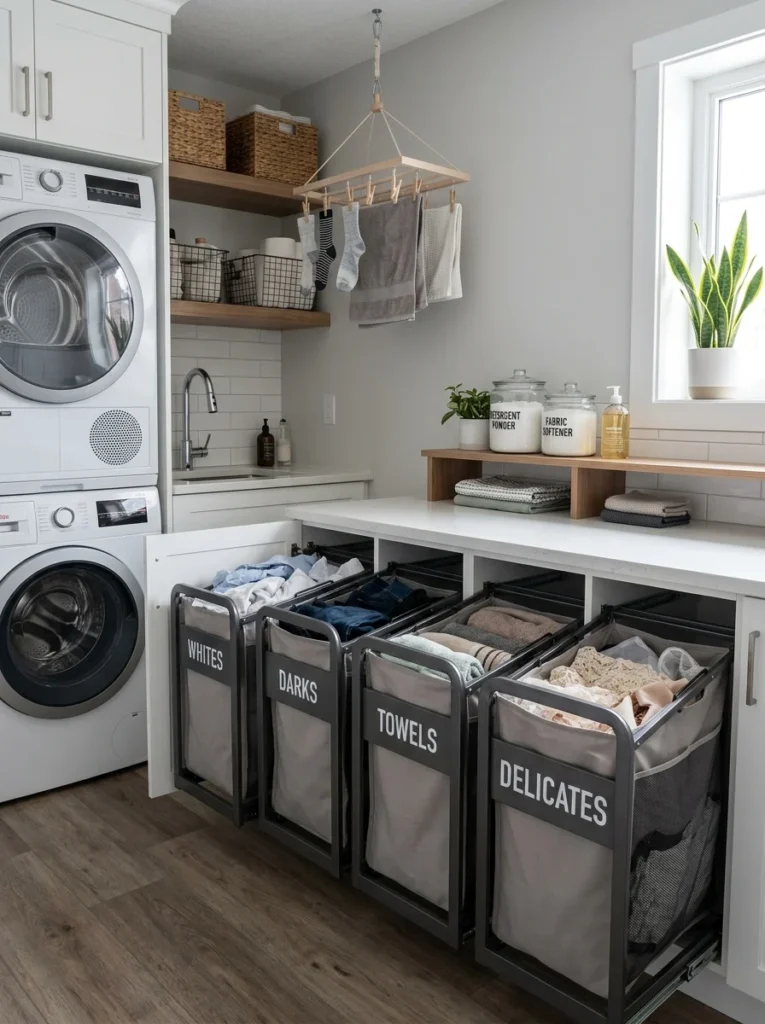
Sorting dirty laundry before washing — separating laundry into categories that are washed separately — is the step that most households find most burdensome, and the primary reason is that sorting is treated as a task performed at the washing machine rather than a continuous process that happens as laundry is collected.
The most efficient sorting system is one where laundry is sorted at the point of collection — when it is taken off and put in a hamper — rather than at the point of washing. This is achieved through multiple hampers, each designated for a specific laundry category, positioned in the laundry room’s dirty laundry zone and, ideally, supplemented by collection hampers in the bedrooms and bathrooms where laundry is generated.
How Many Hampers — The Two-Hamper Versus Three-Hamper Decision
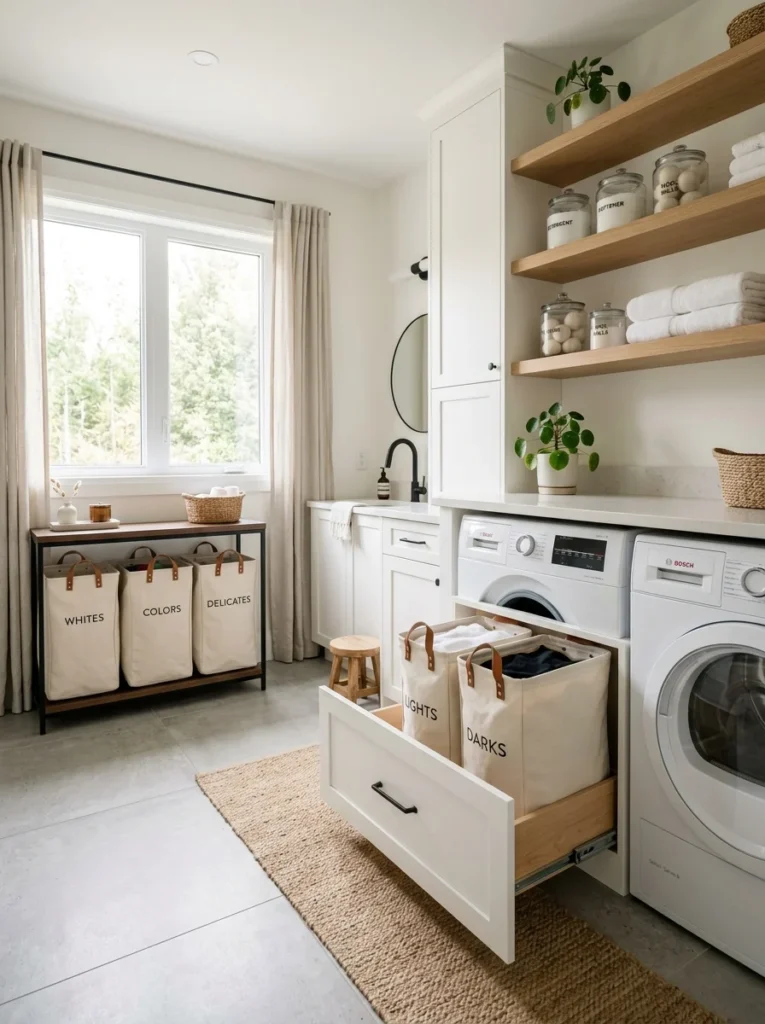
The minimum effective sorting system uses two hampers — one for dark and colored items and one for light and white items. This two-category division covers the most essential sorting requirement — preventing color bleeding onto whites — without requiring the household to make more fine-grained sorting decisions.
A three-hamper system adds a third category — typically delicates, which require a gentler washing cycle and lower spin speed than standard laundry — to the two-category dark-light division. For households that have a significant quantity of delicate items — hand-wash labels, silk and wool garments, lingerie, and similar items — the three-hamper system prevents delicates from being washed on a standard cycle by accident, which is one of the most common causes of clothing damage in laundry.
For households with very specific sorting requirements — separate hampers for towels, bed linen, work clothes, and gym clothes — a multi-compartment hamper unit or a row of individual hampers provides the granularity the household needs. The risk of too many hamper categories is that the sorting decisions become burdensome enough that household members stop sorting correctly, which defeats the purpose of the system. The right number of hamper categories is the minimum that satisfies the household’s actual washing requirements without adding unnecessary complexity.
Hamper Types and Positions
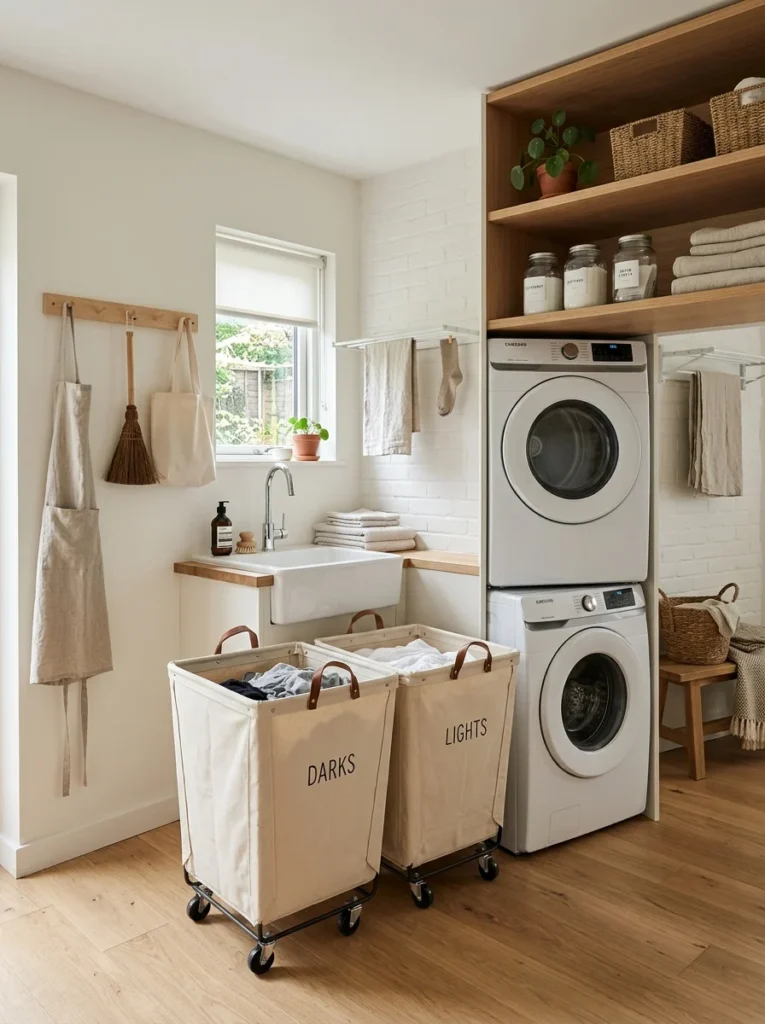
Hampers in the laundry room’s dirty laundry zone should be open-topped rather than lidded — open tops allow laundry to be dropped in quickly without lifting a lid, which reduces the friction of sorting and makes it more likely that household members will actually sort correctly rather than defaulting to a single pile. Lids on hampers create a subtle but real barrier to use that accumulates over time into sorted laundry piling on top of the lid rather than going in the correct hamper.
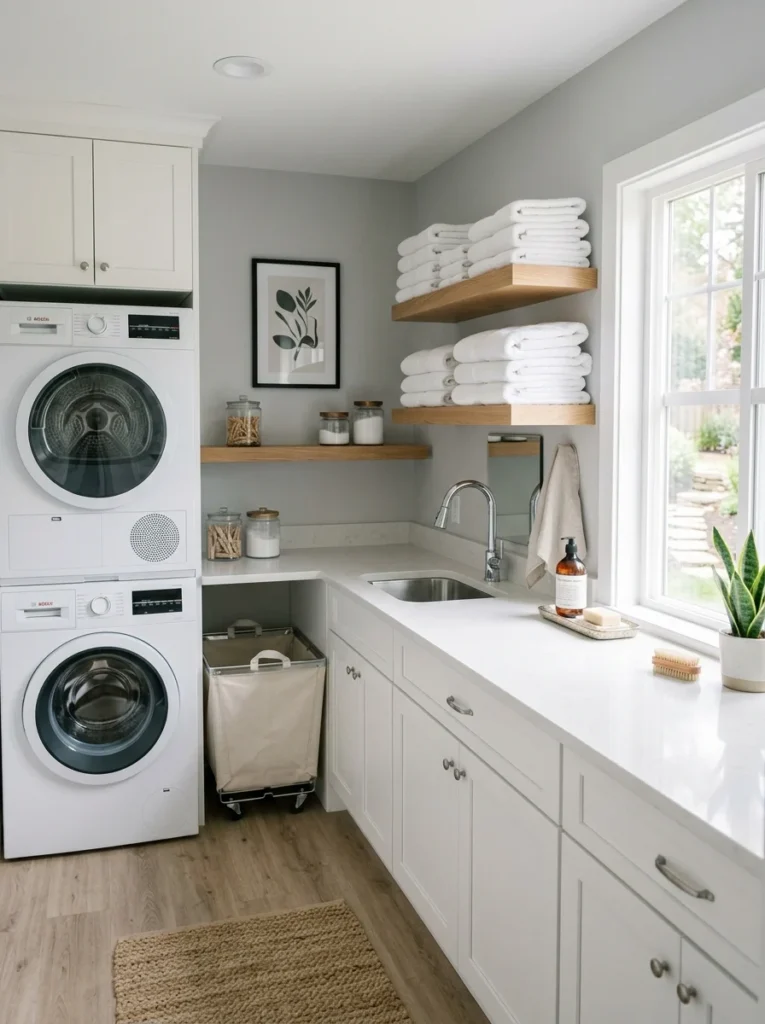
Hampers on wheels — rolling hampers — are significantly more practical than static hampers in a laundry room because they can be rolled directly to the washing machine for loading and returned to the dirty laundry zone after emptying without carrying a heavy hamper across the room. Rolling hampers are available in a range of sizes and materials, with canvas rolling hampers being the most lightweight and the most affordable, and rigid rolling bins being the most durable for heavy-use applications.
Laundry Product Storage — Keeping Everything in Its Place
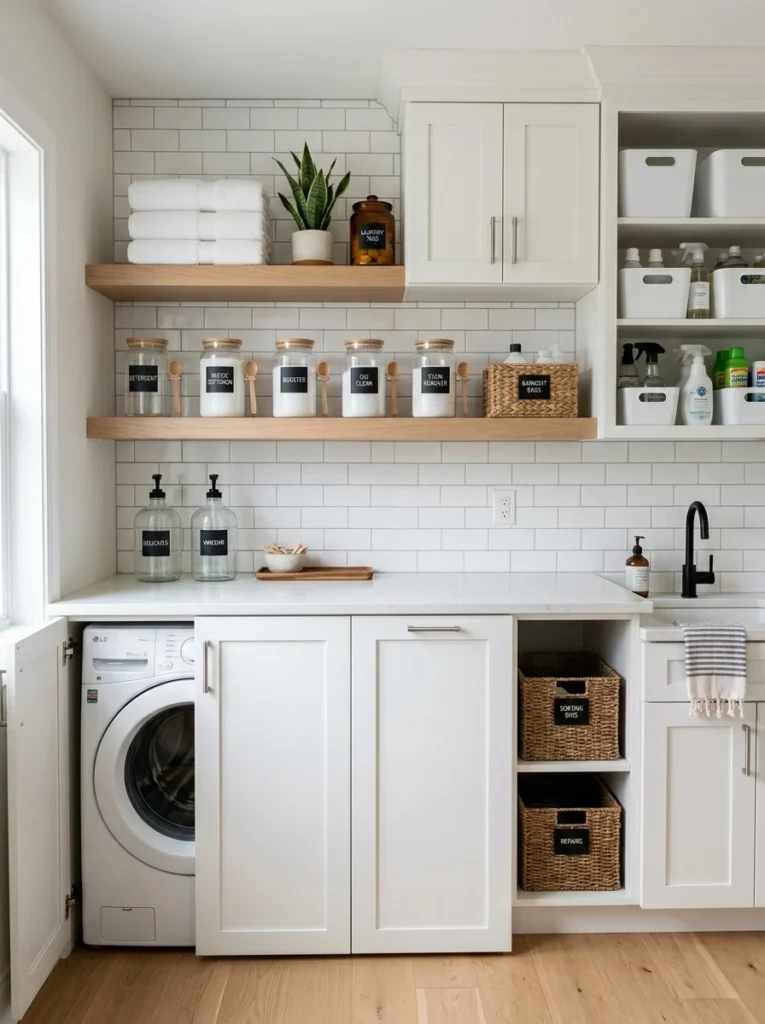
Laundry products — detergent, fabric softener, stain remover, dryer sheets, laundry pods, delicate wash, bleach, and any specialty products the household uses — accumulate over time into a collection of bottles, boxes, and containers in varying sizes that resist organized storage if not deliberately managed.
The primary principle of laundry product storage is that every product has a designated place within the active washing zone and returns to that place after every use. Products left on random surfaces — on top of the dryer, on the window ledge, on the floor beside the machine — gradually migrate around the laundry room and create the cluttered, disorganized appearance that makes the space feel inadequate even when it is adequately equipped.
Above-Machine Storage
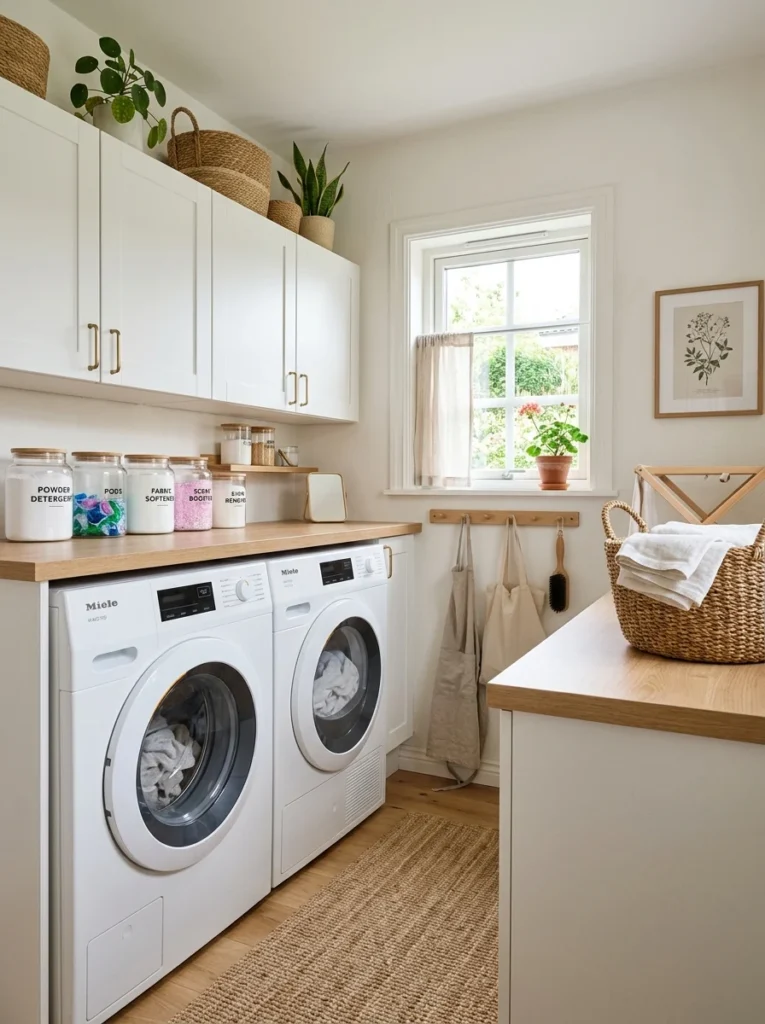
A cabinet or shelving unit mounted on the wall above the washing machine and dryer is the most effective location for laundry product storage in most laundry rooms. Products stored directly above the machines are within easy reach during loading and unloading without requiring any movement away from the appliances. The cabinet format — with doors that close to conceal the products — keeps the laundry room looking clean and organized regardless of the variety and number of products stored inside.
When specifying cabinets or shelving above machines, ensure that the cabinet depth does not interfere with the operation of top-loading washing machines — a top-loading machine requires clear space above the door for it to open. Front-loading machines and dryers can have cabinets mounted directly above them at the standard upper cabinet height, providing maximum storage volume above the full width of the appliance.
A shelf immediately above the front panel of front-loading machines — at a height that allows the machine doors to open freely — provides a convenient small surface for products in active use during a laundry session. This shelf is most useful when it holds only the products needed for the current wash cycle rather than becoming a permanent overflow storage surface for all laundry products.
Decanting Laundry Products
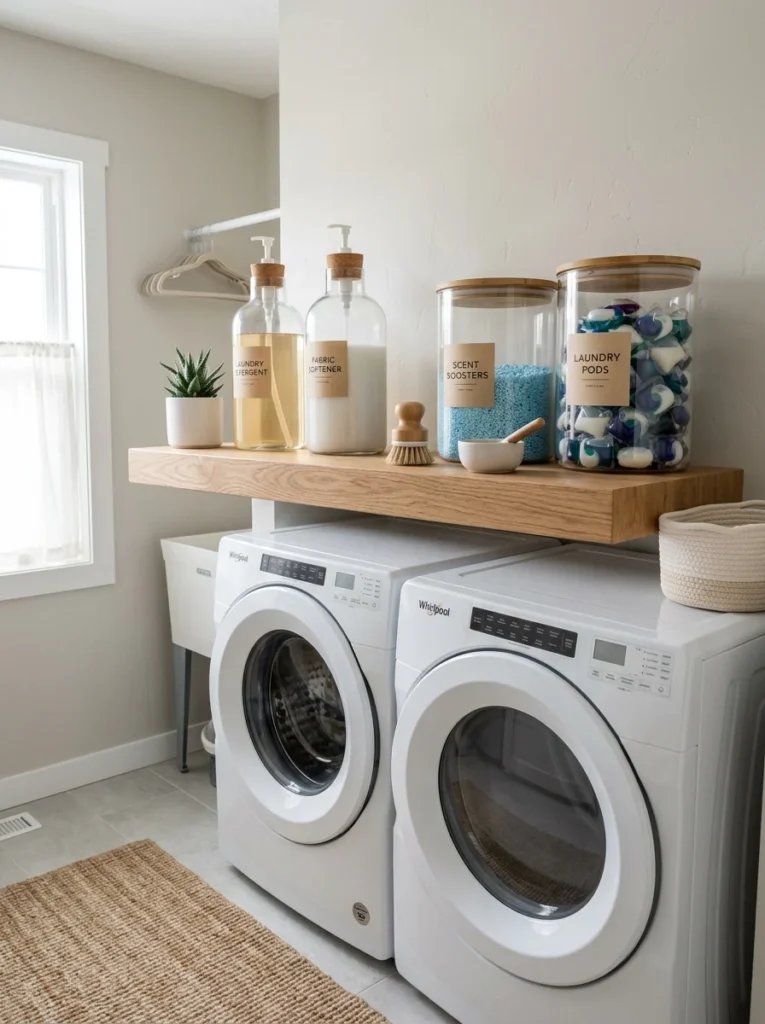
Decanting liquid laundry detergent and fabric softener from their original bulk containers into smaller, labeled dispensing bottles positioned at the machines provides a more controlled and more convenient dispensing experience than pouring from large bottles, reduces the visual clutter of multiple large containers in the active washing zone, and makes measuring the correct dose easier and more consistent.
This decanting principle applies most practically to liquid detergent — where a purpose-designed dispenser with a measuring cup or dosing cap provides accurate, drip-free dispensing — and to laundry pods, which can be stored in a clear airtight container beside the machine rather than in their original flexible plastic packaging.
The Folding Station — The Most Important Feature of the Clean Laundry Zone
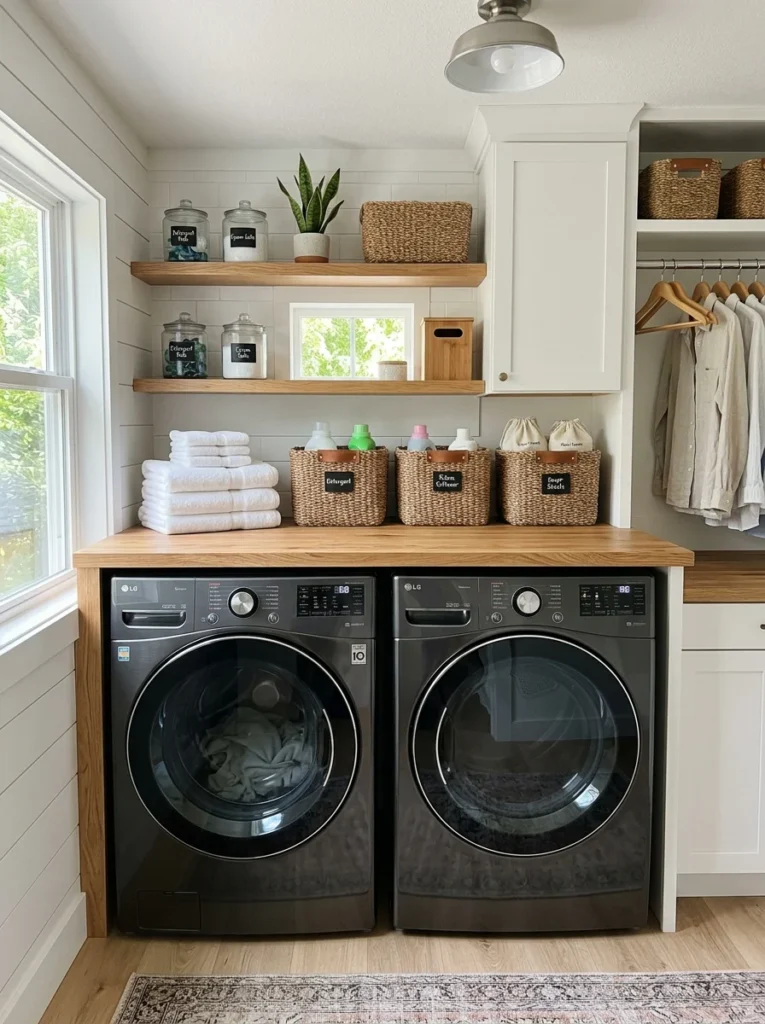
The folding station is the element of the laundry room that most directly determines whether clean laundry is folded promptly and returned to the rest of the house or whether it accumulates in baskets and on surfaces waiting for a folding session that is perpetually deferred.
A household that does laundry regularly but folds inconsistently — that washes and dries laundry promptly but allows folding to wait until a dedicated session — typically does so not because of a lack of intention but because of a lack of an appropriate surface for folding at the moment the dryer finishes. When the dryer door opens and there is no immediate, adequate surface on which to fold the contents, the laundry goes into a basket or pile that requires a separate folding session to clear. When the dryer door opens onto a clear, appropriately sized folding surface positioned immediately adjacent to the dryer, folding happens immediately and the laundry cycle completes without interruption.
Counter Above Front-Load Machines — The Most Efficient Setup
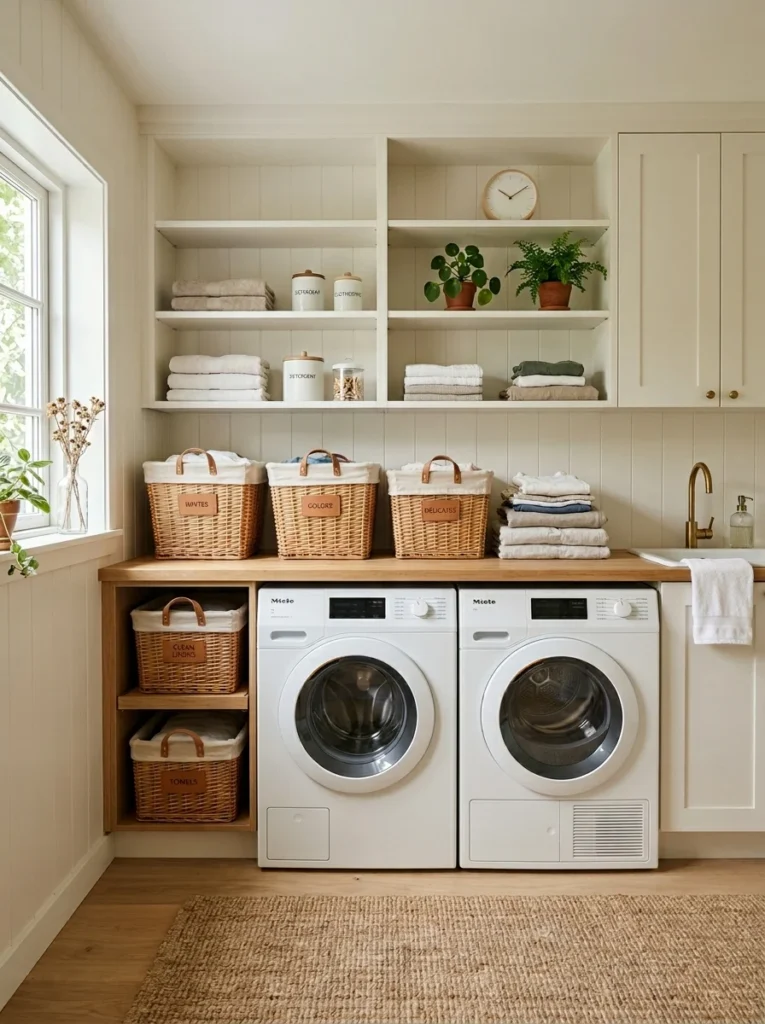
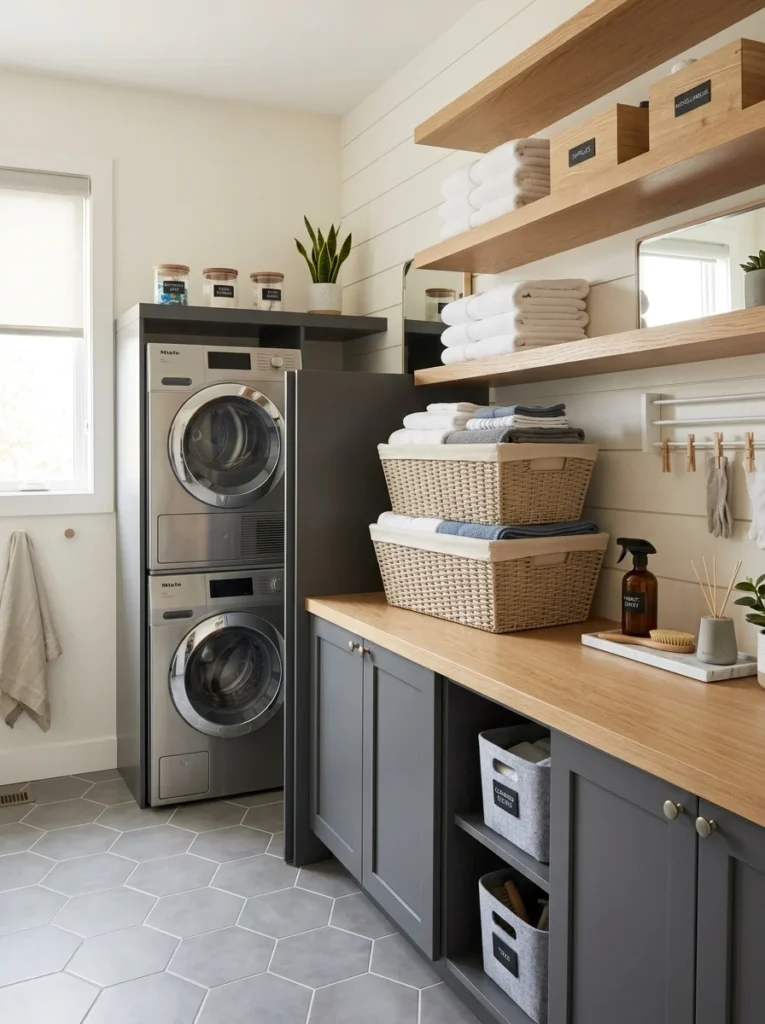
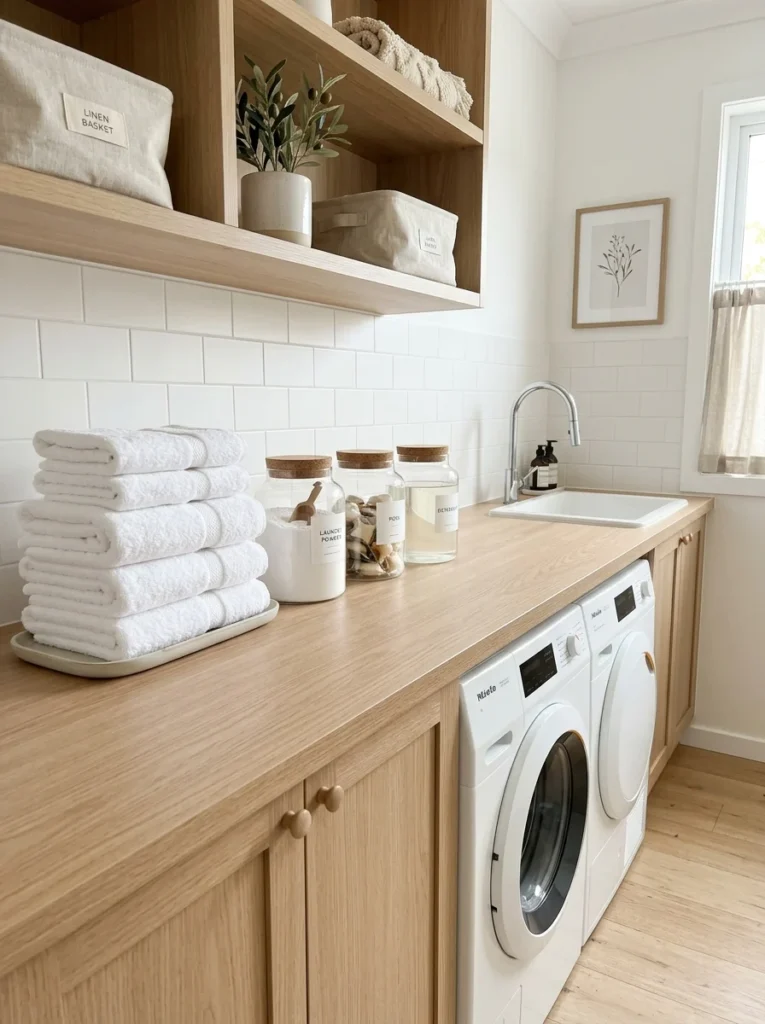
The most space-efficient and most functional folding station in a laundry room with front-loading machines is a counter installed directly above the machines. A countertop spanning the full width of both the washer and the dryer creates a generous folding surface at a comfortable standing height, positions the folding station directly adjacent to the dryer for immediate transfer of clean laundry, and uses a zone of the laundry room that is otherwise unused.
A counter above front-load machines requires a support structure — either wall-mounted brackets, a cabinet structure on each side of the machines, or a purpose-built laundry counter unit — that spans the machines without resting on them. The counter surface material should be smooth, easy to clean, and resistant to moisture — laminate, solid surface, or sealed wood are all appropriate choices.
The depth of the counter above the machines is typically limited by the depth of the machines themselves plus any clearance needed at the rear of the machines for connections and ventilation. Standard washing machines and dryers are approximately 24 to 27 inches deep, which provides adequate counter depth for folding most clothing items. A folding board — a lightweight rigid board used as a template for achieving consistent shirt and trouser folds — can be stored on the counter surface or behind a nearby cabinet door for use during folding sessions.
Wall-Mounted Fold-Down Folding Table
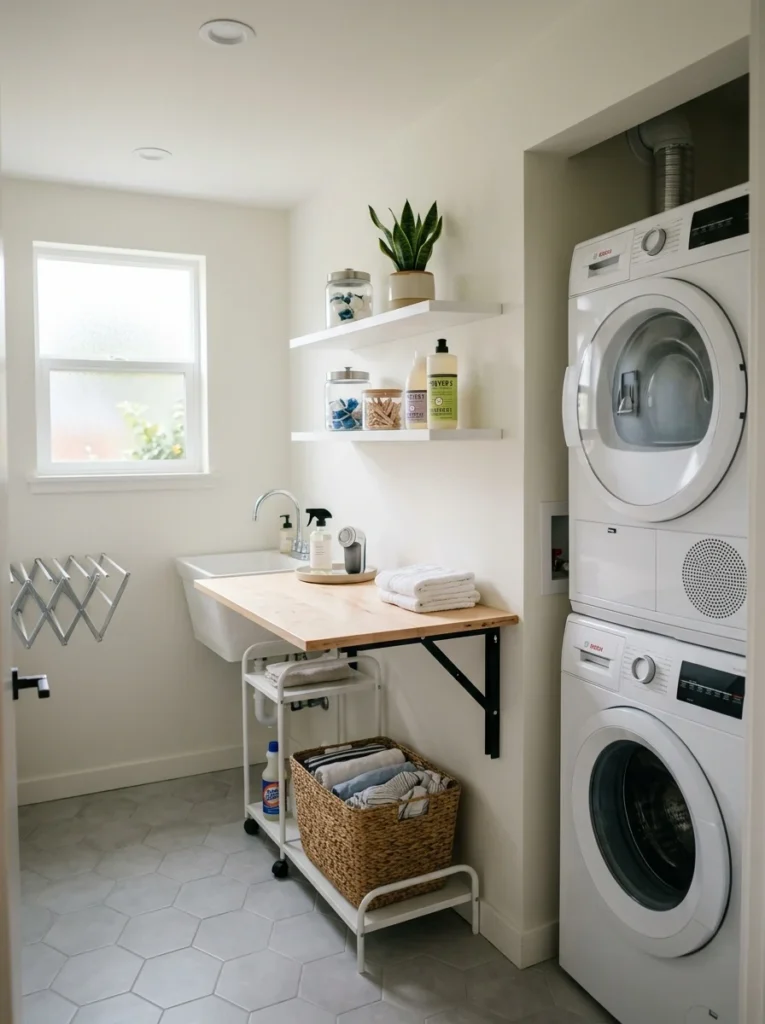
In laundry rooms where a permanent counter above the machines is not possible — in rooms with top-loading machines, in rooms where the machines are positioned against walls that do not allow a spanning counter, or in very small laundry rooms where a permanent counter would reduce the available floor space unacceptably — a wall-mounted fold-down table provides a folding surface when needed and folds flat against the wall when not in use.
A wall-mounted fold-down table hinges at the wall, folds down to a horizontal position supported by fold-out legs or a fold-down bracket, and folds back flat against the wall when the folding session is complete. In its folded position, it occupies only the depth of the table surface — typically 1 to 2 inches — against the wall. In its extended position, it provides a dedicated folding surface at a comfortable standing height without permanently reducing the available floor space of the laundry room.
Hanging and Drying Solutions
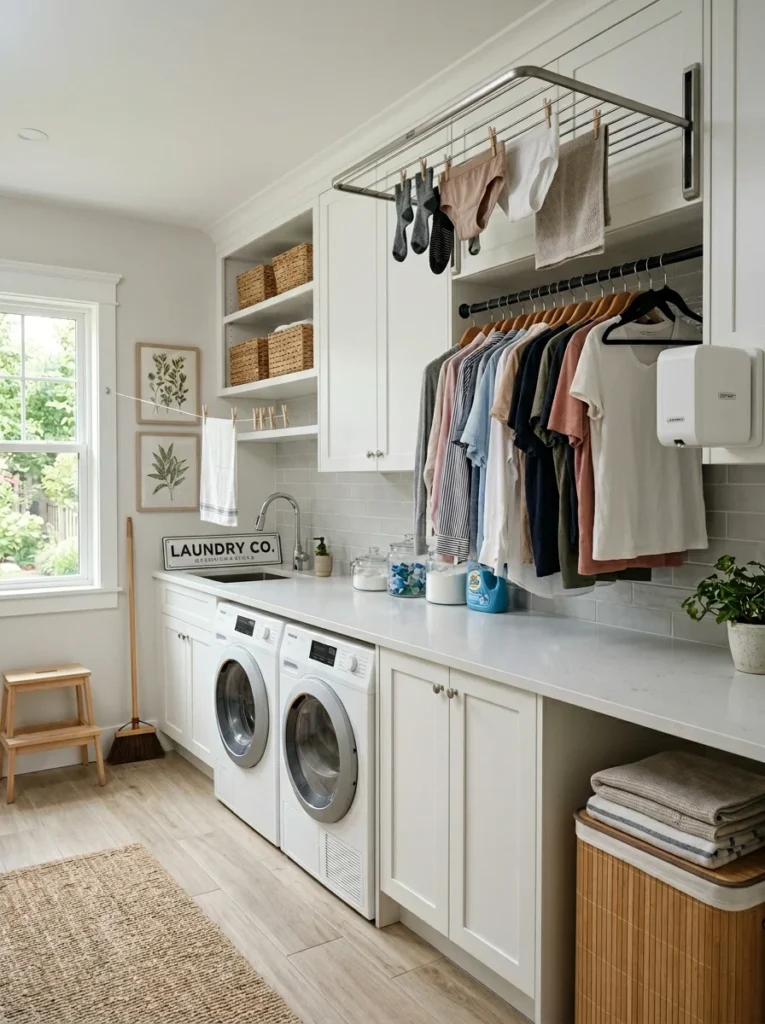
Not all laundry goes through the dryer. Delicate items, wool garments, items with heat-sensitive components, and clothing that shrinks in the dryer all require air drying, and the laundry room needs to accommodate this requirement without creating a tangle of damp clothing draped over every available surface.
The Retractable Clothesline
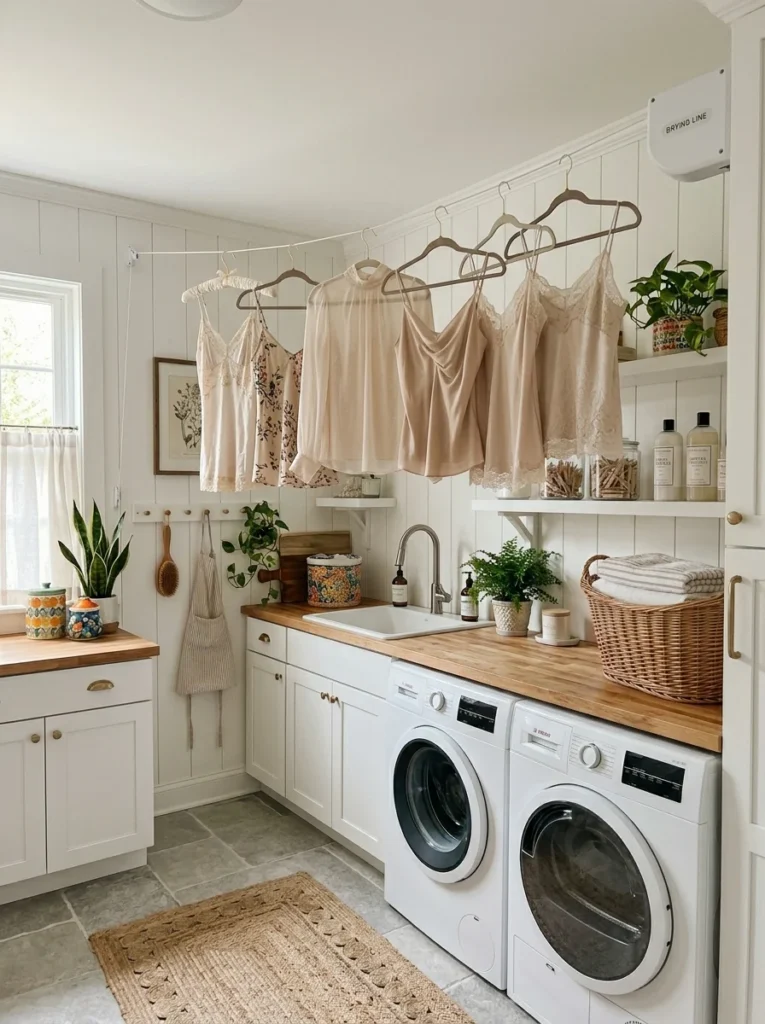
A retractable clothesline — a spring-loaded line that extends from a wall-mounted housing to a hook on the opposite wall when needed and retracts back into its housing when not in use — is the most space-efficient hanging solution for a laundry room. In its retracted position, it is invisible — a small wall-mounted disc at one end and a small hook at the other. In its extended position, it provides a full-length hanging line capable of supporting multiple garments on hangers or draped over the line for drying.
Retractable clotheslines are available in single-line and multi-line configurations. A single line suits small households with modest air-drying needs. A multi-line retractable system — two or three parallel lines that retract together — suits larger households or households with significant air-drying requirements.
The positioning of the retractable line within the laundry room is an important consideration. The line needs to be mounted at a height that allows garments on hangers to hang fully without touching the floor — typically 78 to 84 inches from the floor — and in a location where the space beneath the line is available for the length of time that air drying requires, which can be several hours for heavier garments.
Wall-Mounted Drying Rack
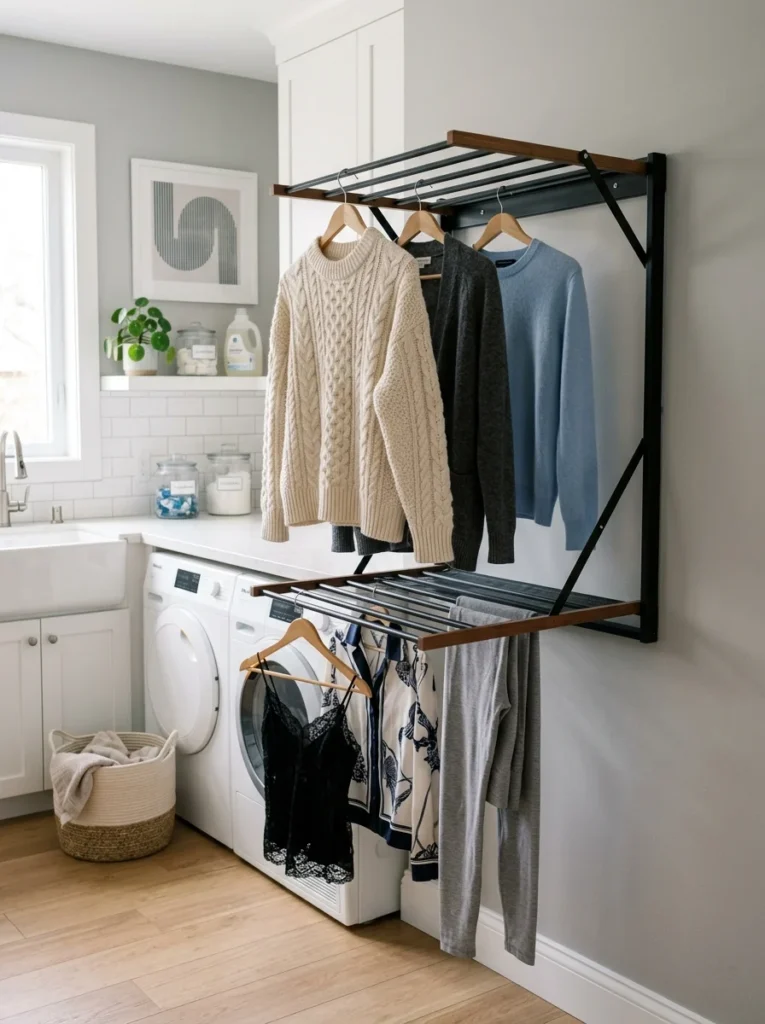
A wall-mounted drying rack — a folding rack with multiple horizontal bars that mounts on the laundry room wall and folds flat when not needed — provides a generous air-drying capacity in a form that uses wall space rather than floor space. In its open position, a wall-mounted drying rack can hold a full laundry load of flat-dried items — sweaters, delicates, and similarly items that cannot hang without distorting. In its folded position, it sits flush with the wall surface and occupies no usable room space.
Wall-mounted drying racks are most appropriate for laundry rooms where flat drying is a regular requirement and where the rack will be used frequently enough to justify the permanent wall mounting. For households with occasional flat-drying needs, a freestanding folding drying rack stored in a closet or corner is a more flexible alternative.
A Rod for Hang-Dry Items
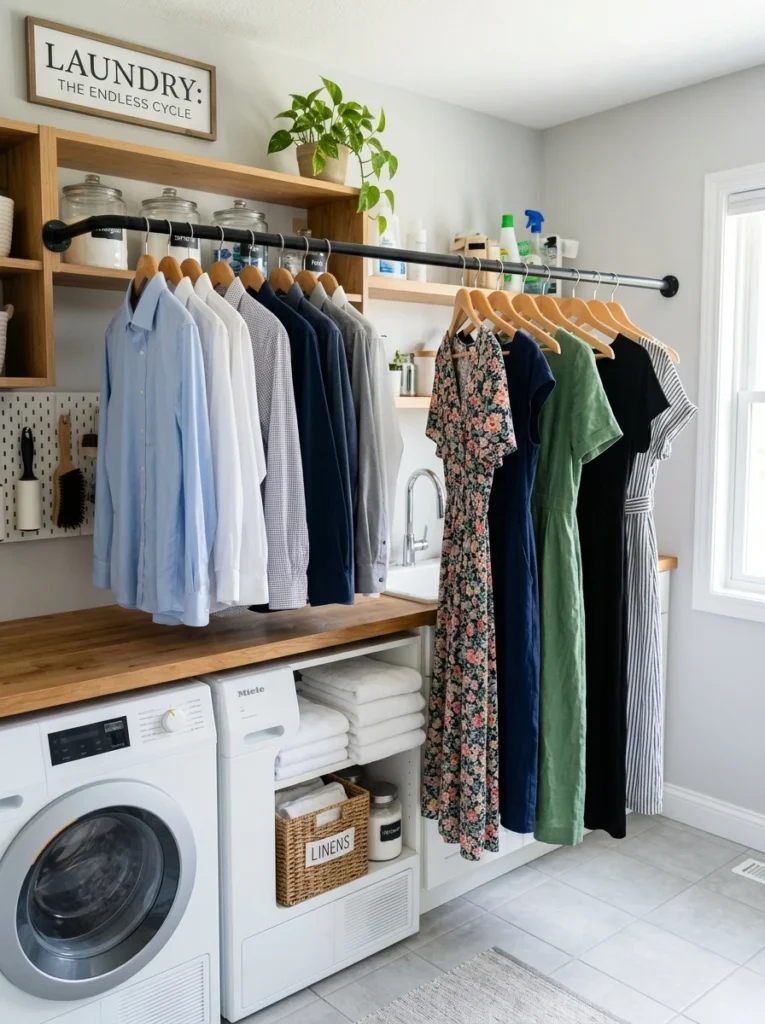
A simple hanging rod — a rod mounted between two walls, between two cabinet sides, or on wall-mounted brackets — positioned in the laundry room at a height that allows garments on hangers to hang fully provides a permanent hanging station for items that come out of the dryer and need to be hung immediately to prevent wrinkles, for items that air dry on hangers, and for freshly ironed items waiting to be returned to the wardrobe.
A hanging rod in the laundry room is one of the most frequently used and most practically valuable features of a well-organized laundry room, and its absence is consistently felt by households that do not have one. The simple act of being able to hang a garment on a hanger immediately after removing it from the dryer — rather than laying it on a surface, putting it in a basket, or carrying it through the house before finding a place to hang it — reduces wrinkles, reduces the ironing requirement, and reduces the number of steps between the dryer and the wardrobe.
Small Supply Organization — The Details That Make a Big Difference
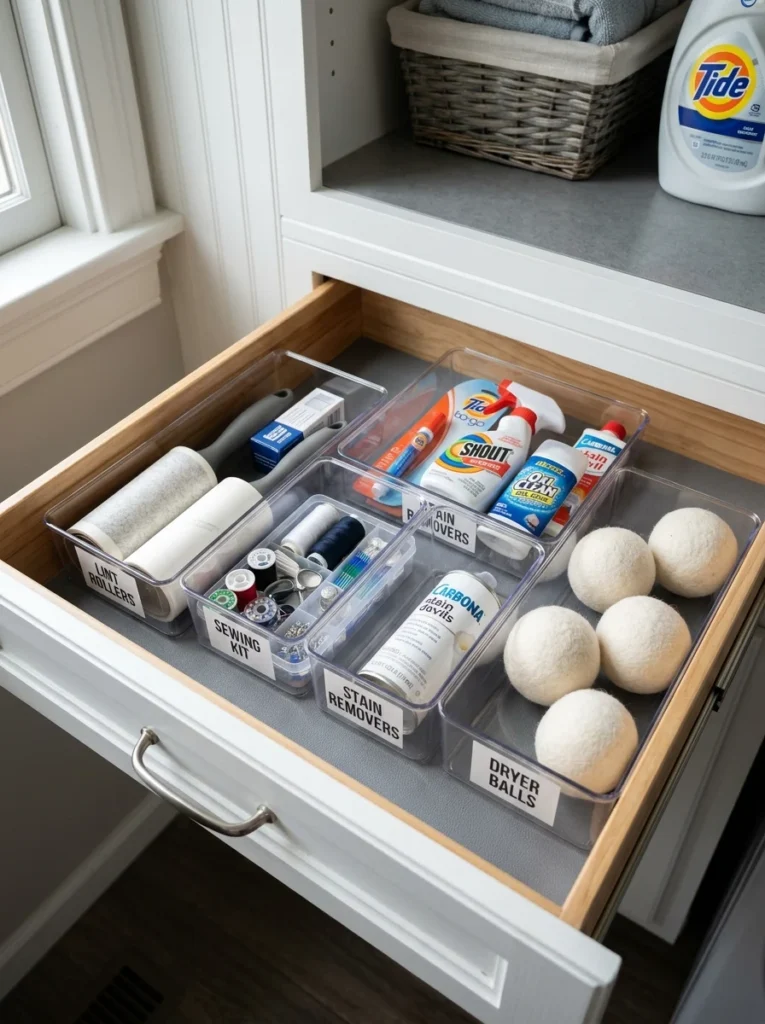
Beyond the primary laundry products and the major organizational elements of the room, every laundry room accumulates a collection of small items — stain removers, lint rollers, safety pins, sewing kits for emergency repairs, spare buttons, laundry bags for delicates, dryer balls, and similar items — that need designated storage to avoid becoming a chaotic accumulation of small clutter on every available surface.
The Dedicated Small Supply Drawer or Box
A dedicated drawer or open box in the active washing zone — labeled and used exclusively for small laundry accessories — gives every small item a designated home within immediate reach of the machines. The contents of this drawer or box should be edited regularly — items that are never used should be removed, items that run out should be replaced, and the drawer should not become a general miscellaneous storage area for items that have no other home in the laundry room.
The Lost Sock System
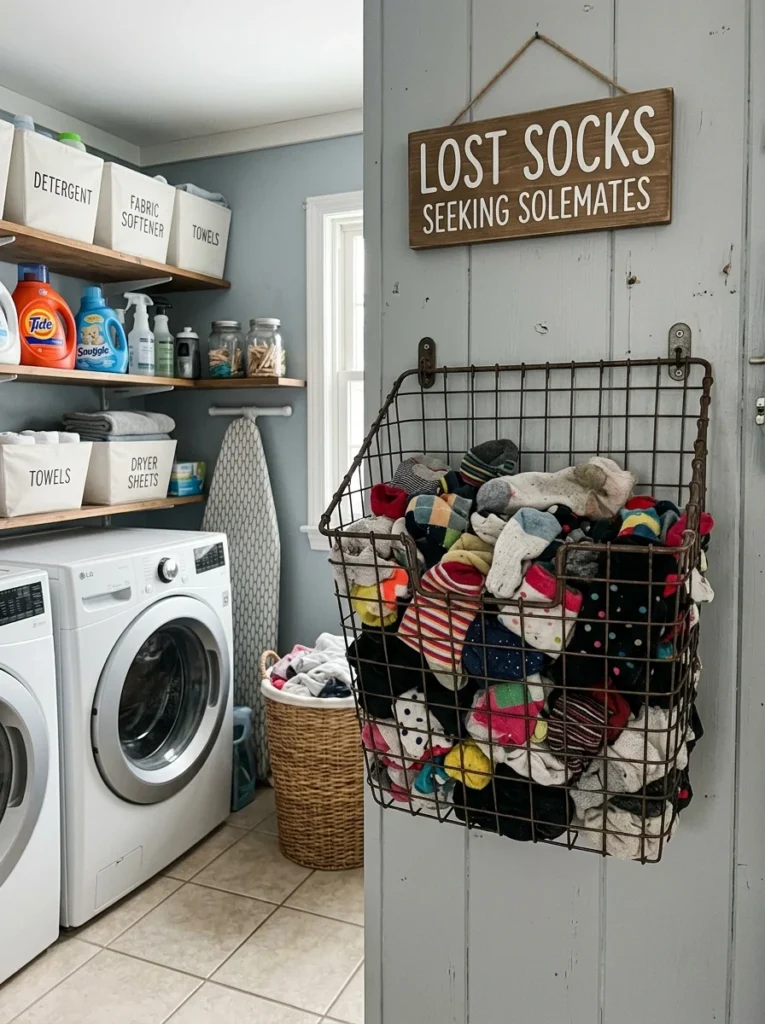
The lost sock — the single sock that emerges from the dryer without its pair — is one of the most persistent and most universally experienced laundry frustrations. A dedicated lost sock container — a small basket, box, or hanging pocket positioned on the laundry room wall or inside a cabinet door — provides a specific home for unmatched socks waiting for their pair to emerge from a future laundry cycle. When a matching pair is found, both socks leave the container together. When socks in the container have been waiting through multiple laundry cycles without finding a match, they are likely permanently separated and can be repurposed or discarded.
This simple system — a dedicated container for unmatched socks — prevents unmatched socks from accumulating on the folding counter, in the clean laundry baskets, and in drawers throughout the house, and gives the perpetually unmatched sock a temporary home that is retrievable rather than lost.
The Maintenance Habits That Keep the System Working
A laundry room organization system that is not supported by consistent maintenance habits deteriorates over the same time scale that any unmanaged space deteriorates — gradually at first, then more rapidly as disorder compounds itself. The maintenance habits that keep the laundry room system functional are simple and require minimal time, but they must be consistent to be effective.
The Empty Machine Rule
Laundry that sits in the washing machine after its cycle completes or in the dryer after drying is finished creates two practical problems simultaneously — the laundry in the machine develops musty odors and may require rewashing, and the next load of laundry cannot be started until the machine is emptied. Establishing the habit of emptying machines immediately when their cycles complete — transferring wet laundry to the dryer or to the hanging station, and folding and removing dry laundry from the dryer before starting the next load — prevents both problems and keeps the laundry cycle flowing without interruption.
The Clear Counter Rule
The folding counter or folding surface in the clean laundry zone should be clear at the end of every laundry session — folded laundry should leave the laundry room and return to its destination in the rest of the house, and the counter should be wiped down and left empty for the next session. A counter that accumulates laundry, laundry products, and miscellaneous items between sessions becomes a surface that requires clearing before it can be used for folding, which adds friction to the start of every laundry session and makes the room feel perpetually disordered.
The Weekly Wipe-Down
A weekly five-minute wipe-down of the laundry room surfaces — the counter, the tops of the machines, the shelves, and the floor — prevents the accumulation of detergent residue, lint, and the general grime that laundry room use generates. A clean laundry room is significantly more pleasant to work in than a grubby one, and the weekly wipe-down is a small investment of time that maintains the quality of the space on a permanent basis.
Conclusion
A well-organized laundry room does not make laundry enjoyable — but it makes it significantly less painful. It does this by eliminating the friction at every stage of the laundry process: dirty laundry goes where it belongs and is pre-sorted for the wash, laundry products are at hand when loading the machines, a clear folding surface allows clean laundry to be folded immediately after drying, hanging solutions accommodate items that cannot go in the dryer, and a clear route returns folded laundry to the rest of the house without intermediate piling.
The three-zone system — dirty laundry zone, active washing zone, clean laundry zone — is the organizational framework that makes all of these elements work together as a cohesive system rather than as a collection of independent solutions. Establishing this system, equipping each zone appropriately, and maintaining it with simple consistent habits transforms the laundry room from a source of daily frustration into a functional space that supports the laundry process efficiently and without drama.
The laundry will always need doing. The right laundry room organization makes sure that doing it takes as little time, as little effort, and as little frustration as possible.