
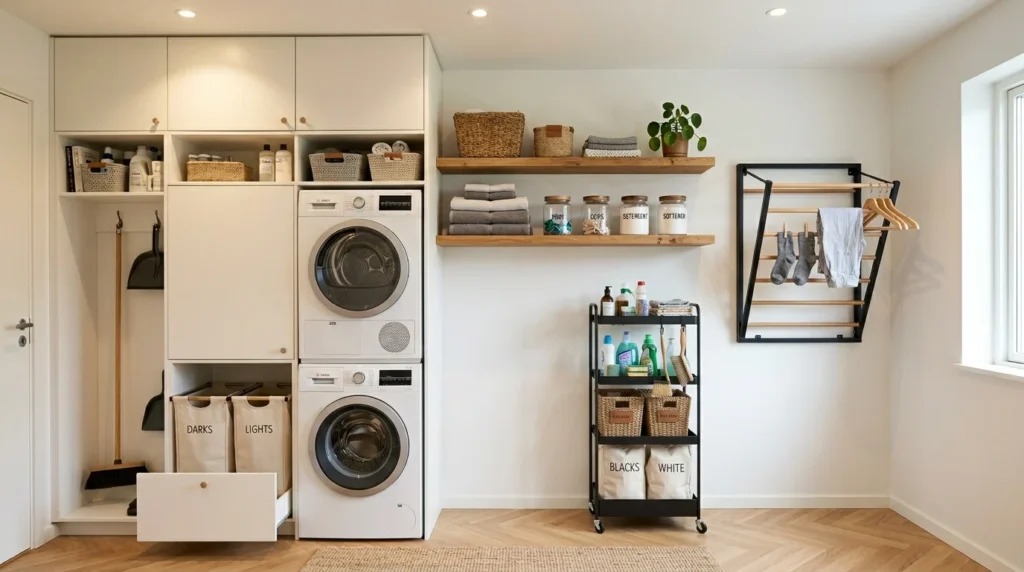
The laundry room is the room in the home that receives the least storage investment relative to its daily use. Most kitchens are designed with storage as a primary consideration — cabinets from floor to ceiling, dedicated drawers for every category of utensil, purpose-built solutions for every storage challenge. Most bathrooms have at least a vanity cabinet and a medicine cabinet. Most bedrooms have a wardrobe. The laundry room, by contrast, typically receives whatever storage is left over after every other room has been considered — a shelf above the machines if there is space, a cabinet if the budget allows, and improvised solutions for everything else.
The consequence of this storage neglect is a laundry room that accumulates clutter on every available surface, where laundry products are stored wherever there happens to be space for them rather than where they are most useful, where clean and dirty laundry coexist in adjacent piles because there is no system to separate them, and where the small accessories that support the laundry process — stain removers, lint rollers, safety pins, spare hangers — disappear into general disorder rather than remaining accessible when needed.
Addressing this storage deficit does not require a full laundry room renovation. The sixteen storage ideas in this guide cover every zone of the laundry room — above the machines, beside the machines, on the door, on the walls, at the floor level, and on every surface — and provide specific, implementable solutions for each zone that can be installed without structural changes in most cases. Some require mounting a bracket or installing a shelf. Most require nothing more than purchasing the right storage product and positioning it in the right place.
The principle underlying all sixteen ideas is the same principle that underlies all effective home storage: every item in the laundry room needs a designated place, every designated place should be in the zone where the item is used, and every storage solution should make accessing and returning items easier rather than harder. Applied consistently across all sixteen ideas, this principle transforms a laundry room from a space of accumulated clutter into one of organized, efficient functionality.
Above-Machine Storage Ideas
Idea 1: Install Full-Width Cabinets Above the Machines
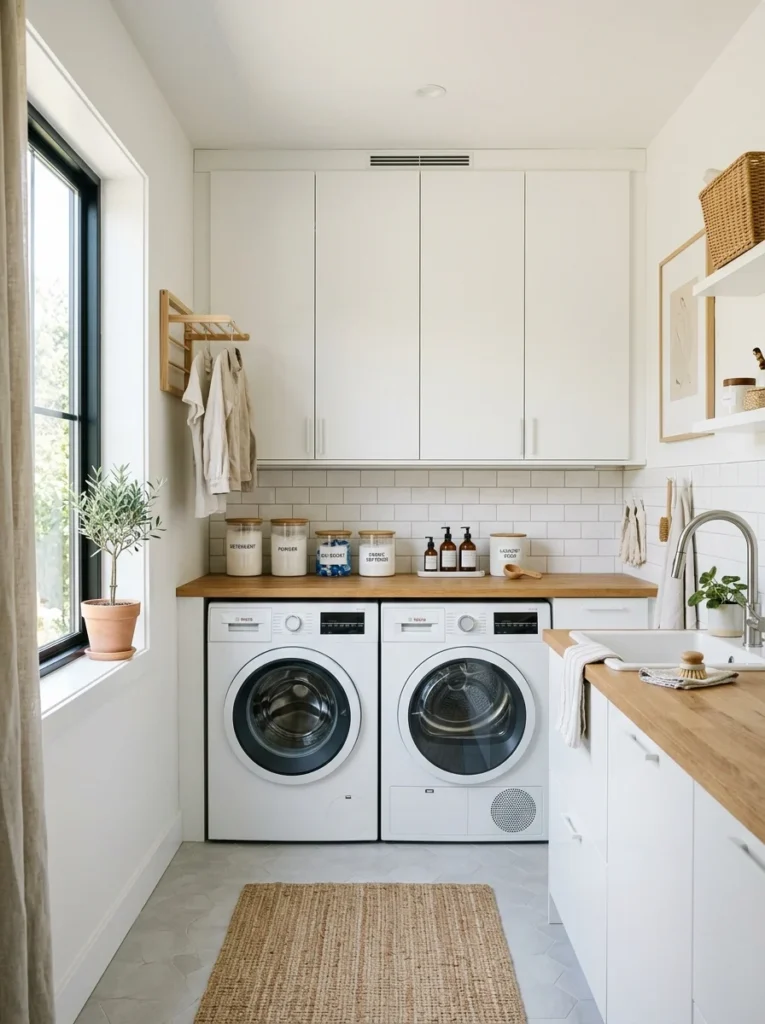
The wall space directly above the washing machine and dryer — a zone that spans the full width of both machines and extends from the top of the machines to the ceiling — is the most valuable storage zone in most laundry rooms, and it is the zone most consistently underutilized. A single shelf above the machines is the most common use of this zone, and it is also the least efficient — a single shelf at one height holds items of that approximate height well and wastes the space above and below.
Full-width wall cabinets installed above the machines — extending from just above the machine tops to the ceiling — use this zone at its maximum capacity. The enclosed cabinet format keeps laundry products, cleaning supplies, and accessories out of sight and the room looking clean regardless of the variety and quantity of products stored inside. Multiple shelves within the cabinet can be configured at different heights to suit the specific items stored — one shelf height for tall detergent bottles, another for flat dryer sheet boxes, another for the collection of smaller accessory items.
When selecting cabinets for above-machine installation, confirm that the cabinet depth suits the available space between the wall and the front edge of the machines. Standard upper kitchen cabinets — 12 to 13 inches deep — are appropriate for most laundry room above-machine installations and provide adequate storage volume without projecting so far from the wall that loading the machines requires reaching under the cabinet overhang.
Idea 2: Add Open Shelving for Frequently Used Products
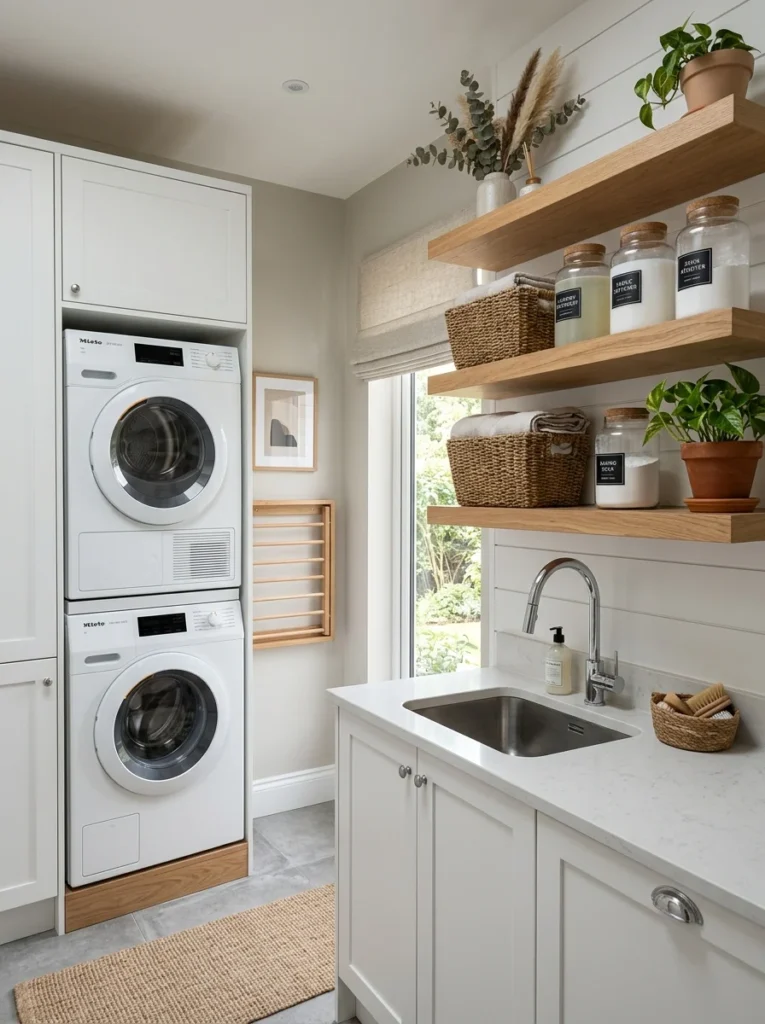
Where full enclosed cabinets are not preferred — either because of budget, because of the aesthetic preference for an open, accessible storage format, or because the wall space above the machines is insufficient for full cabinet height — open shelving provides an accessible alternative that keeps laundry products visible and immediately reachable during the laundry process.
Open shelves above the machines work best when the items stored on them are limited to those used every laundry session — the primary detergent, the fabric softener, and perhaps a stain remover — rather than used as general storage for every laundry-related item the household owns. The visual discipline required to keep open laundry room shelves looking organized rather than cluttered is significant, and limiting the contents to a curated selection of frequently used items is the most reliable way to maintain that discipline.
Decanting laundry products into matching dispensers — a ceramic or glass dispenser for liquid detergent, a clear jar for laundry pods, a simple bottle for fabric softener — transforms an open shelf of laundry products from a collection of commercial packaging in competing colors and sizes into a cohesive, visually calm display. This decanting approach is the single most effective aesthetic improvement available for open laundry room shelving.
Idea 3: Use a Shelf With a Hanging Rod Below
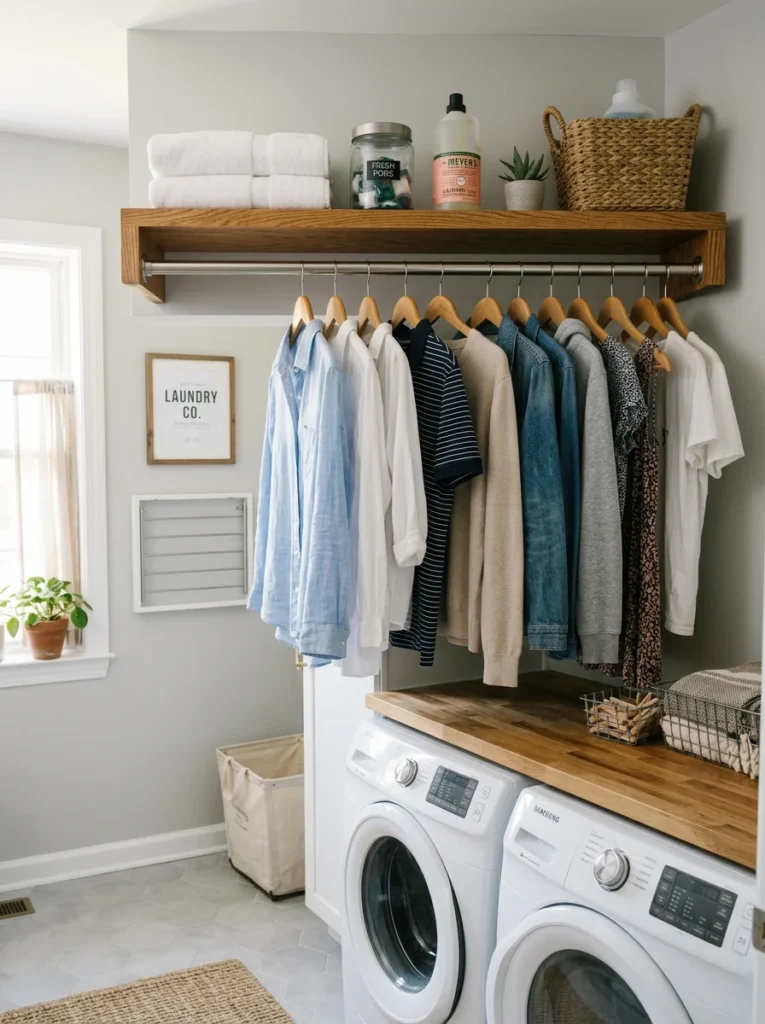
A shelf installed above the machines with a hanging rod mounted on the underside of the shelf — or on a bracket just below the shelf — creates a dual-function storage element that addresses two of the most common laundry room storage needs simultaneously. The shelf surface holds laundry products and accessories. The hanging rod below holds freshly dried items on hangers, air-dry items, and ironed clothes waiting to be returned to the wardrobe.
This shelf-and-rod combination is one of the most space-efficient storage additions available for a laundry room because it provides two distinct storage functions — horizontal surface storage and vertical hanging storage — within the vertical space of a single shelf installation. The rod below the shelf uses the space beneath the shelf that would otherwise be wasted — the air gap between the shelf surface and the top of the machines — as productive hanging storage.
The height of the rod below the shelf must accommodate the full length of hanging garments without the hems touching the machine tops. For standard adult garments on hangers, a clearance of approximately 48 to 54 inches from the rod to the machine top is sufficient — which means the shelf needs to be mounted at approximately 54 to 60 inches above the machine tops for the rod to provide adequate garment clearance.
Side and Between-Machine Storage Ideas
Idea 4: Install a Slim Rolling Cart in the Gap Beside the Machines
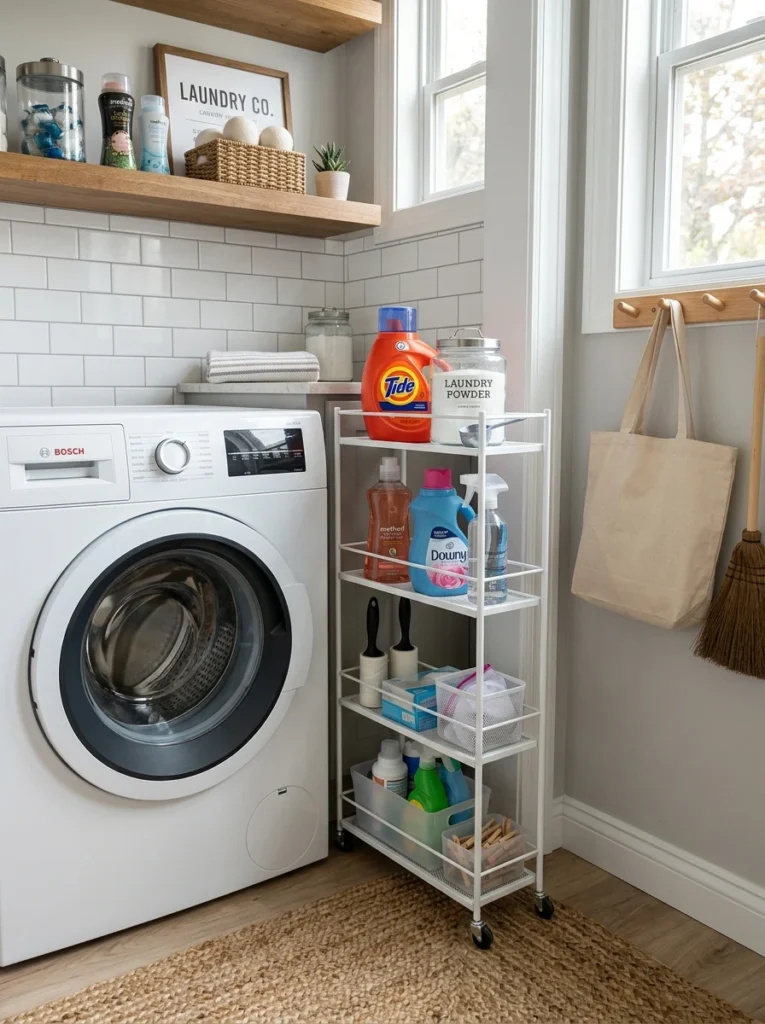
The narrow gap between the washing machine or dryer and the adjacent wall or cabinet is one of the most consistently wasted spaces in the laundry room. In most laundry rooms, this gap — typically four to eight inches wide — is too narrow to be used for any standard storage solution and too awkward to clean, which means it collects lint, dust, and small items that fall between the machines and the wall.
A slim rolling cart specifically designed for this gap — a narrow unit on wheels with multiple shelves or racks for laundry products, accessories, and small items — converts this wasted space into practical, accessible storage. The cart rolls out of the gap for access and rolls back in when not needed, keeping the laundry room visually clean while providing the storage that the gap itself cannot provide in any other format.
Slim rolling carts for laundry room gaps are available in widths from three to eight inches and in heights that match standard washing machine and dryer heights. They typically feature multiple wire shelves or racks that hold bottles, boxes, and small containers. The most useful configurations include a top surface that creates a small additional counter area when the cart is pulled out, and side rails or hooks that hold additional small items.
Idea 5: Add Side-Mount Storage to the Machine Sides
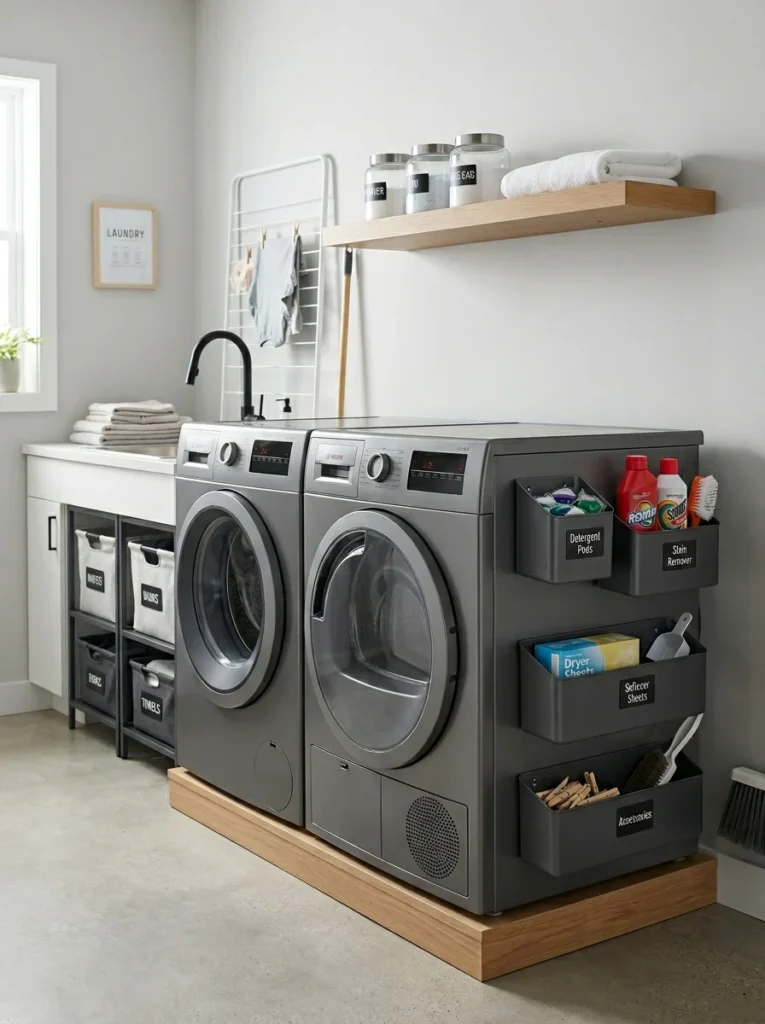
The side panels of washing machines and dryers are smooth, flat metal surfaces that are magnetically receptive in most cases — and magnetic storage accessories designed for appliance sides provide storage on a surface that is otherwise completely unused.
Magnetic storage bins — small bins or baskets with a magnetic back plate that adheres to the side of the machine — hold small laundry accessories such as stain remover sticks, lint rollers, spare dryer sheets, and safety pins on the side of the machine where they are within immediate reach during loading and unloading. The magnetic attachment requires no drilling, no mounting hardware, and no permanent modification to the machine, which makes it one of the most installation-free storage additions available for the laundry room.
Magnetic strips — the same type used for knife storage in kitchens — mounted on the side of a machine hold small metal tools such as scissors for cutting loose threads, seam rippers for emergency repairs, and safety pins. A magnetic strip on the side of the dryer holds a pair of scissors and a small collection of safety pins within immediate reach during the folding and sorting process.
Door Storage Ideas
Idea 6: Mount an Over-Door Organizer on the Laundry Room Door
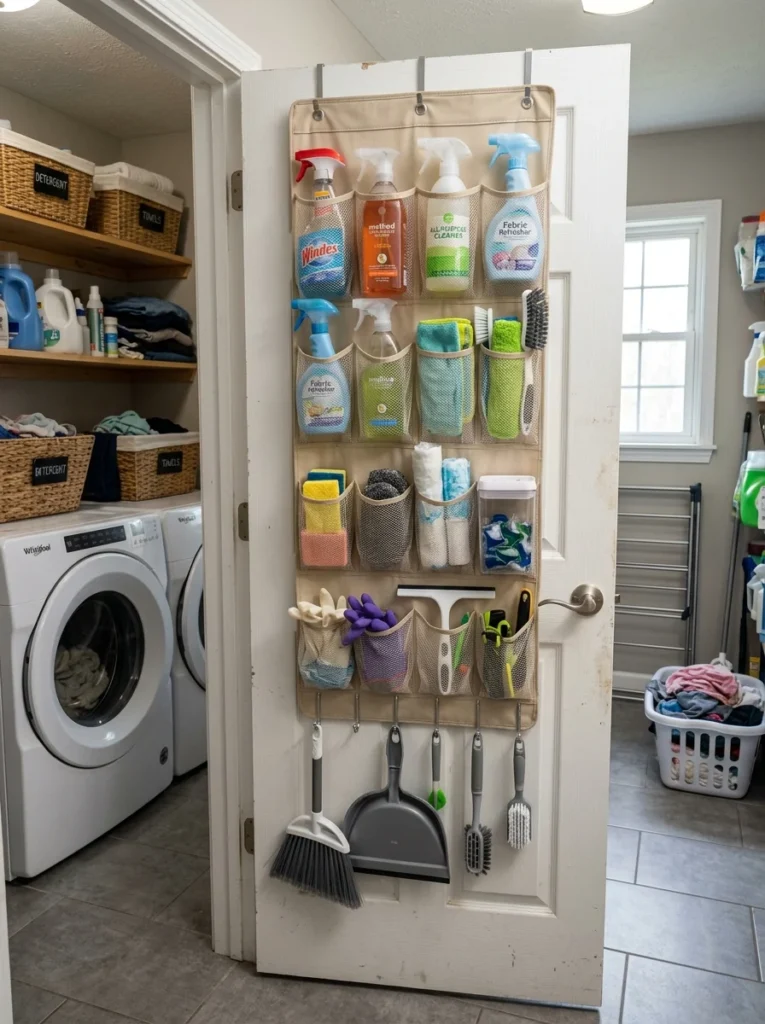
The back of the laundry room door is a flat vertical surface that is typically left completely unused despite being a meaningful storage area. An over-door organizer — a unit that hangs over the top of the door and provides pockets, shelves, or hooks on the door’s back surface — converts this unused surface into practical storage without any drilling or permanent modification.
Over-door organizers for laundry rooms are available in several formats suited to different storage needs. A pocket organizer with multiple fabric or plastic pockets of varying sizes holds small items — dryer sheets, stain remover sachets, laundry bags, spare sponges, and similar small accessories. A wire shelf organizer with horizontal shelves holds larger items — bottles, boxes, and containers. A hook strip provides hanging storage for aprons, cleaning cloths, and bag handles.
The most practical over-door organizer for a laundry room is one with a combination of shelf space for bottles and boxes, pocket space for small loose items, and at least one or two hooks for hanging items. This combination addresses the full range of small-item storage needs that accumulate in a laundry room without requiring multiple separate organizers.
Idea 7: Mount an Ironing Board Holder on the Back of the Door
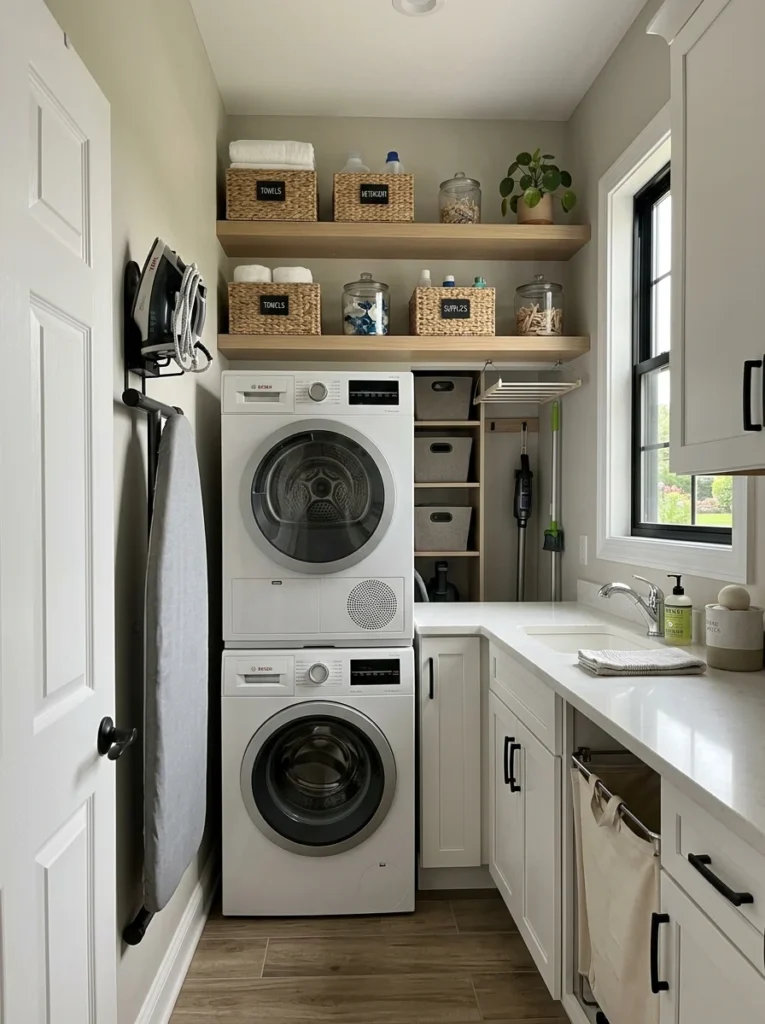
An ironing board is one of the most awkward items to store in a laundry room because of its size and its irregular shape — it is too long to stand upright in most storage configurations without falling, too bulky to lie flat without consuming a significant floor area, and too regularly used to justify storing it in a location that is inconvenient to access.
A wall-mounted or door-mounted ironing board holder — a bracket system that holds the ironing board flat against the door or wall surface in a secure, stored position — resolves the ironing board storage problem by using vertical wall or door space rather than floor space. The ironing board is held in a horizontal or slightly angled position against the surface, where it is completely out of the way of the room’s floor space and immediately accessible when needed by lifting it off the bracket.
Door-mounted ironing board holders are available as over-door units that require no drilling, and as surface-mounted units that attach to the door back with screws. The over-door format is simpler to install and reversible — it can be removed without any damage to the door — while the surface-mounted format provides a more secure hold for heavier ironing boards.
Wall Storage Ideas
Idea 8: Install a Pegboard for Fully Customizable Wall Storage
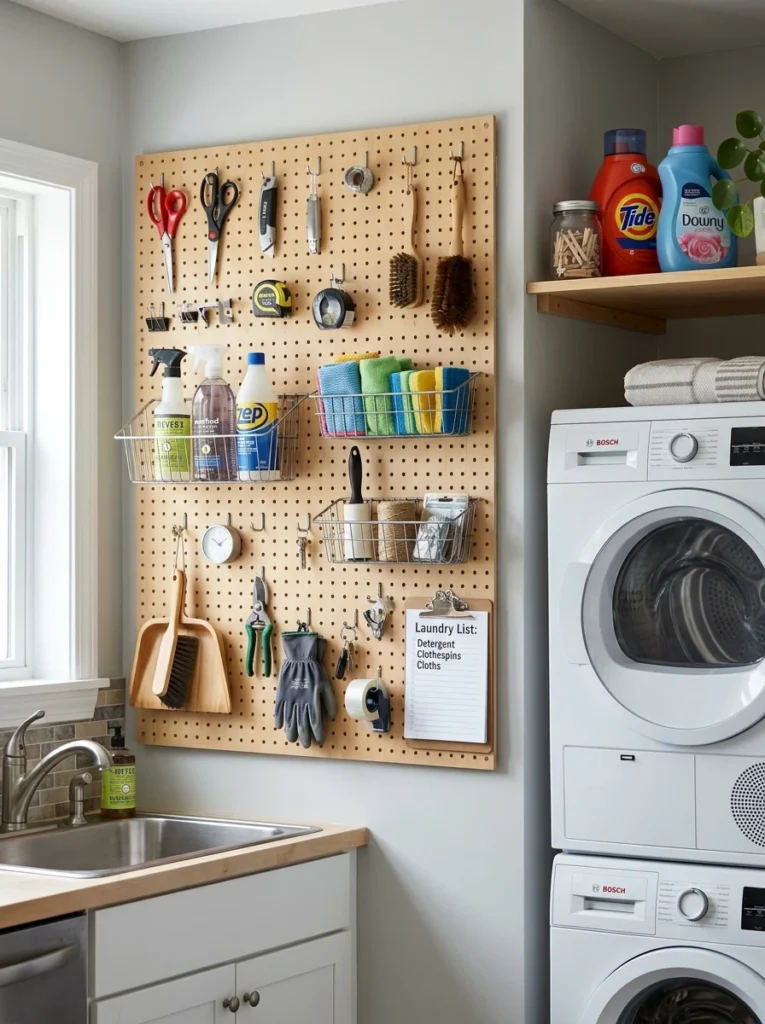
A pegboard mounted on the laundry room wall creates a completely customizable vertical storage surface that adapts to any combination of storage needs. Pegboard hooks, shelves, baskets, bins, and holders slot into any hole on the board and can be repositioned in seconds without tools — which means the storage configuration can be changed as the room’s storage needs evolve without any additional drilling or mounting.
In a laundry room, pegboard is most useful for storing the collection of small tools and accessories that support the laundry process — scissors, a seam ripper, a fabric shaver for removing pilling, a small brush for treating stains, spare hooks and hangers, and similar small items that have no natural home in the cabinet and drawer storage of the room. These items, hung on pegboard hooks or held in small pegboard bins, are visible, accessible, and organized without consuming any counter or shelf space.
A pegboard painted in the same color as the laundry room wall nearly disappears visually while still providing full storage function. A pegboard in a contrasting accent color — white pegboard on a grey wall, for example — becomes a deliberate design feature that adds visual interest to the room’s most utilitarian wall.
Idea 9: Add a Wall-Mounted Drying Rack
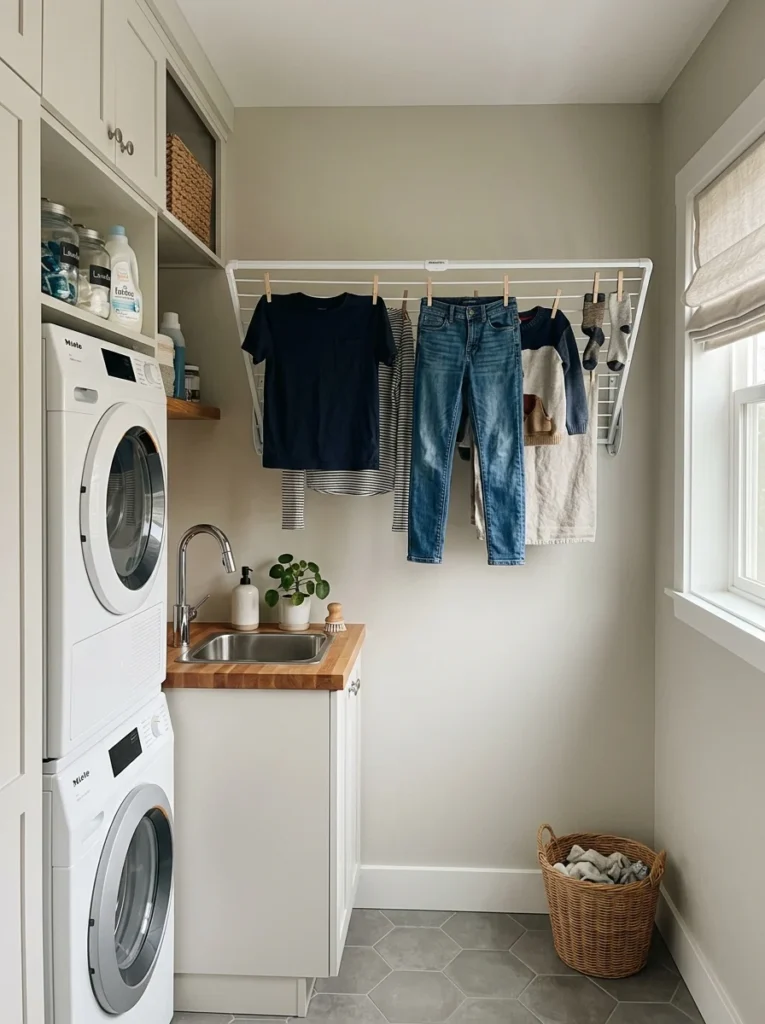
A wall-mounted drying rack — a folding rack with multiple horizontal bars that mounts on the wall and folds flat when not in use — provides generous air-drying capacity without consuming any floor space. In its extended position, the rack holds multiple garments for flat drying or draping. In its folded position, it sits flush with the wall and leaves the full floor area of the laundry room accessible.
The most useful wall-mounted drying racks for laundry rooms have three to five horizontal bars of sufficient length to hold full-size garments without items overlapping so much that air circulation between them is prevented. Overlapping items on a drying rack dry significantly more slowly than items with adequate spacing between them — a rack with fewer bars spaced further apart dries items faster than one with many bars packed closely together.
The installation position of the wall-mounted drying rack should be chosen to provide adequate clearance below the rack when extended — enough space for flat-drying items to hang slightly below the rack bars without touching any surface below them, and enough ceiling clearance above the wall for the rack to fold upward if it is a fold-up rather than fold-down design.
Idea 10: Use Wall-Mounted Broom and Mop Holders
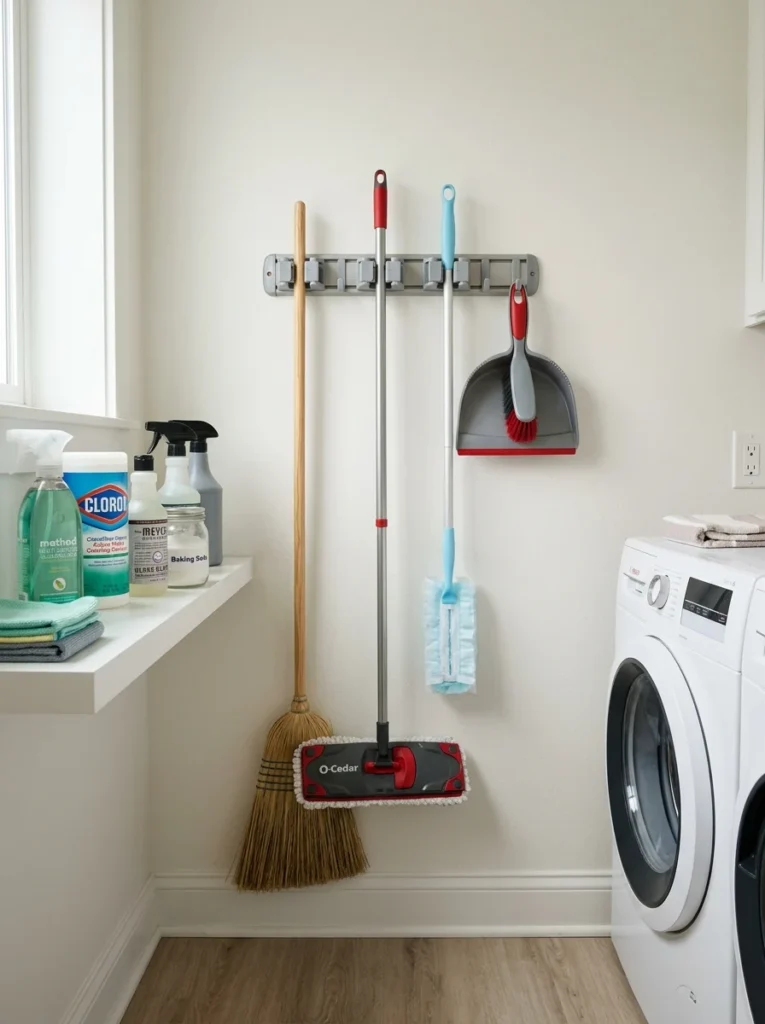
Cleaning tools — brooms, mops, dustpan and brush sets, and similar long-handled tools — are regularly stored in laundry rooms because the laundry room is the designated cleaning utility space of the home. These tools have irregular shapes and varying lengths that make them resistant to standard storage solutions — they fall over when stored upright in a corner, they do not fit in standard drawers or cabinets, and they take up disproportionate floor space when leaned against a wall.
Wall-mounted broom and mop holders — strips with spring-loaded clamps or rubber-tipped clips that grip the handles of cleaning tools and hold them against the wall — provide clean, secure, floor-free storage for cleaning tools in a narrow wall-mounted format that uses almost no wall space. A single holder strip can hold four to six cleaning tools in a vertical arrangement that keeps all of them accessible without any tool being hidden behind another.
Counter and Surface Storage Ideas
Idea 11: Use a Tray System to Corral Counter Items
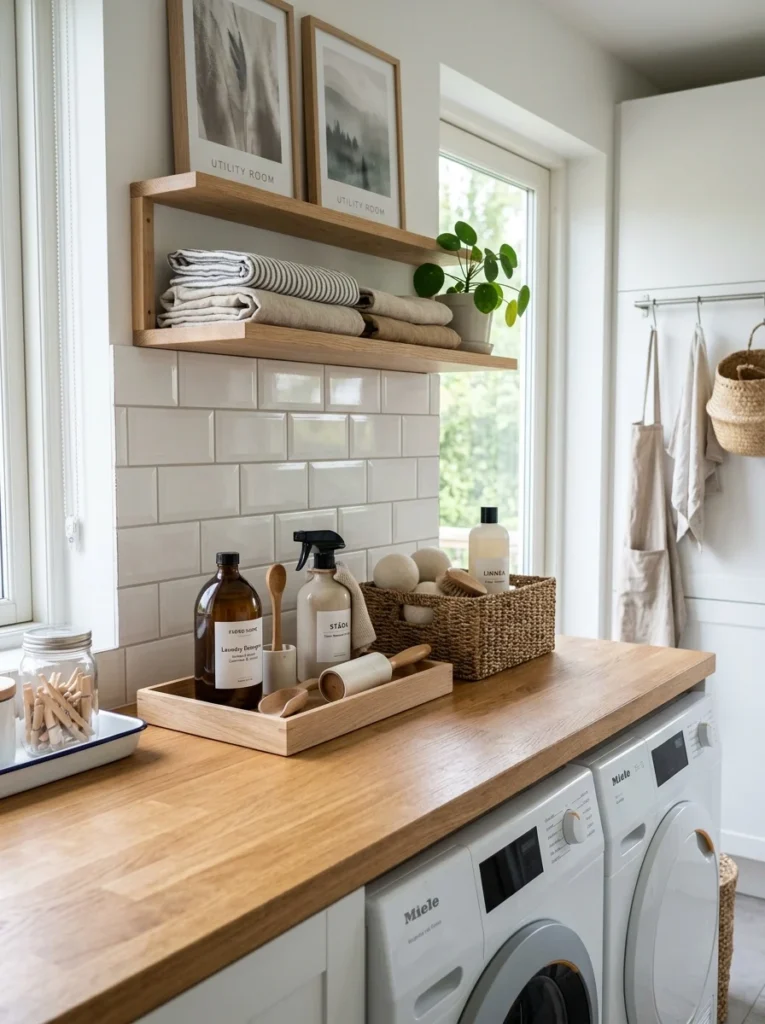
The folding counter above the machines — or whatever flat surface serves as the primary working surface in the laundry room — is the surface most prone to accumulating random items that have no other designated home. Laundry products temporarily set down during loading, accessories retrieved for a specific task and not returned, and miscellaneous items that migrate from other rooms all end up on the laundry room counter and gradually transform it from a functional working surface into a storage shelf.
A tray system — one or two defined trays on the counter surface that contain specific categories of items — creates implicit boundaries that prevent the counter from becoming general storage. Items within the tray are organized and contained. Items outside the tray have no designated counter position and need to be stored elsewhere. The tray functions as a physical boundary that communicates the counter’s primary purpose — as a working surface, not a storage shelf — and limits the natural tendency of surfaces to accumulate items.
A single tray near the machines holds the laundry products in active use during a laundry session — the detergent, the fabric softener, and the stain remover — in a contained group that is accessible during loading without spreading across the counter surface. A second tray or basket near the folding area holds the small accessories used during folding — safety pins, the lint roller, the laundry marker for labeling items — in a similar contained group.
Idea 12: Add a Wall-Mounted Fold-Down Shelf for Extra Counter Space
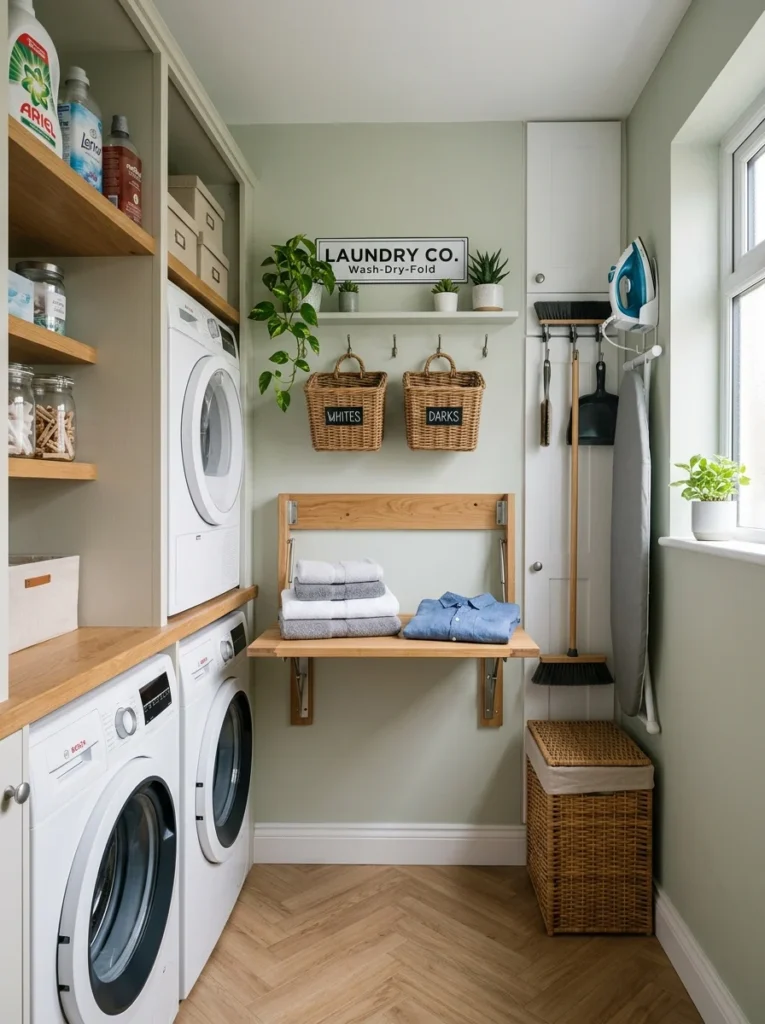
In laundry rooms where the counter above the machines is the only flat working surface and where the available counter area is insufficient for comfortable folding, a wall-mounted fold-down shelf provides additional counter space when needed without permanently reducing the room’s available floor area.
A fold-down shelf mounted on the wall adjacent to the machines — at counter height, approximately 36 inches from the floor — folds down to provide an additional horizontal surface for folding, sorting, and temporary item placement during a laundry session, and folds back flat against the wall when the session is complete. In its folded position, the shelf occupies only the depth of the shelf surface — typically two to three inches — against the wall.
Under-Counter and Floor-Level Storage Ideas
Idea 13: Install Pull-Out Hampers Under the Counter
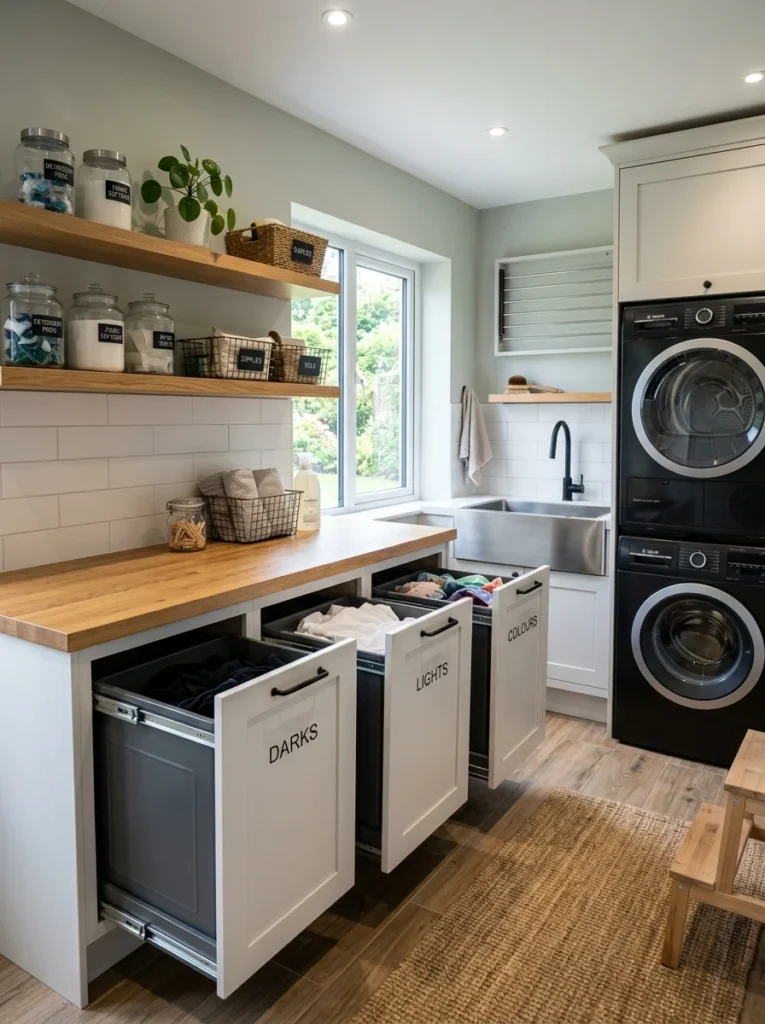
In a laundry room with a counter spanning the machines or a custom-built laundry counter unit, the space below the counter and beside or between the machines is a storage zone that can accommodate pull-out hampers — rolling hamper units that slide out from under the counter for loading and push back under it when not in use.
Pull-out hampers built into the counter structure of a laundry room are one of the most sophisticated and most space-efficient dirty laundry storage solutions available. The hampers are fully concealed when pushed in, keeping the laundry room looking clean and organized even when multiple loads of unsorted laundry are waiting. They are immediately accessible for sorting, and they roll directly to the machines for loading without requiring the hamper to be carried across the room.
Custom pull-out hamper systems — built into the cabinet structure of a laundry room during renovation — are the most refined version of this solution. Freestanding pull-out hamper units — rolling hamper frames with canvas bags that can be installed under an existing counter without cabinet modification — provide a similar function at a significantly lower cost and without renovation.
Idea 14: Use Pedestal Drawers Under Front-Load Machines
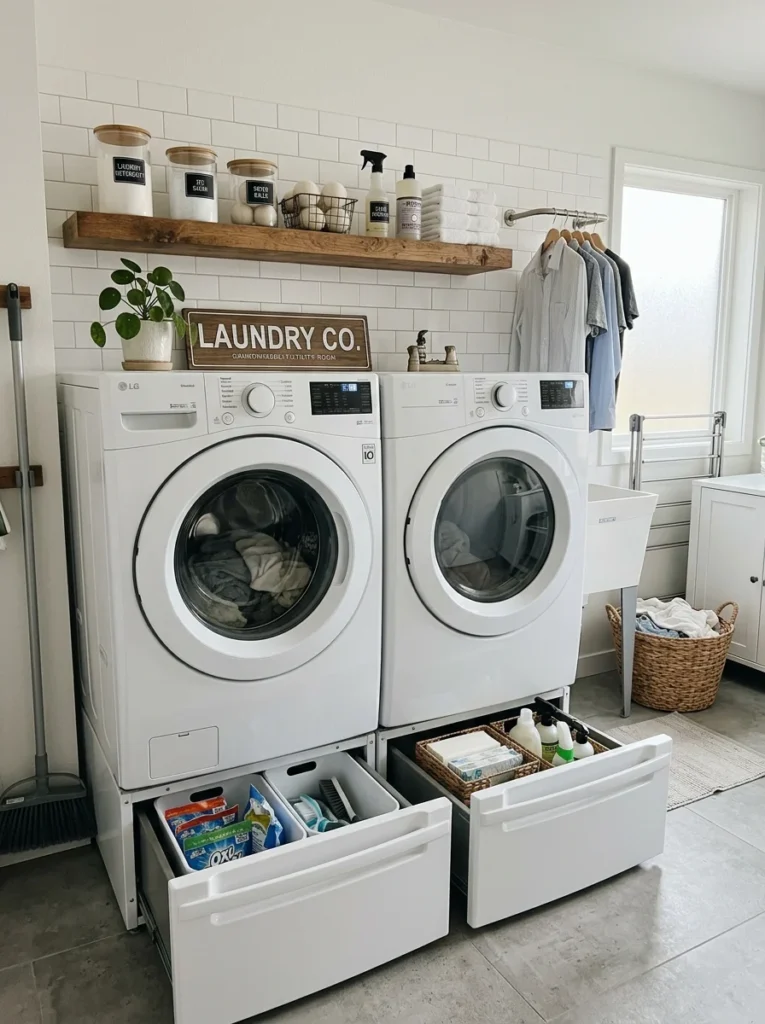
Many front-loading washing machine and dryer manufacturers offer matching pedestal units — raised platforms with a large drawer below that the machine sits on top of. These pedestals raise the machine door to a more ergonomically comfortable height — reducing the bending required to load and unload the machine — and provide a generous drawer for laundry room storage in the space below the machine that would otherwise be an inaccessible gap between the machine base and the floor.
The drawer in a washing machine or dryer pedestal is large enough to hold multiple laundry supplies — detergent, fabric softener, dryer sheets, and similar products — along with accessories and small items. It provides enclosed, organized storage in the most valuable proximity to the machines — directly below the appliances that use the products stored within it.
Aftermarket pedestal alternatives — pedestal units produced by third-party manufacturers that are compatible with multiple machine brands and models — are available at lower cost than manufacturer-matched pedestals and provide the same ergonomic and storage benefits.
Idea 15: Add Rolling Bins for Bulk Storage
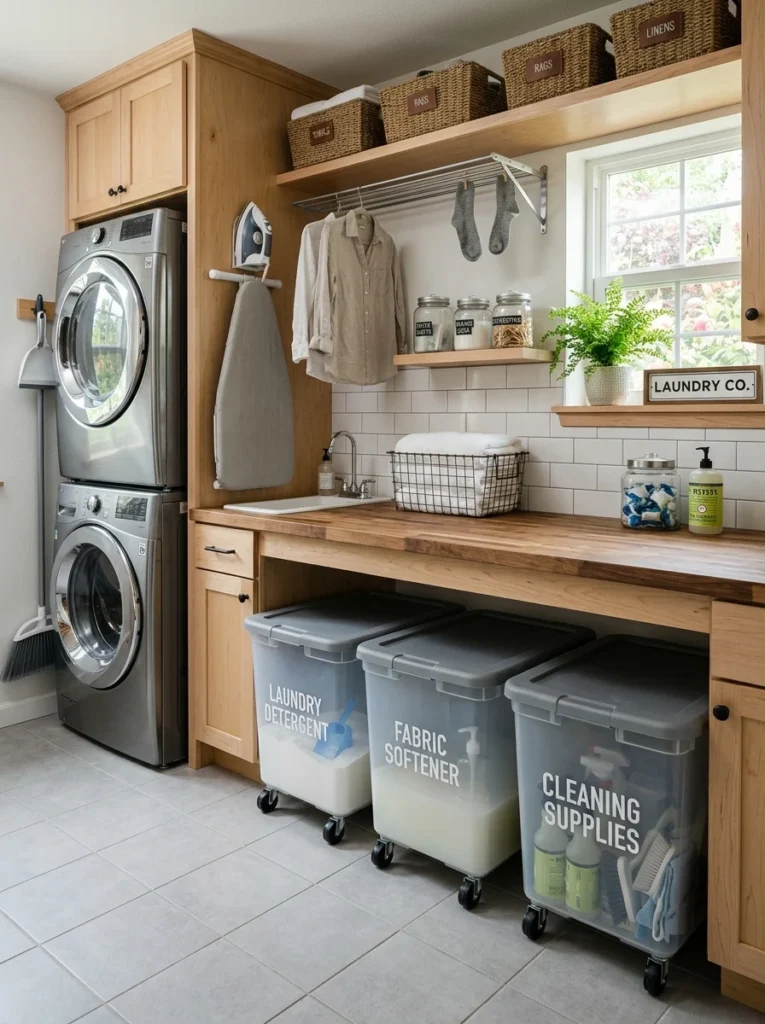
Bulk laundry supplies — large bags of laundry powder, bulk quantities of fabric softener sheets, spare cleaning products, and similar large-format items that are used regularly but do not fit in standard cabinet storage — need a dedicated storage zone in the laundry room that keeps them organized and accessible without consuming the primary storage areas that are needed for everyday-use items.
Rolling bins — large bins on casters that can be moved around the laundry room floor without lifting — provide floor-level bulk storage that is accessible from above by lifting the lid, can be rolled to wherever they are needed for restocking, and can be pushed under a counter or into a corner when not in active use. A rolling bin dedicated to bulk laundry powder, for example, allows the bulk purchase to be stored in a sealed container that protects it from moisture and keeps the measurement process clean — a scoop stored inside the bin provides consistent dosing without the mess of scooping from an open bag.
Specialty Storage Ideas
Idea 16: Create a Dedicated Cleaning Supply Station
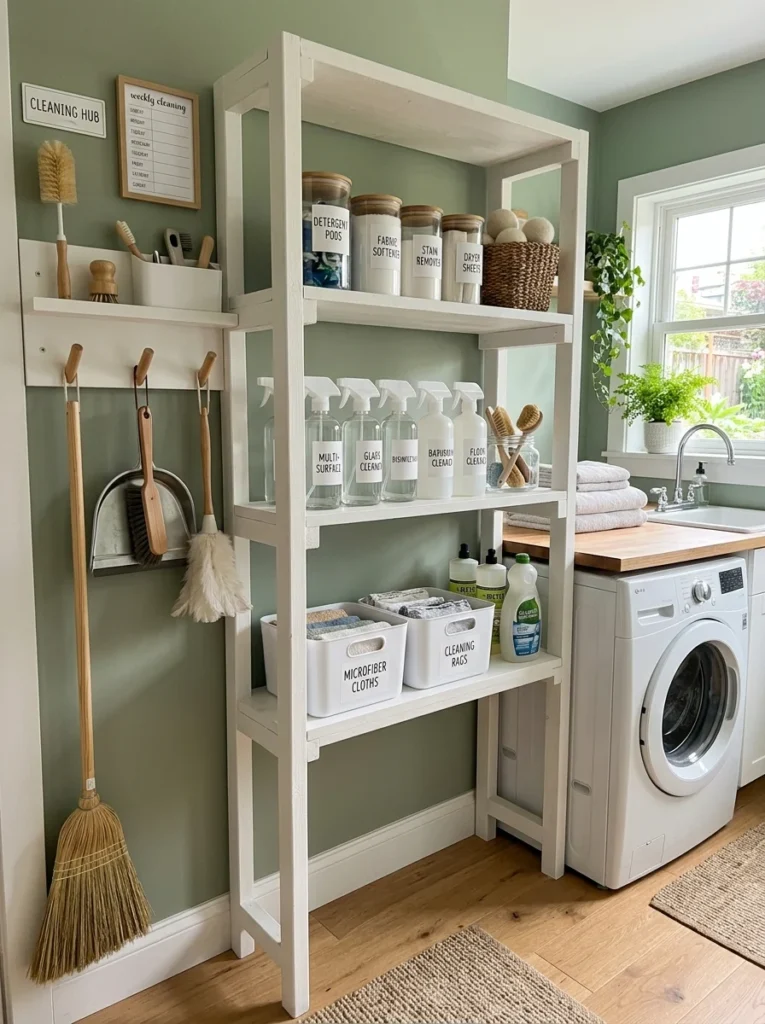
The laundry room typically serves as the home’s cleaning supply storage room as well as its laundry space — cleaning products, mops, brooms, buckets, and similar cleaning equipment share the laundry room with the washing and drying appliances and their associated supplies. Without a dedicated system for cleaning supply storage, the cleaning items and the laundry items gradually intermingle into a general accumulation that serves neither function well.
A dedicated cleaning supply station — a defined zone within the laundry room with specific storage solutions for cleaning products, tools, and equipment — keeps cleaning supplies organized and separate from laundry supplies. This zone can be as simple as a dedicated shelf or cabinet section with labeled storage for cleaning products and hooks or holders for cleaning tools, or as comprehensive as a purpose-built cleaning supply cabinet with doors that conceal the entire collection.
The most important element of the cleaning supply station is the separation of cleaning chemicals from laundry products. Cleaning chemicals — bleach, multi-surface cleaners, descalers, and similar products — should not be stored intermingled with laundry detergents and fabric softeners, both for safety reasons and for organizational clarity. A dedicated closed cabinet or a clearly demarcated shelf section for cleaning chemicals keeps them separate, visible as a category, and inaccessible to children who might enter the laundry room.
Putting It All Together — A Practical Storage Improvement Plan
The sixteen storage ideas in this guide address every zone of the laundry room, from the ceiling-height cabinets above the machines to the floor-level rolling bins. Not every idea is appropriate for every laundry room — the right selection depends on the specific dimensions, layout, and storage needs of the room in question.
The most practical approach to implementing these ideas is to prioritize them by impact and by ease of implementation. The highest-impact and most immediately implementable improvements are the ones that address the most significant current storage problems in the specific laundry room — the zone where clutter accumulates most persistently, the area where the most frequently needed items are hardest to access, or the storage challenge that creates the most friction in the daily laundry process.
For most laundry rooms, the highest-priority storage improvements are full-width cabinets or shelving above the machines — which addresses the largest available storage zone and the most frequently accessed storage location simultaneously — and an over-door organizer for small items and accessories — which addresses the most commonly lacking small-item storage in a format that requires no installation beyond hanging over the door.
The second priority for most laundry rooms is the folding surface and hanging rod combination — which directly addresses the clean laundry zone’s primary requirement for a functional processing area — and a slim rolling cart in the gap beside the machines, which converts a consistently wasted space into productive storage without structural modification.
The remaining ideas — wall pegboard, magnetic side-mount storage, pull-out hampers, pedestal drawers, and the cleaning supply station — are implemented as the primary storage improvements are in place and as the budget and the available time allow.
Conclusion
A laundry room with adequate, well-organized storage is a fundamentally more functional space than one where storage has been improvised or neglected. The sixteen ideas in this guide address every dimension of laundry room storage — above, beside, behind, below, and on the walls — and provide specific solutions for each that can be implemented without structural renovation in most cases.
The underlying principle throughout is that every item in the laundry room needs a designated place, that designated place should be in the zone where the item is used, and the storage solution should make accessing and returning items easier rather than harder. Applied consistently, this principle transforms a laundry room from one of the most disorganized rooms in the home to one of its most efficiently organized — a space where the laundry process flows smoothly from start to finish without the friction of inadequate storage creating obstacles at every stage.
The investment in laundry room storage pays dividends that extend beyond the laundry room itself. A laundry room that works efficiently reduces the time and effort that laundry requires throughout the week, keeps clean laundry moving promptly back to the rest of the house, and makes a routine that is rarely anticipated with pleasure at least one that is completed without frustration.