
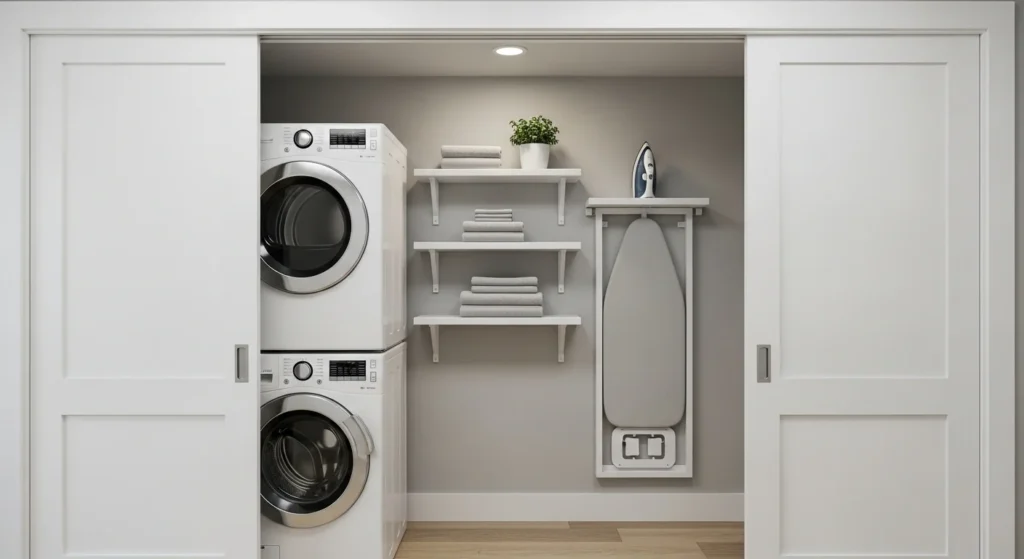
The small laundry room — or the laundry space that barely qualifies as a room at all — is one of the most common and most persistently challenging design situations in residential homes. A closet converted to hold a stacked washer and dryer with no room for anything else. A narrow alcove between the kitchen and the garage that accommodates the machines but nothing more. A bathroom corner where a washing machine has been fitted beside the toilet. A hallway recess with bifold doors that conceal a laundry setup so tight that loading the machines requires a particular sequence of movements.
These are the laundry situations that most home organization content ignores in favor of the spacious, beautifully appointed laundry rooms that appear in design publications — rooms with custom cabinetry, generous countertops, dedicated folding areas, and enough natural light to make the space genuinely pleasant to work in. For the many households working with a fraction of this space, that content is simultaneously aspirational and irrelevant.
This guide is written for the small laundry space — the space where the machines barely fit, where storage is a genuine challenge rather than a styling opportunity, and where making the space functional requires problem-solving rather than simply choosing between beautiful options. Every idea covers a specific challenge of the small laundry room and provides a practical, implementable solution that works within real constraints of space, budget, and the fixed positions of plumbing and electrical connections.
The goal of designing a small laundry room well is not to make it look like a large one — that is neither achievable nor necessary. The goal is to make it work as well as any laundry space can work in its given dimensions: to accommodate the machines comfortably, to provide adequate storage for the supplies and accessories the laundry process requires, to include a functional solution for folding and hanging clean laundry, and to look sufficiently neat and considered that the space feels intentional rather than improvised.
These goals are achievable in even the smallest laundry spaces, and achieving them produces a room that functions reliably and pleasantly for every laundry session that takes place within it.
Section 1: Maximizing the Machine Configuration
The Stacked Washer and Dryer — When It Makes Sense
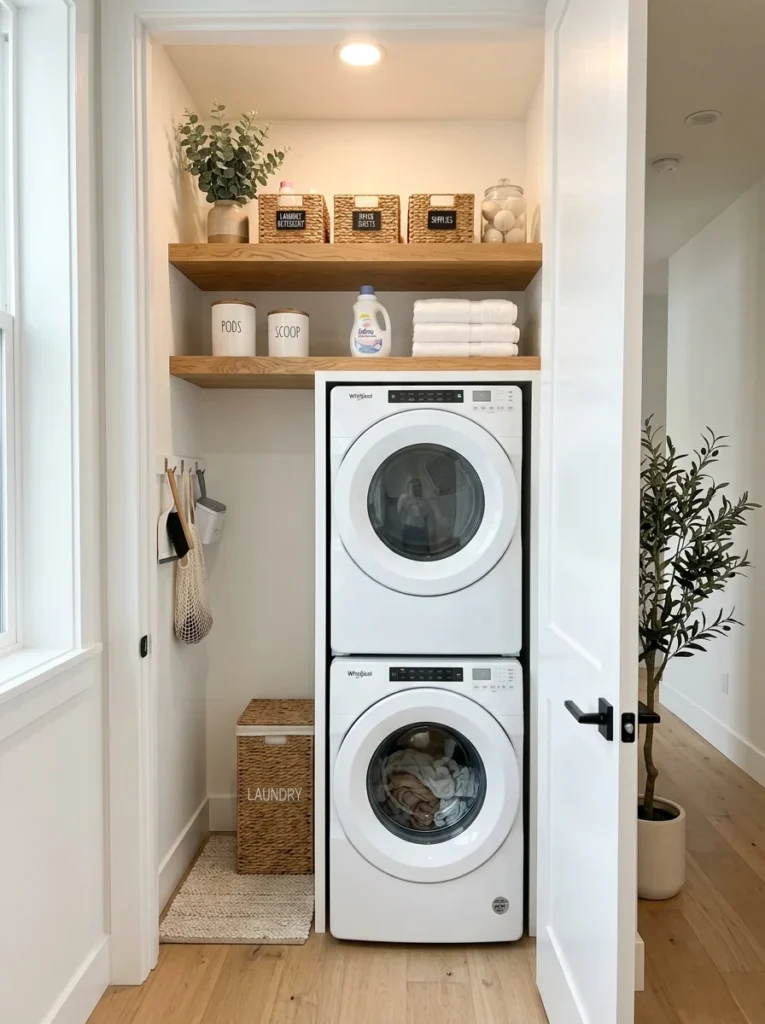
The most fundamental space-saving decision in a small laundry room is whether to stack the washer and dryer vertically — one on top of the other — rather than placing them side by side horizontally. Stacking reduces the floor footprint of the two machines from double the width of one machine to the width of a single machine, which in a narrow laundry space can be the difference between a room that works functionally and one that does not.
The floor footprint of a standard front-loading washing machine and dryer placed side by side is approximately 54 to 60 inches wide and 27 to 30 inches deep. The same two machines stacked vertically occupy approximately 27 to 30 inches wide and 27 to 30 inches deep — roughly half the floor width. In a laundry closet or alcove where the width is limited to 30 to 36 inches, stacking is not simply a preference — it is the only configuration that fits.
Stacking requires front-loading machines — a top-loading washing machine cannot have a dryer placed above it because the top-loading door cannot open. Both machines must be compatible with stacking, which in practice means either purchasing machines from the same manufacturer in a stacking-compatible configuration or using a universal stacking kit that bridges machines from different manufacturers.
The practical consideration of stacked machines that is most frequently cited as a limitation is the height of the dryer when stacked — the dryer door is positioned at approximately 60 to 70 inches from the floor when stacked above a washing machine, which is above the comfortable loading height for shorter adults. For household members under approximately 5’4″, loading and unloading the stacked dryer can be physically awkward. This consideration is real but manageable in most situations — a small step stool stored beside the stacked unit provides the additional height needed for comfortable dryer access and occupies minimal floor space.
The Stacking Kit — What to Know Before Purchasing
A stacking kit is a metal frame or bracket system that connects the dryer securely to the top of the washing machine, preventing the dryer from shifting or vibrating off the machine during spin cycles. Stacking without a proper stacking kit — relying on the weight of the dryer and friction to keep it in place — is unsafe and risks the dryer falling, which can cause serious injury and significant property damage.
Manufacturer-specific stacking kits — kits produced by the same manufacturer as the machines — are the most reliable option and are designed to fit the specific dimensions and connection points of the machines they are intended for. Universal stacking kits are available for use with machines from different manufacturers, but their compatibility with specific machine combinations should be confirmed before purchase.
The stacking kit installation is typically straightforward and can be completed without professional help in most cases — the kit mounts on the top of the washing machine and provides a frame into which the dryer’s base fits and locks securely. The instructions included with quality stacking kits are clear and the process takes approximately thirty to forty-five minutes.
Washer-Dryer Combo Units — The Ultimate Space Saver
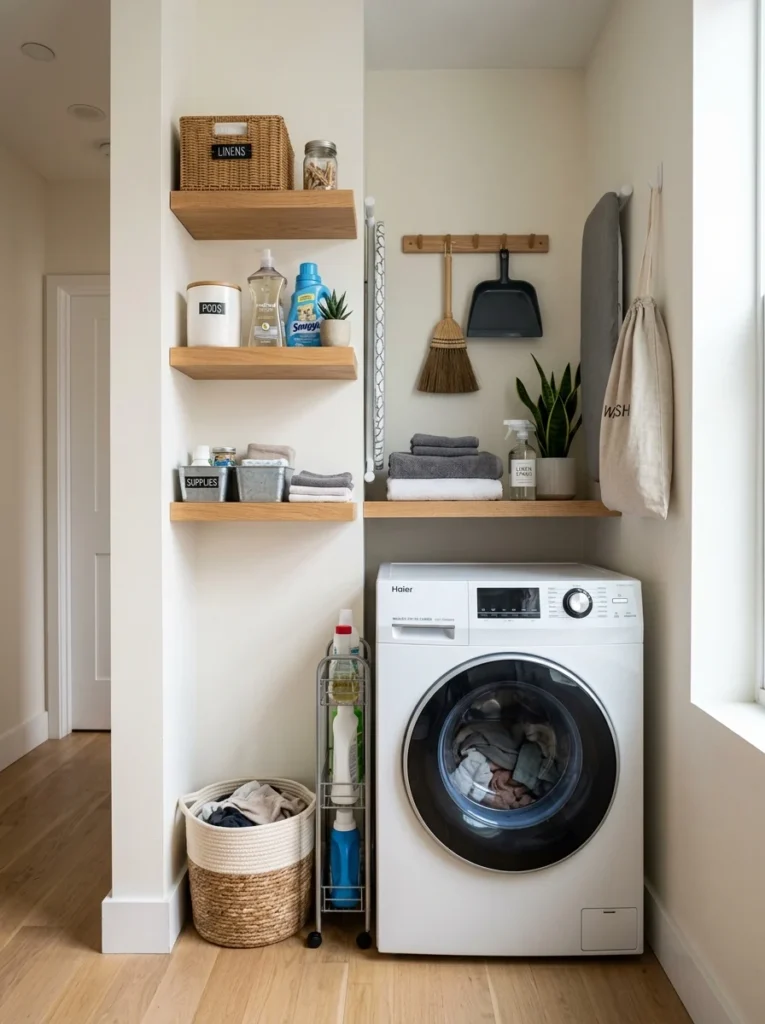
A washer-dryer combination unit — a single appliance that washes and dries in one drum — occupies the floor footprint of a single machine while performing both the washing and drying functions. In laundry spaces where even a stacked configuration is too wide — a very narrow closet, a bathroom corner, or a kitchen alcove — a combo unit may be the only practical appliance option.
The trade-offs of washer-dryer combo units relative to separate machines are significant and need to be understood before committing to one. Combo units wash and dry sequentially — the drying cycle follows the washing cycle in the same drum rather than the two processes occurring simultaneously or in an overlapping sequence. This means the total time from loading to dry laundry is significantly longer than with separate machines — a wash-then-dry cycle in a combo unit typically takes three to five hours compared to one to two hours for separate machines. For households that do large quantities of laundry regularly, this sequential limitation creates a throughput bottleneck that separate machines do not have.
The drying capacity of combo units is also typically lower than that of a dedicated dryer — combo units dry a smaller load than they wash, which means oversized loads need to be split for the drying cycle even after washing as a full load. For households with modest laundry needs — one or two people generating limited laundry per week — a combo unit is an entirely practical solution. For households with four or more people and regular large laundry loads, the throughput limitations of a combo unit create practical problems that the space savings do not compensate for.
Section 2: Door Solutions for Small Laundry Rooms
The door of a small laundry room or laundry closet has a disproportionate effect on how functional the space is in daily use. A door that swings into the laundry space reduces the available floor area for standing in front of the machines. A door that swings outward requires clear floor space in front of the laundry room in the adjacent hallway or room. A door that cannot open fully prevents comfortable access to the machine nearest the hinged side. The right door type for a small laundry space makes a meaningful practical difference to how the space functions every time it is used.
Pocket Doors — The Most Space-Efficient Option
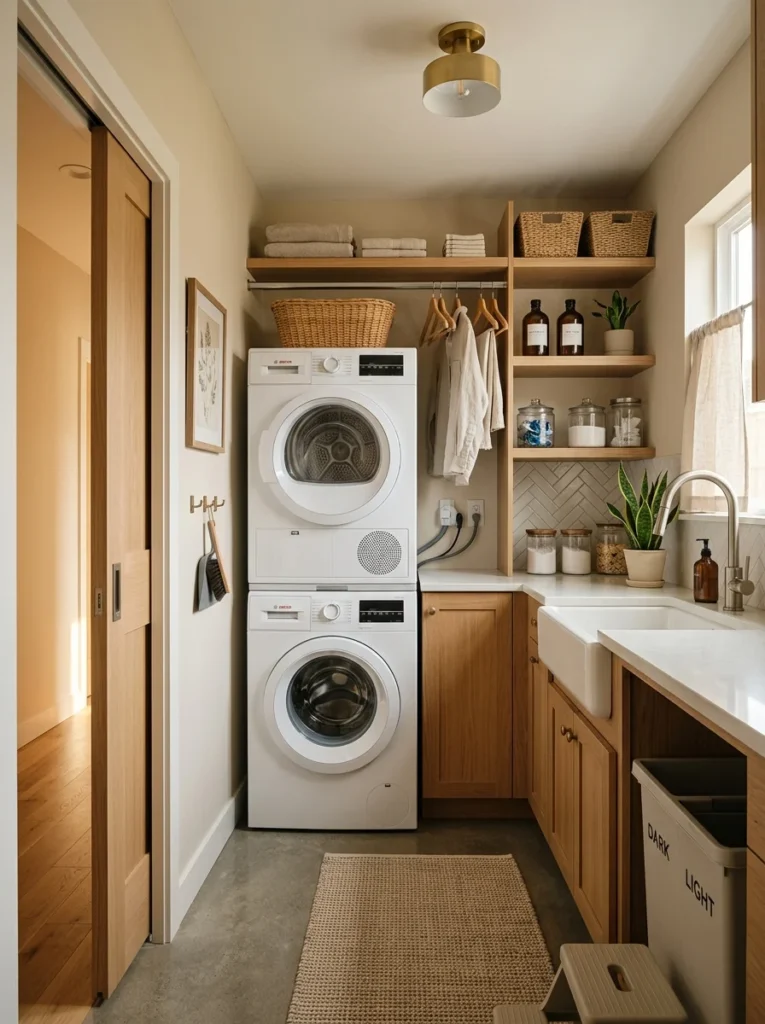
A pocket door slides into a cavity within the wall rather than swinging on hinges, which means it requires no clearance on either side of the doorway when opening or closing. In a small laundry room where every inch of floor clearance matters, a pocket door eliminates the floor space that a hinged door’s swing requires on both the laundry room side and the adjacent room side.
The installation of a pocket door requires a wall cavity wide enough to accommodate the door panel — the cavity needs to be at least as wide as the door itself — and the wall containing the pocket must be free of plumbing, electrical wiring, and structural elements that would be disrupted by the cavity. In an existing construction, these requirements can make pocket door installation complex and expensive if the wall structure needs modification. In a new construction or a significant renovation where walls are being opened, a pocket door is a relatively straightforward specification.
Barn Doors — Style and Space Efficiency Combined
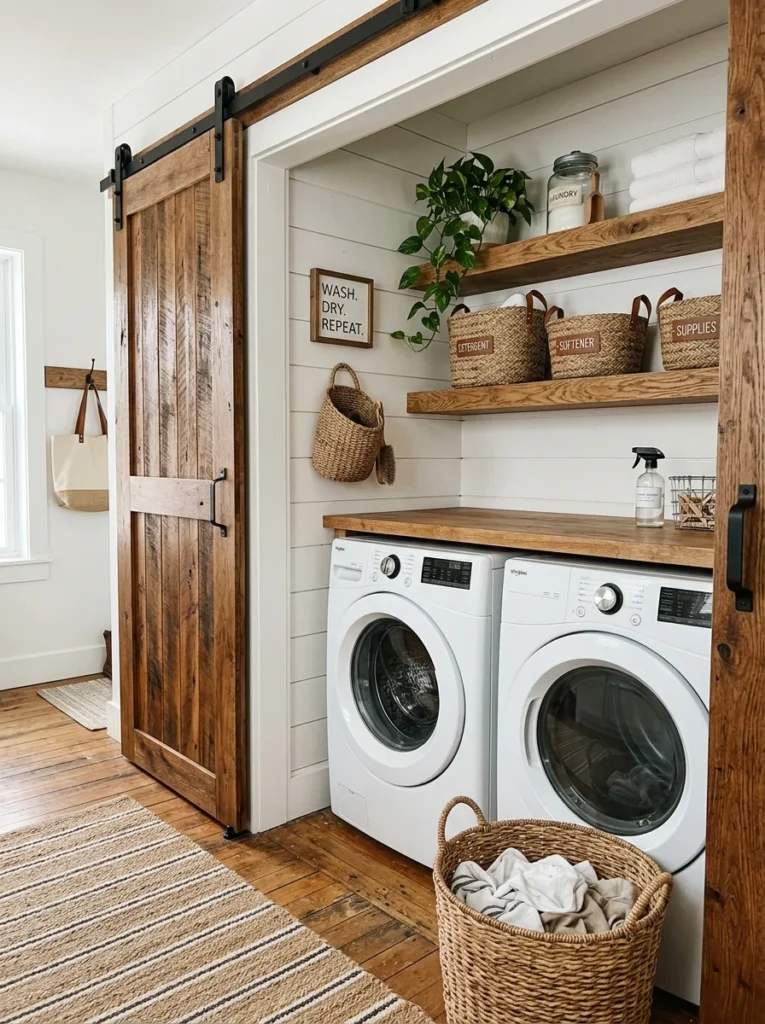
A barn door — a door that slides on a surface-mounted rail along the wall beside the doorway rather than swinging on hinges or disappearing into a wall pocket — requires no floor clearance on either side of the opening and adds a distinctive, characterful aesthetic to the laundry room entrance. When open, the barn door sits flat against the wall beside the doorway, completely clear of the laundry room floor area.
The practical limitation of a barn door for a laundry room is that it requires clear wall space beside the doorway — at least as wide as the door itself — on which to slide when open. If the wall beside the laundry room doorway is occupied by another door, a cabinet, a corner, or any other element that prevents the barn door from sliding fully open, the barn door format is not practical in that location.
A barn door also provides less acoustic and visual privacy than a pocket door or a standard hinged door, because the door surface slides past the doorway rather than filling it precisely. The gap between the barn door edge and the doorframe when the door is in its open position allows sound and light to pass between the laundry room and the adjacent space. In most laundry room situations this is an acceptable trade-off, but in laundry rooms adjacent to bedrooms or other spaces where noise and light transmission are significant concerns, the barn door’s acoustic and visual privacy limitations are a consideration.
Bifold Doors — The Budget-Friendly Space Saver
A bifold door — a pair of door panels hinged together in the center that fold back on themselves when opened — requires approximately half the clearance of a standard single hinged door of the same width, which makes it a practical middle ground between the full clearance requirement of a standard door and the zero clearance of a pocket or barn door.
Bifold doors are available for standard doorway widths and can replace standard hinged doors without structural modification in most cases — the bifold door hardware mounts on the existing doorframe. Their installation is straightforward and their cost is modest compared to pocket door or barn door alternatives.
The practical limitation of bifold doors in a laundry room context is that they do not provide full access to the doorway when open — the folded panel occupies a portion of the doorway width, which can restrict access on the folded-door side of the opening. In a laundry closet where both machines are accessed from the center and sides of the opening, this restriction is typically manageable. In a very narrow laundry closet where one machine is positioned close to the bifold door’s folded side, the restricted access can make loading and unloading that machine more awkward.
Removing the Door Entirely
In small laundry rooms that are not located in a position where visual privacy is required — a laundry alcove that opens onto a utility room, a laundry recess in a garage, or a laundry corner in a basement — removing the door entirely and either leaving the opening open or installing a curtain provides the maximum possible access to the laundry space without any door clearance requirement at all.
A curtain — a simple panel of fabric on a tension rod or a ceiling-mounted curtain rail — conceals the laundry area when privacy is desired, slides fully open for unobstructed access during laundry sessions, and requires no floor clearance of any kind. A curtain in the palette of the adjacent room integrates the laundry space visually rather than treating it as a separate area to be concealed, which suits open-plan home designs where the laundry alcove is visible from the primary living area.
Section 3: Storage Solutions Scaled for Small Laundry Spaces
The storage challenges of a small laundry room are more acute than those of a larger one — the same laundry supplies, accessories, and cleaning products need to be stored in a fraction of the space. The solutions that work for small laundry spaces are those that use vertical space efficiently, that mount on walls and doors rather than consuming floor space, and that contain multiple items in compact formats.
Tall Narrow Cabinets Beside the Machines
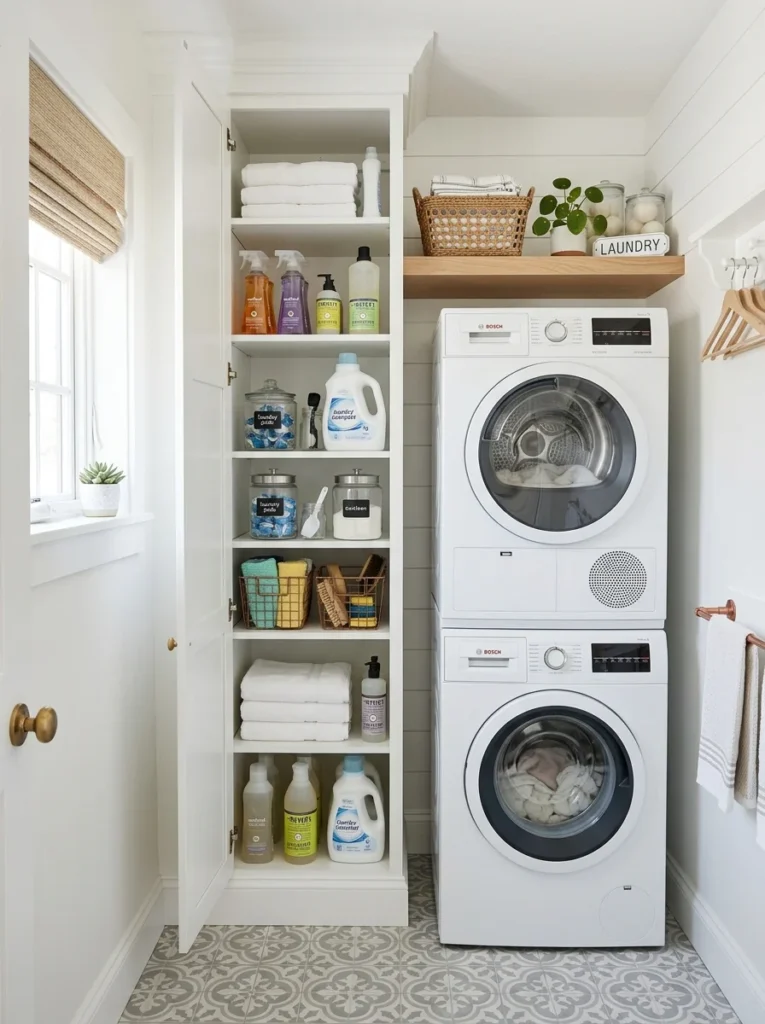
In a laundry room where the machines are positioned beside a wall that provides additional width beyond the machine footprint, a tall narrow cabinet — 12 to 18 inches wide, floor to ceiling — beside the machines provides a substantial storage volume in a minimal floor footprint. A cabinet of these dimensions holds a full range of laundry products, cleaning supplies, and accessories on multiple interior shelves while adding only 12 to 18 inches to the room’s occupied floor width.
Tall narrow cabinets are available in stock sizes from kitchen and bathroom cabinet retailers, which makes them significantly more affordable than custom-built laundry room cabinetry. A stock kitchen tall cabinet — a pantry or utility cabinet in a narrow width — installed beside the laundry machines and finished in a paint that matches the room’s walls provides a custom-looking storage solution at a stock-cabinet price.
Floating Shelves Above the Machines
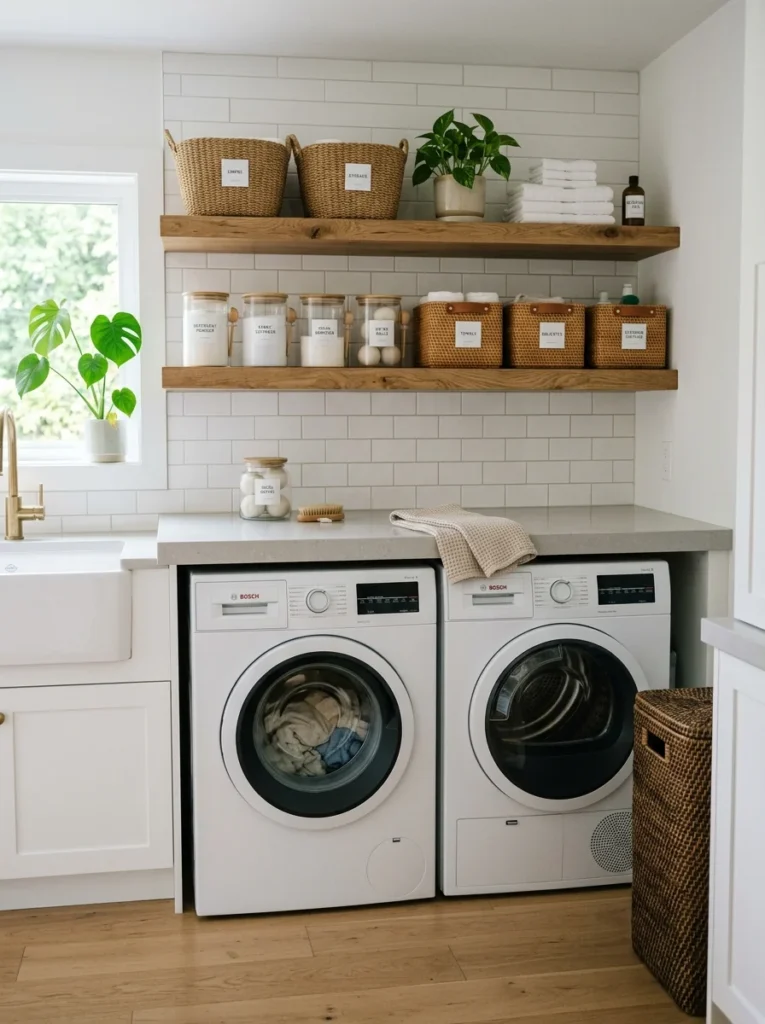
In stacked laundry configurations where the dryer occupies the full height of the alcove or closet above the washing machine, there is limited wall space above the machines for overhead storage. In side-by-side configurations, the wall above the machines is the primary storage zone — and floating shelves installed at intervals above the machines maximize this zone efficiently.
Floating shelves above side-by-side machines at two or three height levels — one shelf immediately above the machines for everyday products, one shelf higher for bulk supplies and less frequently used items, and one shelf near the ceiling for seasonal or rarely needed items — provide substantially more storage than a single shelf at one height, using the full available wall height above the machines rather than just the most convenient level.
In a stacked configuration, the wall space beside the stacked unit — if any is available — can accommodate a vertical run of floating shelves that provides the storage volume the wall above the machines would provide in a side-by-side configuration.
The Wall-Mounted Ironing Center
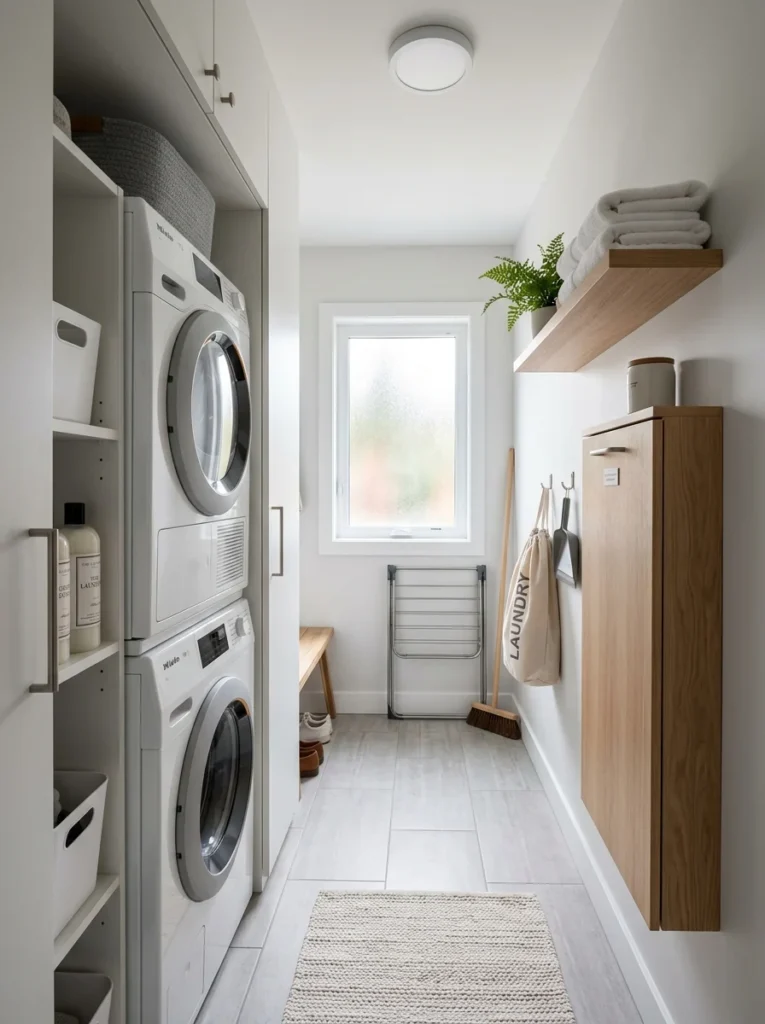
In a small laundry room where a freestanding ironing board is impractical — it takes up floor space the room cannot spare and has no adequate storage position when not in use — a wall-mounted ironing center provides an ironing board and sometimes integrated storage within a single wall-mounted unit.
A wall-mounted ironing center consists of a cabinet mounted on the wall from which an ironing board pulls out and unfolds to a horizontal ironing position. When retracted, the ironing board folds back into the cabinet and the cabinet door closes, concealing the entire ironing setup within a flush wall-mounted box that projects only four to six inches from the wall surface. Some wall-mounted ironing centers include additional storage within the cabinet — a small compartment for the iron itself, hooks for the iron cord, and a small shelf for starch and similar ironing products.
This solution combines ironing board storage and ironing functionality in a single wall-mounted installation that uses wall space rather than floor space and eliminates both the storage problem of a freestanding ironing board and the space problem of using it in a small laundry room.
Section 4: The Folding and Hanging Solution for Small Laundry Rooms
The clean laundry zone — the area where laundry is folded, sorted, and prepared for return to the rest of the house — is the zone that small laundry rooms most frequently fail to provide adequately. Without a dedicated folding surface, clean laundry accumulates in baskets and on top of the machines, creating the piles of clean-but-unfolded laundry that are one of the most persistent sources of laundry room dysfunction.
The Counter Over the Stacked Unit
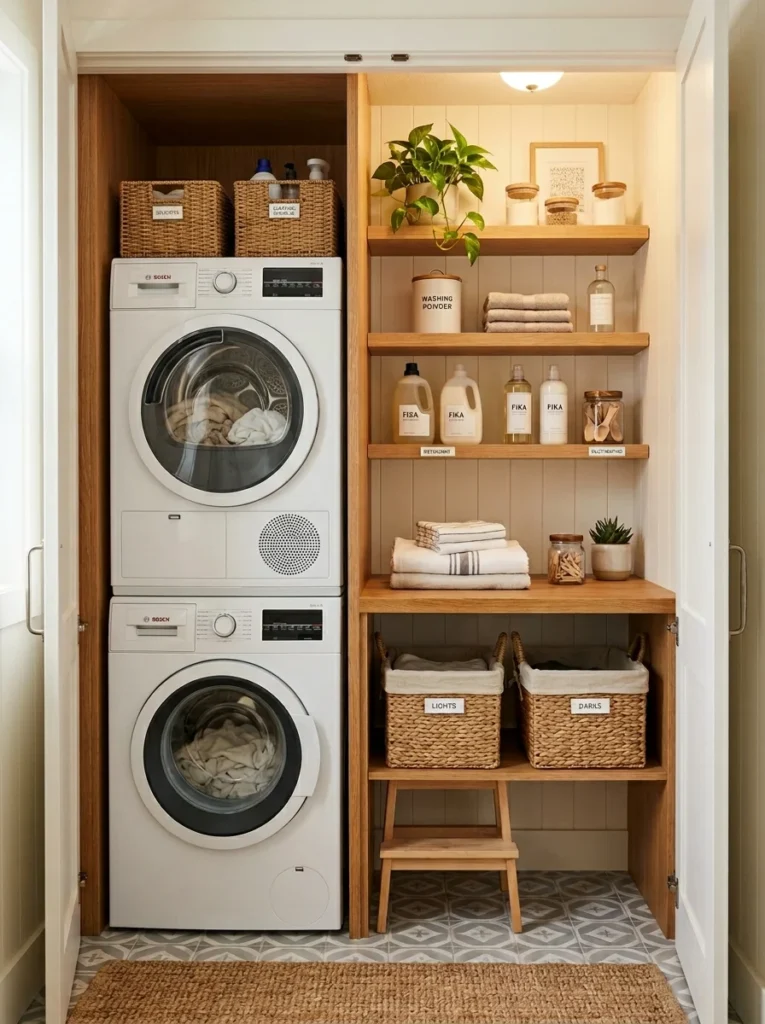
In a stacked washer-dryer configuration within a laundry closet, the wall space beside the stacked unit is often the only available location for a folding surface. A countertop installed at the standard 36-inch counter height on a bracket or cabinet support beside the stacked unit — even a very narrow counter of 18 to 24 inches — provides a dedicated folding surface that keeps clean laundry off the machine tops and the floor.
A counter beside the stacked unit also creates a landing surface for items removed from the dryer during the sorting process — garments that go on hangers, items that need to be put in a specific pile for a specific household member, and items that need special attention such as air drying or hand washing. Without this landing surface, all of these items end up in an undifferentiated pile that must be sorted again before distribution.
The Wall-Mounted Fold-Down Table as Folding Station
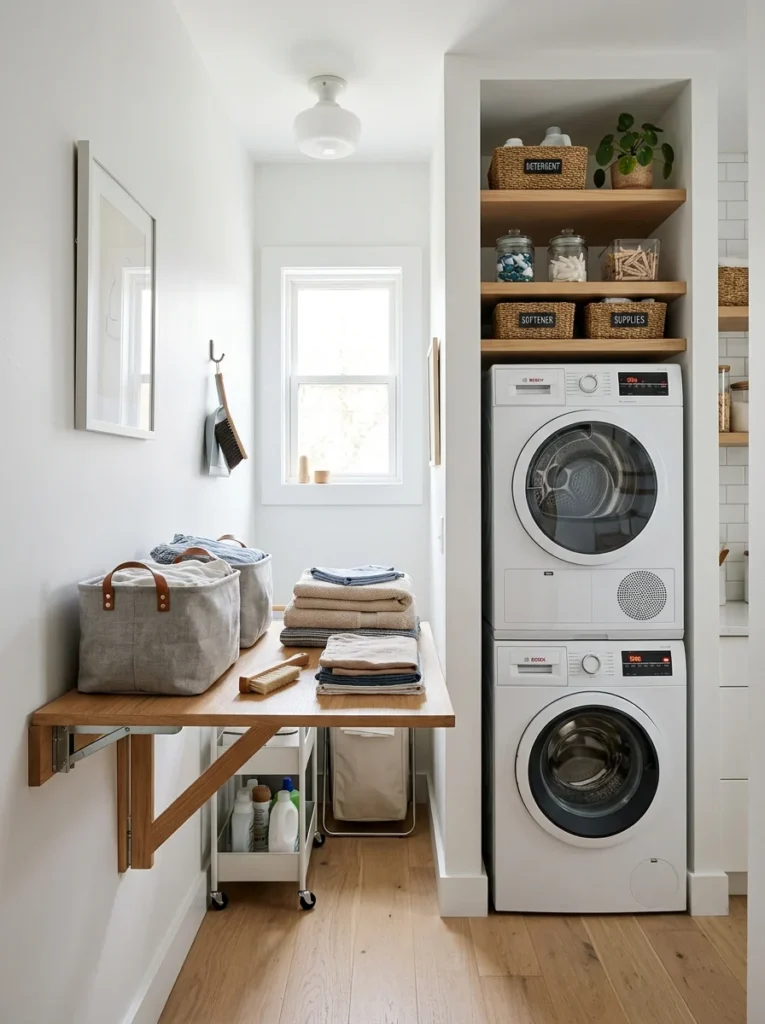
Where even a narrow counter beside the machines is not possible — in a laundry closet that is entirely filled by the stacked machines with no adjacent wall space — a wall-mounted fold-down table in the hallway, kitchen, or room immediately adjacent to the laundry closet provides the folding surface that the laundry space itself cannot accommodate.
A fold-down table positioned within a few steps of the dryer door — even if it is technically outside the laundry room — provides the functional benefit of an immediate folding surface when the dryer finishes. The proximity is sufficient to allow the dryer to be unloaded directly to the fold-down table without the laundry going through an intermediate pile stage.
Retractable Hanging Rod Solutions
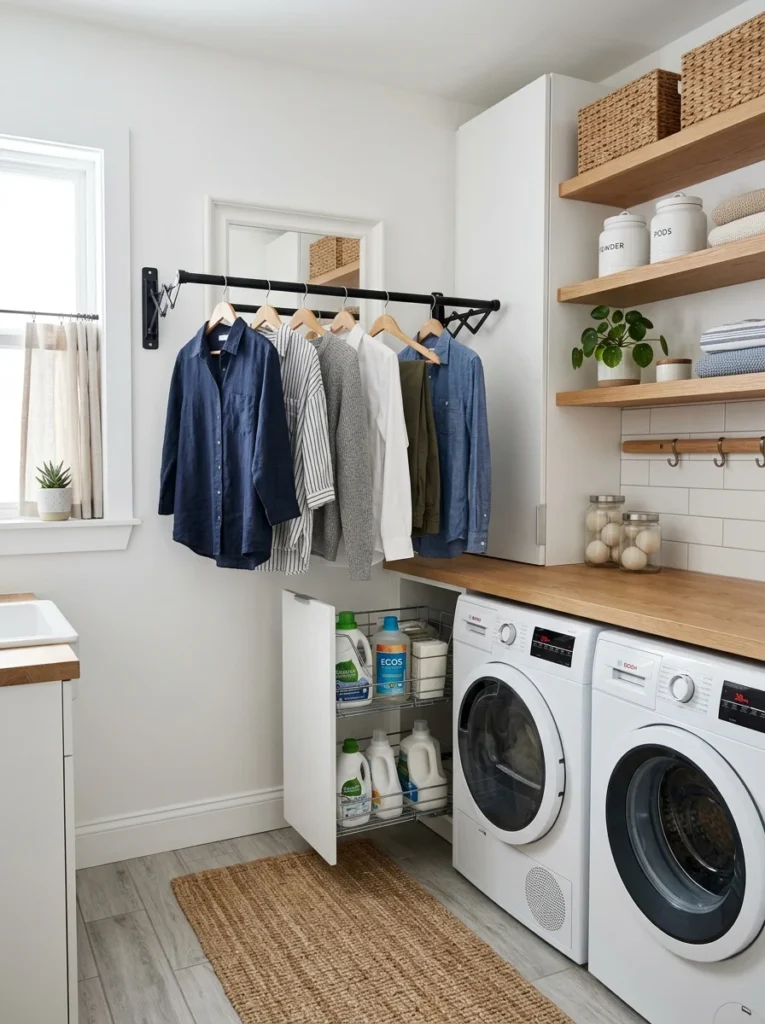
Hanging clean laundry directly from the dryer onto hangers is the fastest and most wrinkle-preventing way to handle garments that are worn on hangers — shirts, jackets, dresses, and trousers pressed on hangers all go directly from the dryer onto a hanger without a folding step. A hanging rod within arm’s reach of the dryer door makes this direct transfer possible.
In a small laundry room where a permanent hanging rod would obstruct access to the machines or reduce the available working space, a retractable hanging rod — one that extends from the wall when needed and retracts into a minimal wall-mounted housing when not — provides the hanging function without the permanent spatial intrusion. A retractable rod extended during the unloading process and retracted afterward adds virtually nothing to the room’s occupied space while providing the hanging capacity that makes immediate garment hanging possible.
Section 5: Color, Light, and Atmosphere in Small Laundry Rooms
The functional design of a small laundry room — the machines, the storage, the folding surface, the door — determines whether the space works. The aesthetic design — the colors, the lighting, the finishes, and the styling — determines whether the space feels good to be in. Both matter, and the aesthetic quality of even a very small laundry room has a genuine effect on how the chore of doing laundry feels.
Light Colors — Particularly Important in Small Laundry Rooms
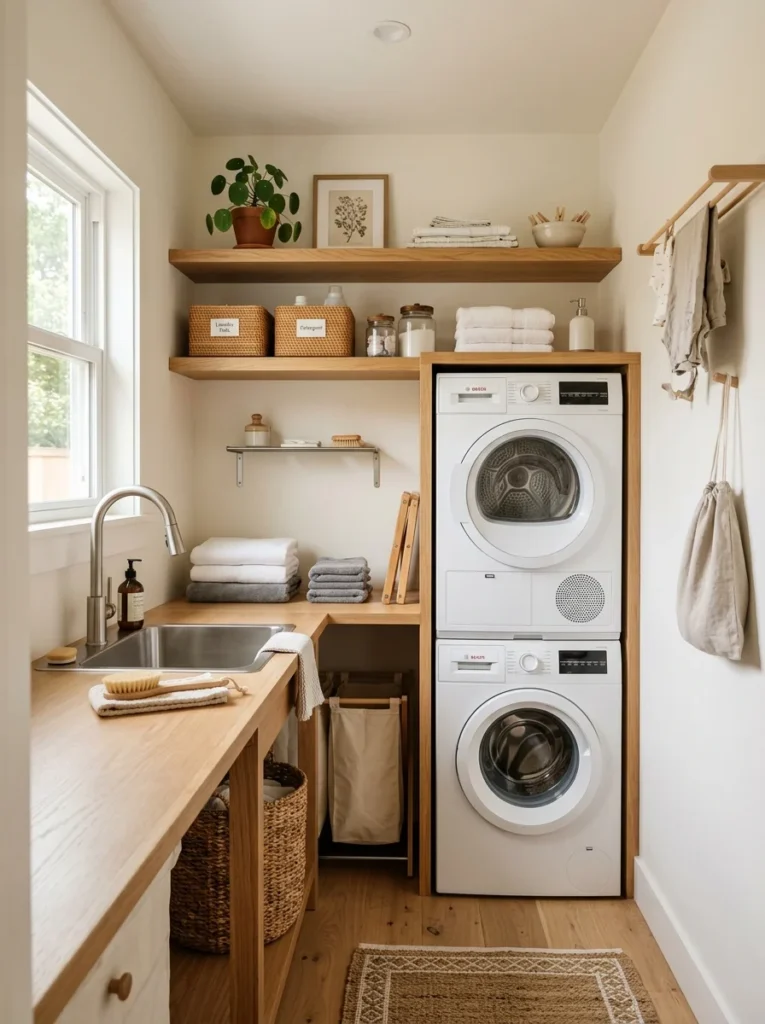
Small laundry rooms are frequently internal rooms or deeply recessed alcoves with limited or no natural light. In these conditions, light wall colors — soft whites, pale greys, and warm creams — are particularly important because they reflect the available artificial light throughout the room, making it feel brighter and more spacious than it actually is. Dark colors in a small, naturally dim laundry room absorb the limited available light and make the space feel smaller, darker, and less pleasant to spend time in.
White is the most commonly used and most consistently effective color for small laundry rooms because it maximizes light reflection and creates a clean, fresh quality that suits the functional character of the space. A warm white — one with cream or yellow undertones rather than cool blue undertones — is more welcoming than a stark cool white and suits laundry rooms of all styles.
For laundry rooms where all-white feels too plain, a single accent color on one wall — a soft sage green, a pale dusty blue, or a warm terracotta — adds visual interest and personality without reducing the room’s overall brightness. The accent wall should be the wall facing the room’s entry — the wall most visible when the door or curtain is opened — which ensures the color makes the strongest impression in the most visible location.
Lighting Quality — Brighter Than You Think You Need
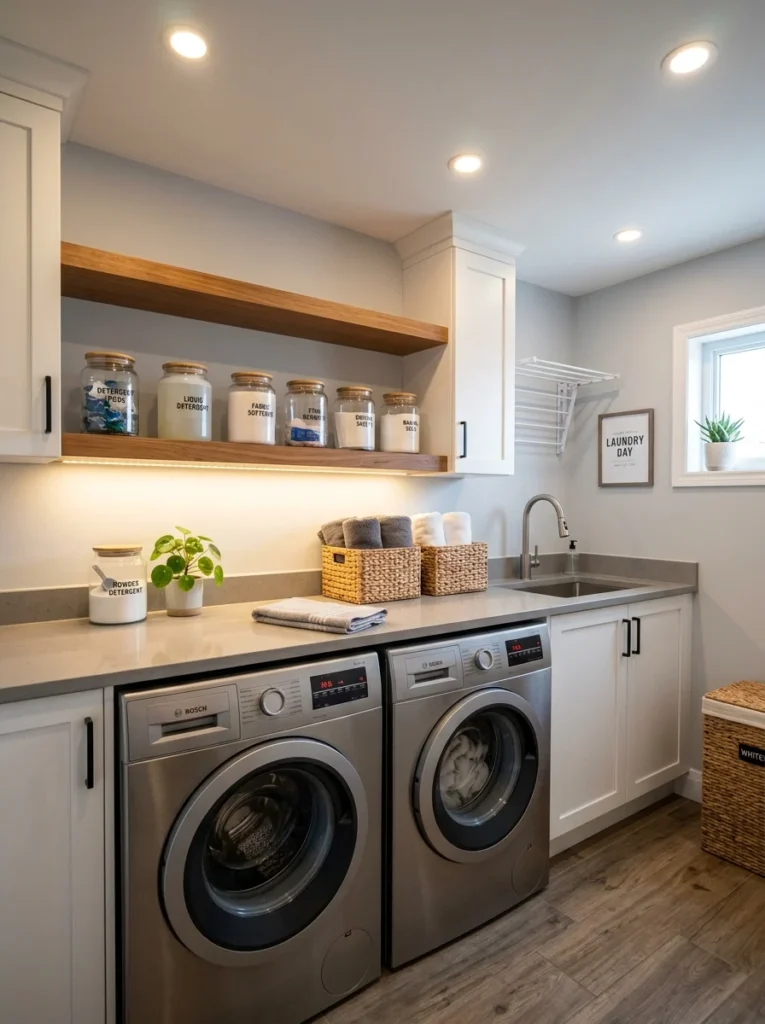
Small laundry rooms need to be well lit for the practical tasks that take place in them — checking clothing for stains, reading care labels, sorting by color, and identifying specific garments in the clean laundry pile. Insufficient lighting in the laundry room makes all of these tasks more difficult and the space more unpleasant to work in.
The lighting standard for a small laundry room should be brighter than for most other rooms in the home. A laundry room is a task-focused space — unlike a bedroom or living room where ambient, atmospheric lighting is appropriate — and it benefits from clear, bright illumination that makes the working surfaces and the laundry itself easy to see.
Recessed ceiling lights in the laundry room provide even, shadow-free illumination that suits the task-focused character of the space without the visual intrusion of surface-mounted fixtures in a room where ceiling height may already be limited. Two or three recessed lights distributed across the ceiling of a small laundry room provide significantly more even coverage and better task lighting than a single central fixture.
Under-shelf lighting — LED strips mounted on the undersides of shelves above the machines — supplements ceiling lighting by illuminating the machine tops and the products on the shelves directly. This direct shelf-level lighting makes reading detergent labels, measuring doses, and locating specific products significantly easier than relying on overhead illumination that casts shadows under every shelf.
Aesthetic Details That Elevate the Space
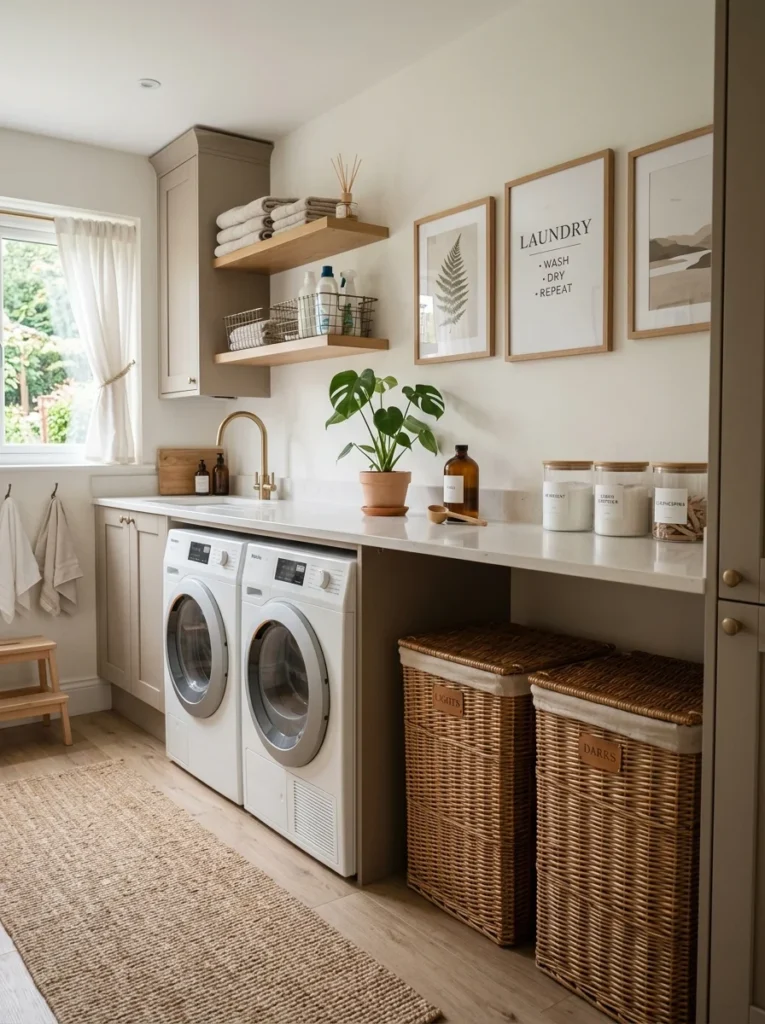
A small laundry room that is functional but visually neglected — white walls, utilitarian shelving, no decorative detail of any kind — functions adequately but communicates nothing about the household’s care for the space. Small aesthetic additions that cost very little in money or space elevate the small laundry room from adequate to genuinely considered.
A small plant on a shelf — a trailing pothos, a small succulent, or a few stems of dried eucalyptus — introduces natural color and warmth without consuming meaningful space. A simple framed print on the wall — a botanical illustration, a laundry-themed typography print, or a simple abstract in colors that complement the room’s palette — adds a personal touch that makes the space feel designed rather than improvised. A matching set of storage containers — coordinated jars, baskets, or bottles for laundry products — creates visual coherence that elevates the room’s overall impression significantly relative to the same products in their original commercial packaging.
Coordinated hampers — hampers in the same color, the same material, or the same design — contribute to the visual coherence of the dirty laundry zone in the same way that matching storage containers contribute to the active washing zone. A row of three identical canvas hampers in a neutral color looks deliberately organized. Three different hampers in different colors, heights, and materials looks accumulated rather than designed.
Section 6: Making the Most of a Laundry Closet
The laundry closet — a standard wardrobe-depth closet with bifold or sliding doors that conceals a stacked or side-by-side laundry setup — is the smallest and most constrained laundry configuration. In many apartments and smaller homes, it is the only laundry option available, and making it work as well as possible within its significant constraints requires specific solutions that are different from those applicable to a dedicated laundry room.
Using Every Inch of Vertical Space
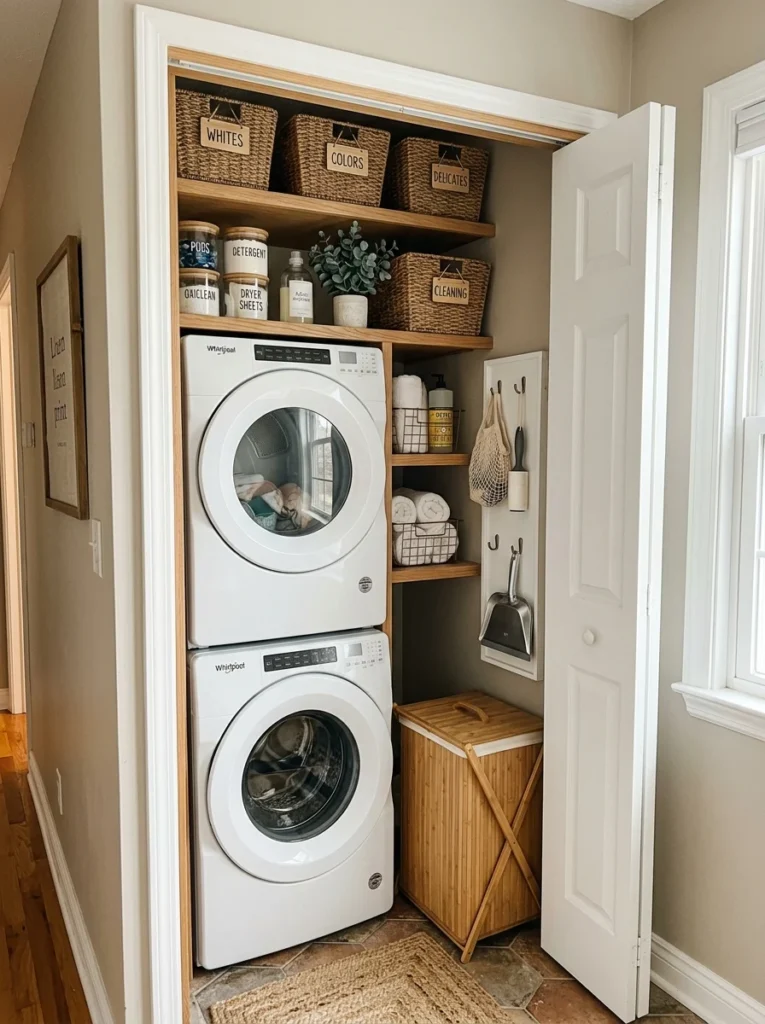
A laundry closet typically has a standard ceiling height of approximately 96 to 108 inches and a depth of approximately 24 to 30 inches. With a stacked washer-dryer unit occupying approximately 72 to 78 inches of height, there is typically 18 to 36 inches of wall space above the stacked unit before the ceiling. This space above the stacked unit is the primary storage zone in the laundry closet and should be used at its full capacity.
Shelves installed at two levels in this above-unit space — one shelf immediately above the unit at approximately 80 inches from the floor, and one shelf near the ceiling at approximately 92 to 96 inches — provide two storage levels for laundry products, cleaning supplies, and accessories in the space that would otherwise be empty air above the machines.
The Side Wall Storage Opportunity
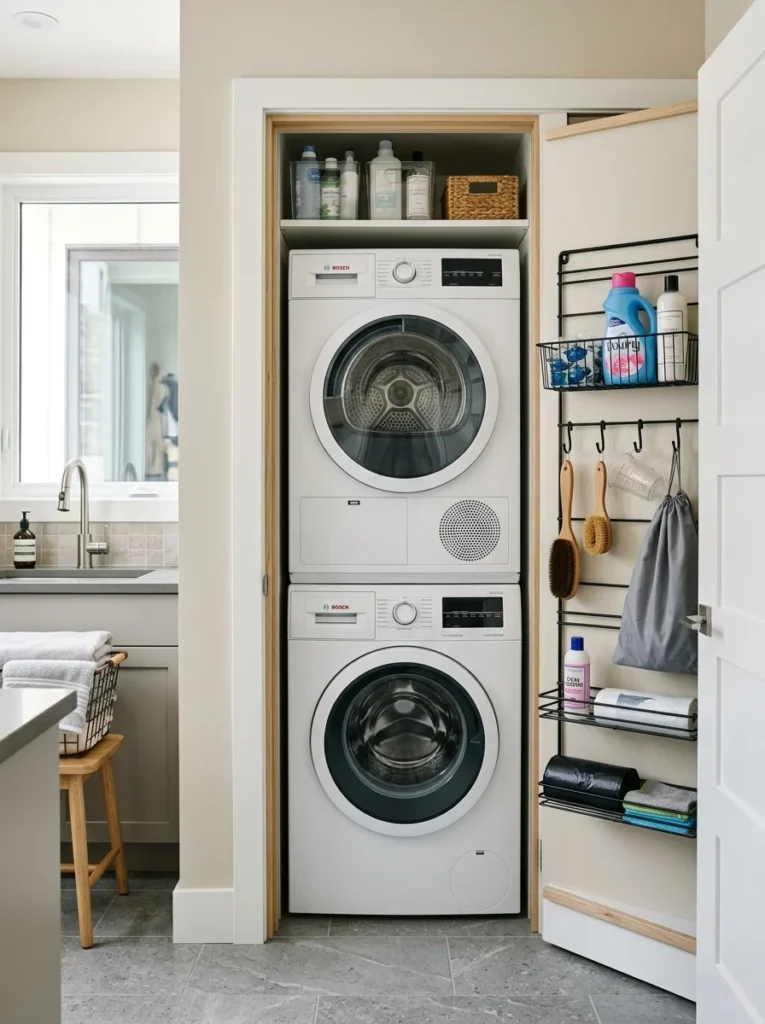
In laundry closets where the width of the closet exceeds the width of the stacked unit — which is typically 24 to 27 inches — the additional width beside the unit provides a narrow wall section that can be used for additional storage. Even a 6 to 12-inch section of wall beside the stacked unit accommodates a magnetic strip for small metal accessories, a narrow wall-mounted organizer for small products, or a row of hooks for hanging small items.
Lighting Inside the Laundry Closet
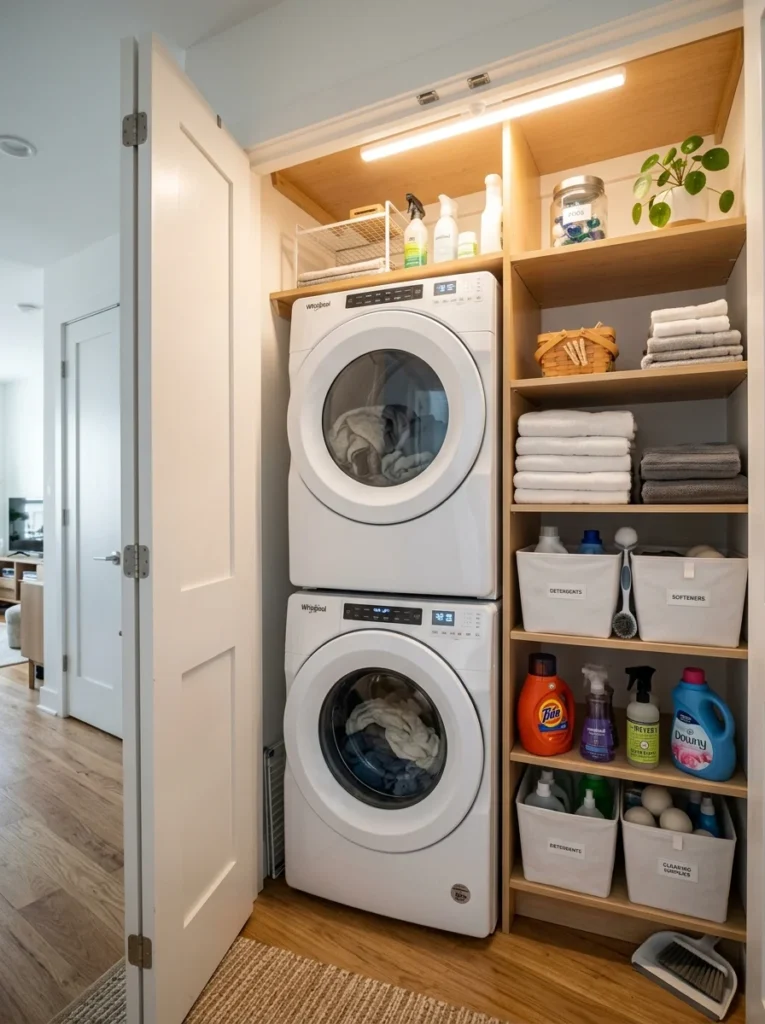
A laundry closet without dedicated interior lighting is a dark storage space that makes every laundry task more difficult — loading and unloading the machines requires good light to see the contents clearly, reading care labels requires adequate illumination, and finding specific products on the shelves above the machines requires seeing them clearly.
A battery-operated LED light bar mounted inside the closet — on the underside of the shelf above the machines, on the inside of the door frame, or on the ceiling of the closet — provides immediate, reliable interior illumination without electrical work. Motion-activated versions turn on automatically when the closet door is opened and off after a set period of inactivity, which eliminates the need for a separate switch and ensures the closet is never accessed in the dark.
Conclusion
A small laundry room designed well — with the right machine configuration, the right door solution, the right storage for every laundry product and accessory, an adequate folding and hanging surface for clean laundry, good lighting, and considered aesthetic details — is a functional, pleasant space that serves the laundry process as effectively as a room many times its size.
The fundamental principle of designing a small laundry room is that every element must earn its place. Every storage solution must use the available space efficiently. Every product must have a designated location. Every surface must serve a specific function rather than accumulating whatever has no other home. And every aesthetic decision must contribute to the room’s overall quality of light, color, and visual coherence without consuming any of the space that function requires.
Applied consistently, this principle produces small laundry rooms that feel considered and intentional rather than improvised and inadequate — rooms that work reliably for every laundry session, that keep laundry products organized and accessible, that provide adequate surfaces for every stage of the laundry process, and that look sufficiently neat and designed that the chore of doing laundry takes place in a space that feels genuinely worth the effort put into creating it.