
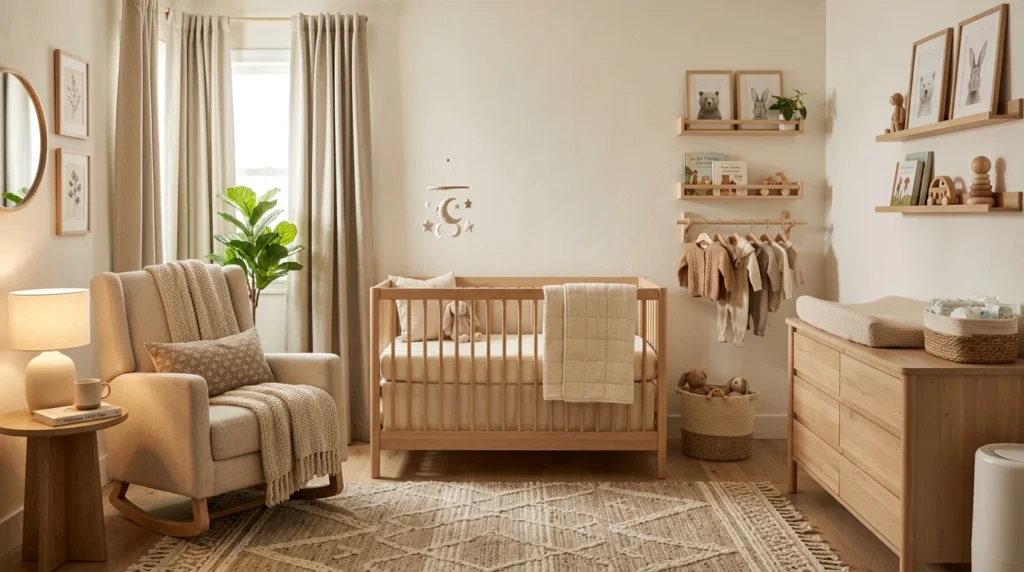
Designing a nursery for the first time is one of the most emotionally significant home projects most people undertake. The room being prepared is not for a guest, not for a family member who will move in and make their own preferences known, and not for a purpose that can be adjusted if the initial design does not work perfectly. It is for a person who does not yet exist outside the imagination of the parents preparing for their arrival — a person whose needs in the first months of life are specific, non-negotiable, and significantly different from the preferences that will shape their room later in childhood.
This combination of emotional significance and practical specificity makes nursery design genuinely challenging. The emotional investment in creating the perfect welcoming space for a new baby is real and appropriate. But the practical requirements of a safe, functional nursery — the specific furniture it needs, the safety standards that must be met, the lighting conditions that support infant sleep, the organization that makes nighttime care manageable — are non-negotiable and need to be understood clearly before the first furniture purchase is made or the first wall color is chosen.
The most common nursery design mistakes come from prioritizing the aesthetic vision of the finished room over the practical requirements of the person who will live in it. A beautifully decorated nursery with a crib positioned near a window that lets in bright morning light, with no blackout provision, and with a decorative mobile hanging over the crib that includes small parts is a room that looks impressive in photographs and makes the daily reality of caring for a newborn significantly harder than it needs to be.
This guide addresses both dimensions of nursery design — the practical requirements that are non-negotiable and the aesthetic decisions that make the room beautiful — in the correct order. Safety and function first, then layout, then furniture selection, then lighting, then color and style, then the decorative finishing touches that give the nursery its character. Every decision builds on the decisions that precede it, and the result of following this sequence is a nursery that works as well as it looks — one that supports the daily reality of caring for a new baby while creating a genuinely beautiful space for that baby to grow up in.
Section 1: Safety — The Non-Negotiable Foundation
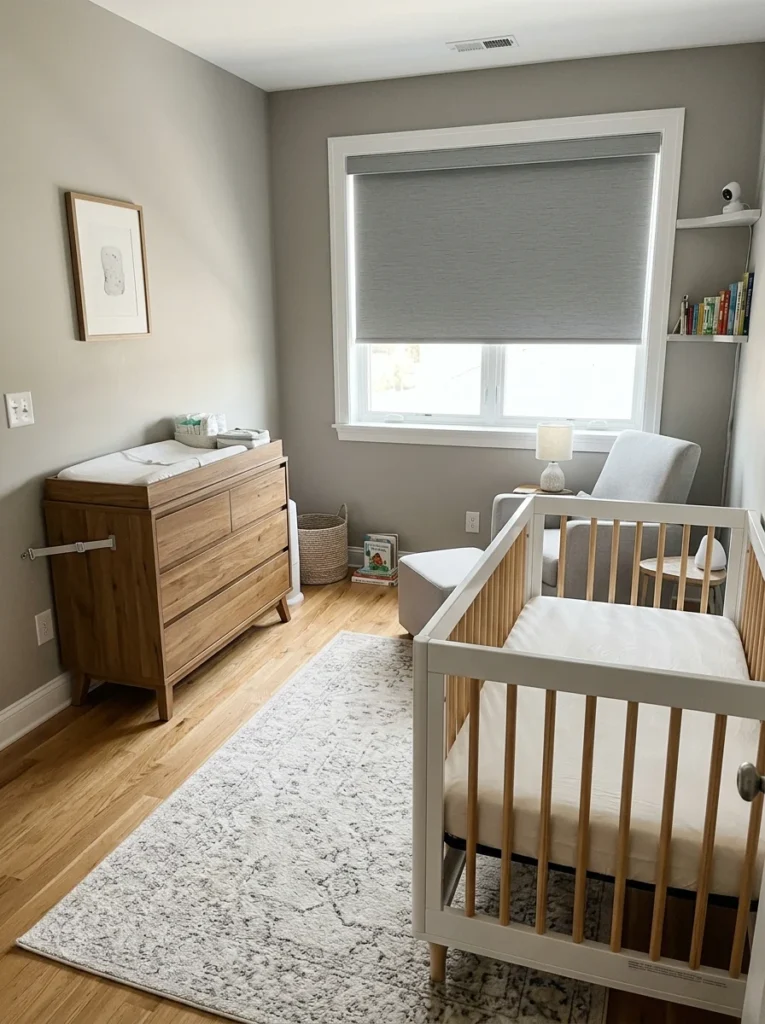
Before any furniture is chosen, any layout is planned, or any color is selected, the safety requirements of a nursery need to be understood and applied without compromise. Infant safety in the nursery is not a matter of preference or degree — the standards that exist are there because departures from them have resulted in serious injury and death, and they apply to every nursery regardless of budget, style, or circumstance.
Crib Safety Standards
The crib is the most safety-critical piece of furniture in the nursery, and choosing and using a crib that meets current safety standards is the most important single decision in nursery design.
Current safety standards for cribs require that the slat spacing be no more than 2 and 3/8 inches — wide enough to allow air circulation but narrow enough that an infant’s head cannot pass between the slats. Slats should be firmly attached to the crib frame with no loose or missing pieces. The crib mattress must fit snugly within the crib frame — a gap of more than two fingers’ width between the mattress and the crib sides is a risk for entrapment. The crib sides must be at least 26 inches above the mattress support in its lowest position.
Older cribs — cribs inherited from family members, purchased secondhand, or stored from a previous generation — may not meet current safety standards. Drop-side cribs, which were standard for decades, have been banned in many countries due to the entrapment and suffocation risks they present. Antique or vintage cribs may have slat spacing, paint, or structural features that do not meet current standards. The safest approach is to purchase a new crib that explicitly meets current safety standards rather than using an older crib regardless of its sentimental value or apparent good condition.
Safe Sleep Environment — What Belongs in the Crib and What Does Not
The crib sleep environment for an infant should contain only the infant and a fitted sheet on the mattress. Nothing else belongs in the crib — no blankets, no pillows, no bumper pads, no stuffed animals, no positioning wedges, no sleep positioners, and no additional bedding of any kind.
These guidelines exist because soft bedding in the crib — items that seem harmless or even protective to adult perception — creates a suffocation risk for infants who lack the motor control to reposition themselves away from an item that is obstructing their breathing. Crib bumper pads, which were standard nursery accessories for generations, are now recognized as a suffocation risk and are banned in several jurisdictions. Blankets and pillows carry the same risk.
An infant is kept warm in the crib through appropriate sleepwear — a sleep sack or wearable blanket in an appropriate weight for the room temperature — rather than through bedding in the crib. This approach is as effective at maintaining the infant’s thermal comfort as blankets while eliminating the suffocation risk that loose bedding creates.
Furniture Anchoring — Preventing Tip-Over Hazards
Every piece of freestanding furniture in the nursery that could tip over if a child pulls on it — dressers, bookshelves, wardrobes, and changing tables with drawers — must be anchored to the wall. The force required to tip a piece of furniture that a young child might pull on while using it to pull themselves to standing, or while climbing, is significantly less than most adults intuitively expect.
Furniture anti-tip straps — flexible straps that connect the top of the furniture to a wall stud — are the standard anchoring solution. They are inexpensive, widely available, and straightforward to install. Anchoring the furniture in the nursery before the baby arrives — before the furniture is in use and before the risk exists — is the most reliable approach. Intending to anchor furniture later and then not getting around to it is a pattern that has contributed to preventable accidents.
Cord and Window Covering Safety
Window blind cords — the looped or hanging cords used to operate roller blinds, venetian blinds, and similar window coverings — are a strangulation hazard for young children and infants. Children and infants can become entangled in blind cords in seconds and without warning, and the resulting strangulation can occur in under a minute.
The safest window covering solution for a nursery is a cordless blind or shade — one that operates without any hanging or looped cord. Cordless roller blinds, cordless cellular shades, and corded blinds with cord winders that keep cords inaccessible to children are all appropriate. Standard corded blinds with hanging or looped cords are not appropriate for a nursery regardless of how the cords are positioned — children are more mobile and more capable than most adults anticipate, and cord strangulation has occurred even when cords were positioned to appear out of reach.
Outlet Safety
All electrical outlets in the nursery should be fitted with outlet covers or safety plugs before the baby comes home. Outlet covers are inexpensive, widely available, and take seconds to install. As the child develops mobility — crawling, cruising along furniture, and eventually walking — the outlet covers should be upgraded to tamper-resistant outlets or to outlet covers with a sliding mechanism that requires two simultaneous movements to open, which young children cannot execute.
Section 2: Layout Planning — Positioning Furniture for Safety and Function
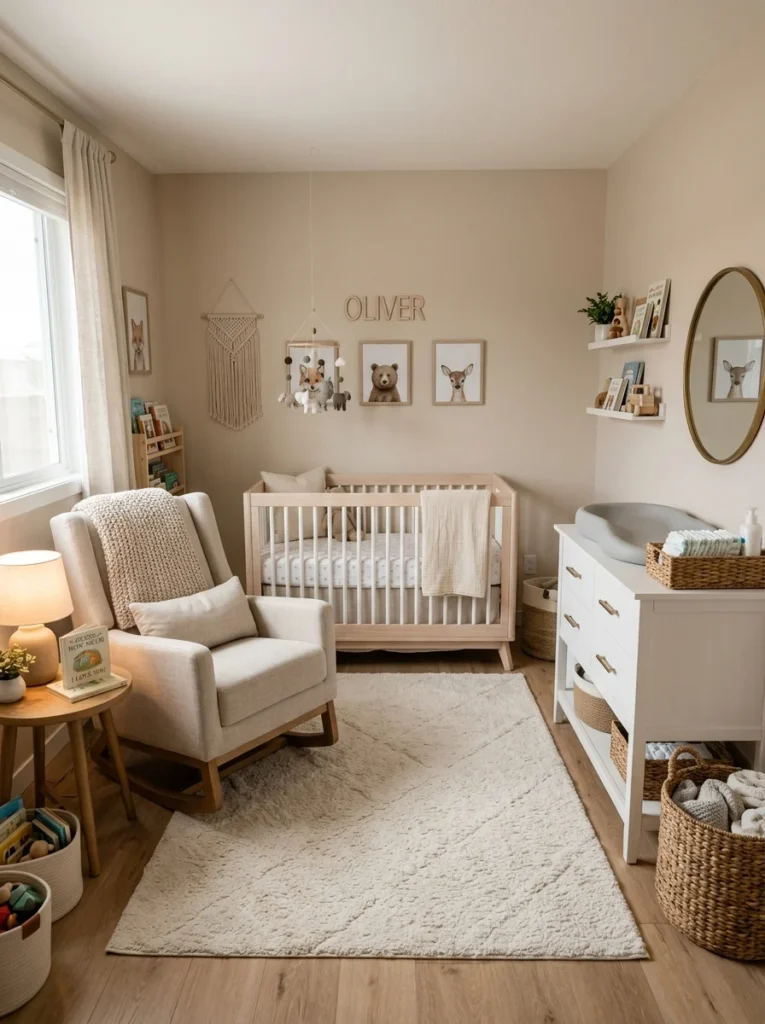
With the safety requirements established, the nursery layout can be planned with confidence that the fundamental safety parameters are understood and will be applied. Layout planning determines where each piece of furniture will be positioned in the room, and the positioning decisions need to reflect both the flow of daily care activities and the specific safety considerations that apply to each piece.
Crib Placement — The Most Important Layout Decision
The crib should be positioned away from windows, away from radiators and heating vents, away from exterior walls that may be cold in winter, and away from any cords or strings that the infant could reach from within the crib.
Away from windows means that the crib is not positioned under or directly beside a window — even with a curtain or blind installed, the temperature beside a window fluctuates more than the center of the room, direct sunlight can overheat an infant in the crib, and window blinds and cords must be kept out of reach of the crib’s occupant. A distance of at least two feet from any window is the minimum — further is better.
Away from radiators means that the crib is not positioned where the infant’s face or body would be exposed to direct heat from a radiator or heating vent. Overheating is a significant risk factor for infant sleep safety, and positioning the crib where radiant heat falls directly on the sleeping infant creates an overheating risk during heating season.
Toward the center of the room, on an interior wall if possible, in a position that allows clear visual access from the doorway — so that a parent opening the nursery door can see the crib occupant without entering the room — and within easy reaching distance of the changing station and the feeding chair, is the optimal crib position in most nurseries.
Glider or Rocking Chair — Position for Nighttime Function
The feeding and settling chair — a glider, a rocking chair, or a comfortable armchair positioned in the nursery for nighttime feeding and settling — should be positioned near the crib to minimize the distance the parent needs to carry the infant between the crib and the chair during nighttime feeds.
The chair should face into the room rather than toward a wall, which allows the parent sitting in it to maintain visual awareness of the room’s other elements during feeding. The chair should be positioned near a power outlet for a night light or a phone charger — items used consistently during nighttime feeds — and ideally near a small surface such as a side table on which a water glass, a phone, and a small lamp can be placed.
The quality of the feeding chair is worth investing in more than any other piece of nursery furniture, with the possible exception of the crib mattress. A parent who spends cumulative hours in the feeding chair during the first months of the baby’s life — potentially three to six hours per night in the newborn period — experiences the quality of that chair directly and physically. A chair that is not supportive, not comfortable, and not designed for extended sitting makes the nighttime feeding process significantly more exhausting than it already is.
Changing Station — Position for Safety and Efficiency
The changing station — whether a dedicated changing table or a dresser with a changing topper — should be positioned near storage for nappies, wipes, and changing supplies, and within reasonable distance of the crib and the feeding chair to minimize the distance traveled during nighttime nappy changes.
The changing station should not be positioned where it would require turning away from the infant to reach supplies — every moment the parent is not actively restraining the infant on the changing surface is a moment in which the infant can roll or fall. Supplies should be within arm’s reach of the changing surface itself, either in the changing station’s integrated storage or in a basket or caddy immediately beside the station.
Section 3: Essential Furniture — What the Nursery Actually Needs
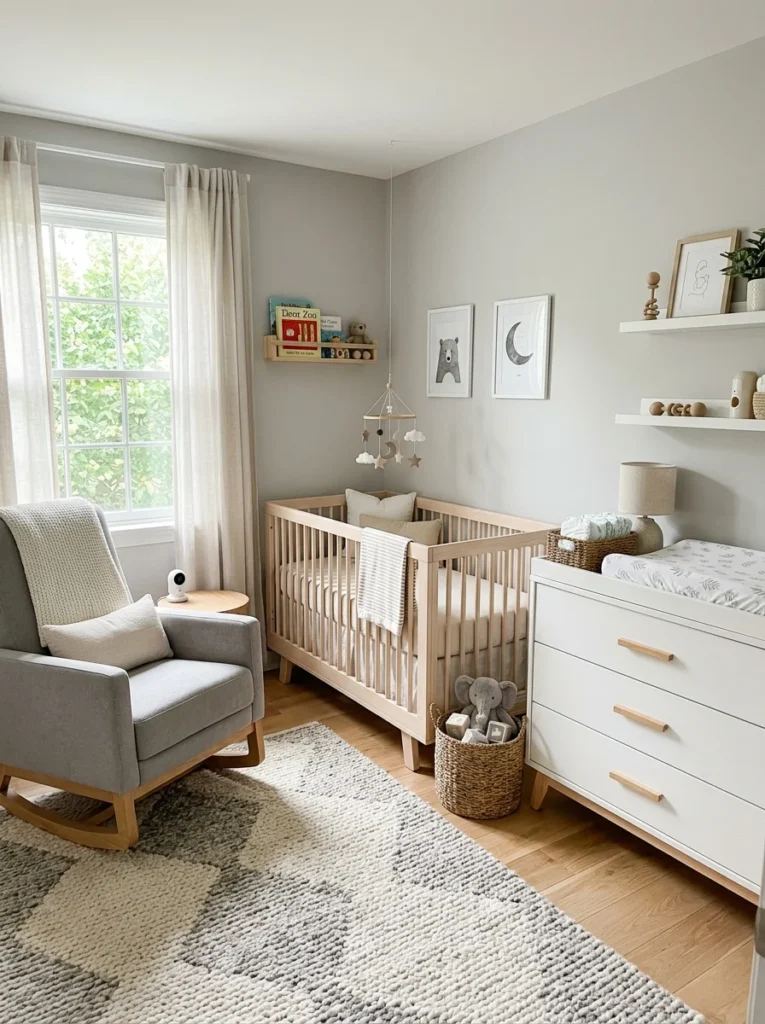
The furniture that a nursery genuinely needs is simpler than most first-time parents initially assume. The nursery furniture industry — like most industries serving first-time parents — benefits from the anxiety and enthusiasm of people preparing for a new baby, and the range of nursery furniture products available suggests that a successful nursery requires significantly more specialized furniture than it actually does.
The genuinely essential nursery furniture consists of four pieces: a crib, a mattress, a changing station, and a feeding chair. Everything else is either optional, preferably deferred until the baby’s needs become clearer, or better served by multi-purpose alternatives.
The Crib — Choosing Between Convertible and Standard
A standard crib serves the nursery function from birth until the child transitions to a toddler bed, typically between eighteen months and three years. A convertible crib serves the same nursery function and then converts — through additional parts sold separately — into a toddler bed, a daybed, or in some cases a full-size bed, extending the piece’s useful life significantly.
The case for a convertible crib is the extended useful life it provides relative to its initial cost — a convertible crib that serves as a crib, then a toddler bed, then a full-size headboard represents a longer investment horizon than a standard crib that is replaced at the toddler bed stage. The case against a convertible crib is that the conversion parts are an additional purchase, the resulting toddler bed or full-size bed may not suit the child’s room aesthetic at the time of conversion, and the long-term plans for the furniture are uncertain at the time of purchase.
For most families, the decision between convertible and standard depends primarily on whether the family intends to have more children — a convertible crib in a dedicated nursery that will be reused for subsequent children may not need to convert, making the convertible feature less valuable. A standard crib that will be the only crib the family purchases benefits more from the convertible feature.
The Crib Mattress — The Investment That Matters Most
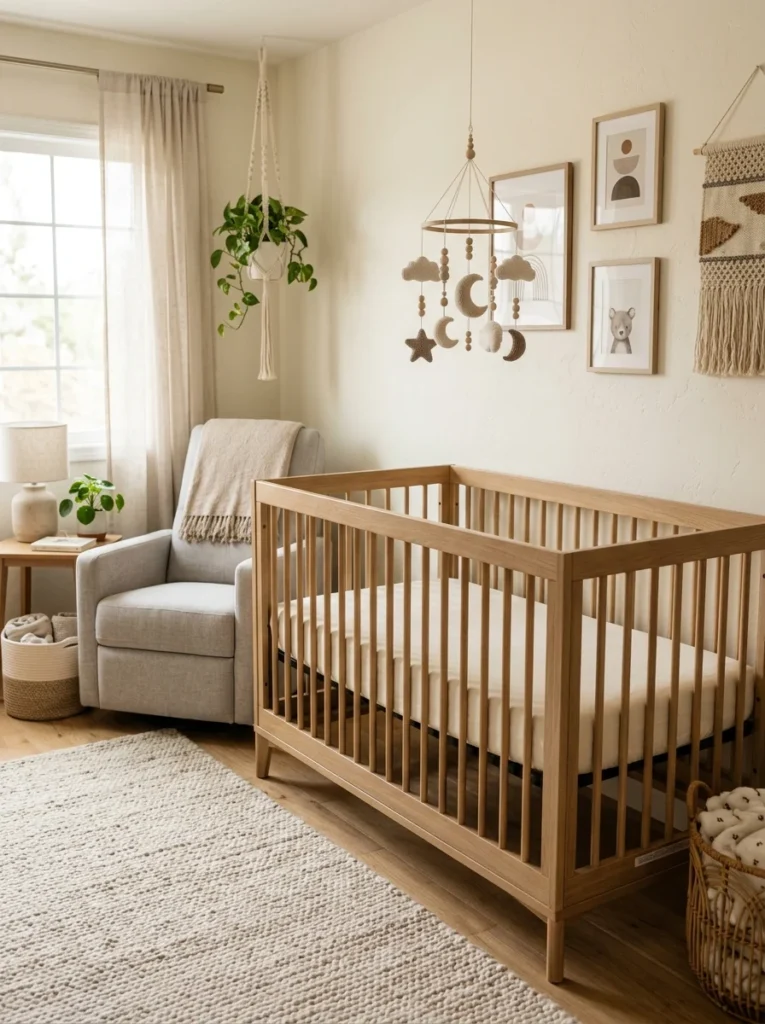
The crib mattress is the nursery purchase that most directly affects the infant’s safety and comfort, and it is the purchase on which compromising for budget reasons has the clearest and most direct consequences.
A crib mattress must be firm — not the comfortable softness that adult mattress preferences favor, but genuinely firm to the point that it does not conform to the shape of a hand pressed against it. A soft or conforming mattress creates a depression around an infant’s face if the infant rolls to a prone position, which can obstruct breathing. The firmness of the mattress is a safety specification, not a comfort preference, and it should not be reduced.
The mattress must fit the crib snugly — the two-finger rule (no gap larger than two fingers’ width between the mattress edge and the crib side) applies in all directions. A mattress that fits some cribs but not others should be paired with the specific crib it fits rather than assumed to fit a new crib without verification.
Waterproof mattress covers — fitted covers in a waterproof material that protect the mattress from the moisture of nappy leaks, spit-up, and similar infant-related moisture — extend the life of the mattress significantly and are worth purchasing as a standard component of the crib setup. Having two waterproof covers — one on the mattress and one in reserve — allows for immediate mattress recover without waiting for the wet cover to be washed and dried.
The Changing Station — Dedicated Table Versus Dresser Topper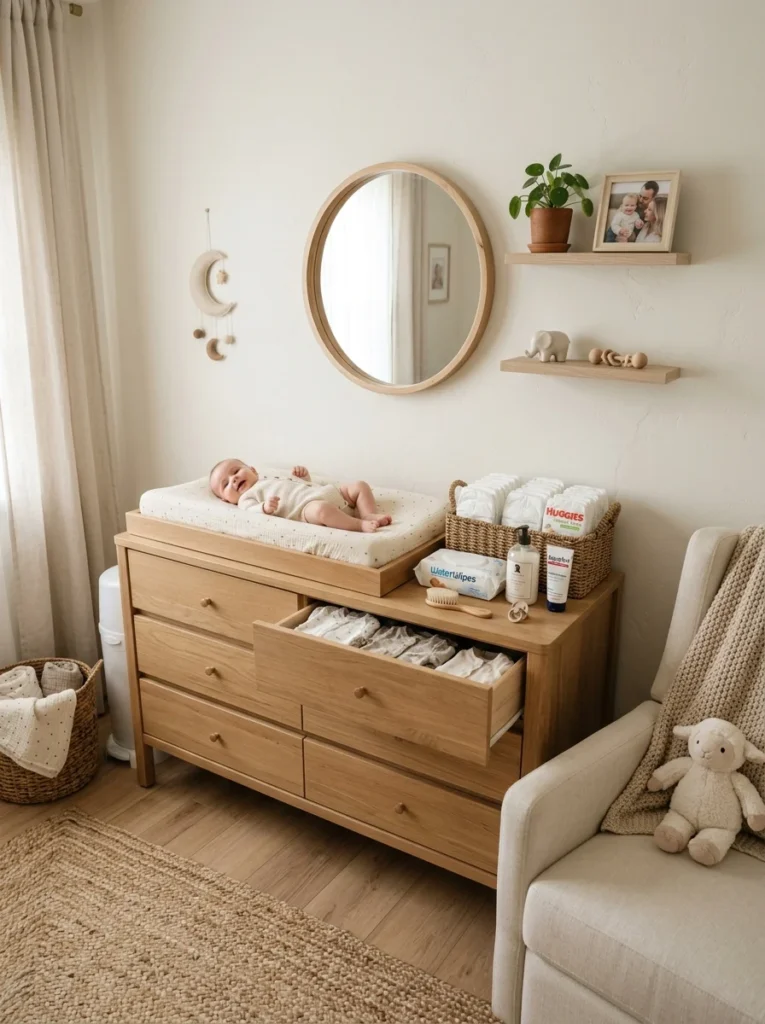
A dedicated changing table — a purpose-built changing surface at adult waist height with integrated storage for nappies, wipes, and changing accessories — provides everything the changing function requires in a single piece. Its limitation is that it is single-purpose — once the nappy stage is over, the changing table’s specific function ends and it becomes a piece of furniture that needs to be repurposed or removed.
A dresser with a changing topper — a standard chest of drawers with a padded changing pad placed on top — provides the changing function while simultaneously providing drawer storage for infant clothing. When the nappy stage ends, the changing pad is removed and the dresser continues to serve its storage function for the child’s growing wardrobe. This dual-purpose quality makes the dresser-with-topper the more space-efficient and the more financially efficient option in most cases.
The key requirement for a dresser used as a changing station is that the topper be secured — either through a non-slip mat between the pad and the dresser surface, or through straps that attach the pad to the dresser — so that it does not shift during nappy changes. The dresser itself must be anchored to the wall per the furniture anchoring requirements discussed in the safety section.
The Glider or Rocking Chair — A Non-Negotiable Investment
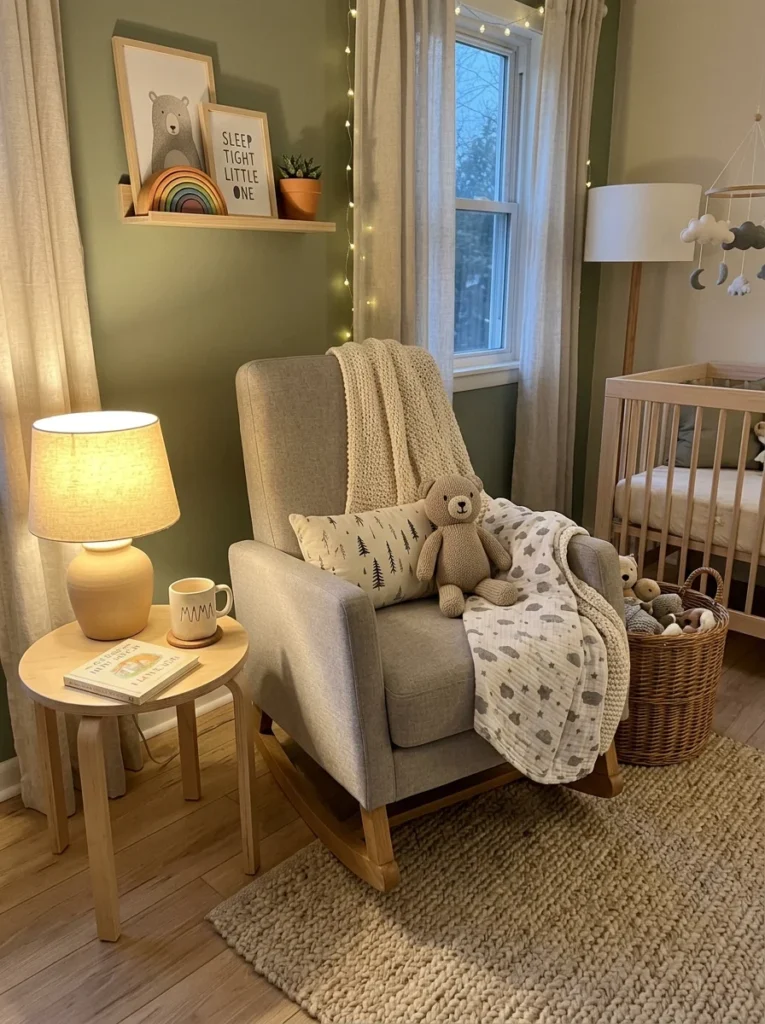
The glider or rocking chair in the nursery is used more hours per week in the first months of the baby’s life than any other piece of furniture in the room — potentially more than any piece of furniture in the house. It is the seat from which nighttime feeds are given, from which settling rocking takes place, and from which the parent spends the extended quiet hours of the night managing an infant who does not yet know the difference between night and day.
Given this level of use, the quality of the feeding chair is not an appropriate place to compromise. A chair that rocks or glides smoothly — without catching, squeaking, or requiring excessive effort to maintain motion — settles babies more effectively than one with a rough or effortful motion. A chair with appropriate lumbar support and arm support at the correct height for nursing or bottle feeding keeps the parent’s back and shoulders comfortable during feeds that may last twenty to forty minutes at a time. A chair with a comfortable fabric that is easy to clean — nursery chairs are exposed to the full range of infant bodily fluids — maintains its appearance and hygiene over time.
Section 4: Lighting — The Element That Determines Sleep Quality
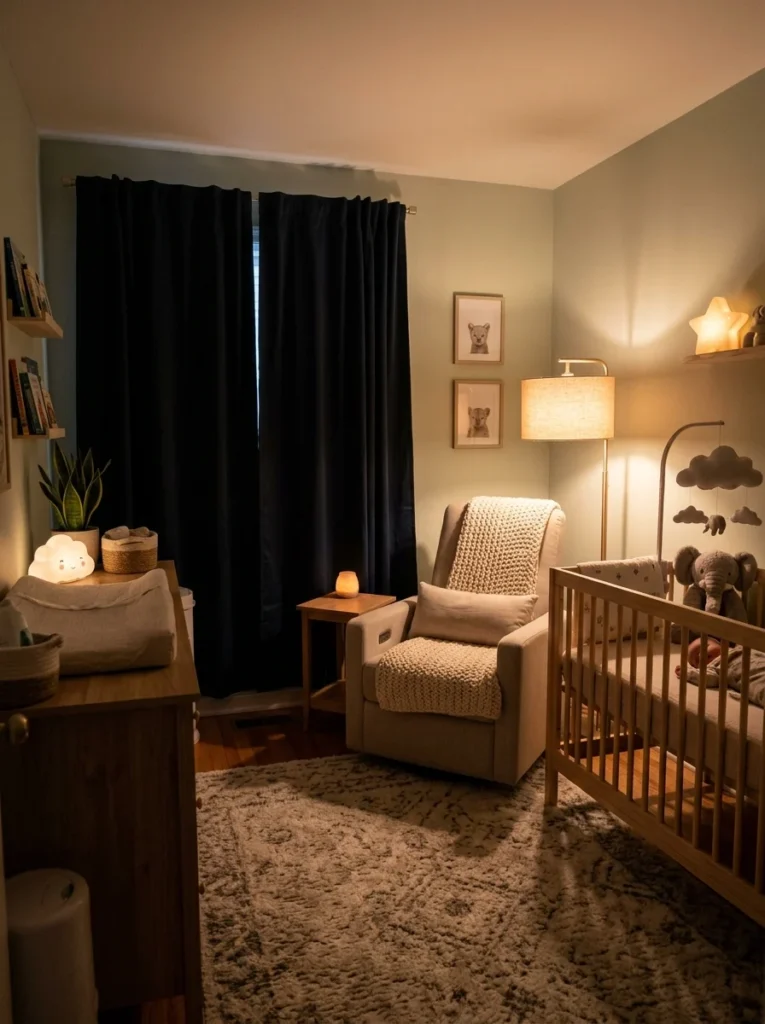
The lighting of the nursery has a more direct and more measurable effect on the baby’s sleep quality — and therefore on the family’s sleep quality — than almost any other design decision in the room. Understanding what infant sleep requires in terms of light conditions, and designing the nursery lighting around those requirements, is one of the most impactful things a parent can do in nursery preparation.
Blackout Curtains — The Most Important Nursery Purchase
Blackout curtains or blinds — window coverings that block all or nearly all light from entering the room — are the most important single purchase for the nursery after the crib and mattress, and they are consistently undervalued in the planning process relative to their practical importance.
Infants and young children are significantly more sensitive to light exposure during sleep than adults. Light entering the room — from the morning sun, from streetlights at night, from car headlights passing the window, and from the ambient glow of a lit street — suppresses melatonin production and disrupts the sleep cycles of young children in a way that is more pronounced than in adults. A room with effective blackout provision maintains darkness through the morning hours when the sun rises before the infant needs to wake, which consistently produces longer infant sleep and therefore more rest for parents.
The effectiveness of a blackout solution depends on how completely it blocks light. A blackout blind or curtain with light gaps at the sides, top, or bottom — gaps through which external light enters the room — is significantly less effective than one that blocks light completely. The most reliable blackout solutions are roller blinds with blackout fabric that mount inside the window recess, with a blackout curtain in front to cover any remaining gaps at the sides, or purpose-designed blackout blind systems with side channels that prevent light leakage around the edges.
Night Light — Warm Amber, Not Cool White
A night light in the nursery provides the minimum level of illumination needed for nighttime nappy changes, nighttime feeds, and checking on the infant without fully waking the baby or the parent by turning on the main room light.
The color of the night light matters significantly. Cool white or blue-toned light suppresses melatonin production in both the infant and the parent, making it more difficult to return to sleep after a nighttime care session. Warm amber or red-toned light — the color spectrum associated with firelight and candles — does not suppress melatonin production and allows the parent and infant to return to sleep more easily after nighttime care.
Choose a night light with a warm amber or red light output rather than a cool white or blue output. Adjustable night lights — ones that allow both the brightness and the color temperature to be set — are particularly useful because they can be set to the minimum brightness sufficient for the nighttime care tasks that take place in the nursery, minimizing the sleep disruption of nighttime light exposure for both parent and infant.
Dimmer Switch on the Main Light
A dimmer switch on the nursery’s main ceiling light allows the room’s general illumination to be adjusted from full brightness for daytime activities — nappy changes, playtime, and the general care tasks that benefit from good visibility — down to a very low level for evening settling routines and nighttime checks.
The ability to gradually reduce the room’s light level during the evening settling routine — turning the light progressively lower as the baby approaches sleep — supports the melatonin production that helps the infant fall asleep. A room that transitions from bright daytime light to full darkness instantaneously provides a less gradual and less sleep-supportive transition than one where the light level can be reduced incrementally.
Section 5: Color — Creating a Calm and Sleep-Supportive Environment
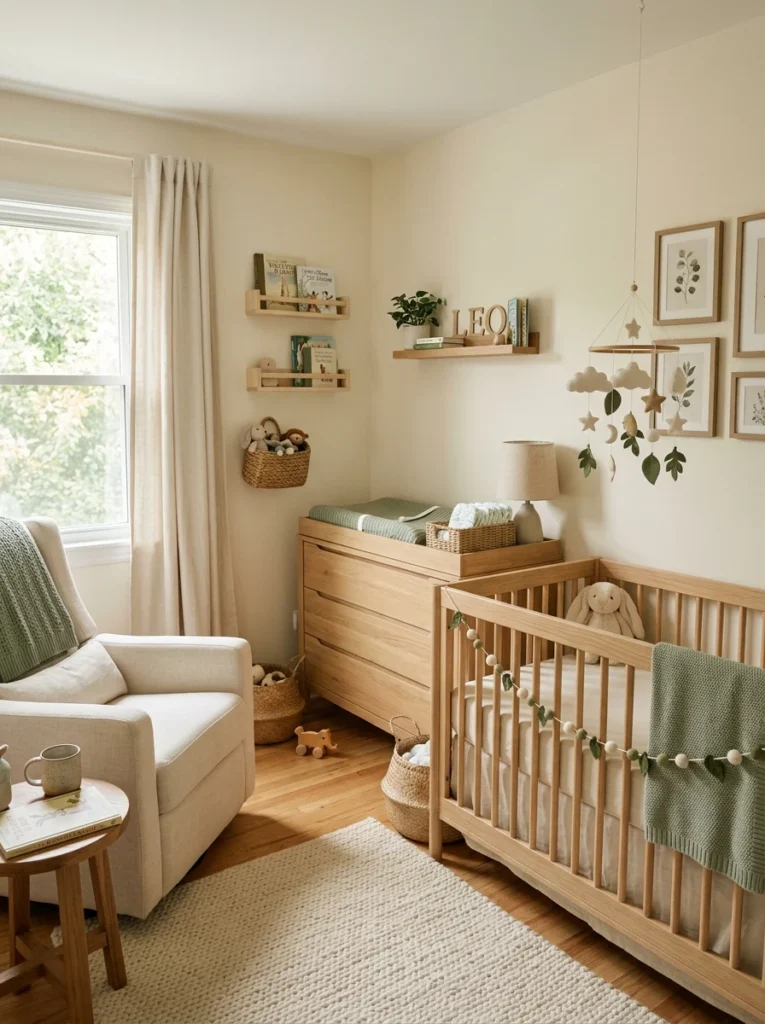
The color of the nursery walls affects the visual environment of the room and, through that environment, the emotional tone of the space. While the direct effect of wall color on infant sleep is less well established than the effect of light, the general principle that calmer, more muted colors create more restful environments than bright, saturated ones is reasonable and well-supported by the broader evidence on color psychology.
Colors That Support Calm
Soft, muted, warm-toned colors create nursery environments that feel calm, sheltered, and restful. Warm whites, soft creams, pale sage greens, muted dusty blues, and gentle warm greys all fall within this category. These colors have in common a low saturation — they are toned down from their pure-hue versions by the addition of grey or brown — which removes the energetic, stimulating quality of saturated colors.
Bright, saturated colors — vivid primary reds, electric blues, and neon yellows — are energizing rather than calming. While they create stimulating, visually interesting environments for play, they are not the most supportive background for a room designed primarily around sleep and rest. This does not mean that color must be excluded from the nursery — a muted version of any hue can work beautifully — but the saturation level of the colors chosen should be kept low.
Avoiding the Pink and Blue Convention
The convention of decorating a girl’s nursery in pink and a boy’s nursery in blue is both more recent and more culturally specific than most people realize — it became dominant only in the mid-twentieth century and is by no means universal across cultures or historical periods. It is also, from a purely design perspective, unnecessarily limiting — the full range of gentle, muted colors is available for any nursery regardless of the baby’s sex, and the most beautiful nurseries in contemporary design are frequently those that use color outside the conventional gender palette.
Gender-neutral color palettes — warm whites, sage greens, warm beiges, dusty terracottas, and soft greys — suit any baby, maintain their relevance as the child grows out of infancy, and allow the nursery to be reused for subsequent children of any gender without repainting. For families who do not know the baby’s sex before birth, or who prefer not to make strong gender associations in their child’s environment from infancy, the gender-neutral palette is both the most practical and frequently the most aesthetically successful approach.
Section 6: Practical Extras That Make Nighttime Care Manageable
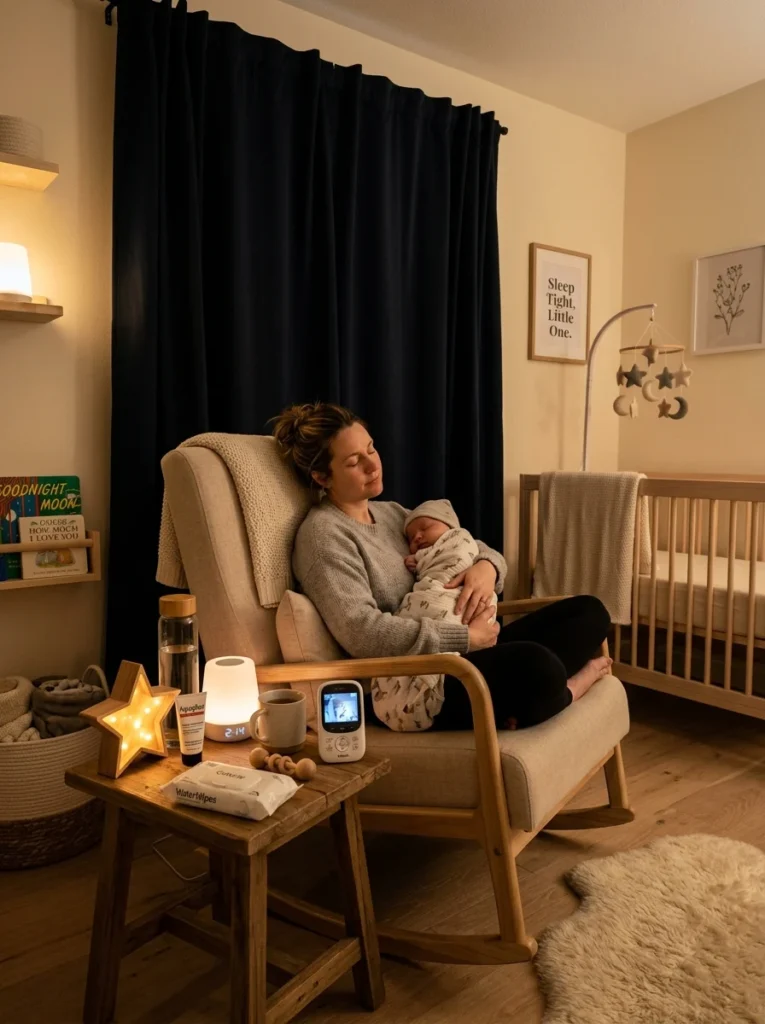
The practical accessories of the nursery — the items beyond the primary furniture that support the daily and nightly reality of infant care — are the details that experienced parents wish they had prioritized more in their initial nursery planning.
White Noise Machine — Position and Type
A white noise machine generates continuous background sound — typically a constant, non-varying noise in the white or pink noise spectrum — that masks the ambient sounds of the household and helps infants stay asleep through the environmental sounds that would otherwise disturb them. Street noise, other household members moving through the house, doorbells, and similar sounds that are present at any random time throughout the night are masked by the continuous white noise, which creates a more consistent sound environment for infant sleep.
The white noise machine should be positioned in the room rather than inside the crib — at least several feet from the infant’s head — and set to a volume that masks external sounds without exceeding a safe listening level for the infant. A volume level roughly equivalent to a running shower — around 50 to 60 decibels at the infant’s position — is generally considered appropriate. The machine should not be placed inside or immediately beside the crib where it would expose the infant’s ears to louder sound than appropriate.
Baby Monitor — Positioning for Effective Coverage
A baby monitor — whether audio-only or video — provides the parent with awareness of the infant’s condition in the nursery from other rooms in the house. The positioning of the monitor camera, if a video monitor is used, should provide a clear view of the crib occupant from a position that is out of reach of a growing infant and that does not require a cord within reach of the crib.
A video monitor positioned on a high shelf or mounted on the wall above and to the side of the crib provides a clear overhead or angled view of the crib occupant while keeping the monitor itself and its cable inaccessible to a developing infant.
Nursing Station on the Side Table
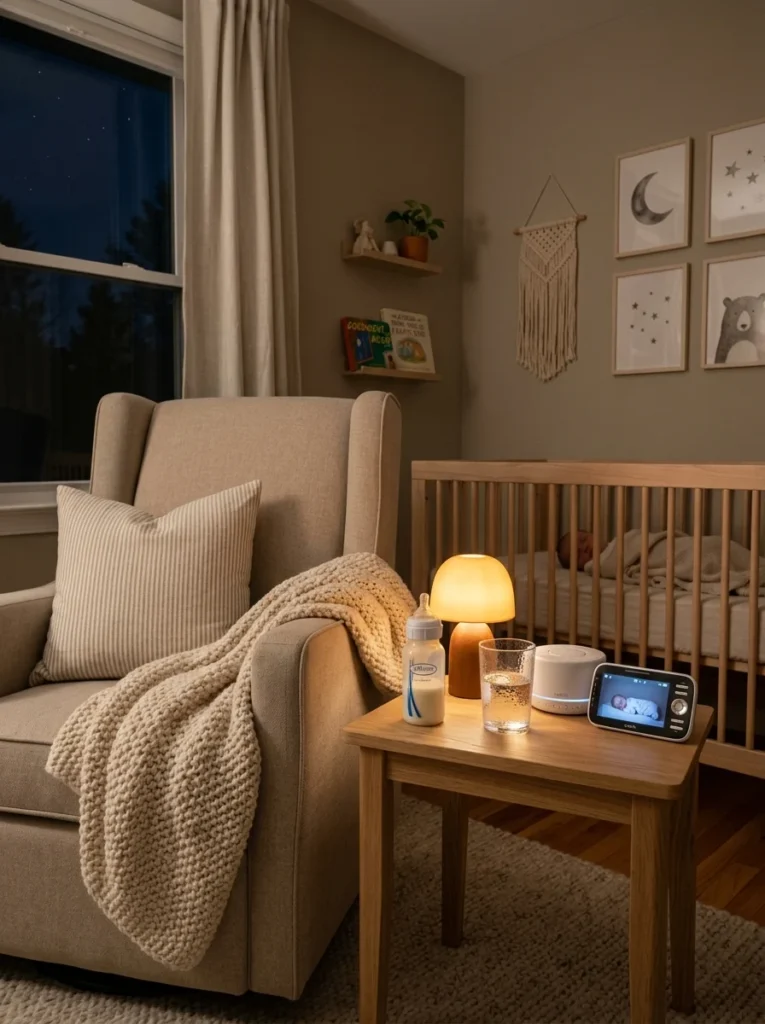
A small side table beside the feeding chair — or a basket on the floor beside it if no table fits — serves as a nursing station during nighttime feeds: a dedicated location for the water glass the nursing parent needs, the phone for checking the time and entertaining during feeds, the night light if it is a portable version, and any other items that are consistently needed during feeding sessions.
Having these items in a dedicated, consistent location means they are always findable in the dark without searching — which matters significantly at three in the morning when the parent is tired and the baby is fussing.
Hamper in the Nursery
A dedicated hamper in the nursery for soiled infant clothing, used muslin cloths, and similar nursery-generated laundry keeps nursery waste contained in the room where it is generated rather than distributed through the house as soiled items are carried to a remote laundry location. A hamper with a lid contains any odor. A hamper in a canvas or washable material can be cleaned if it is contacted by soiled items. A hamper positioned near the changing station — the primary source of nursery-generated laundry — is most convenient for use during nappy changes.
Conclusion
A well-designed nursery is one where safety is the unconditional foundation, function is the primary organizational principle, and aesthetics serve both without compromising either. The beautiful nursery that parents imagine when they begin planning the room is entirely achievable — but it is most durably achieved when the safety requirements are met without compromise, when the layout serves the flow of daily care, when the furniture is chosen for its genuine function rather than its appearance alone, when the lighting supports infant sleep rather than undermining it, and when the color and style choices are made in the context of the practical requirements they share the room with.
A nursery designed in this sequence — safety first, function second, beauty third — is a room that works for the baby who lives in it and for the parents who care for that baby in it, day and night, for the months and years of infancy and early childhood. That is what a nursery is for, and that is what good nursery design achieves.