
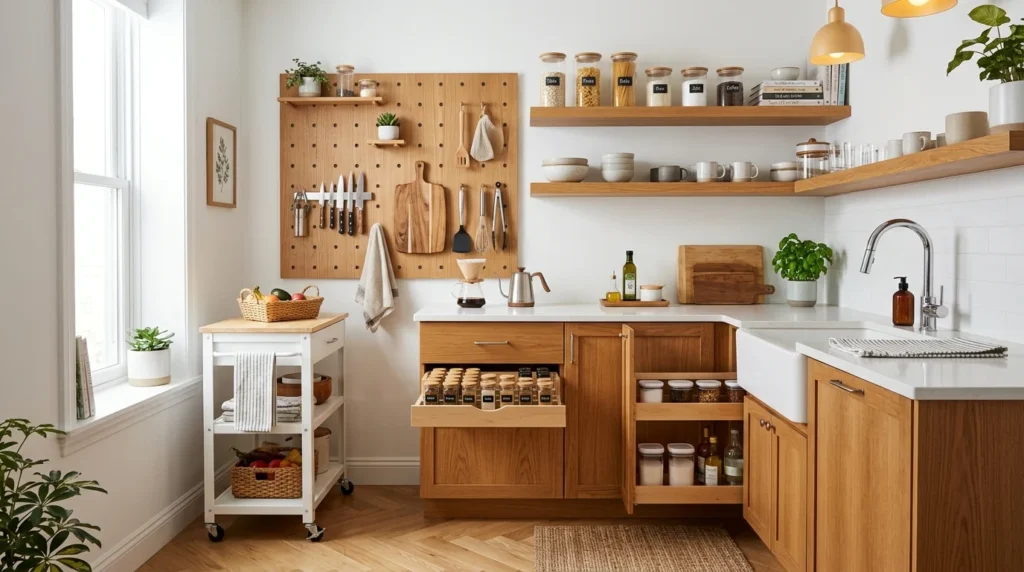
A small kitchen presents a challenge that millions of homeowners and apartment dwellers face every day. There is never quite enough counter space to work comfortably, never quite enough cabinet space to store everything properly, and the moment any surface becomes available it immediately disappears under appliances, utensils, and items that have nowhere else to go.
The instinctive response to a small kitchen storage problem is to assume that the only real solution is renovation — tearing out cabinets, adding new ones, reconfiguring the layout. But renovation is expensive, disruptive, and in many living situations simply not an option. Renters cannot modify their kitchens structurally. Homeowners on a tight budget cannot always justify the cost of a full kitchen remodel. And even those who do renovate often find that the new cabinets fill up just as quickly as the old ones.
The reality is that most small kitchen storage problems are not caused by insufficient cabinet space. They are caused by inefficient use of the space that already exists. The average kitchen cabinet uses only sixty to seventy percent of its available interior volume effectively. The space above cabinets, behind doors, on the sides of appliances, and on walls goes entirely unused. Counter surfaces become storage by default because there is no designated place for the items accumulating on them.
The twenty ideas in this guide address all of these inefficiencies without removing a single cabinet or spending a significant amount of money. They are organized by zone — cabinets, countertops, walls, under the sink, pantry alternatives, and drawers — so you can identify the areas of your kitchen that need the most attention and start there.
Cabinet Storage Solutions
Idea 1: Install Pull-Out Shelves Inside Deep Cabinets
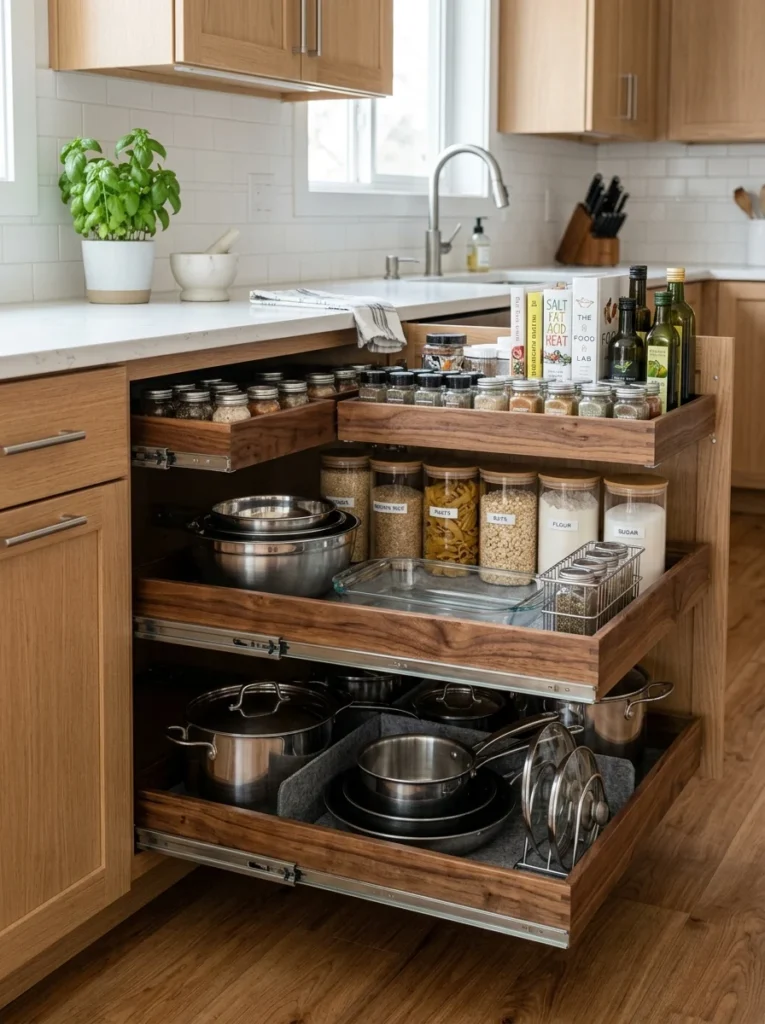
The standard fixed shelf inside a kitchen cabinet is one of the least efficient storage configurations in the home. Items at the back of a deep cabinet are effectively inaccessible in daily use — they require kneeling down, reaching in, and moving everything in front of them to retrieve anything stored behind. As a result, the back half of most deep lower cabinets stores items that are rarely if ever used, while the front half becomes overcrowded.
Pull-out shelves — also called drawer inserts or roll-out trays — solve this problem completely. They mount on drawer slides inside the existing cabinet and extend fully outward when pulled, bringing everything stored on them into clear view and easy reach. The back of the cabinet becomes as accessible as the front, effectively doubling the usable storage volume without changing the cabinet dimensions at all.
Pull-out shelf kits are widely available in standard cabinet widths and require no professional installation — they mount to the interior sides of the cabinet with screws and take approximately thirty minutes to install per shelf. The investment is modest and the improvement in daily usability is immediate and significant.
Idea 2: Add Door-Mounted Organizers to Cabinet Doors
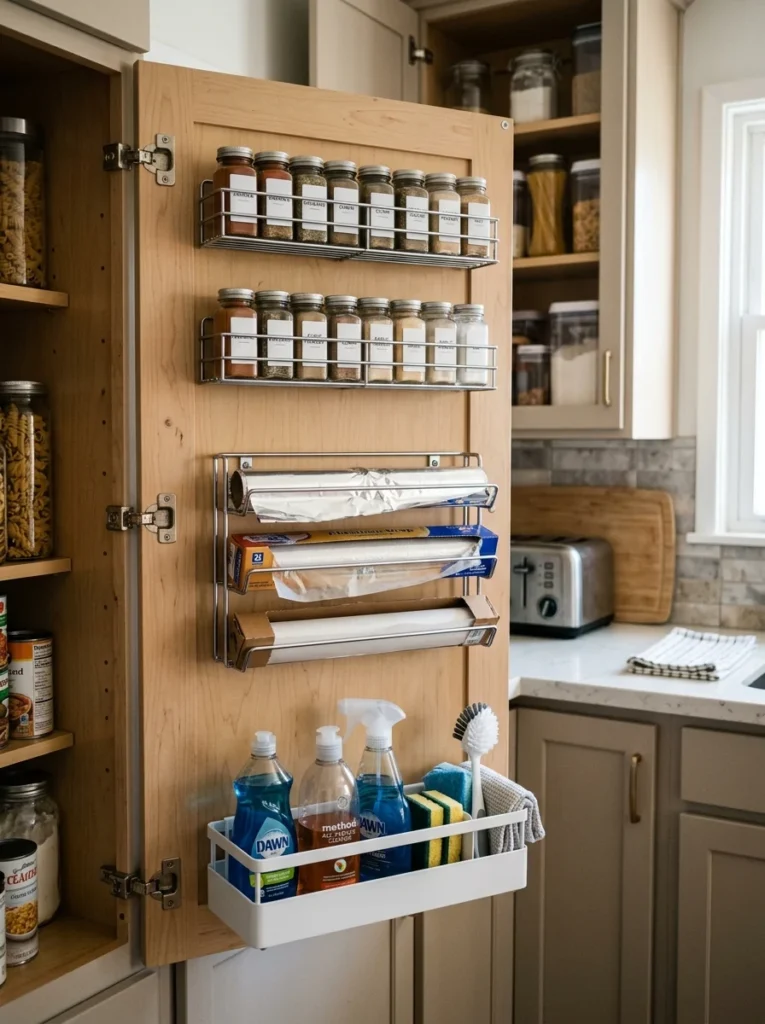
The inside face of every cabinet door in your kitchen is an unused storage surface. In a small kitchen with six to ten cabinet doors, this represents a meaningful amount of additional storage that costs almost nothing to activate.
Door-mounted organizers come in several formats. Narrow wire or plastic racks mount on the inside of cabinet doors and hold spice jars, small bottles, and condiment containers. Over-door pot lid organizers hold lids vertically, eliminating the frustrating pile of lids that typically occupies a disproportionate amount of cabinet space. Door-mounted foil and wrap dispensers keep cling film, aluminum foil, and baking paper organized and easily accessible.
The most valuable application for door-mounted storage is the cabinet directly under the sink and the cabinet closest to the cooking surface. The cabinet under the sink typically has limited shelf space due to plumbing, but its door offers a full surface area for cleaning supply organization. The cabinet nearest the stove benefits from door-mounted spice storage that keeps frequently used seasonings immediately accessible during cooking.
Idea 3: Use Shelf Risers and Stackable Inserts
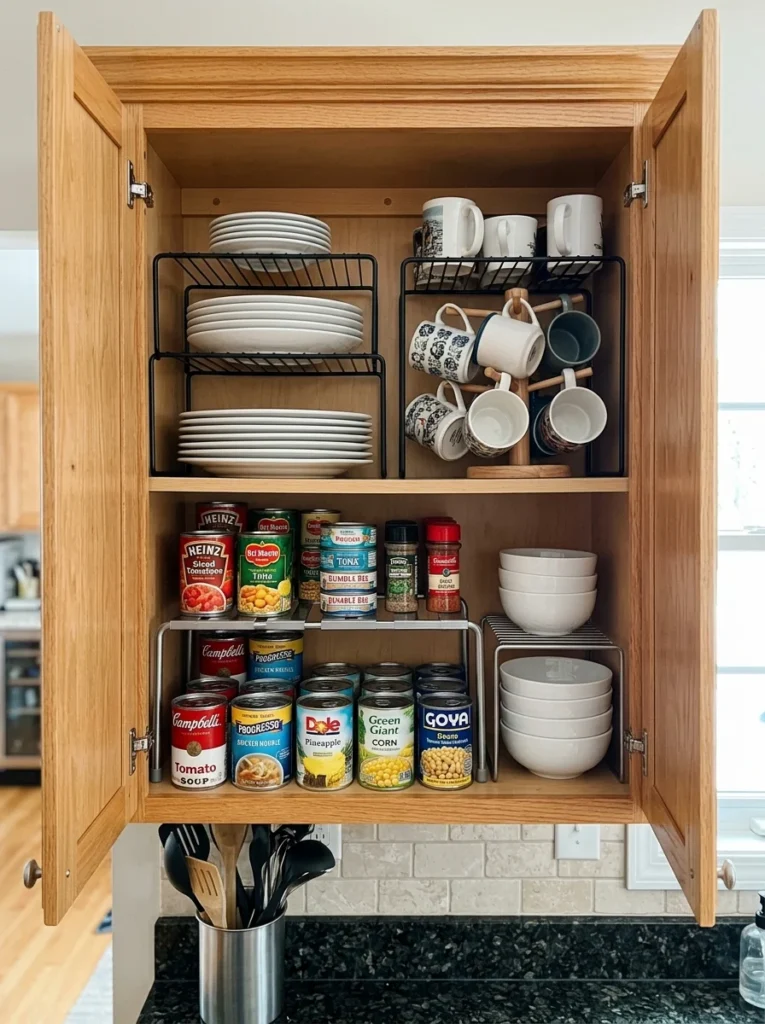
The fixed shelf spacing inside most kitchen cabinets is designed for a generic range of item heights, which means that in almost every cabinet there is a significant gap of wasted vertical space above the items stored on each shelf. A stack of plates that is six inches tall in a cabinet with twelve inches of shelf space leaves six inches of empty air above it — air that represents usable storage volume.
Shelf risers and stackable cabinet inserts fill this wasted vertical space by creating additional horizontal levels within the existing shelf. A simple wire or bamboo shelf riser placed on a cabinet shelf immediately creates two levels of storage where only one existed before. Stackable can organizers create tiered levels for canned goods so that items at the back are visible above items at the front. Plate organizers hold plates vertically rather than in a horizontal stack, using height rather than footprint for plate storage.
The total additional storage created by addressing the wasted vertical space in every cabinet in a small kitchen is typically equivalent to one or two additional cabinets — a meaningful gain without any structural change.
Idea 4: Install a Lazy Susan in Corner Cabinets and Deep Shelves
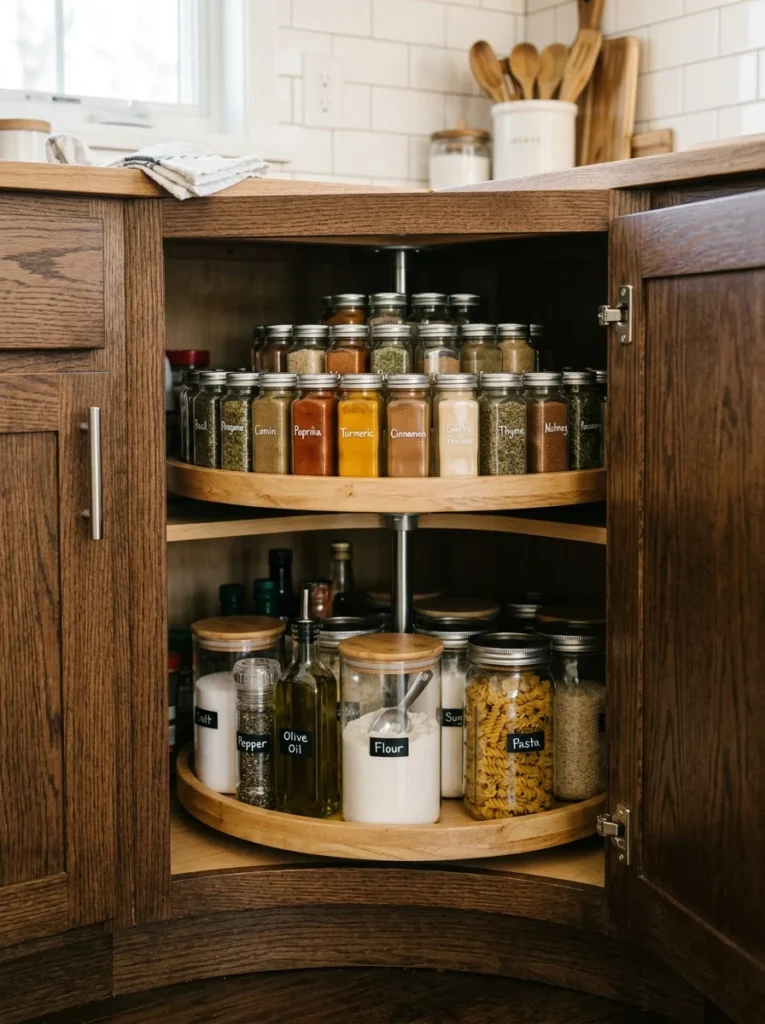
Corner cabinets are the most problematic storage space in any kitchen. The depth of the corner makes items stored at the back almost completely inaccessible, and the shape of the space makes it difficult to use standard storage solutions effectively. The result is that corner cabinets in most kitchens become a repository for items that are used rarely or never — a storage black hole that takes up significant floor space while contributing almost nothing to daily kitchen function.
A lazy susan — a rotating circular tray that spins on a central axis — transforms corner cabinet storage by bringing items at the back of the cabinet forward with a simple spin. Nothing is ever truly at the back of the cabinet when the entire storage surface rotates.
Lazy susans are not limited to corner cabinets. A turntable lazy susan placed on any deep shelf — inside a pantry cabinet, on a refrigerator shelf, or on a countertop spice area — makes items at the back just as accessible as items at the front. The investment is minimal and the improvement in accessibility is immediate.
Countertop Organization Solutions
Idea 5: Decide What Actually Belongs on Your Counter
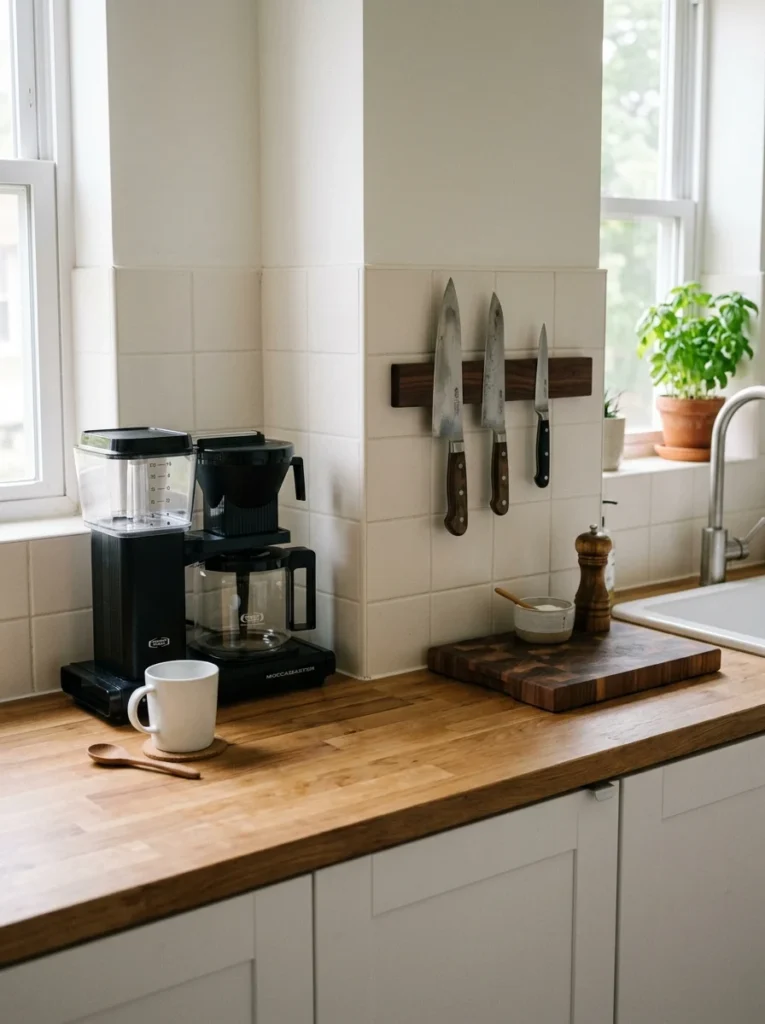
Before adding any storage solution to your countertop, the most valuable thing you can do is audit what is currently on it and ask honestly whether each item earns its place there. Counter space is the most valuable real estate in a small kitchen — the surface you prepare food on, the surface that determines how functional your kitchen feels day to day. Every item permanently occupying counter space needs to justify that position.
Items that genuinely belong on a kitchen counter are those used at least once daily. A coffee maker used every morning earns its counter position. A stand mixer used once a month does not. A knife block used multiple times every day earns its position. A decorative fruit bowl holding two pieces of fruit that could sit on the dining table does not.
Move every item that is not used daily off the counter and into a cabinet, a pantry, or another room entirely. The counter space revealed by this single action often exceeds the space created by any storage product purchase. Do this audit before buying anything else, and reassess the remaining counter items once the rarely-used ones have been relocated.
Idea 6: Use a Magnetic Knife Strip Instead of a Knife Block
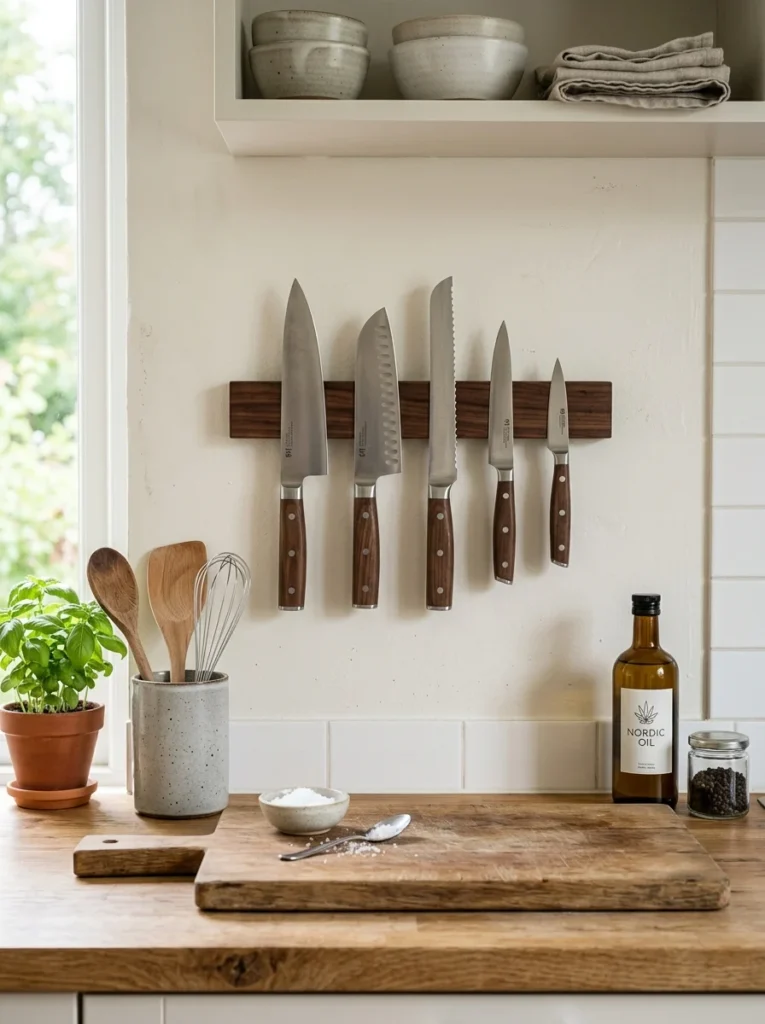
A traditional knife block occupies a footprint of approximately six by ten inches on the counter and typically holds eight to ten knives, most of which are used rarely. A magnetic knife strip mounted on the wall above the counter or on the side of a cabinet holds the same number of knives with zero counter footprint.
The wall-mounted magnetic strip is one of the simplest and most effective counter space reclamation strategies available. Installation requires only two screws, the cost is minimal, and the counter space recovered — the footprint of the knife block plus the clear zone around it — is immediately usable for food preparation.
The secondary benefit of a magnetic knife strip is that knives are easier to see, easier to access, and better maintained than in a block. Knife blocks trap moisture and bacteria around the blade edges. A magnetic strip keeps blades dry, visible, and fully accessible.
Idea 7: Store Small Appliances Vertically or in an Appliance Garage
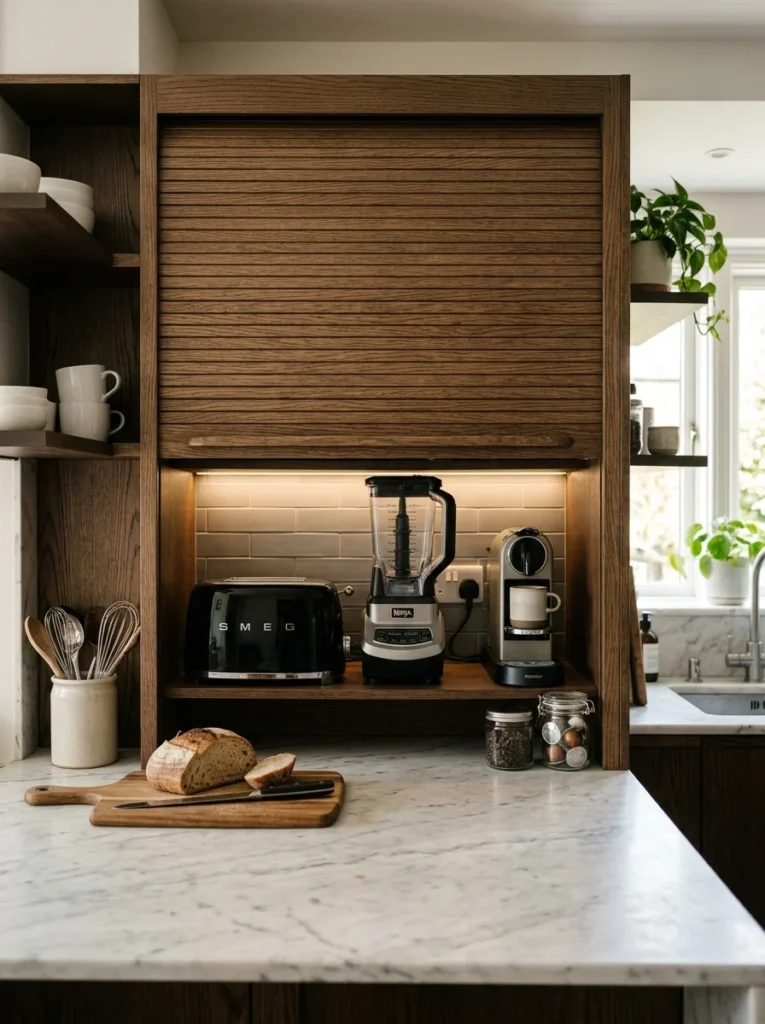
Small appliances are typically the largest consumers of counter space in a small kitchen. A toaster, a kettle, a coffee maker, a blender, and a food processor together occupy a substantial percentage of the available counter area in a small kitchen, and yet several of them may only be used a few times per week.
The most effective solution for small appliance storage depends on how frequently each appliance is used. Daily-use appliances — the kettle, the coffee maker, the toaster — genuinely belong on the counter for convenience. Weekly-use appliances — the blender, the food processor, the sandwich maker — should be stored inside a cabinet and retrieved when needed.
An appliance garage is a dedicated cabinet section with a roll-up or fold-back door positioned at counter height that hides small appliances from view while keeping them accessible without fully putting them away. This is particularly effective for keeping the counter looking clear and uncluttered while maintaining easy access to appliances used several times per week.
Idea 8: Use Tiered Stands for Counter Organization
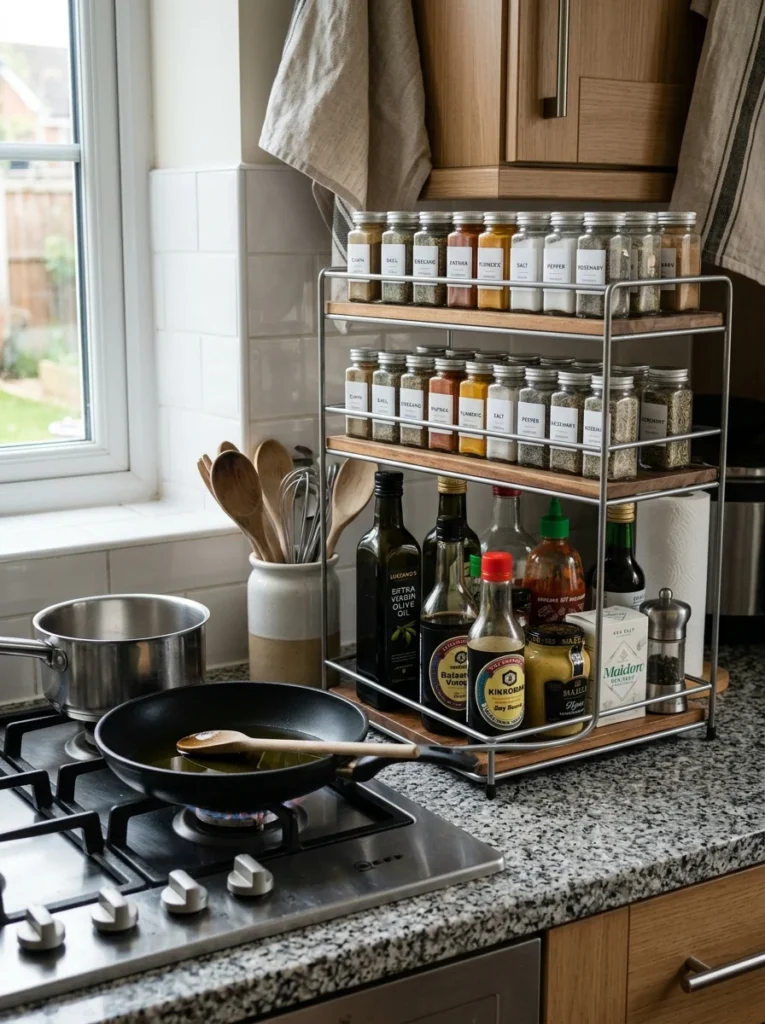
For items that genuinely need to remain on the counter — spices used daily, cooking oils, condiments, fresh produce — a tiered stand uses vertical space above the counter rather than spreading items across the horizontal surface. A two or three-tiered stand holds twice or three times as many items in the same footprint as those items laid flat on the counter.
Tiered stands work particularly well for spices and small bottles near the cooking surface, fruit and vegetables in a corner of the counter, and small items such as salt, pepper, and cooking oils that are needed constantly and genuinely belong within immediate reach.
Wall and Vertical Space Solutions
Idea 9: Install a Pegboard on One Kitchen Wall
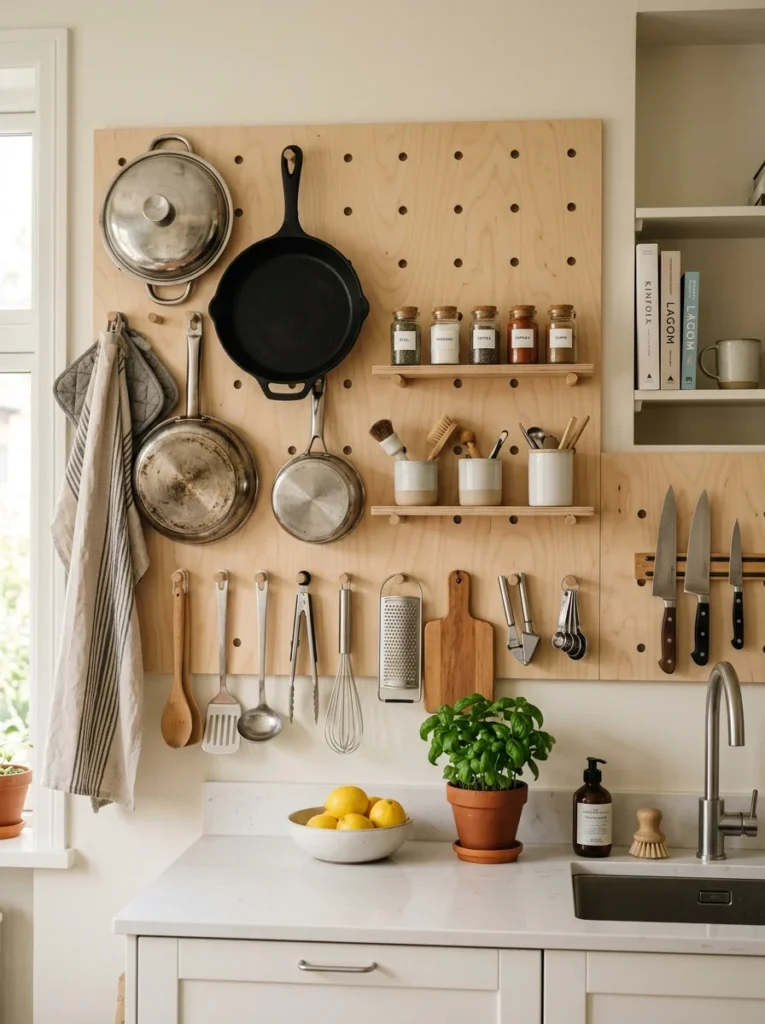
A pegboard — a sheet of hardboard or metal with regularly spaced holes that accept hooks, shelves, and holders — is one of the most flexible and cost-effective kitchen storage solutions available. Mounted on a wall in the kitchen, it creates an entirely customizable vertical storage surface that can hold pots, pans, utensils, spice jars, small shelves, paper towel holders, and almost anything else that can be hung.
The primary advantage of a pegboard over fixed wall storage is complete flexibility. The hooks and accessories slot into any hole on the board and can be repositioned in seconds, which means the storage configuration can be adjusted as needs change without any tools or drilling. Adding a new item simply requires finding an empty hole and inserting a hook.
A pegboard installation requires only four fixings — screws into the wall at the corners of the board — and can be painted any color to suit the kitchen aesthetic. A pegboard painted in the same color as the kitchen wall virtually disappears visually while still providing full storage function.
Idea 10: Mount a Pot Rack on the Wall or Ceiling
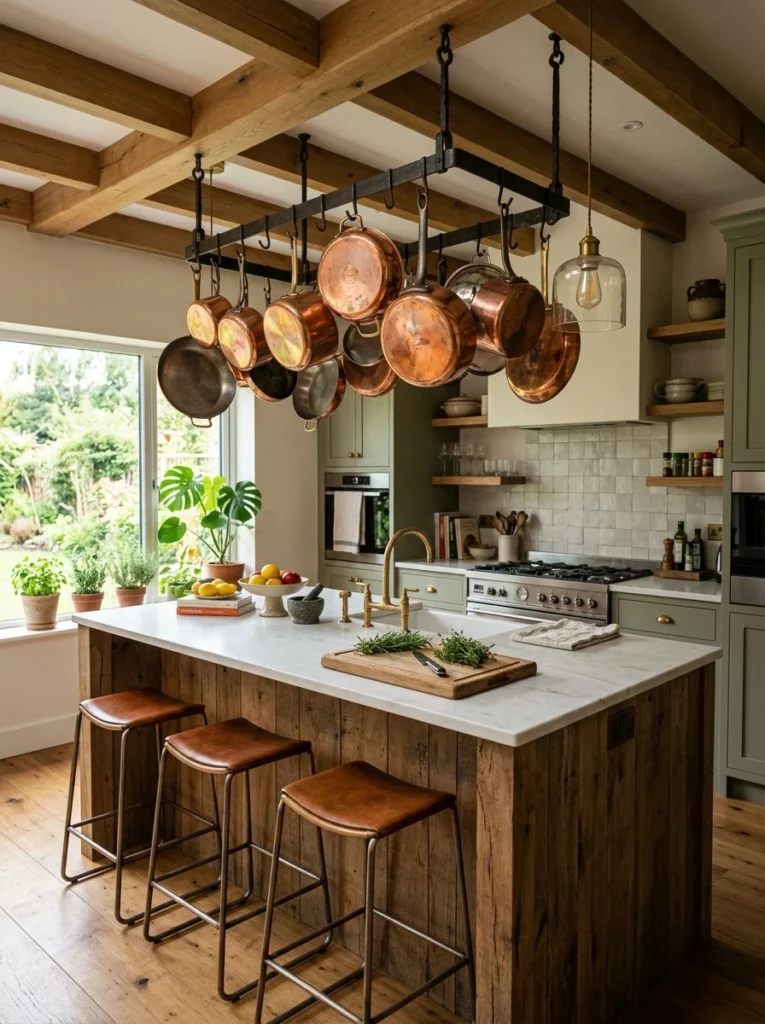
Pots and pans are among the most space-consuming items in any kitchen, and they present a particular storage challenge because of their size, weight, and irregular shapes. Stacking pots inside a cabinet is inefficient — each pot must be removed to access the one beneath it — and dedicated pot drawers require substantial cabinet volume.
A wall-mounted or ceiling-mounted pot rack removes pots and pans from cabinet storage entirely and uses the vertical space above the cooking surface — space that is otherwise completely unused — for storage instead. Hanging pots are easier to access than stacked ones, visible at a glance so the right pot can be identified instantly, and completely out of the way of counter and cabinet space.
A wall-mounted pot rack requires a wall that can support the weight of the pots — typically a solid masonry or stud wall — and access to hooks or a mounting rail. A ceiling-mounted pot rack requires ceiling joists that can take the load. Both options are permanent installations that require some planning, but the storage volume they free up inside cabinets makes them one of the most impactful storage solutions in a small kitchen.
Idea 11: Add Floating Shelves for Overflow Storage
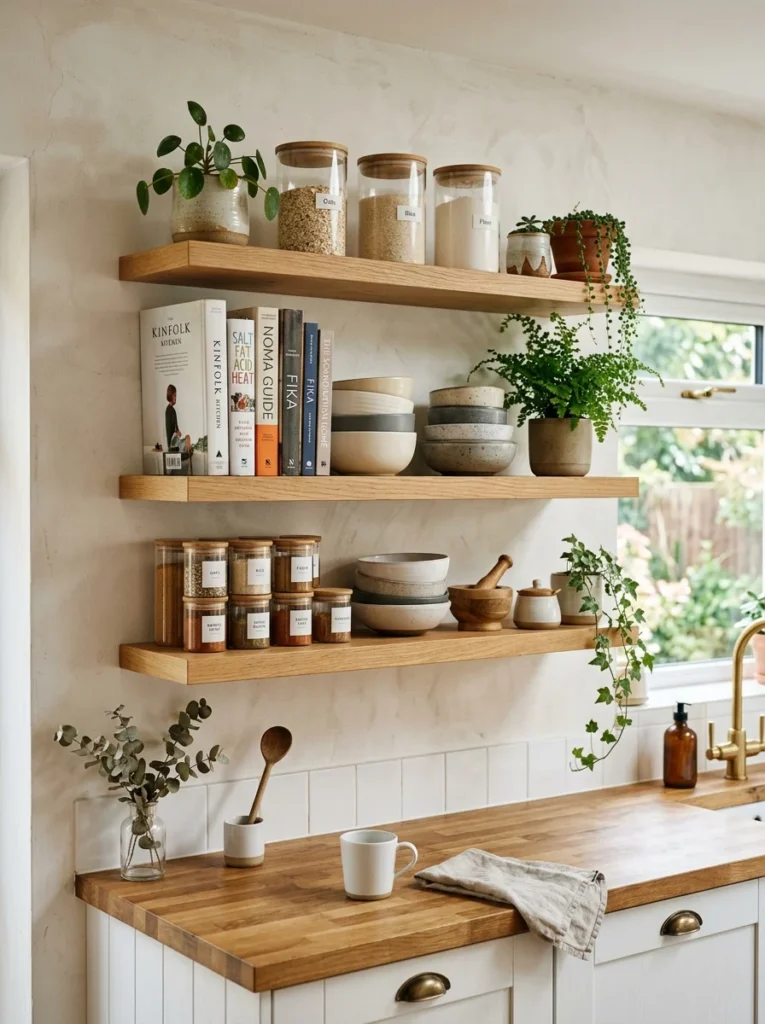
Open floating shelves mounted on the kitchen wall provide additional storage for items that are used regularly and do not need to be hidden behind cabinet doors. In a small kitchen where every cabinet is full, a run of floating shelves above a counter or beside a window adds storage volume with minimal visual weight.
The key to floating shelves in a small kitchen is disciplined styling. Open shelves in a small kitchen are highly visible, which means they need to be kept intentional and edited rather than used as overflow storage for anything that does not fit elsewhere. A shelf styled with matching storage containers, a few attractive pieces of cookware, and carefully selected decorative items looks considered and beautiful. A shelf stacked with random items, mismatched containers, and overflow clutter from overfull cabinets makes a small kitchen look more chaotic rather than more organized.
Use floating shelves for items that are genuinely attractive or that you actively want to display — matching sets of glasses, ceramic mixing bowls, a collection of cookbooks, or attractive storage jars. Store everything else behind cabinet doors.
Idea 12: Use Magnetic Spice Jars on the Fridge or a Metal Panel
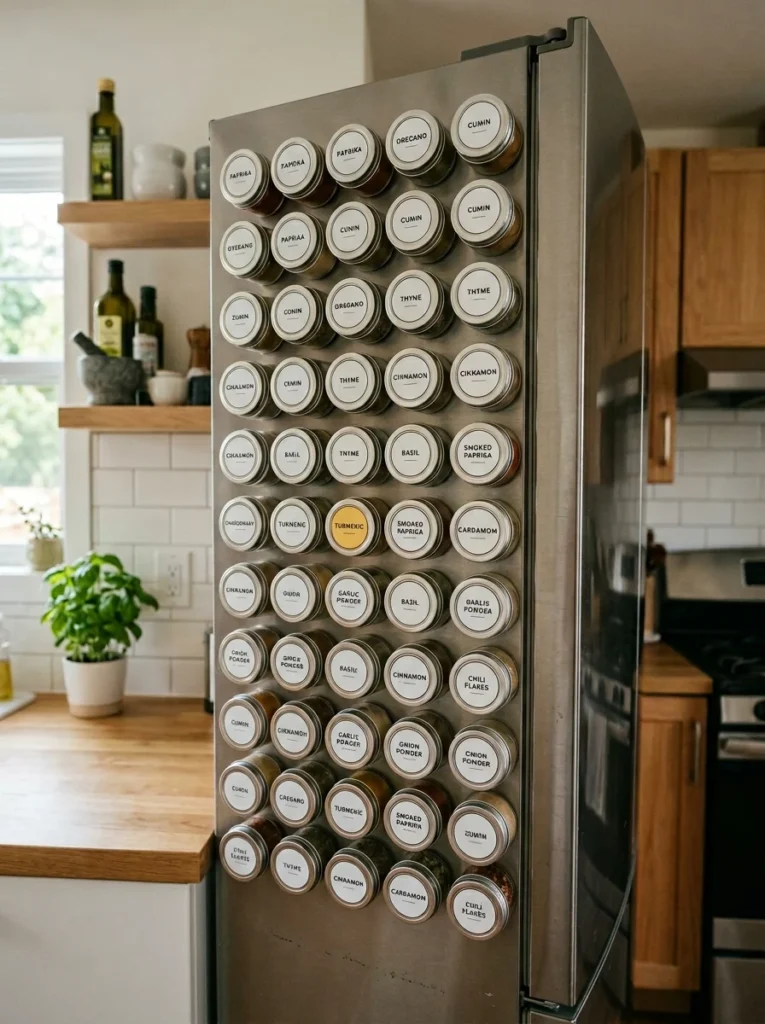
Spice storage is a persistent small kitchen problem. A collection of twenty or thirty spice jars takes up an entire cabinet shelf, a significant section of counter space, or a drawer that could be used for something else. Magnetic spice jars solve this by moving spice storage to the side of the refrigerator or to a metal panel mounted on the wall — surfaces that are otherwise entirely unused.
Magnetic spice jars have a magnetic base that adheres to any metal surface and holds securely enough to withstand the vibration of the refrigerator without falling. The spices are visible at a glance, accessible without opening any cabinet or drawer, and occupy zero counter or shelf space.
The aesthetic requires some commitment — a side of the refrigerator covered in spice jars is a visual statement that not everyone finds appealing. The alternative is a dedicated metal panel mounted on an unused section of kitchen wall, which keeps the spice storage contained in one location and away from the refrigerator’s visual field.
Under-Sink Storage Solutions
Idea 13: Maximize Under-Sink Space With Pull-Out Organizers
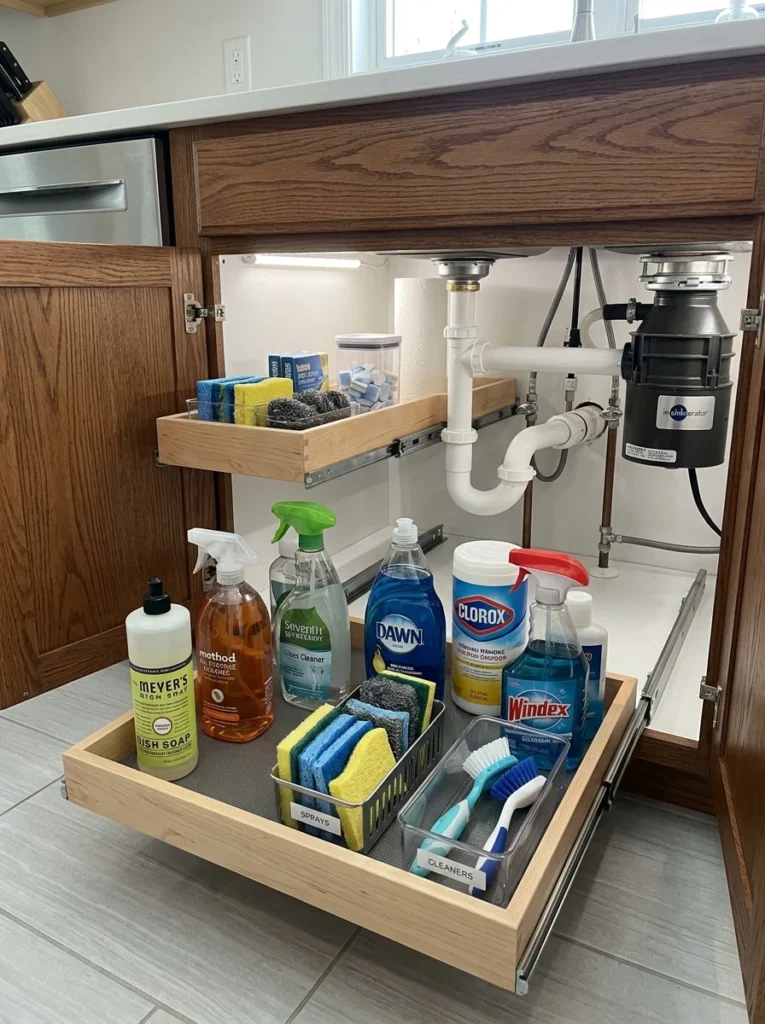
The cabinet under the kitchen sink is typically the most wasted storage space in the entire kitchen. The plumbing that runs through the cabinet — the drainpipe and water supply lines — creates an irregular obstacle that makes standard shelving ineffective, and most under-sink cabinets end up as a disorganized accumulation of cleaning products, spare sponges, and items stored there because they had nowhere better to go.
Pull-out drawer organizers designed specifically for under-sink cabinets work around the plumbing obstacle with cutouts and adjustable configurations that use the available space on either side of the pipes. A well-organized under-sink cabinet using these systems can hold a full range of cleaning products, dishwasher tablets, spare bin bags, and cleaning tools in a way that is completely accessible without removing everything to find what is needed.
Idea 14: Use Tension Rods for Spray Bottle Storage
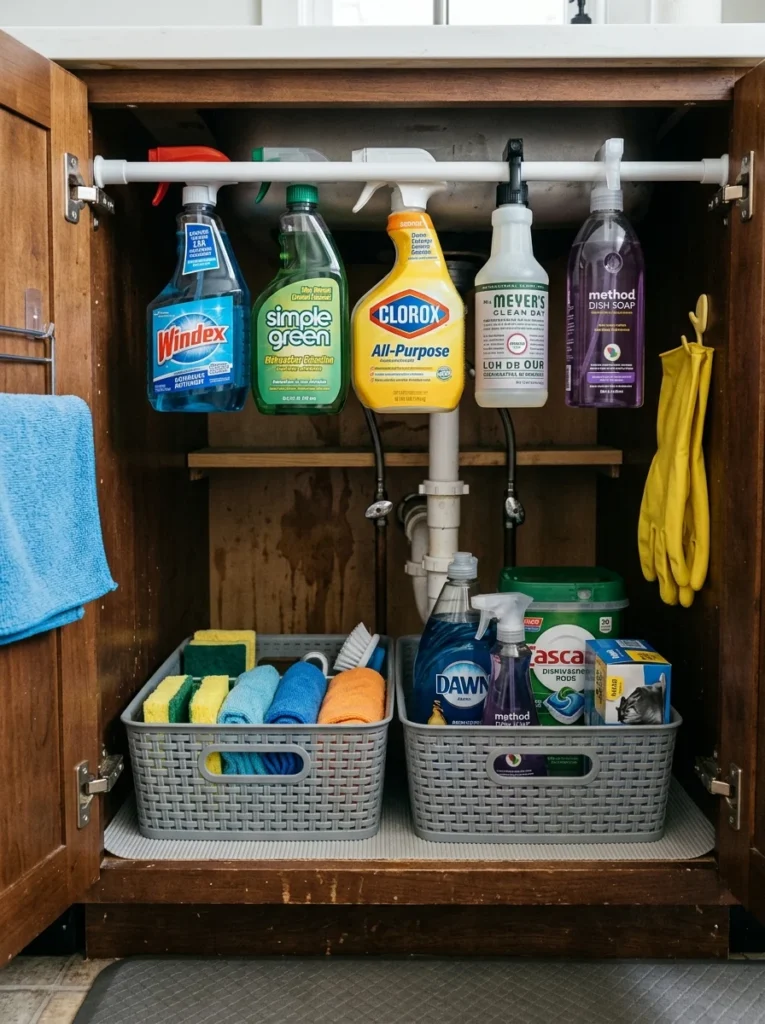
Spray bottles — surface cleaners, glass cleaners, and similar products — are awkward to store upright in a cabinet because they fall over and take up disproportionate floor space relative to the amount of product they contain.
A simple tension rod installed horizontally near the top of the under-sink cabinet, at a height that allows spray bottles to hang from their trigger handles, stores an entire collection of spray bottles vertically in the space above whatever is stored on the cabinet floor. The bottles are visible, accessible, and completely out of the way of the cabinet floor area, which remains available for other items.
This solution costs almost nothing — a tension rod is one of the most affordable storage accessories available — and takes approximately two minutes to install with no tools required.
Pantry Alternative Solutions
Idea 15: Use an Over-Door Pantry Organizer
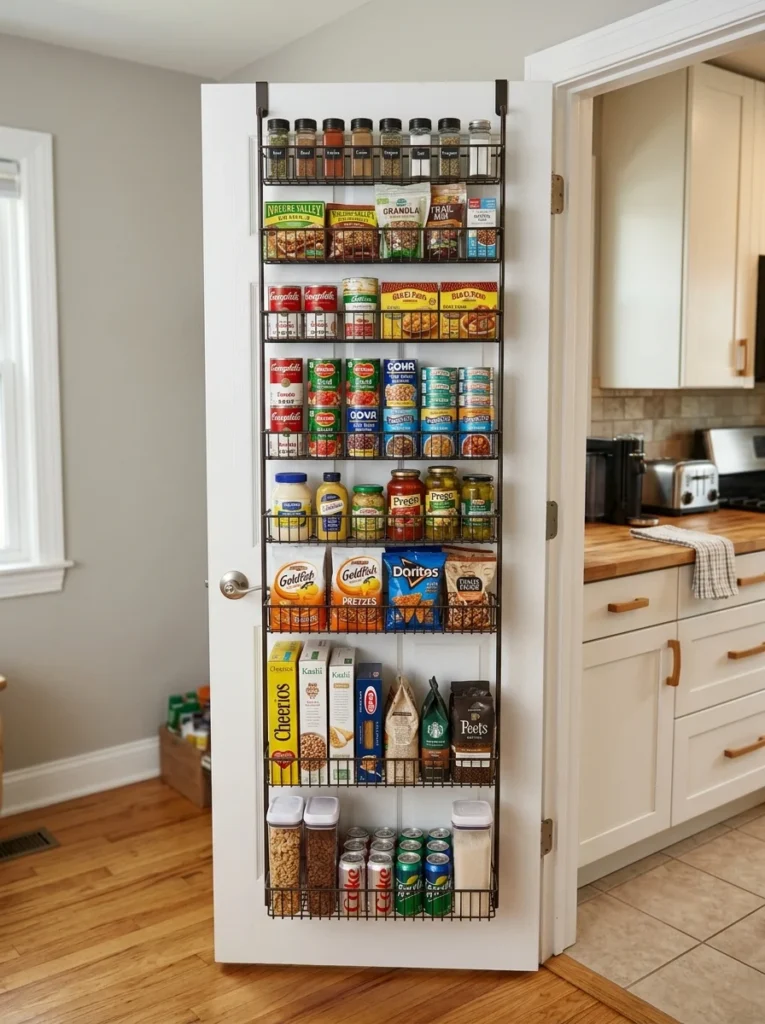
In a kitchen without a dedicated pantry, an over-door organizer mounted on the back of a kitchen door or a nearby closet door creates immediate pantry-style storage with no drilling or permanent modification. Over-door pantry organizers hold multiple shelves of food items, spices, and small bottles on a structure that hangs over the top of the door and is held in place by its own weight and the door frame.
The storage capacity of a good over-door pantry organizer is significant — a full-height model with multiple shelves can hold forty to sixty items in the vertical space behind a standard door that would otherwise be completely unused.
Idea 16: Use a Rolling Cart as a Mobile Pantry
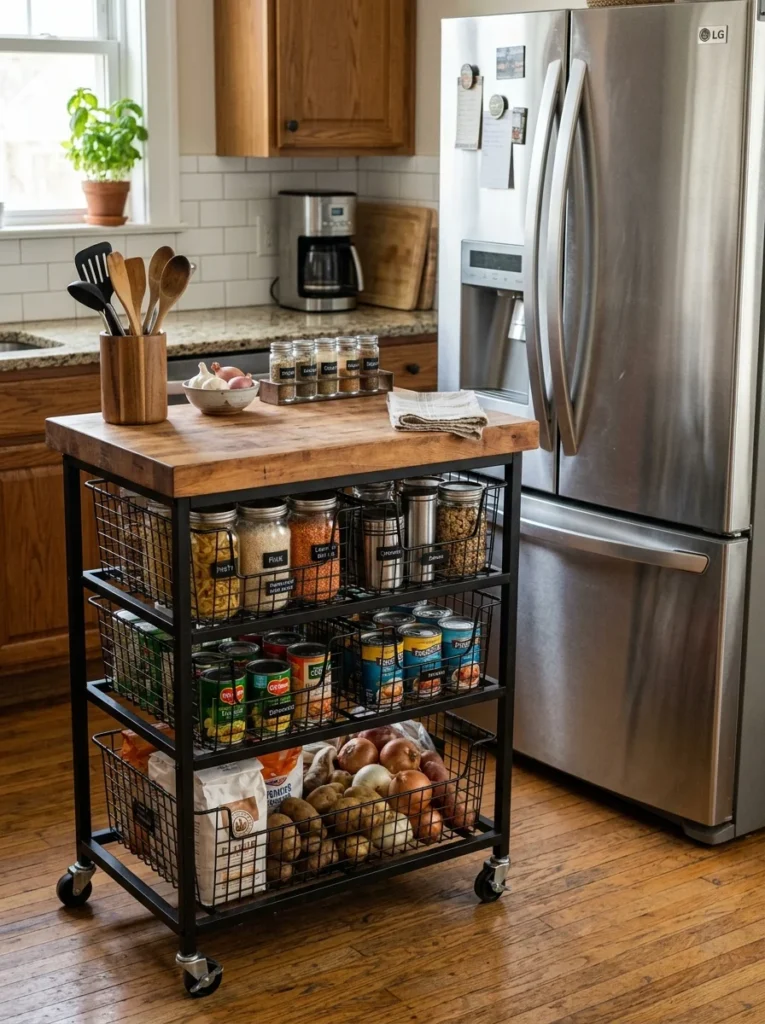
A rolling kitchen cart positioned beside the refrigerator, at the end of a counter run, or in any available corner creates additional storage and preparation surface that can be moved wherever it is needed and pushed aside when the space is required for another purpose.
A rolling cart with open shelves on the lower levels and a solid work surface on top serves simultaneously as overflow pantry storage, additional preparation counter, and a mobile serving station that can be wheeled to the dining area when needed. In a very small kitchen, a rolling cart that can be moved out of the kitchen entirely when cooking is finished gives the cook full use of the floor space during active kitchen use while providing full storage function when parked in its regular position.
Drawer Organization Solutions
Idea 17: Install Expandable Drawer Dividers
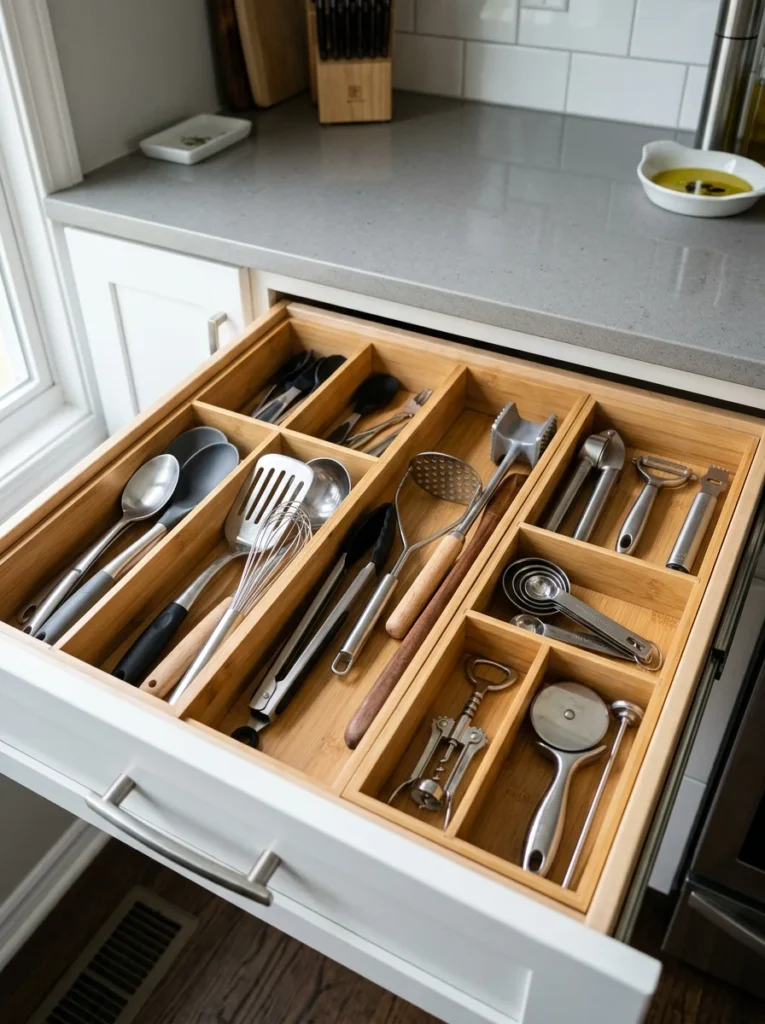
Kitchen drawers without dividers become chaotic within days of being organized — utensils, tools, and small items migrate freely across the drawer surface and jumble together until the drawer becomes a frustrating scramble to search through. Drawer dividers eliminate this by creating fixed sections that keep categories of items separated and in place.
Expandable drawer dividers — dividers that extend to fit any drawer width — are the most flexible option because they can be reconfigured as the contents of the drawer change. A drawer that holds cooking utensils on one side and small tools on the other can be reorganized into three sections for different utensil categories when the drawer contents are adjusted.
Idea 18: Organize Deep Drawers With Vertical Dividers for Pots and Pans
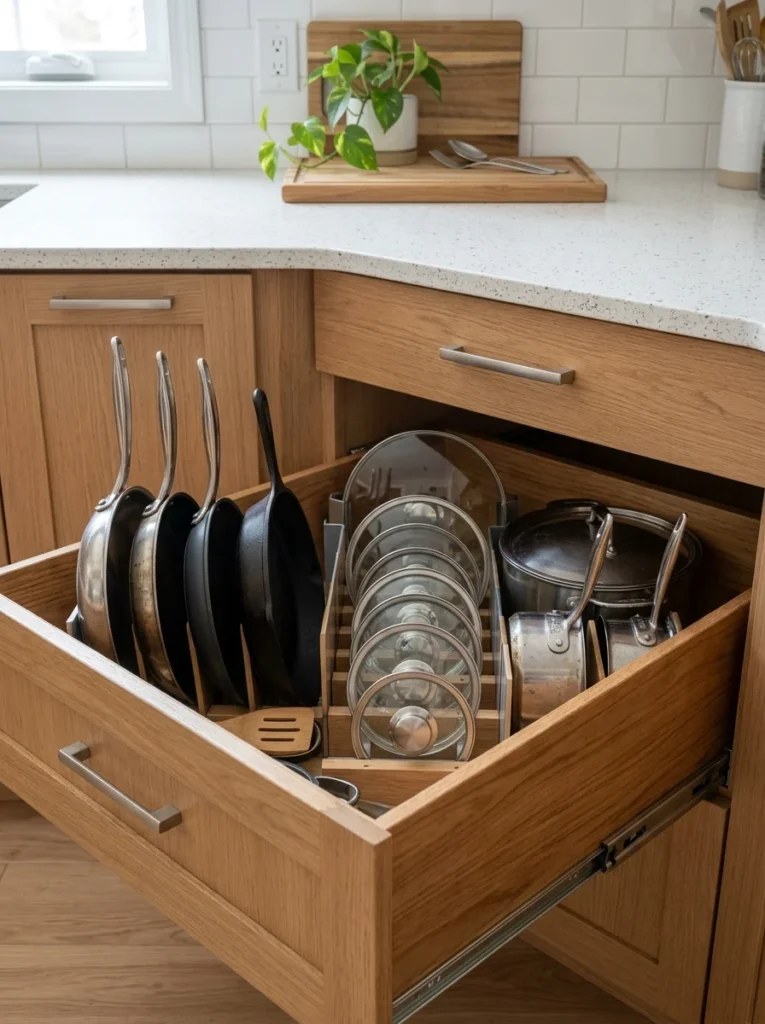
Deep drawers — the tall drawers found in many modern kitchens — are one of the most useful storage formats in a kitchen but also one of the most frequently misused. Without organization, deep drawers become a stacked pile of pots, pans, and lids where accessing any item requires removing several others first.
Vertical drawer dividers installed in a deep drawer create individual slots that hold each pot, pan, or lid upright and separately. Every item is immediately visible from above when the drawer is opened, accessible without moving anything else, and stored in a way that protects the finishes from scratching caused by stacking.
Idea 19: Dedicate One Drawer Entirely to a Decanted Spice System
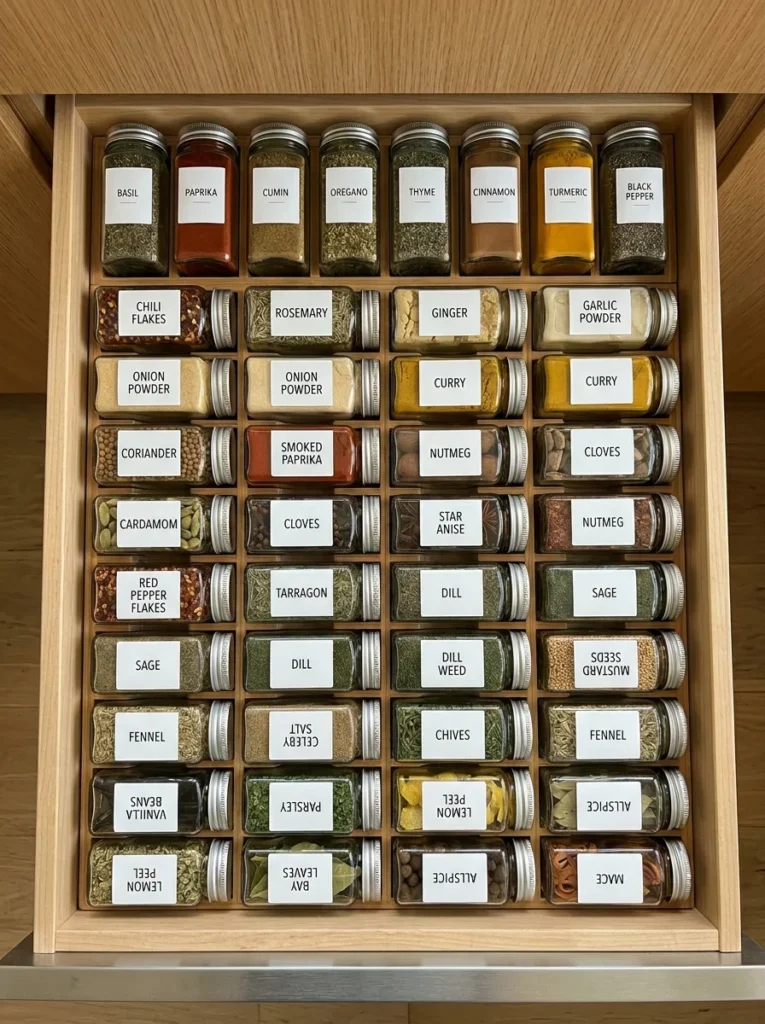
A dedicated spice drawer with uniform flat-lid spice jars stored label-up is one of the most satisfying and functional kitchen organization systems available. Unlike spice racks, shelves, or door-mounted organizers, a spice drawer keeps every spice visible at a glance from above when the drawer is opened — no reaching to the back of a shelf, no rotating jars to read labels, no searching through a crowded rack.
The system requires decanting spices from their original packaging into matching uniform jars — square or round flat-lid jars work best for drawer storage — and labeling the lids so that the name of each spice is readable from directly above. The initial setup takes time, but the daily convenience of instantly finding any spice in a single glance makes it one of the most consistently valued kitchen organization investments.
Idea 20: Eliminate the Junk Drawer With a Simple System
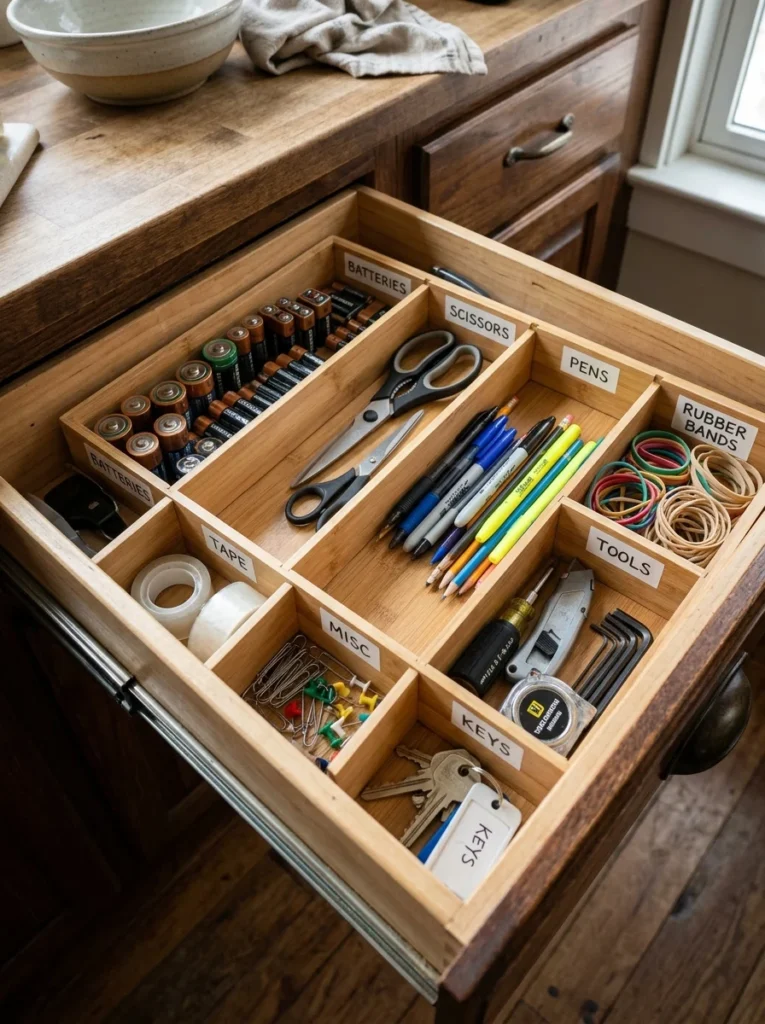
Almost every kitchen has a junk drawer — a catch-all for batteries, rubber bands, takeaway menus, random tools, expired coupons, and everything else that has no designated home. The junk drawer is not inherently a problem — having one location for miscellaneous items is genuinely useful. The problem is when the junk drawer expands to two or three drawers, or when the items inside it make it genuinely difficult to find anything.
The solution is not to eliminate the junk drawer but to organize it with a simple system. A drawer organizer with multiple small sections contains the miscellaneous items in a way that keeps them separated and findable. A regular — quarterly is sufficient — clear-out removes the items that have accumulated without being used and throws away anything expired, broken, or genuinely unnecessary.
One well-organized junk drawer is a useful part of any kitchen. Multiple disorganized overflow drawers are a storage problem that takes up space needed for kitchen tools and equipment.
Putting It All Together: Where to Start
Twenty ideas for a small kitchen storage transformation can feel overwhelming if approached all at once. The most effective approach is to start with the changes that require the least investment — time, money, and effort — and build from there.
Begin with the audit. Empty every cabinet and every drawer, remove everything from the counter, and assess what you actually have and what you actually use. This step alone — before spending any money or installing any product — typically reveals a significant amount of space that was being occupied by items that no longer belong in the kitchen.
Then address the cabinet interiors. Pull-out shelves, shelf risers, and door-mounted organizers are the highest-impact, lowest-cost interventions available and together transform how much usable storage your existing cabinets provide.
Then clear the counter. Move every non-daily-use appliance and item off the work surface and into a cabinet, a pantry, or another room. Install a magnetic knife strip to replace the knife block. Assess what remains and ask whether it genuinely needs to be there.
Then address the walls and the under-sink space. These are the storage zones most consistently ignored in small kitchens and the ones that offer the most untapped potential.
The result of working through even half of the twenty ideas in this guide is a small kitchen that functions significantly better than before — one where the available space is used efficiently, where every item has a designated place, and where the counter surfaces are clear enough to actually cook on.
Conclusion
A small kitchen does not need to be a frustrating kitchen. The difference between a small kitchen that works beautifully and one that feels constantly cramped and disorganized is almost never the amount of cabinet space available — it is how intelligently that space is used.
The twenty ideas in this guide cover every zone in the kitchen and every category of storage problem, from the most common issues with cabinet interiors and counter clutter to the frequently overlooked potential of walls, doors, and the space under the sink. None of them require renovation, most require minimal investment, and all of them create immediate and meaningful improvements in how the kitchen functions.
Start with the audit, address the quick wins, and work through the remaining ideas systematically. A small kitchen organized with intention and the right storage solutions is not a compromise — it is a kitchen that works exactly as well as one twice its size.