
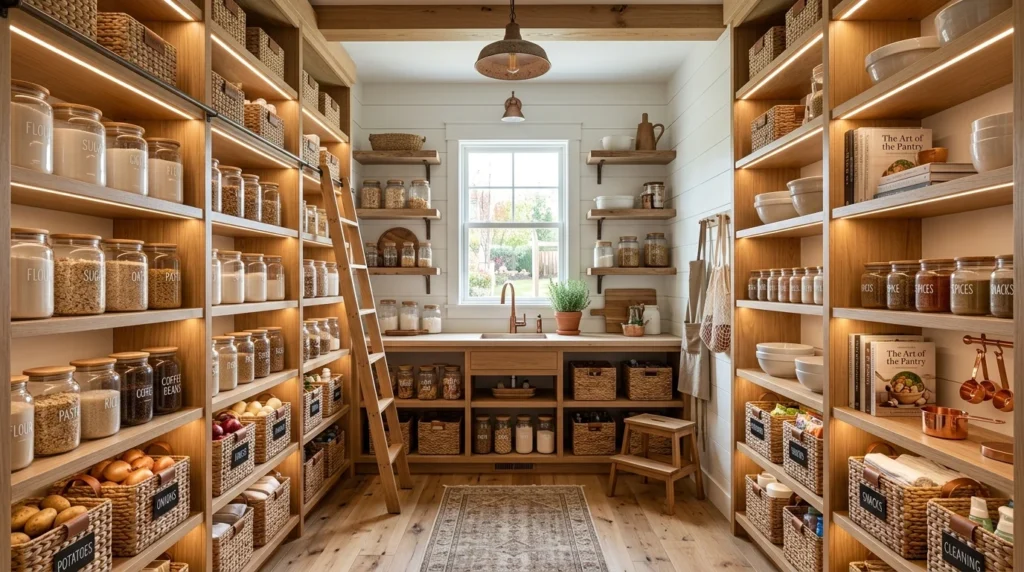
A walk-in pantry is one of the most consistently desired features in residential kitchen design. Ask homeowners what they would add to their kitchen if they could add anything, and a dedicated walk-in pantry appears near the top of the list with remarkable consistency — ahead of more expensive renovations, ahead of premium appliances, and ahead of most other storage or design upgrades. The reason is straightforward: a well-designed walk-in pantry solves more daily kitchen frustrations simultaneously than almost any other single feature a kitchen can have.
The appeal of a walk-in pantry goes beyond simple storage volume. A dedicated food storage room with its own door creates a clear organizational separation between cooking space and storage space that transforms how both areas function. The kitchen itself — freed from the obligation to hold every food item, every small appliance, and every surplus supply — can be organized purely around the activities of cooking and preparing food. The pantry becomes the backstage area that supports the kitchen’s front-of-house function, holding the inventory, the equipment, and the supplies that the kitchen draws from rather than storing.
But a walk-in pantry that is poorly designed — one where the layout does not suit the household’s actual storage needs, where the shelving system does not use the available space efficiently, or where the lighting and organization make finding items difficult — fails to deliver the practical benefits that make a walk-in pantry so desirable. A poorly designed walk-in pantry is simply a room full of disorganized food, which is no improvement over the disorganized cabinet storage it replaced.
This guide covers everything needed to plan, design, organize, and style a walk-in pantry that genuinely works — one that uses every inch of available space efficiently, keeps every category of stored item visible and accessible, suits the specific storage needs of the household it serves, and looks beautiful enough to be a room the household is proud of rather than one that stays hidden behind a closed door. Whether the walk-in pantry is a new room being created within a home renovation, an existing room being redesigned, or a space being optimized for the first time, this guide provides the complete framework for making it exceptional.
Section 1: Layout Options — Choosing the Configuration That Suits Your Space
The layout of a walk-in pantry — the configuration of shelving and storage surfaces within the room — is the most important design decision in the entire planning process. The right layout maximizes the usable storage volume of the available space, creates efficient access to every stored item, and suits the specific dimensions of the room. The wrong layout wastes space, creates accessibility problems, and produces a pantry that looks impressive but functions poorly.
There are four primary layout configurations for walk-in pantries, each suited to different room dimensions and storage needs.
The Single-Wall Layout
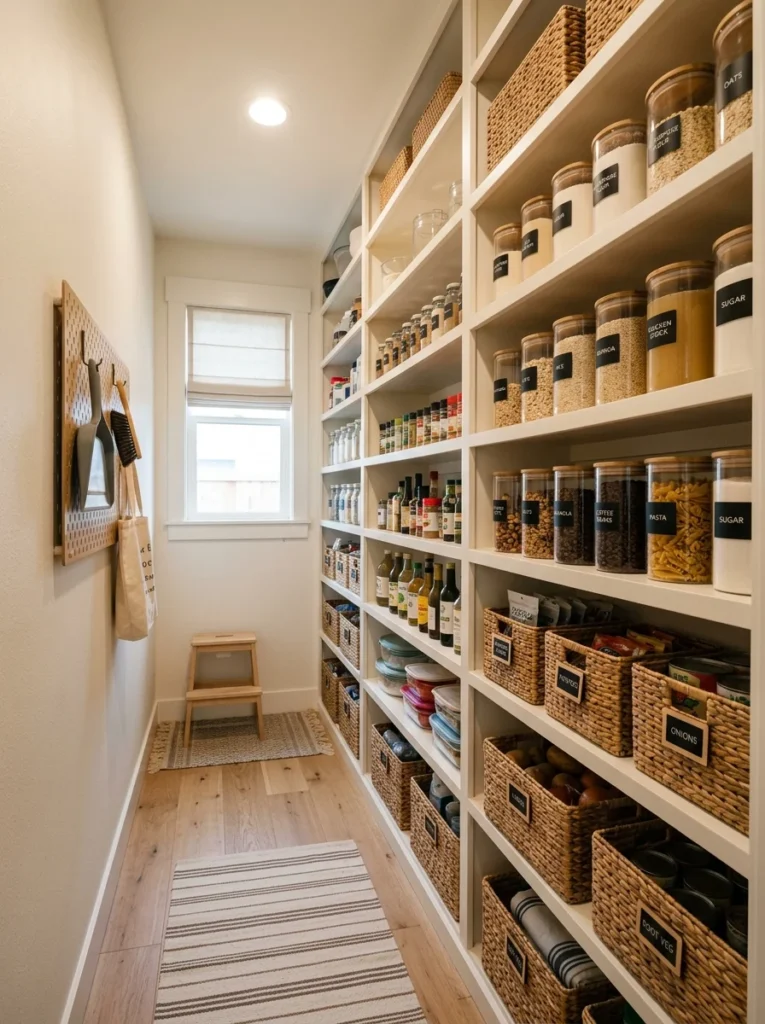
The single-wall layout places all shelving along one wall of the pantry, leaving the opposite wall and the floor area clear. This is the simplest configuration and the most appropriate for narrow pantry rooms — rooms where the width is insufficient to accommodate shelving on two facing walls with comfortable passage between them.
A single-wall layout requires a minimum room width of approximately 36 inches to allow a person to stand comfortably in front of the shelving and access items without the opposite wall creating a feeling of confinement. Rooms narrower than this can still accommodate single-wall shelving, but the usability is compromised by the limited standing space.
The primary limitation of the single-wall layout is total storage volume — only one wall surface is used for shelving, which means the total storage capacity is lower than any other configuration in the same room. This limitation is partially addressed by maximizing the height of the shelving — running shelves from floor to ceiling rather than stopping at a standard cabinet height — and by using the full depth of each shelf for accessible storage with appropriate organizational tools such as lazy susans and pull-out inserts.
The single-wall layout suits pantry rooms that are long and narrow — a converted closet, a narrow alcove beside the kitchen, or a corridor section between the kitchen and the garage or utility area. In these spaces, the available wall length compensates for the single-wall limitation by providing an extended run of shelving that accumulates meaningful storage volume.
The Double-Wall (Galley) Layout
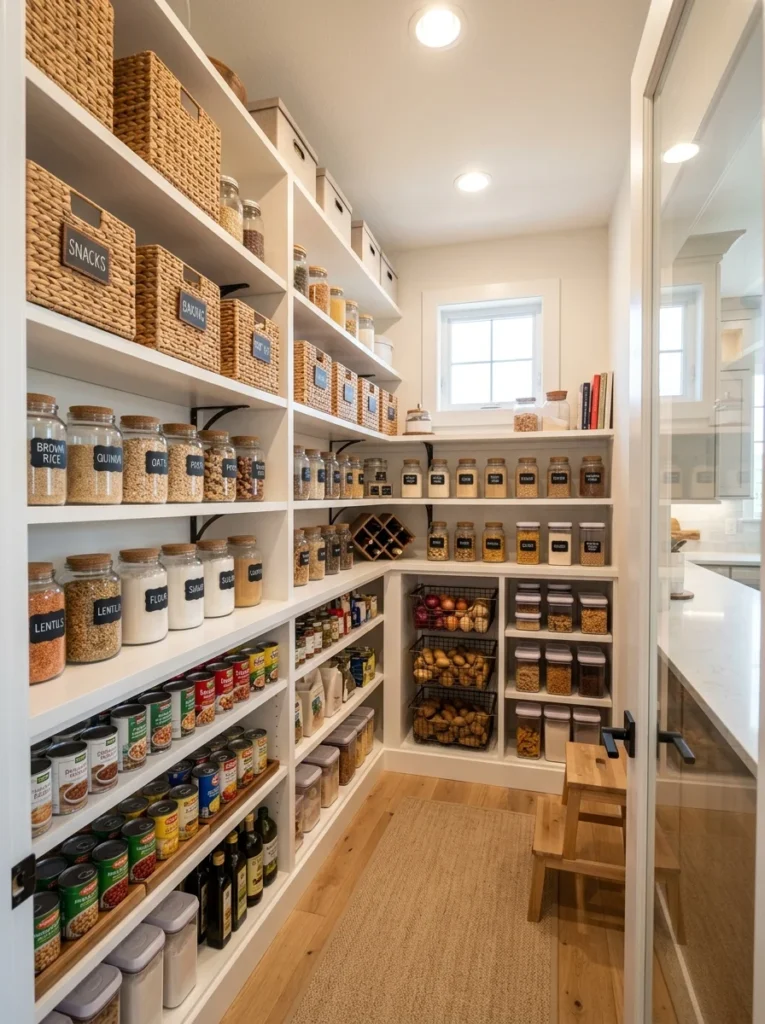
The double-wall or galley layout places shelving on two facing walls with a corridor of floor space between them. This is the most storage-efficient configuration for a dedicated pantry room and the one that professional kitchen designers recommend most consistently for pantry spaces with adequate width.
A functional double-wall pantry requires a minimum corridor width of 42 inches between the faces of the two opposing shelf systems. This width allows a person to stand in front of either shelf, bend down to access lower shelves, and open pull-out drawers or baskets without being obstructed by the opposite shelf. A corridor narrower than 42 inches creates a pantry that feels cramped and in which lower shelf access is genuinely restricted.
The double-wall layout provides approximately twice the total shelf surface area of a single-wall layout in the same room, which makes it the most efficient configuration when the room width supports it. It also creates a natural organization logic — one wall for one set of categories, the opposite wall for another — that makes the pantry easy to navigate and maintains the organizational separation between different food categories.
The U-Shape Layout
The U-shape layout places shelving on three walls of the pantry room — two facing walls and the wall at the end of the room — creating a U-shaped shelving configuration that surrounds the person standing in the pantry on three sides. This is the configuration with the highest total storage volume and the one most associated with the beautifully organized, expansive pantries seen in design publications and social media.
The U-shape layout requires a pantry room that is wide enough to accommodate shelving on two facing walls with adequate corridor space between them — the same 42-inch minimum corridor requirement as the double-wall layout — and long enough to accommodate the end wall shelving without making the pantry feel like a confined dead end rather than a spacious storage room.
In a U-shape pantry, the end wall is typically where the most visually prominent and most frequently photographed elements are placed — the matching clear containers on open shelves, the organized spice display, the decorative elements that give the pantry its distinctive styled appearance. The two side walls carry the bulk of the storage volume in more utilitarian formats — pull-out drawers, baskets, and shelves for bulk goods.
The L-Shape Layout
The L-shape layout places shelving on two adjacent walls that meet at a corner, forming an L configuration. This is the most flexible layout in terms of the room shapes it suits — it works well in rooms that are not perfectly rectangular, in rooms where one wall is partly occupied by a door or window that prevents full-length shelving, and in rooms where the available space is sufficient for more than a single wall but not quite enough for the full double-wall or U-shape configuration.
The L-shape layout creates a corner junction where the two walls of shelving meet — a corner that presents the same accessibility challenge as corner cabinets in a kitchen. The deep corner behind the shelving on both walls is difficult to access without specialized storage solutions. Lazy susans, pull-out corner units, and angled shelf arrangements at the corner junction address this challenge and prevent the corner from becoming wasted space.
Section 2: Shelving Types — Choosing the Right System for Your Pantry
The shelving system is the structural foundation of the walk-in pantry — everything else in the pantry depends on the shelving being the right type, at the right depths, at the right heights, and with the right organizational accessories. Choosing the shelving system before planning the zone layout and storage details is the correct sequence.
Wire Shelving
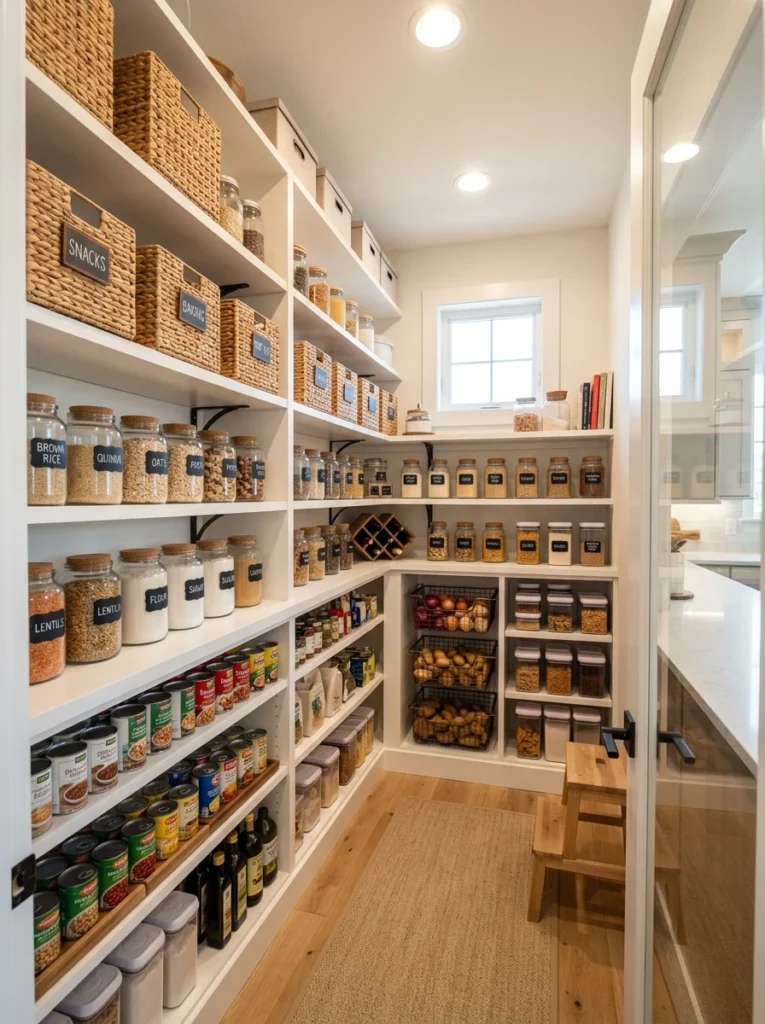
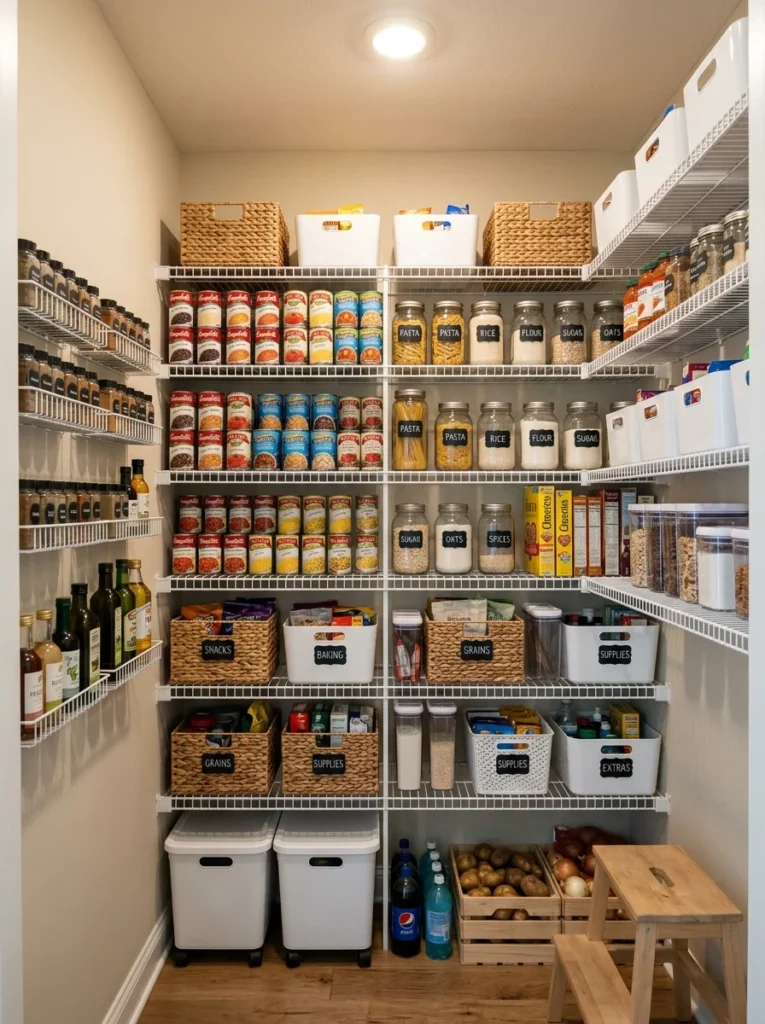
Wire shelving — open metal wire grids supported by wall-mounted brackets or freestanding frames — is the most affordable walk-in pantry shelving option and the most widely used in residential pantry installations. Its primary practical advantages are air circulation — the open wire construction allows air to move freely around stored food, reducing moisture accumulation and extending the freshness of stored goods — and ease of installation, which is straightforward enough for confident DIY installation without professional help.
The limitations of wire shelving for a walk-in pantry are primarily aesthetic and practical. Aesthetically, wire shelving has an industrial, utilitarian quality that does not suit pantry designs where visual appeal is a priority. Small items — spice jars, small packets, and loose items — fall through or between the wire grids unless placed in containers or baskets. Items with flat bases do not sit as securely on wire as they do on solid shelving, which can make wire shelves feel less stable than they are.
For pantries where the primary goal is maximum storage capacity at the lowest cost, wire shelving is an entirely appropriate choice. For pantries where the aesthetic quality of the space matters — where the pantry is designed to be a room the household takes pride in — other shelving types produce better visual results.
Solid Wood Shelving
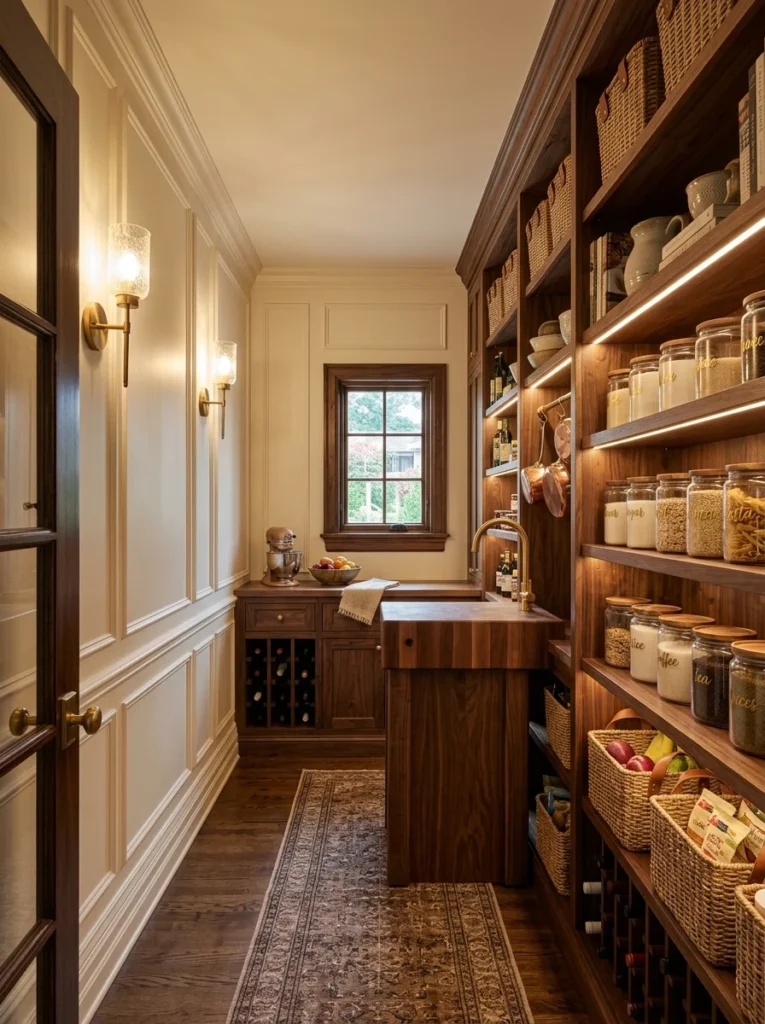
Solid wood shelving — custom-built or pre-fabricated wooden shelves in a stained, painted, or natural finish — is the shelving type most associated with beautifully designed walk-in pantries and produces the most visually impressive results of any shelving option. Solid wood shelves provide a stable, continuous surface for stored items, a warm and attractive visual quality that suits any pantry aesthetic, and a sense of permanence and quality that wire and engineered board shelving cannot replicate.
The primary limitation of solid wood shelving is cost — custom-built solid wood shelving is significantly more expensive than wire shelving or engineered board options, and the installation requires carpentry skills that most homeowners do not possess without professional help. For a pantry renovation where the budget is a significant constraint, solid wood shelving may not be achievable at the full extent of the pantry, and a hybrid approach — solid wood shelves in the most visible and most prominent areas, with more affordable shelving in the less prominent zones — is a practical compromise.
Solid wood shelves also require finishing — painting, staining, or sealing — to protect the wood from the moisture that is inevitably present in a room used for food storage. Unfinished wood shelving in a pantry environment absorbs moisture, potentially warps over time, and can harbor bacteria in the grain. A properly finished wood shelf is sealed against moisture and is as hygienic and durable as any other shelving material.
Engineered Board Shelving
Engineered board shelving — medium-density fiberboard (MDF) or particleboard with a melamine or laminate surface — is the most common shelving material in kitchen cabinetry and pantry systems sold at accessible price points. It provides a smooth, stable, and easy-to-clean surface at a significantly lower cost than solid wood, and it is available in a wide range of colors and finishes — including painted white, grey, and wood-effect laminates — that suit most pantry aesthetic approaches.
The primary limitation of engineered board shelving is its vulnerability to moisture. Particleboard and MDF expand, swell, and eventually delaminate when exposed to persistent moisture, which makes them inappropriate for use in areas with direct water exposure. In a dry pantry room with good ventilation, engineered board shelving performs well and maintains its appearance over time. In a pantry room with poor ventilation or in a climate with high ambient humidity, the moisture vulnerability of engineered board is a genuine practical concern.
Adjustable Shelving Systems
Regardless of the material chosen for the shelving itself, the ability to adjust the height of individual shelves within the system is one of the most valuable features a walk-in pantry shelving system can have. Storage needs change over time — as household composition changes, as cooking habits evolve, and as the categories of goods stored in the pantry shift — and a shelving system that can be reconfigured to accommodate these changes is significantly more valuable over the long term than one with fixed shelf positions.
Adjustable shelving systems use a rail or slot system on the shelf supports that allows individual shelves to be repositioned at different heights within the system without tools or structural modification. Rail-mounted systems — where a vertical rail is fixed to the wall and individual shelf brackets clip into the rail at any position — are the most flexible and the most widely used for walk-in pantry applications. Slot-mounted systems — where the shelving uprights have a series of regularly spaced slots and individual shelf brackets insert into the slots — are slightly less flexible in their positioning options but provide a more rigid and stable shelf at each position.
Section 3: Shelf Depth Guide — What Goes Where
The depth of each shelf in a walk-in pantry should be matched to the items stored on it. Shelves that are deeper than needed for their contents waste the depth behind stored items. Shelves that are shallower than needed for their contents require items to be stored in front of the shelf edge, where they obstruct the door and create a disorganized appearance.
12-Inch Shelves — Spices, Small Jars, and Canned Goods
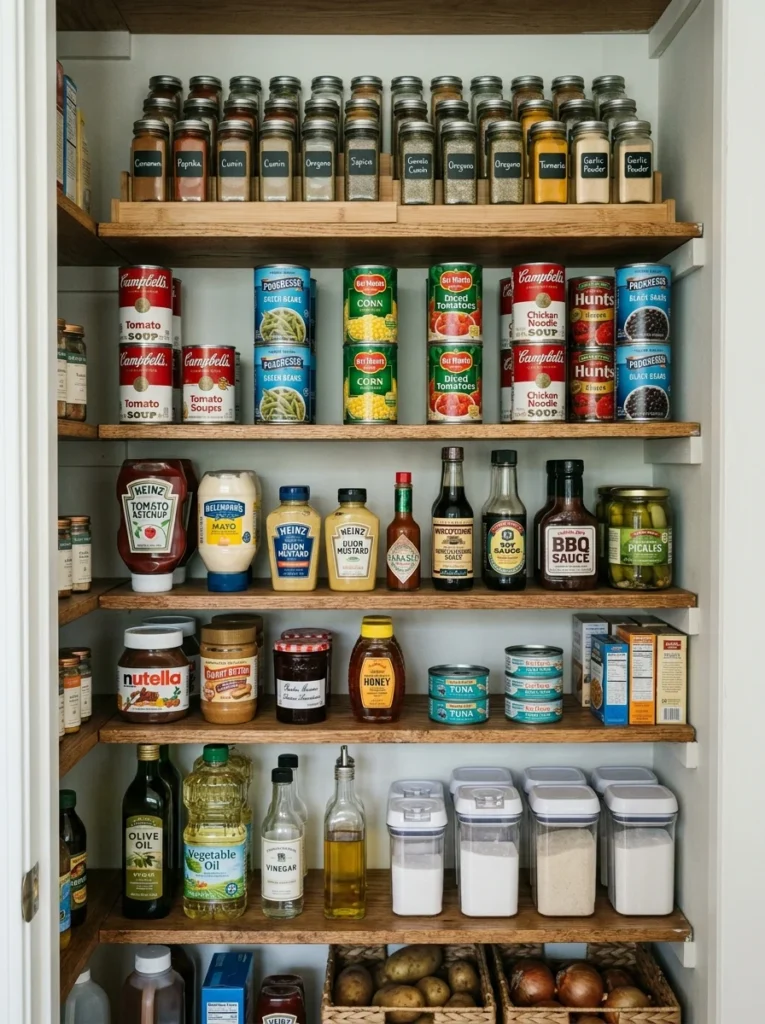
A 12-inch shelf depth is appropriate for spice jars, small condiment jars, single-row canned goods, and similarly sized small items. At 12 inches, a single row of standard-sized canned goods sits comfortably within the shelf depth, visible and accessible without items being hidden behind others in a second row. A 12-inch shelf is also appropriate for the door-facing shelf in a walk-in pantry — the shelf that is immediately visible when the pantry door is opened — where the shallowest depth keeps the entry clear and the most frequently accessed items within immediate reach.
16-Inch Shelves — Standard Pantry Items and Packaged Goods
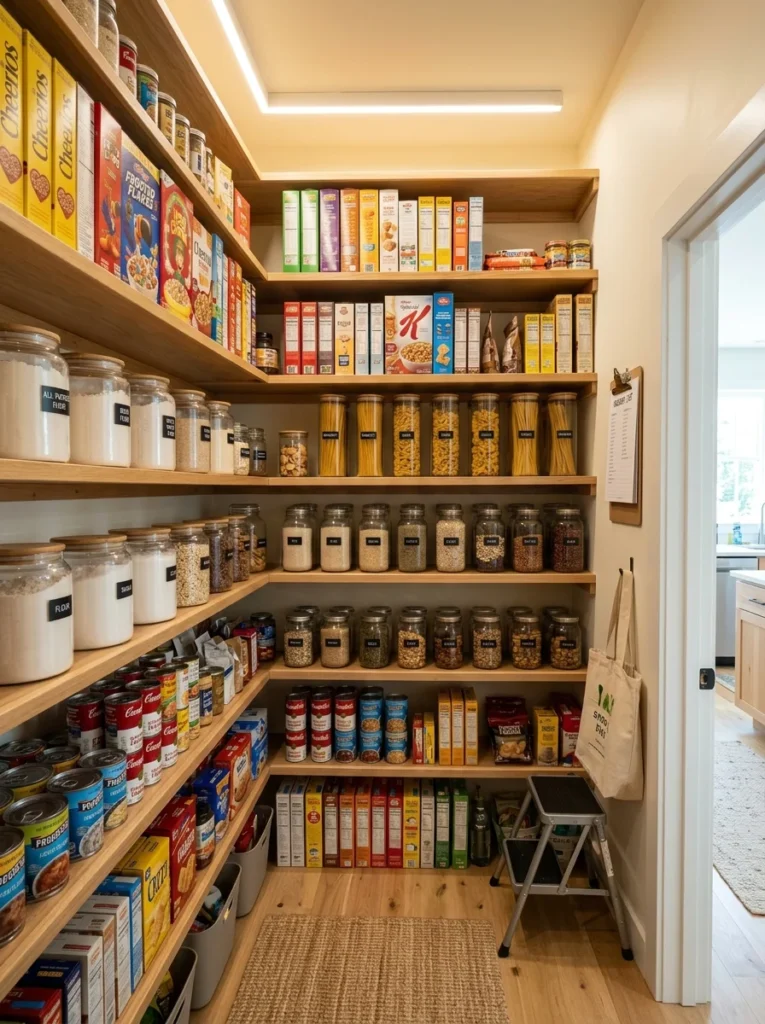
A 16-inch shelf depth accommodates the majority of standard pantry items — pasta boxes, cereal boxes, rice bags, flour bags, and most packaged goods — in a single row with room to spare. This is the most versatile shelf depth for general pantry use and the one that suits the widest range of stored items. If a single shelf depth needs to be chosen for the majority of the pantry, 16 inches is the most practical choice for most households.
20-Inch Shelves — Large Containers, Appliances, and Bulk Goods
A 20-inch shelf depth accommodates larger items — bulk purchase bags, large appliances stored in the pantry, oversized containers, and double-row storage for smaller items — that do not fit comfortably on shallower shelves. The 20-inch depth is most appropriate for the lower shelves of the pantry, which hold the largest and heaviest items and where the additional depth is most useful. Lower shelf depth is also most practical because the deeper shelf can be accessed by looking down into it rather than by reaching into the back at an awkward angle.
Counter-Height Section — The Working Surface
A counter-height section within the walk-in pantry — a section of shelving at approximately 36 inches from the floor with a solid, flat surface rather than open shelving — provides a working surface within the pantry for tasks performed there. Decanting dry goods into containers, organizing shopping, writing the grocery list, and sorting through newly purchased items are all activities that benefit from a work surface within the pantry rather than requiring items to be carried out to the kitchen counter for processing.
The counter-height section also provides an opportunity for small appliance storage — appliances used infrequently enough not to live on the kitchen counter but frequently enough to benefit from being plugged in and ready to use. An electrical outlet installed in the counter-height section of the walk-in pantry during the design and construction phase makes this appliance storage genuinely functional rather than merely theoretical.
Section 4: Zone Planning — Organizing the Pantry Interior
With the layout and shelving system determined, the interior of the walk-in pantry needs to be organized into zones — dedicated areas for each category of stored item, planned to put the most frequently used items in the most accessible positions and the least frequently used items in the least accessible positions.
The Daily Use Zone — Eye Level and Waist Height
The zone between waist height and eye level — approximately 30 to 60 inches from the floor — is the most accessible zone in any walk-in pantry for standing adults. Items stored in this zone can be seen, identified, and retrieved without bending, reaching, or using a step stool. This zone should be reserved exclusively for items used at least once per week — the dry goods used in almost every meal, the condiments and sauces reached for regularly, the snacks consumed daily, and the breakfast items used every morning.
In a well-designed walk-in pantry, the daily use zone is also the most visually prominent zone — the area that is most visible when the pantry door is opened and the area that makes the strongest impression on anyone who enters or looks into the pantry. This is the zone where matching clear containers, carefully organized shelves, and deliberate styling efforts make the most significant visual impact.
The Weekly Use Zone — Slightly Above and Below the Daily Zone
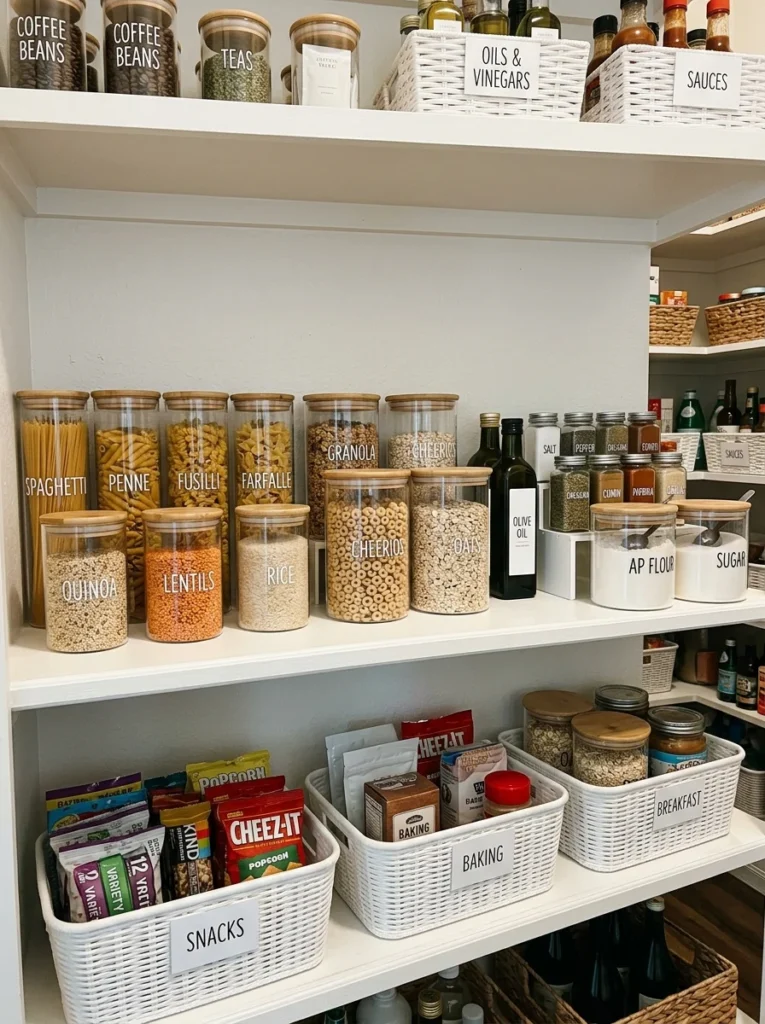
The zone slightly above eye level — 60 to 80 inches from the floor — and slightly below waist height — 18 to 30 inches from the floor — accommodates items used approximately once per week. Baking supplies used for weekend baking, specialty grains and legumes used in specific recipes, bulk condiments and sauces not yet opened, and the overflow stock of daily use items that does not fit in the primary daily use containers all belong in this zone.
The above-eye-level portion of this zone requires a small reach for most adults and may require a step stool for shorter household members or for items stored at the upper end of this range. The below-waist portion requires a slight bend to access comfortably. Both are accessible enough for regular weekly use without the inconvenience that the highest and lowest zones present.
The Monthly and Seasonal Zone — Top Shelves and Floor Level
The highest shelves — above 80 inches from the floor — and the floor level area below the lowest shelves are the least accessible zones in the walk-in pantry and should hold items accessed least frequently. Bulk purchases of non-perishable goods that supplement the primary stock, seasonal items used only at certain times of year, rarely used specialty ingredients purchased for specific recipes, and any pantry-adjacent items that do not belong with the food but have no other storage location are all appropriate for these least-accessible zones.
Items stored on the highest shelves are most conveniently retrieved with a step stool — a small, sturdy step stool stored inside the pantry near the door is a practical accessory for any walk-in pantry with shelving above comfortable reaching height. Items stored at floor level are most conveniently held in rolling bins or baskets with handles that allow them to be pulled out from the floor position without kneeling.
The Appliance Zone — Counter Height With Power
The counter-height section discussed in the shelf depth guide serves simultaneously as a working surface and as an appliance storage zone. Small appliances stored in the pantry — a stand mixer, a food processor, a slow cooker, a rice cooker — are most usable when stored at counter height with access to an electrical outlet, so that they can be used in place within the pantry for tasks that do not require the full kitchen counter.
Appliances stored at counter height in the pantry are visually prominent — they should be kept clean and presentable rather than used as a surface for stacking other items on top of them. The pantry counter is a working surface, not a storage platform.
The Beverage Zone
In households where the pantry stores a significant range of beverages — tea, coffee, hot chocolate, juice boxes, sparkling water, wine, and similar drinks — a dedicated beverage zone within the pantry creates a convenient, organized system for the household’s drink selection. The beverage zone benefits from being positioned at an accessible height and in a location within the pantry that is easy to reach without navigating past the primary food storage zones.
A dedicated section of shelving for beverages — with wine rack inserts for bottles stored horizontally, clear containers for loose tea bags, and baskets for juice boxes and similar packaged drinks — provides an organized system that makes the daily beverage routine easier and more enjoyable.
Section 5: Lighting — Making Everything Visible
Why Pantry Lighting Matters More Than Most People Expect
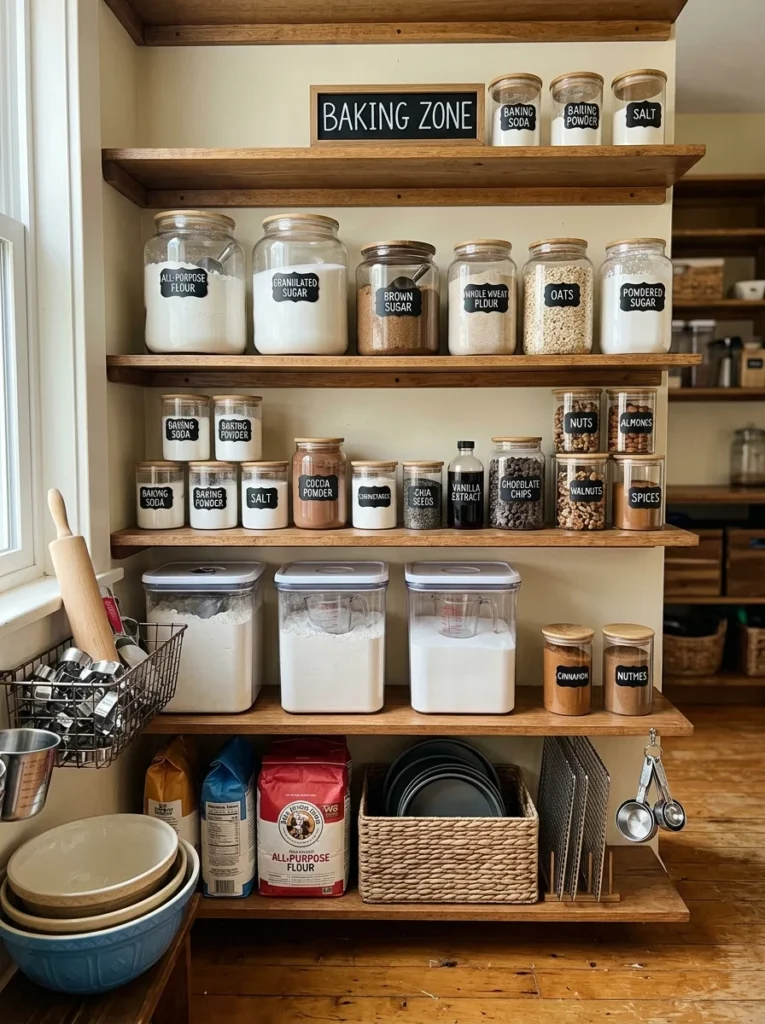
Lighting is the most commonly underestimated element of walk-in pantry design, and poor lighting is one of the primary reasons that well-organized pantries are not as functional in daily use as their layout and organization should make them. A pantry that is dark when its contents are accessed requires the user to squint, reach for items tentatively without being able to see them clearly, and miss items stored in shadow — all of which undermine the accessibility and usability that good organization creates.
A walk-in pantry that is located in an interior room — as most are, since they are typically positioned away from exterior walls — has no natural light source. Every lux of illumination in the pantry comes from artificial lighting, which means the artificial lighting system needs to provide sufficient intensity and coverage to make every item on every shelf clearly visible from every position within the pantry.
Ceiling Lighting Options
A ceiling-mounted light fixture or recessed ceiling lights are the primary ambient light source for most walk-in pantries. A single ceiling-mounted fixture in the center of the pantry provides general illumination but creates shadows on the shelves nearest the walls — the shelves that typically hold the most items. Multiple recessed lights distributed across the ceiling provide more even coverage and fewer shadows, which makes the pantry interior more uniformly visible.
A motion-activated light switch — one that turns the pantry light on automatically when someone enters and off after a set period of inactivity — is a practical feature for a pantry that is accessed frequently throughout the day. The motion activation eliminates the need to reach for a light switch while carrying items in and out of the pantry and ensures that the light is never left on when the pantry is empty.
Under-Shelf Lighting
Under-shelf lighting — LED strip lights or puck lights mounted on the underside of each shelf to illuminate the shelf below — supplements ceiling lighting by providing direct illumination at the level of each shelf surface rather than from above. This direct shelf-level lighting eliminates the shadows that ceiling lights create on lower shelves and makes items stored at every level equally visible regardless of the ceiling light’s angle and intensity.
LED strip lights are the most practical format for under-shelf pantry lighting — they are inexpensive, easy to install with adhesive backing or simple clips, available in warm and cool white color temperatures, and draw very little power. A warm white color temperature — 2700 to 3000 Kelvin — creates a welcoming, visually flattering light that suits the aesthetic goals of a beautifully styled pantry. A cool white temperature — 4000 Kelvin and above — provides clinical clarity that suits pantries where functional visibility is the primary concern over aesthetic quality.
Section 6: Styling the Walk-In Pantry — From Functional to Beautiful
The Aesthetic Foundation — Matching Containers Throughout
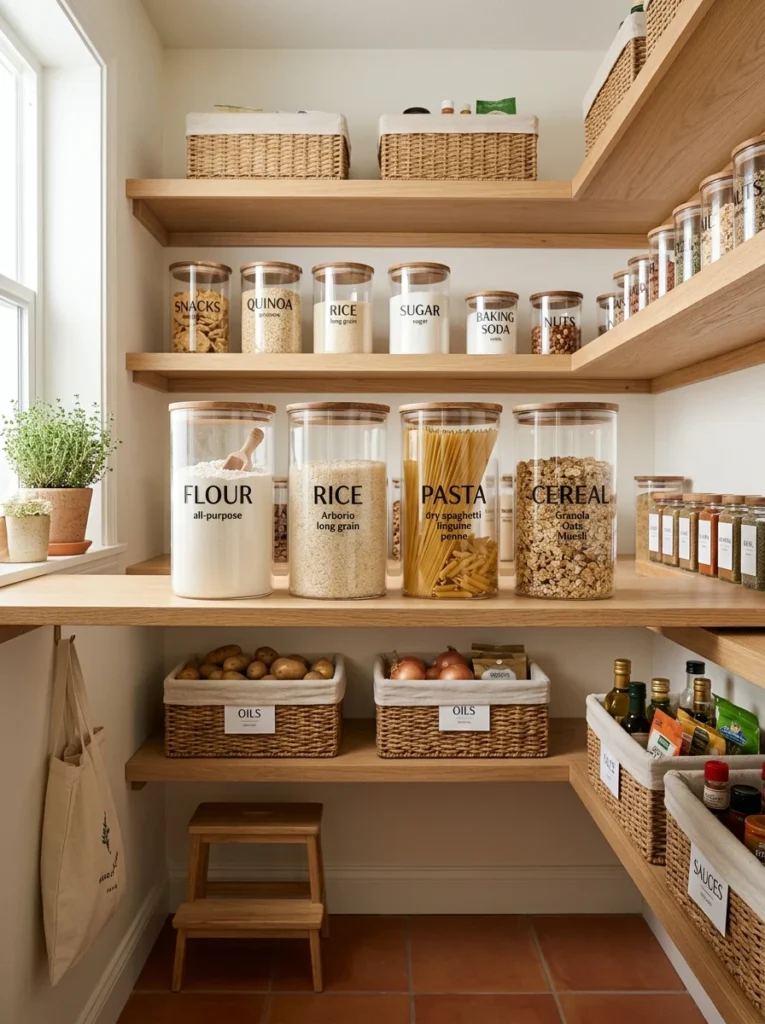
The single most impactful aesthetic decision in styling a walk-in pantry is the choice to use matching containers consistently throughout the primary storage zones. A pantry where dry goods are stored in a single consistent style of clear container — the same brand, the same shape, the same size range — has a visual coherence and calm that no other styling intervention can replicate or substitute for.
The matching container principle works because it removes the visual noise of original packaging — the competing colors, graphics, typefaces, and shapes of commercial food packaging — and replaces it with a single consistent visual element. The eye reads a shelf of matching clear containers as an organized, resolved system. The same shelf with the same items in their original diverse packaging reads as a collection of unrelated objects that happen to share a shelf.
Clear containers have the additional functional advantage of making their contents visible at a glance — the level of rice remaining in the container, the color of a spice through the glass, the quantity of pasta left before a restock is needed. This immediate visibility is one of the primary practical benefits of decanting pantry goods into clear containers.
Basket and Bin Styling
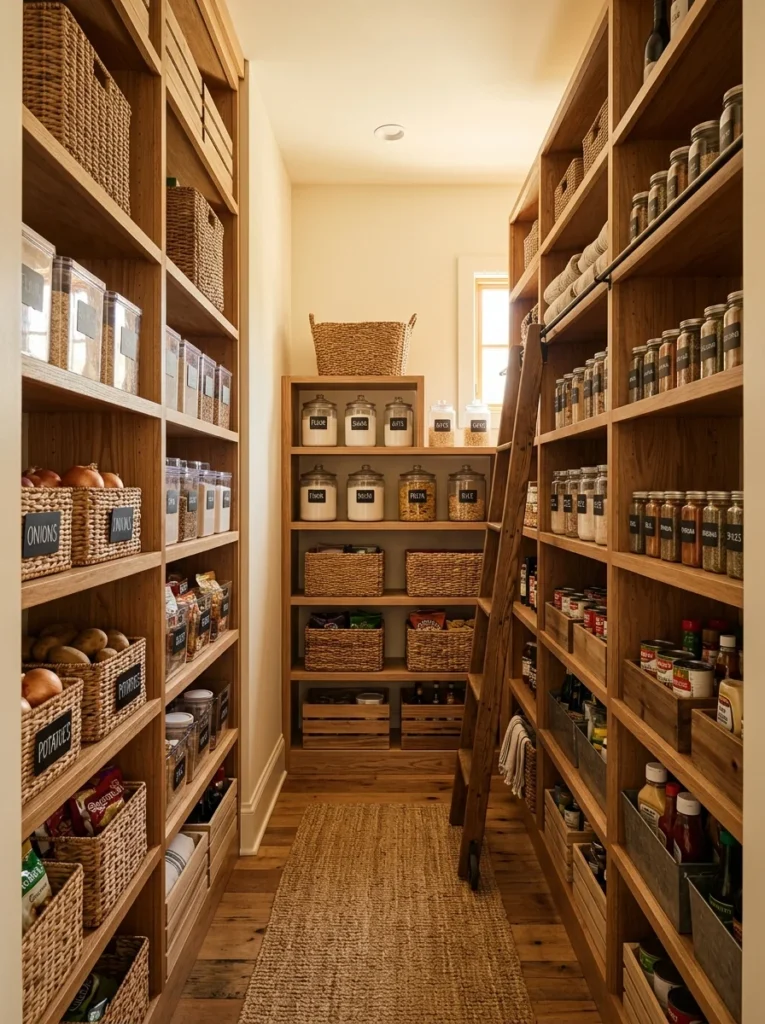
Baskets and bins — woven, wire, or fabric — provide both organizational function and aesthetic warmth in a walk-in pantry. They contain categories of loose items — packaged snacks, individual seasoning packets, loose vegetables, fruit, or items that do not decant well into rigid containers — in a contained, labeled unit that can be pulled from the shelf as a single accessible piece.
The aesthetic contribution of baskets is the natural warmth and texture that woven materials introduce into what would otherwise be an entirely hard-surfaced environment. A pantry shelf of clear containers and labeled baskets has a warmth and visual richness that the same shelf of containers alone does not achieve. The basket material should be chosen in relation to the pantry’s overall aesthetic — natural seagrass and wicker suits warm, organic pantry aesthetics; wire baskets suit more industrial or contemporary aesthetics; linen-lined fabric baskets suit softer, more traditional aesthetics.
The Chalkboard or Whiteboard Panel
A chalkboard or whiteboard panel — either a dedicated chalkboard wall section or a large framed chalkboard mounted on the pantry wall — is one of the most popular and most functionally useful styling elements in a walk-in pantry. It serves simultaneously as a grocery list surface, a meal planning board, a note-taking area for family members, and a decorative focal point that adds character to the pantry interior.
A chalkboard wall — an entire wall section painted with chalkboard paint — makes the strongest visual statement and provides the most writing surface. A framed chalkboard mounted on the wall provides a contained, more formal version of the same function. Either format contributes a personalized, lived-in quality to the pantry that transforms it from a purely functional storage room to a space with genuine character.
Decorative Elements That Earn Their Place
A beautifully styled walk-in pantry has decorative elements — a small plant, a framed print, a candle, a handmade ceramic jar — that give the space personality and warmth beyond its organizational function. These elements should be chosen deliberately and used sparingly — the decorative quality of a well-organized pantry comes primarily from the organization itself, and decorative additions that compete with or clutter the organized shelving undermine the calm, resolved quality that the organization creates.
A small plant — a trailing pothos on a high shelf, a small succulent on the counter section, or a sprig of dried herbs hung from a hook — introduces natural color and life without consuming shelf space. A framed print on the pantry wall — a botanical illustration, a kitchen-themed typography print, or a simple abstract in the palette of the kitchen — adds a personal touch without practical impact. A small candle or reed diffuser on the counter section contributes fragrance to the pantry environment, which improves the sensory experience of entering and using the space.
Section 7: What Not to Store in a Walk-In Pantry
A well-designed walk-in pantry is a food and kitchen equipment storage room — not a general-purpose storage overflow for the home. Clarity about what belongs in the pantry and what does not is essential for keeping the pantry functional and preventing it from accumulating non-pantry items that reduce the storage space available for its intended purpose.
Medications and Supplements
Medications and dietary supplements are commonly stored in kitchen pantries because the kitchen is a frequently visited room and because the pantry provides convenient storage near the daily routine. However, most medications require storage away from heat and moisture — conditions that a kitchen pantry, adjacent to the cooking zone, does not reliably provide. A dedicated medicine cabinet or bathroom storage is the appropriate location for medications. Storing medications with food also creates a risk of confusion — particularly for children and older adults — that is best avoided through physical separation.
Cleaning Products
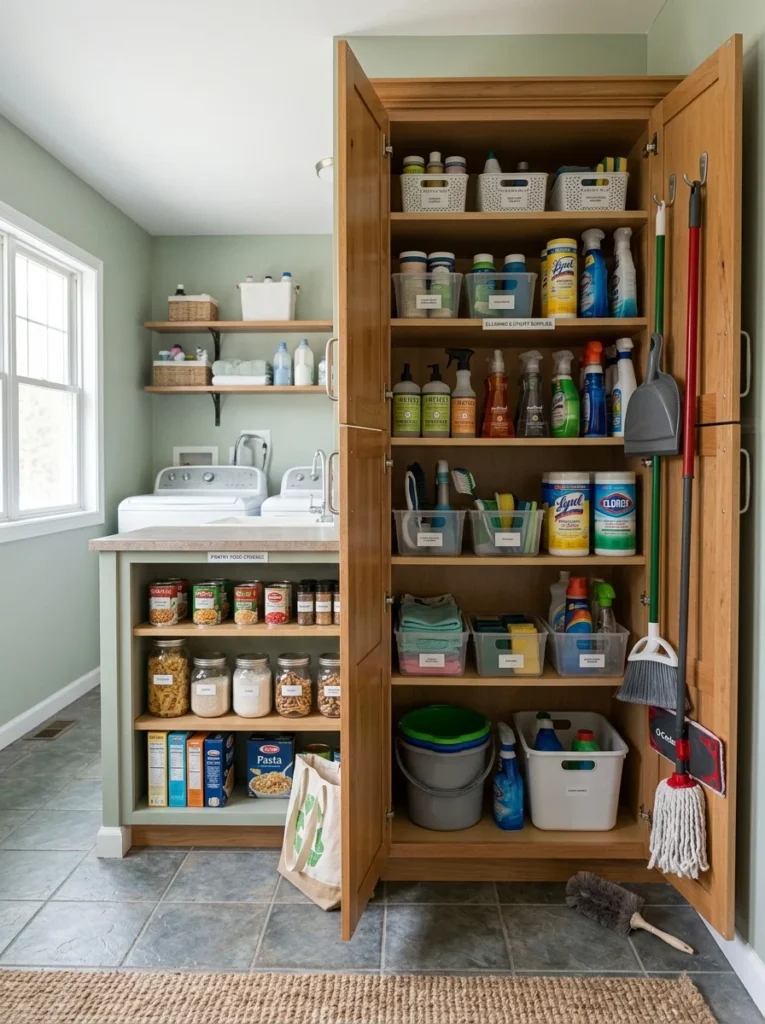
Cleaning products stored in the food pantry create a risk of cross-contamination — chemical odors can transfer to nearby food items, and the proximity of toxic cleaning chemicals to food storage raises obvious safety concerns. Cleaning products belong in a dedicated cleaning storage area — under the sink, in a utility room, or in a separate cleaning cabinet — rather than in the food pantry.
Pet Food in Large Quantities
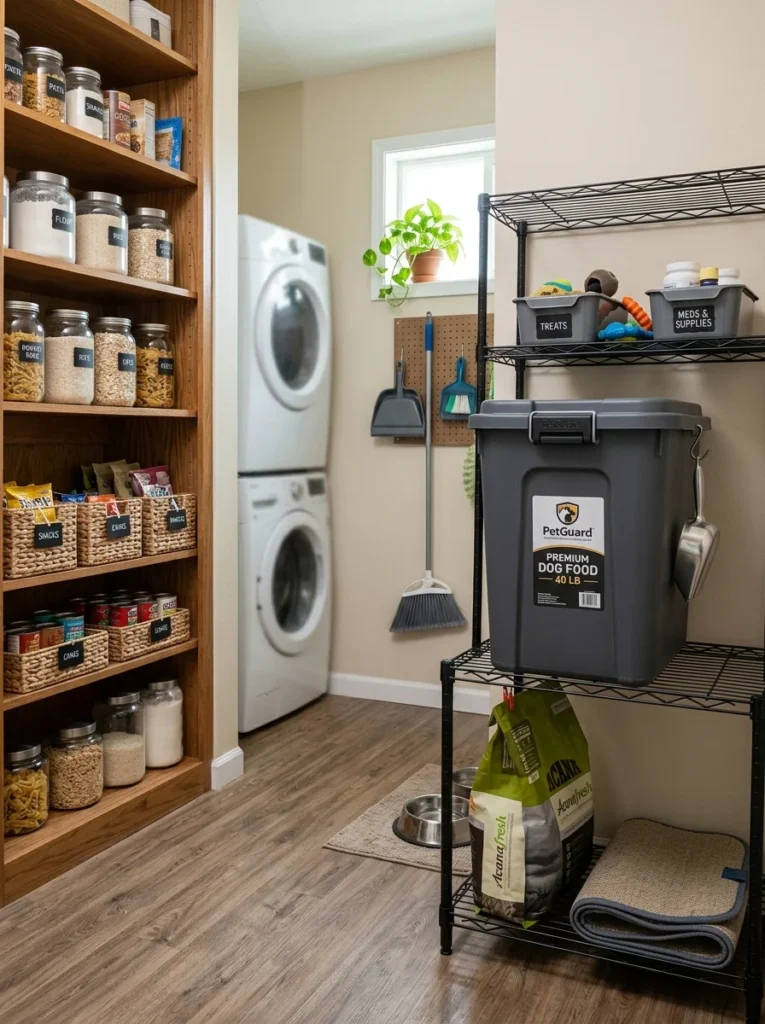
A small quantity of pet food in a sealed container is a reasonable pantry item. A large bag of bulk pet food stored on the pantry floor is both a space consumer and a potential pest attractant — the strong scent of dry pet food attracts insects and rodents that can then access the surrounding food storage. Pet food is better stored in a dedicated sealed container outside the food pantry.
Items That Attract Pests
Any item that is strongly scented, imperfectly sealed, or known to attract kitchen pests — fruit flies, pantry moths, ants, or rodents — creates a risk for the entire pantry’s contents when stored in the enclosed environment of a walk-in pantry. Fruit and vegetables that release strong scents as they ripen, open bags of pet food, improperly sealed bulk grains, and any item that has already shown signs of pest interest are better stored elsewhere or in airtight containers that prevent their scent from attracting pests into the pantry.
Conclusion
A walk-in pantry designed with attention to layout, shelving, zone organization, lighting, and styling is one of the most transformative improvements possible for a kitchen and a home. It solves the daily frustrations of inadequate food storage, reduces food waste, simplifies the cooking routine, and creates a room that the household takes genuine pride in — a room that functions as efficiently as it looks beautiful.
The planning sequence matters enormously: layout first, shelving system second, shelf depths third, zone planning fourth, lighting fifth, and styling last. Each decision builds on the decisions that precede it, and shortcuts in the early stages — choosing a shelving system before finalizing the layout, styling before establishing the organizational system — produce results that look good initially but fail in practical daily use.
A walk-in pantry planned carefully in the correct sequence, built with appropriate materials, organized with a clear zone logic, lit well enough to make every item visible, and styled with matching containers and deliberate decorative touches is a room that earns its place as one of the most valued features in the home — day after day, meal after meal, for every year it serves the household that built it.