
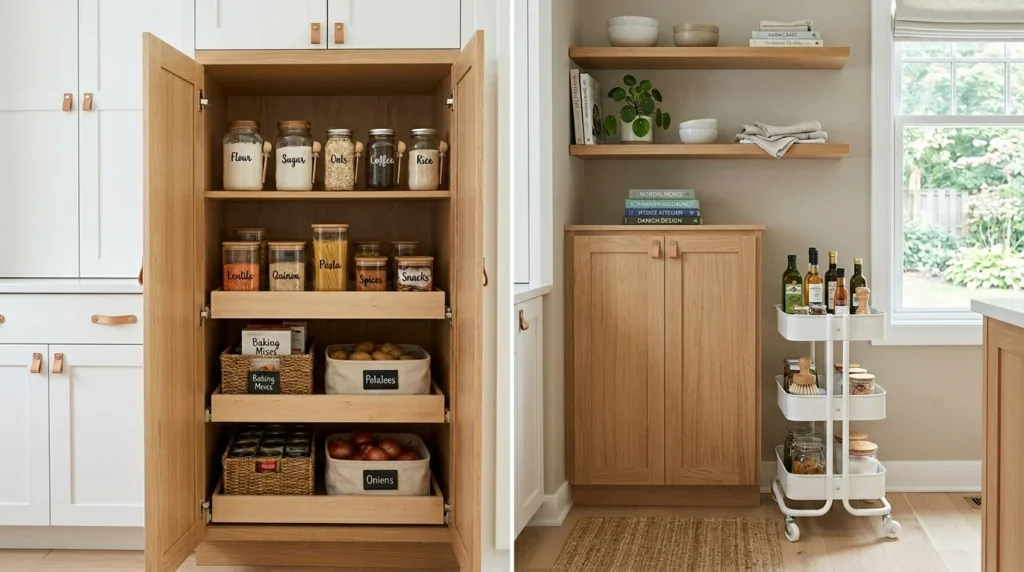
Not every home comes with a dedicated walk-in pantry or even a generous pantry cabinet. Many kitchens — particularly in apartments, older homes, and compact modern builds — offer limited or no dedicated pantry space at all. A single shallow cabinet, a narrow alcove beside the refrigerator, a closet that doubles as food storage, or simply a collection of kitchen cabinets that need to serve every storage function simultaneously — these are the realities that most home cooks actually work with rather than the spacious, beautifully organized pantries that dominate home organization content online.
The gap between the pantry most people have and the pantry most organization content assumes they have creates a genuine frustration. The advice to install matching clear containers on deep wooden shelves, to dedicate a full wall to organized food storage, or to create designated zones for every food category is excellent advice for people with the pantry space to apply it. For people working with a single cabinet or a converted closet, it is advice that does not translate without significant adaptation.
This guide is written specifically for tight kitchen spaces — the small pantry cabinet, the narrow pantry alcove, the kitchen without any dedicated pantry at all. The eighteen solutions it covers have been selected for their applicability in genuinely limited spaces, their affordability, and their ability to be implemented without structural changes to the kitchen. Some require minimal installation — a shelf bracket, a door-mounted organizer, a tension rod. Most require nothing more than the decision to use the available space more intelligently than it is currently being used.
The principle underlying all eighteen solutions is the same: small pantry spaces are not primarily storage problems. They are space utilization problems. The issue is rarely that there is genuinely insufficient storage space for the household’s pantry needs — it is that the available space is being used at a fraction of its actual capacity. Vertical space above items is left empty. Door surfaces go unused. Deep shelves hold only what fits in the front half. Corner space is inaccessible. Addressing these utilization inefficiencies, rather than seeking additional space, is where the most significant storage gains in a small pantry are found.
Cabinet Pantry Solutions
Solution 1: Install Pull-Out Shelves to Double Accessible Storage
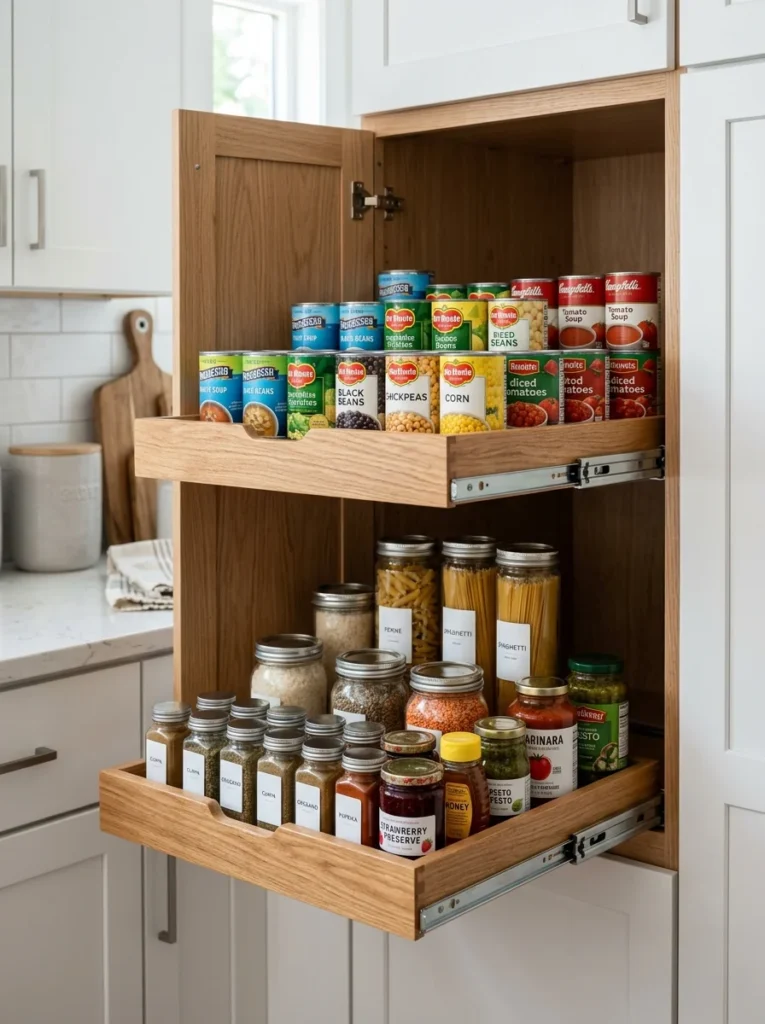
The standard fixed shelf in a pantry cabinet is one of the most inefficient storage formats in the home. Items placed at the back of a deep fixed shelf are effectively invisible and inaccessible in daily use — retrieving them requires moving everything in front of them, which discourages regular access and leads to items accumulating at the back of the shelf unused until they expire.
Pull-out shelves — sliding shelves that extend fully out of the cabinet on drawer slides when pulled — solve this problem completely and at a relatively modest cost. When a pull-out shelf is fully extended, every item stored on it is visible from above and accessible from the front, sides, and back without moving anything else. The back of the shelf becomes as usable as the front, which effectively doubles the accessible storage on that shelf.
Pull-out shelf kits are available for standard cabinet widths and require no professional installation — they mount to the interior sides of the cabinet with screws and can be installed by anyone comfortable with basic DIY. The installation takes approximately thirty to forty-five minutes per shelf. For a pantry cabinet with three or four shelves, replacing all fixed shelves with pull-out versions is a half-day project that produces one of the most significant improvements in pantry usability available for the investment of time and money.
When selecting pull-out shelf kits, choose full-extension slides rather than partial-extension ones. A full-extension slide allows the shelf to pull out completely beyond the cabinet face, giving access to the full depth of the shelf. A partial-extension slide leaves the back portion of the shelf inaccessible even when extended, which partially replicates the problem it is meant to solve.
Solution 2: Add Door-Mounted Organizers to Every Cabinet Door
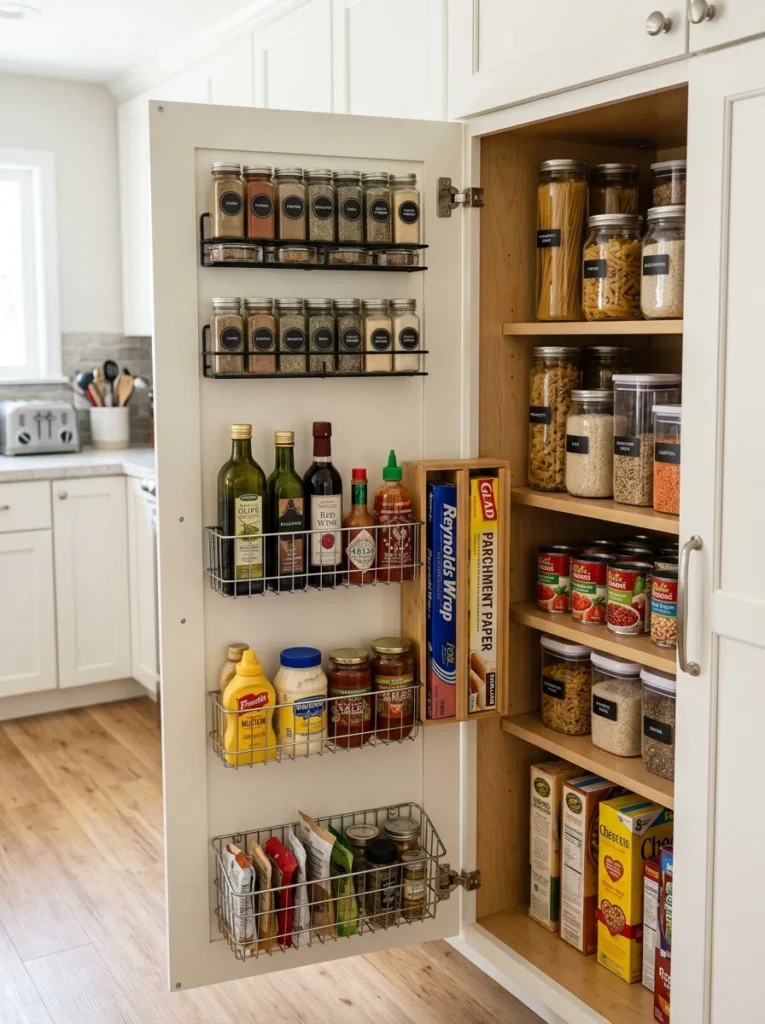
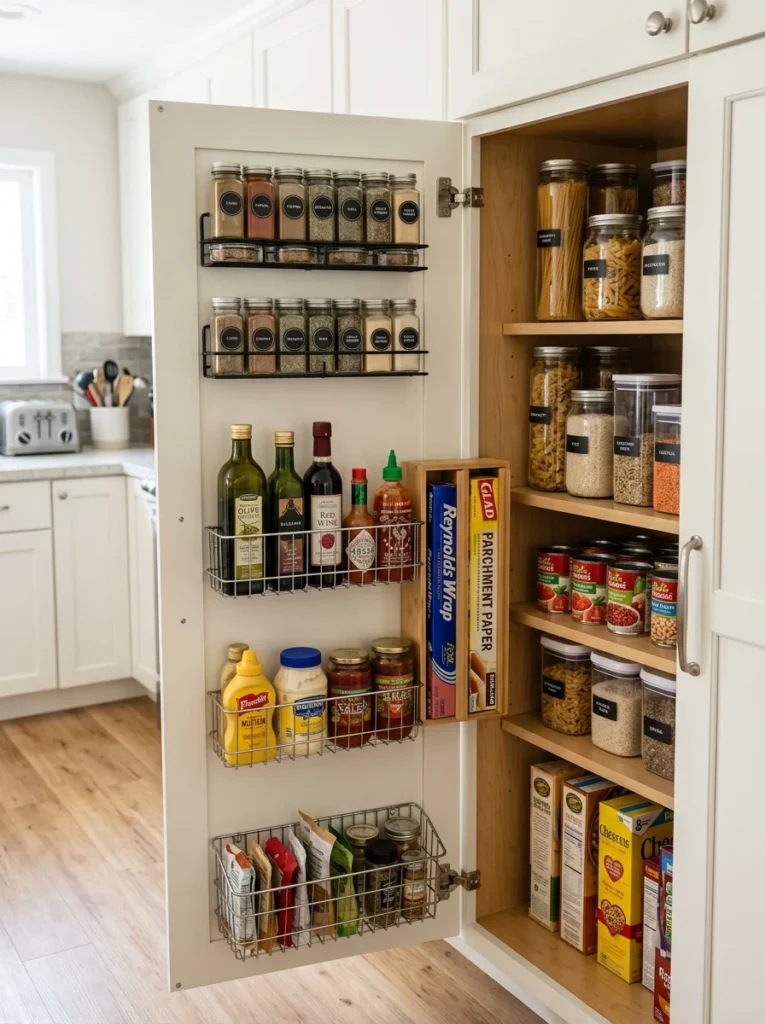
The inside face of every pantry cabinet door is a flat, vertical storage surface that is almost universally left completely unused. In a small pantry cabinet with two or three doors, this represents a meaningful amount of additional storage area — surface area that can hold spice jars, small canned goods, condiment bottles, foil and wrap rolls, and dozens of other small items that currently occupy valuable shelf space.
Door-mounted organizers for pantry cabinets come in several formats suited to different storage needs. Wire rack organizers with multiple horizontal shelves mount on the inside of the cabinet door and hold a range of small items — spice jars, small bottles, condiment packets, and similar items that are used regularly but do not need to occupy prime shelf space. Spice rack door organizers are designed specifically for spice jars and typically hold twelve to twenty-four jars on tiered shelves that keep every jar visible and accessible. Foil and wrap dispensers mount on the inside of a cabinet door and hold rolls of cling film, aluminum foil, baking paper, and similar kitchen wraps in a dispenser format that makes tearing off a sheet significantly easier than managing loose rolls.
The primary consideration when selecting door-mounted organizers is the depth of the organizer relative to the space between the back of the closed door and the front edge of the nearest shelf. If the organizer protrudes more than this clearance distance, it will prevent the door from closing. Measure this clearance before purchasing any door-mounted organizer and choose products with a depth that fits within it.
Solution 3: Use Stackable Shelf Risers for Instant Double Levels
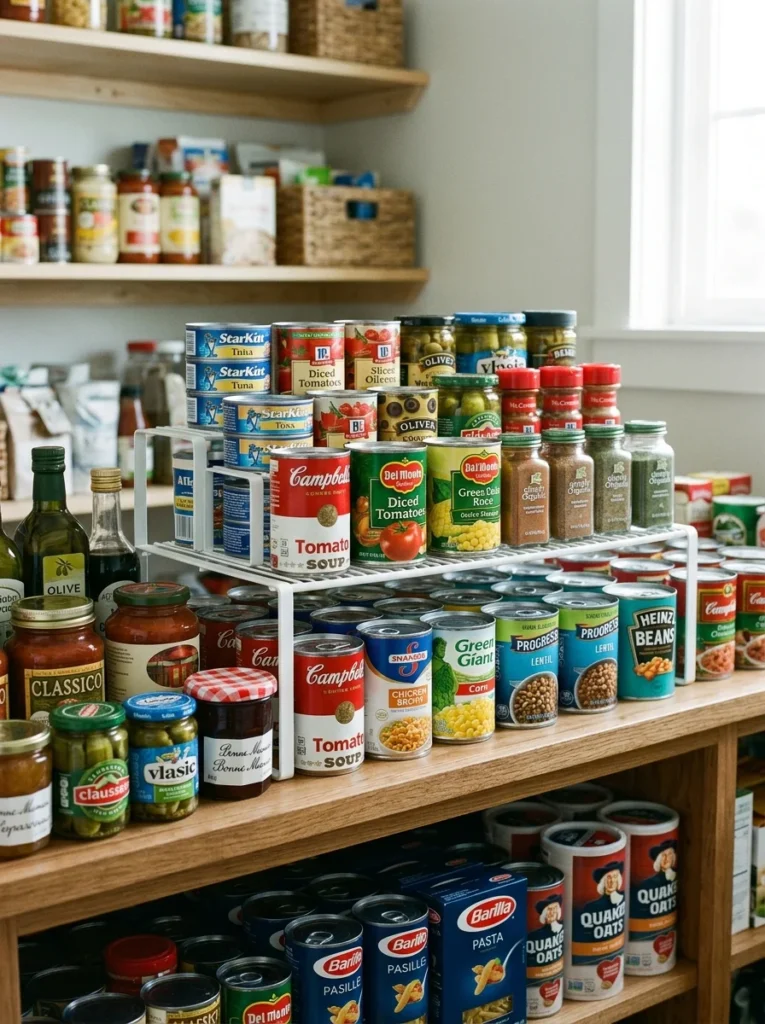
The fixed shelf spacing in most pantry cabinets creates a consistent height between shelves that suits the tallest item typically stored on each shelf — but most shelves hold items of varying heights, which means there is a significant amount of unused vertical space above shorter items on every shelf. A shelf of canned goods that are four inches tall in a cabinet with twelve inches of shelf-to-shelf clearance leaves eight inches of empty air above every can — space that a shelf riser can convert into productive storage.
A shelf riser is a small elevated platform placed on a cabinet shelf that creates a second level of storage above the items stored on the original shelf level. The items placed on the riser occupy the otherwise wasted vertical space above the items below, effectively adding a second shelf within the existing space between fixed shelves.
Wire shelf risers and bamboo shelf risers are the most common formats. Wire risers are lightweight, allow air circulation, and are easy to clean. Bamboo risers are more attractive if the cabinet interior is visible and suit pantries where the aesthetic matters as much as the function. Both types are available in a range of widths that suit standard shelf dimensions.
Shelf risers are most valuable on shelves holding canned goods, small jars, and spice containers — items of consistent small height where the unused vertical space is most significant and most consistent. On shelves holding items of highly variable heights — tall cereal boxes alongside small jars — risers are less useful because the tall items prevent the riser from being positioned where it would be most effective.
Solution 4: Install a Lazy Susan on Deep Shelves
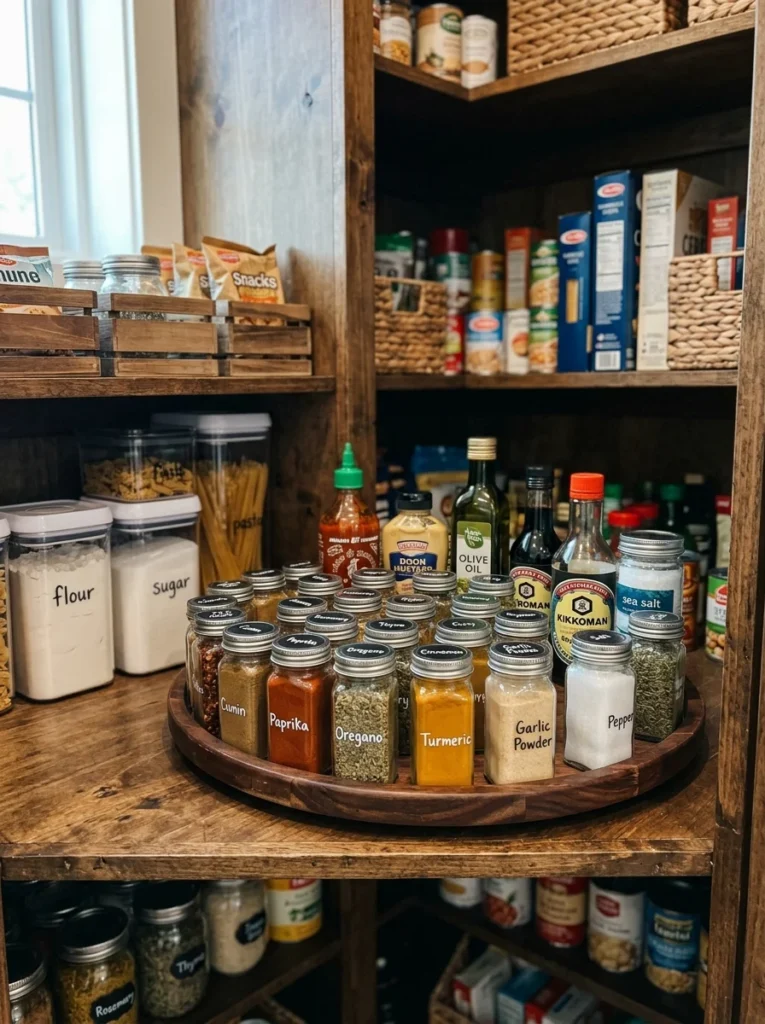
A pantry cabinet shelf that is twelve or more inches deep holds items in rows from front to back — and items in the back row are consistently less accessible than those in the front, which leads to the back row holding items that are rarely used and eventually forgotten. A lazy susan — a rotating circular tray that spins on a central axis — addresses this problem by bringing items from the back row forward with a simple rotation, making every position on the tray equally accessible.
Lazy susans are particularly valuable in corner cabinet sections where the depth of the corner makes standard storage extremely inefficient. A two-tiered lazy susan installed in a corner section of a pantry cabinet can hold a significantly larger number of items in an accessible way than any fixed shelf arrangement in the same space.
When selecting a lazy susan for a pantry shelf, choose a diameter that fills as much of the shelf width as possible without preventing the cabinet door from closing. A lazy susan that leaves significant unused shelf space around its perimeter is less effective than one that fills the available shelf area. For shelves holding spice jars and small containers, a smaller diameter lazy susan with a lip to prevent jars from falling off during rotation is the most practical choice. For shelves holding larger items — bottles, canned goods, and jars — a larger diameter flat lazy susan without a central post is more versatile.
Solution 5: Use Vertical Dividers for Tray, Cutting Board, and Sheet Pan Storage
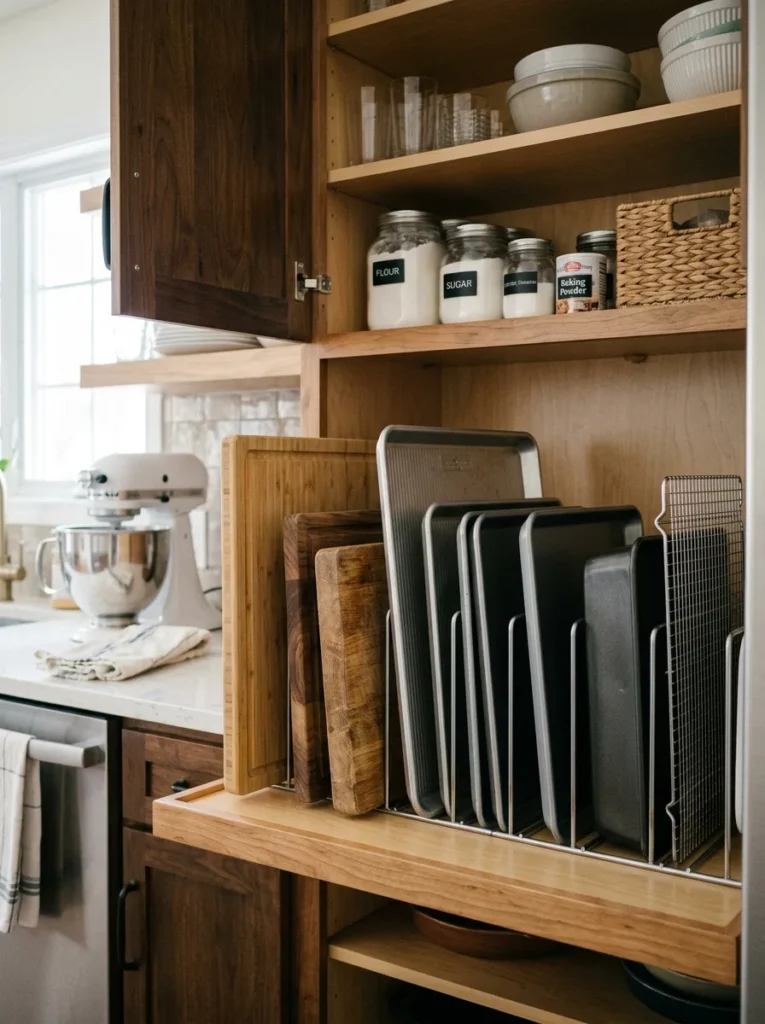
Baking trays, cutting boards, sheet pans, and cooling racks are awkward items to store in a pantry cabinet because their large, flat form means they typically occupy an entire shelf width when stored horizontally — a significant amount of shelf space for a single item. Storing them vertically — standing upright rather than lying flat — reduces their footprint from the full shelf surface to only their thickness.
Vertical storage for flat kitchen items requires dividers that keep the items upright and separated — without dividers, vertically stored trays and boards lean against each other and fall over when any one item is removed. Adjustable vertical dividers — freestanding divider units that sit on the cabinet shelf and hold items upright between them — are available for standard cabinet shelf widths and convert an entire shelf of flat-stored baking items into a neatly filed vertical arrangement that takes up a fraction of the horizontal space.
The shelf converted from horizontal tray storage to vertical tray storage — using vertical dividers to free up the shelf area — can then be used for additional food storage, which is the primary goal.
Closet-to-Pantry Conversion Solutions
Solution 6: Convert Any Nearby Closet Into a Dedicated Pantry
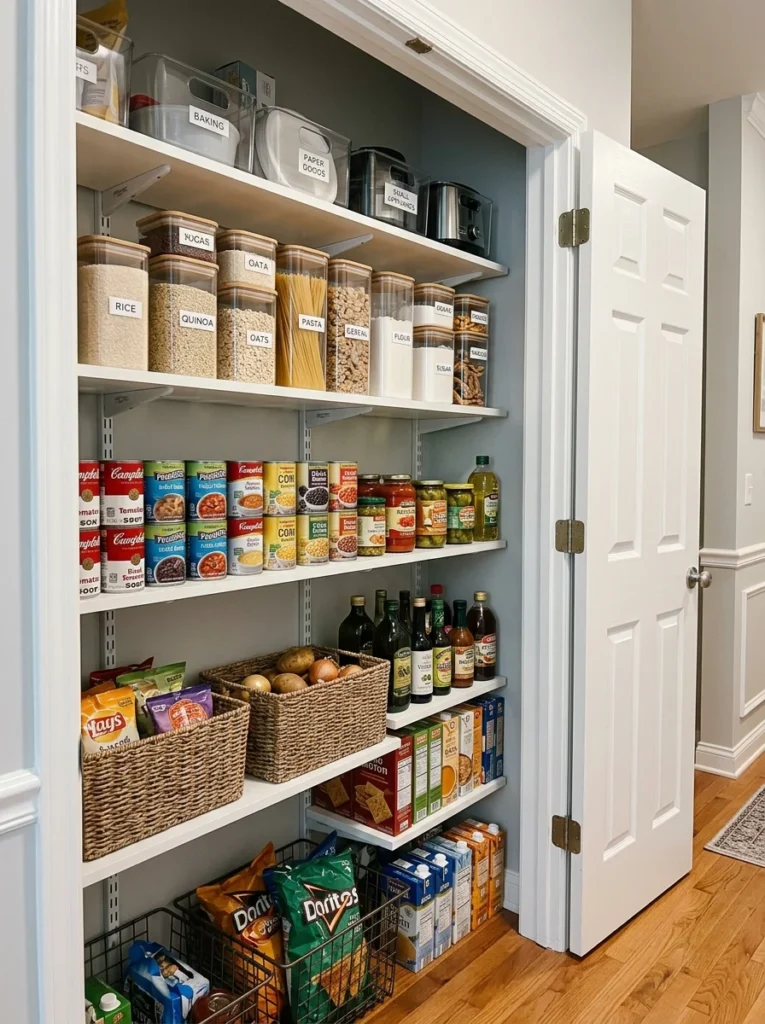
Any closet located near the kitchen — a hallway closet, a utility closet, a coat closet — can be converted into a dedicated pantry with relatively simple modifications. The proximity to the kitchen is the primary requirement — a pantry that requires significant travel from the kitchen to access is less practical than dedicated pantry space within the kitchen, but any closet within a few steps of the kitchen serves the pantry function well enough to be significantly more useful than no dedicated pantry at all.
The conversion process begins with emptying the closet entirely and assessing its dimensions — width, depth, and ceiling height. A closet that is at least 12 inches deep and 24 inches wide can accommodate useful pantry shelving. Deeper and wider closets offer more storage volume and more flexibility in the shelving configuration.
The most practical shelving system for a closet pantry conversion is an adjustable shelf system — a rail-mounted or bracket-mounted system where individual shelves can be positioned at any height within the rail system and repositioned as storage needs change. These systems are widely available at accessible price points, require only basic installation skills, and provide significantly more storage volume than the single shelf and hanging rail typically found in a standard closet.
The lighting inside a converted pantry closet is an important consideration that is frequently overlooked. A closet without natural light and without a dedicated interior light fixture is a dark storage space where finding items requires good ambient light from the room and close inspection. A simple battery-operated LED light strip mounted inside the closet door frame, or a plug-in LED light connected to an outlet inside or just outside the closet, transforms the interior visibility significantly and makes the pantry genuinely easy to use.
Solution 7: Choose the Right Door for a Converted Pantry
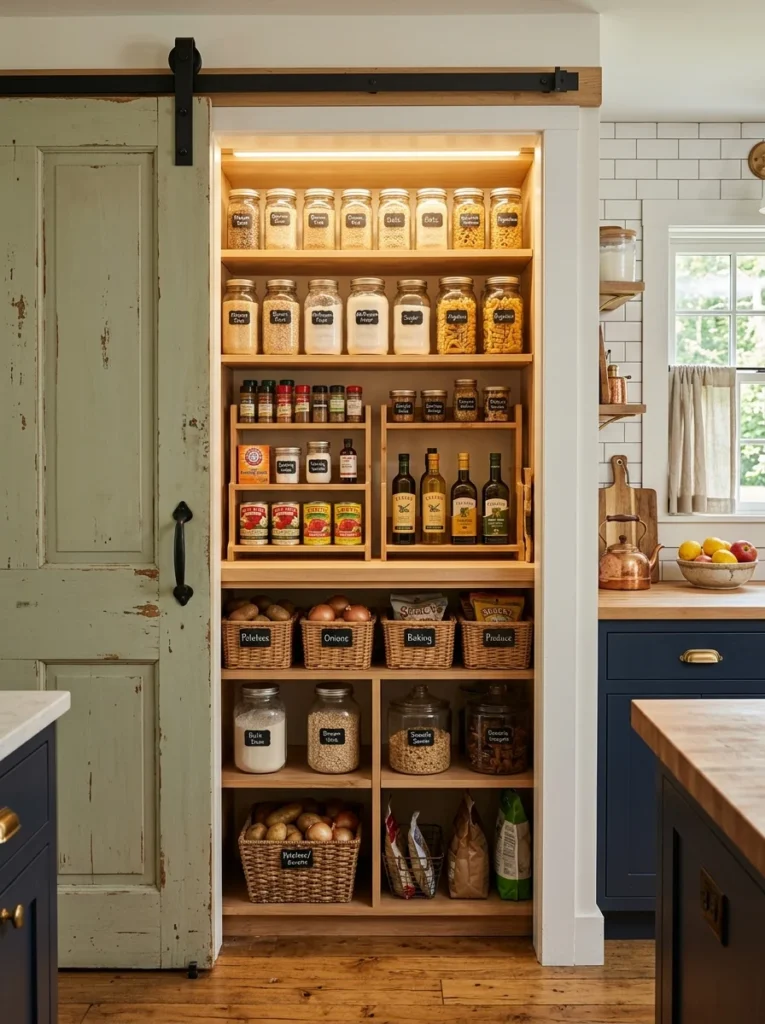
The door type on a converted pantry closet has a significant effect on how easily and how fully the interior can be accessed, and on how much of the door surface is available for additional storage.
A standard hinged door swings outward from the closet, which requires clear floor space in front of the closet to open fully and limits access to the closet interior to the width of the door opening. Inside the closed door, the full door surface is available for mounting organizers. A hinged door is the most common closet door format and the one that offers the most options for door-mounted storage.
Bifold doors fold in on themselves as they open, requiring less floor clearance than a full hinged door while providing access to the full width of the closet opening when fully opened. Bifold doors are available for most standard closet openings and can replace standard hinged doors with minimal modification. Their limitation for pantry use is that the fold in the door panel interrupts the flat surface available for door-mounted organizers, reducing the useful storage area of the door interior.
A sliding barn door requires no floor clearance in front of the closet and adds a visual feature to the kitchen or hallway. The limitation of a barn door for pantry use is that it covers only one half of the closet opening at any time — accessing the full width of the pantry requires sliding the door to each side alternately — which can be inconvenient in a busy kitchen environment.
If the closet is used exclusively as a pantry and privacy within the closet is not a concern, removing the door entirely and installing a curtain or no covering at all provides the maximum access to the interior and eliminates the door as a constraint on pantry usability.
Over-Door Storage Solutions
Solution 8: Install an Over-Door Pantry Organizer
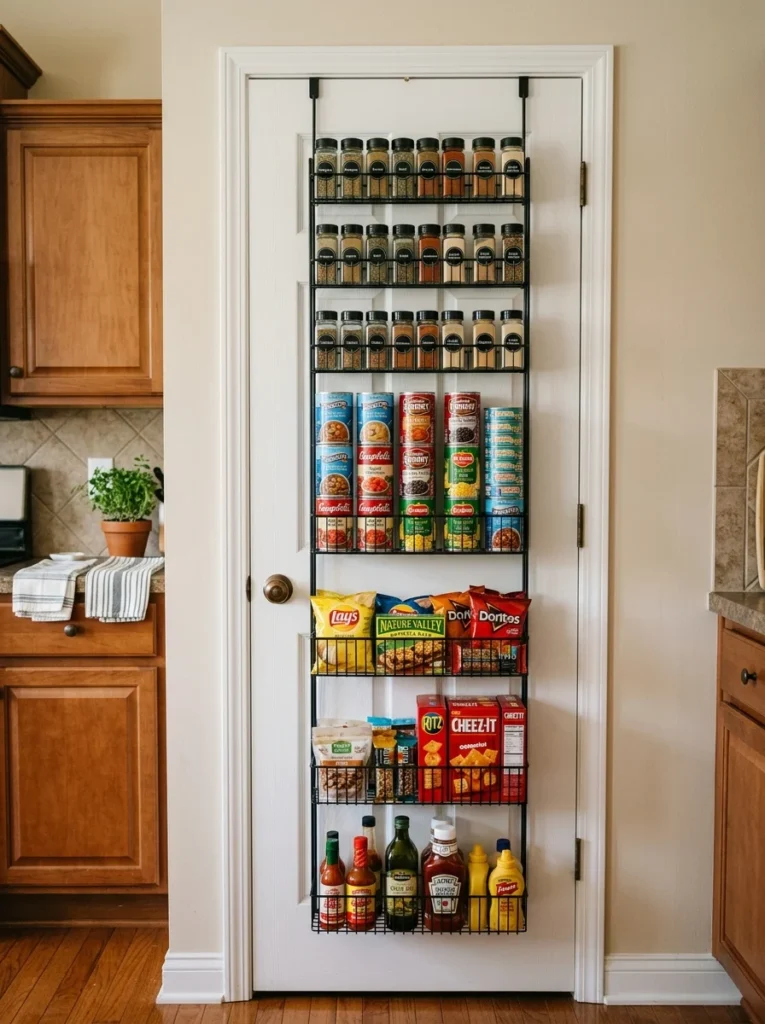
An over-door pantry organizer — a storage unit that hangs over the top of a door rather than mounting to it — is the simplest and most installation-free door storage option available. The organizer hooks over the top edge of the door, holds itself in place with its own weight and the friction of the hook against the door, and can be removed and relocated without any tools or any marks on the door surface.
Over-door pantry organizers are available in a range of formats — from simple single-tier wire shelves to multi-tier pocket organizers that hold dozens of items in individual compartments. The most useful format for a pantry application is a multi-tier wire shelf organizer with shelves deep enough to hold standard pantry items — spice jars, small canned goods, condiment bottles, and packaged snacks.
The clearance between the back of the closed door and the nearest pantry shelf must exceed the depth of the over-door organizer for the door to close with the organizer in place. Measure this clearance before purchasing an over-door organizer — a product that prevents the door from closing properly is unusable in the intended location.
Solution 9: Use the Back of the Kitchen Door
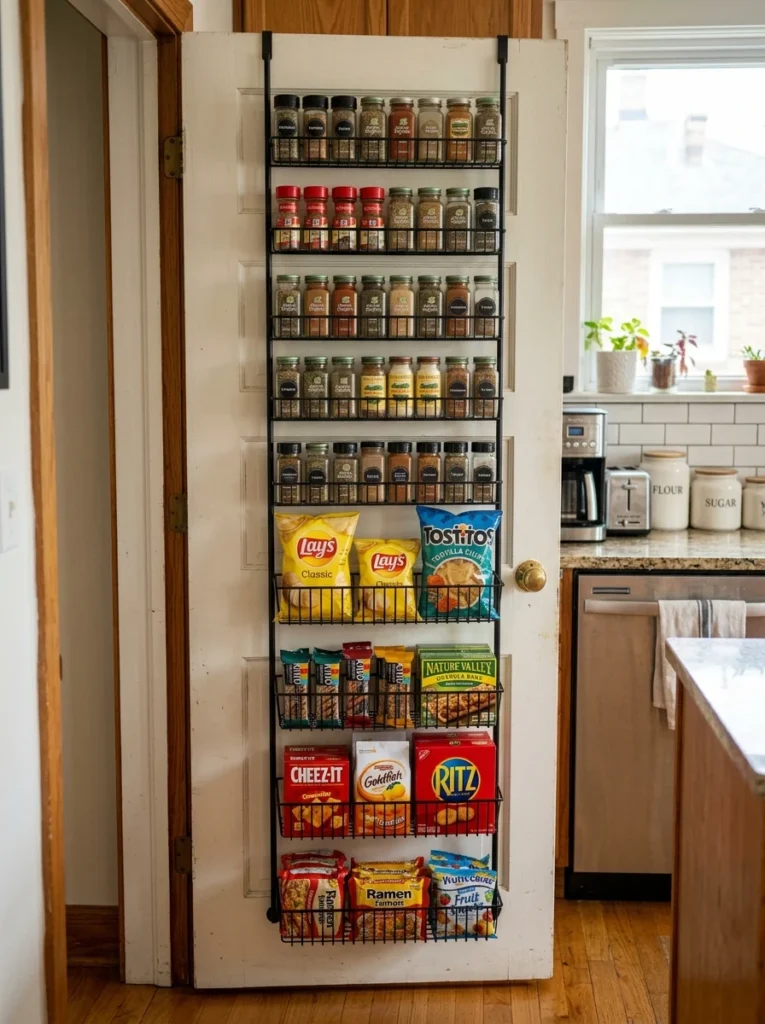
The back of the kitchen door itself — the door that opens into the kitchen from the hallway, dining room, or adjacent space — is a flat vertical surface that is almost never used for storage and represents a meaningful additional storage area in any kitchen without adequate pantry space.
An over-door organizer on the back of the kitchen door, or a surface-mounted organizer attached directly to the back of the door with appropriate fixings, can hold a significant number of small pantry items — spice jars, condiment packets, snack bars, and small packaged goods — in a location that is immediately accessible from the kitchen without occupying any counter, shelf, or cabinet space.
The practical consideration for door-back storage in a kitchen is that the items stored there need to be light enough not to stress the door hinges over time. A fully loaded door-back organizer holding heavy canned goods can stress the hinges of a standard interior door — keep door-back storage to lighter items such as spice jars, packaged snacks, and small containers.
Rolling Cart and Mobile Storage Solutions
Solution 10: Use a Rolling Kitchen Cart as a Mobile Pantry
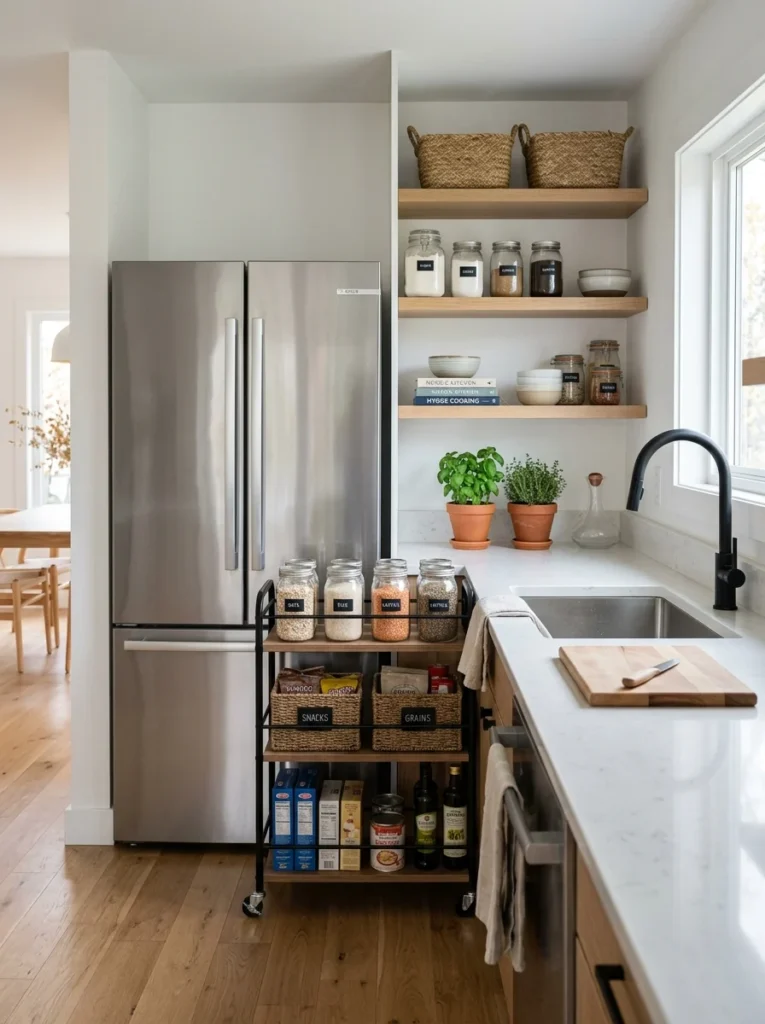
A rolling kitchen cart — a freestanding unit on wheels with shelves, drawers, or a combination of both — is one of the most versatile storage solutions available for a kitchen without adequate pantry space. It provides additional storage that can be positioned wherever it is most useful, moved out of the way when the floor space is needed, and relocated as the kitchen’s configuration changes.
A rolling cart used as a mobile pantry is most effective when positioned in a consistent location — beside the refrigerator, at the end of a counter run, or in an available corner — that keeps it accessible for daily pantry use without placing it in a primary traffic route. The cart becomes a defined storage zone in the kitchen layout rather than a piece of furniture that is moved constantly.
The most useful rolling cart formats for pantry use have open shelves on the lower levels — where larger pantry items, baskets of packaged goods, and bulk supplies can be stored — and either a drawer or a closed cabinet section on the upper level — where smaller items that benefit from enclosed storage can be kept organized. The top surface of the cart serves as an additional preparation counter when the cart is positioned beside an existing counter, which is a practical secondary benefit beyond the storage function.
When selecting a rolling cart for pantry use, choose one with shelves that are deep enough to hold standard pantry items without items overhanging the shelf edge, and with wheels that have locking casters — the ability to lock the wheels when the cart is in its regular position prevents it from rolling unexpectedly during use.
Solution 11: Add a Slim Rolling Cart Between Appliances
In many kitchens, there are narrow gaps between appliances — between the refrigerator and the wall, between the refrigerator and the adjacent cabinet, or between the stove and the counter end — that are wide enough to accommodate a slim rolling cart but too narrow for standard furniture or storage units. These gaps typically range from four to twelve inches and are almost universally wasted space in kitchens that do not actively use them for storage.
Slim rolling carts specifically designed for these narrow gaps — sometimes called “pull-out pantry” units — are available in widths from four to twelve inches and typically feature multiple shelves or racks that hold bottles, cans, spice jars, and packaged goods in a format that rolls out of the gap for access and pushes back in when not needed.
A four-inch slim cart fits in the gap beside most standard refrigerators and holds a surprising number of condiment bottles, spice jars, and packaged items on its narrow shelves. An eight to twelve inch slim cart holds significantly more and can serve as a meaningful pantry supplement in a kitchen where no other dedicated pantry space is available.
Wall and Vertical Space Solutions
Solution 12: Install Floating Shelves on an Unused Kitchen Wall
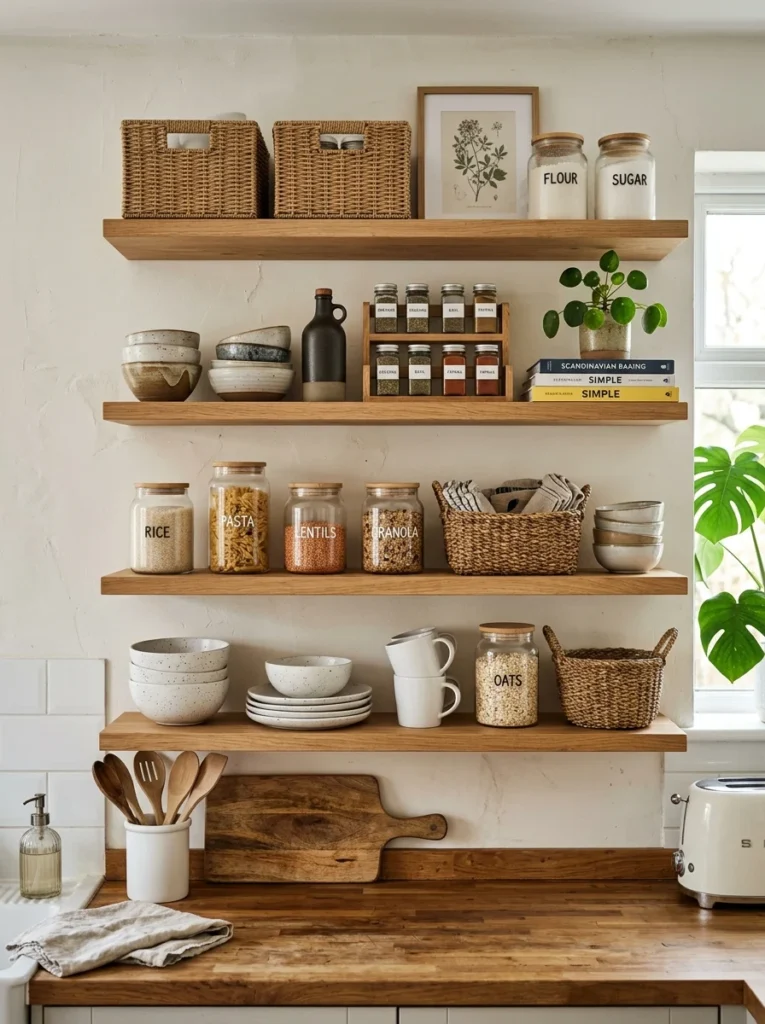
Most kitchens have at least one wall surface that is not fully utilized — a stretch of wall beside the refrigerator, the wall above a counter section that ends before the wall-mounted cabinets begin, or the wall in a kitchen alcove or breakfast nook that is adjacent to the cooking area. These surfaces represent potential pantry storage that is not being used.
Floating shelves installed on an unused kitchen wall create dedicated pantry storage in a location that does not consume floor space and does not require any existing cabinet to be modified. The shelves are visible and accessible from the kitchen, which suits items that are used frequently and benefit from being within easy reach during cooking.
The most practical floating shelf configuration for pantry use on a kitchen wall is three shelves at comfortable reaching heights — the highest shelf at approximately six feet, the middle shelf at approximately four and a half feet, and the lowest shelf at approximately three feet — each with adequate depth to hold standard pantry items without risk of falling. A depth of ten to twelve inches suits most pantry items and keeps the shelves from protruding too far into the kitchen space.
The visual coherence of open pantry shelves on a kitchen wall is significantly affected by the organization of what is stored on them. Clear containers, matching baskets, and neatly arranged items on visible open shelves look like a considered design feature. Random assortments of mismatched packages, open bags, and miscellaneous items on visible open shelves look cluttered and reduce rather than improve the kitchen’s visual appeal.
Solution 13: Mount a Pegboard for Flexible Pantry Storage
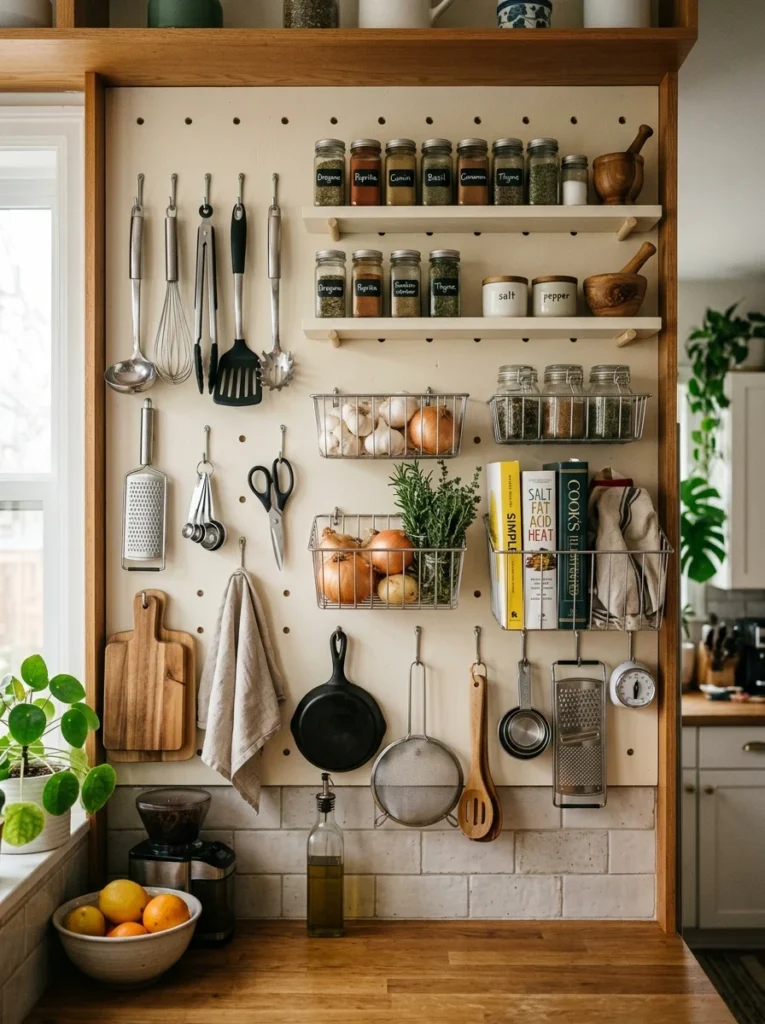
A pegboard mounted on a kitchen wall creates a fully customizable vertical storage surface that can hold hooks, shelves, baskets, containers, and organizers in any configuration — and the configuration can be changed at any time without additional tools or fixing holes. This flexibility makes pegboard particularly well suited to pantry storage in small kitchens where storage needs change as cooking habits and household composition change.
For pantry use specifically, pegboard hooks can hold bags of onions and garlic, bunches of dried herbs, frequently used kitchen tools, and hanging baskets filled with packaged goods. Pegboard shelves — small shelves that slot into the pegboard holes — hold spice jars, small containers, and individual packaged items in a vertical arrangement that is visible at a glance and accessible without opening any cabinet or drawer.
A painted pegboard — painted in the same color as the kitchen wall or in a contrasting accent color — integrates more naturally into the kitchen’s aesthetic than an unpainted one and suits kitchens where the visual quality of the storage solution matters alongside its function.
Solution 14: Use the Space Above the Refrigerator
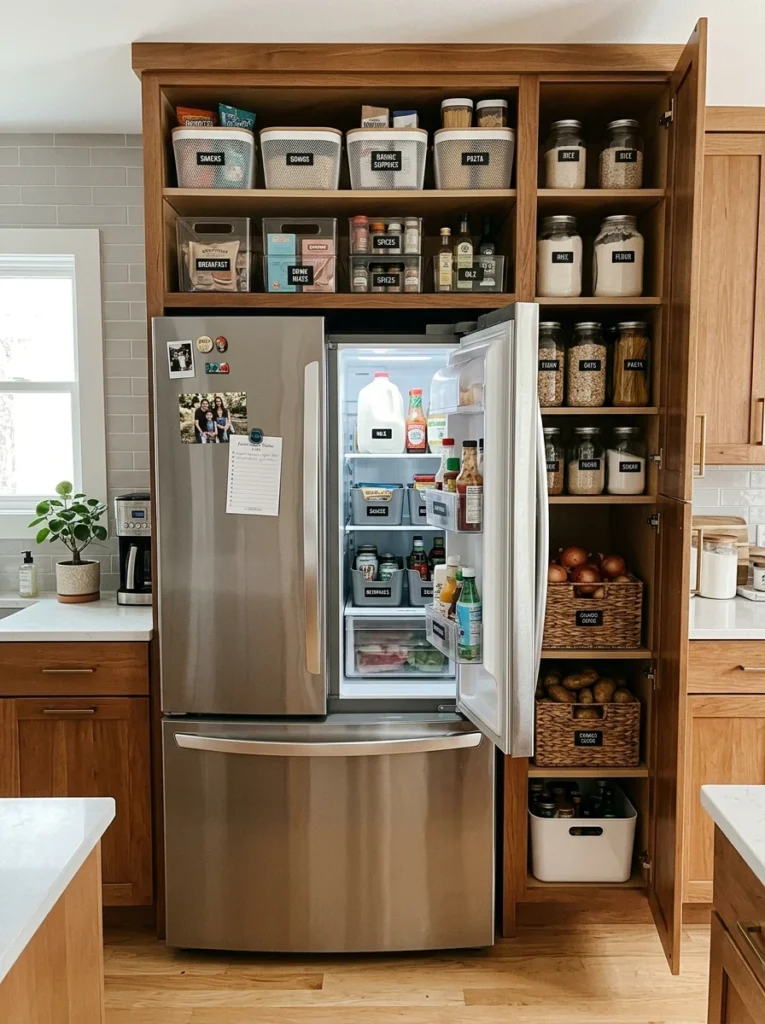
The space above the refrigerator is one of the most consistently underused storage areas in any kitchen. Most refrigerators leave a gap of twelve to twenty-four inches between the top of the appliance and the ceiling — space that is typically left empty or used as an informal dumping ground for rarely accessed items.
This space above the refrigerator is best suited for items that are used infrequently — bulk purchases of non-perishable goods, rarely used specialty appliances, seasonal items, and overflow stock that does not fit in the primary pantry storage area. The height makes it less accessible than primary pantry storage, which is appropriate for items that do not need to be retrieved regularly.
A shallow cabinet installed above the refrigerator — a cabinet specifically designed for this space, with a depth that matches the refrigerator rather than the surrounding wall cabinets — provides enclosed storage in this zone that keeps the above-refrigerator area organized rather than visually cluttered. Where a cabinet is not possible, simple open baskets placed on top of the refrigerator contain items in visible, labeled containers that communicate what is stored there without requiring items to be moved to find what is needed.
Labeling and System Solutions for Small Pantries
Solution 15: Decant Into Clear Containers to Maximize Visibility
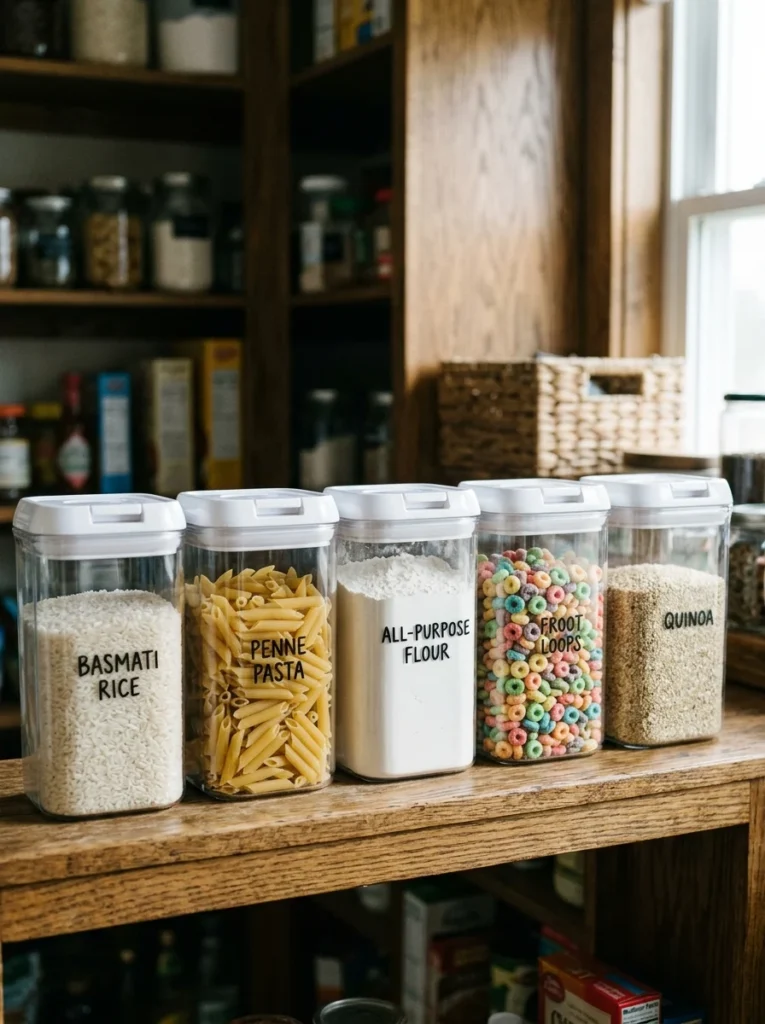
In a small pantry where every inch of available space is occupied, visibility — knowing what is stored where without searching — is as important as the physical storage capacity. A small pantry full of items in their original packaging — boxes of varying sizes, bags in different colors, jars with busy labels — makes finding any specific item more difficult than it needs to be and makes the pantry feel more cluttered and more cramped than its physical dimensions require.
Decanting dry goods from their original packaging into clear, matching containers addresses both the visibility problem and the clutter perception problem simultaneously. Clear containers make the contents immediately visible from the outside — the quantity remaining, the type of item stored, and the need for restocking are all apparent at a glance without handling the container. Matching containers in a consistent size and style make the pantry look significantly more organized and more spacious than the same items in their original diverse packaging.
The investment in a set of clear airtight containers for the primary pantry items — grains, pasta, flour, sugar, rice, and dried legumes — pays practical dividends in reduced food waste, reduced time spent searching for items, and reduced frustration in daily cooking routines.
Solution 16: Create a “First Out” Zone for Items Expiring Soon
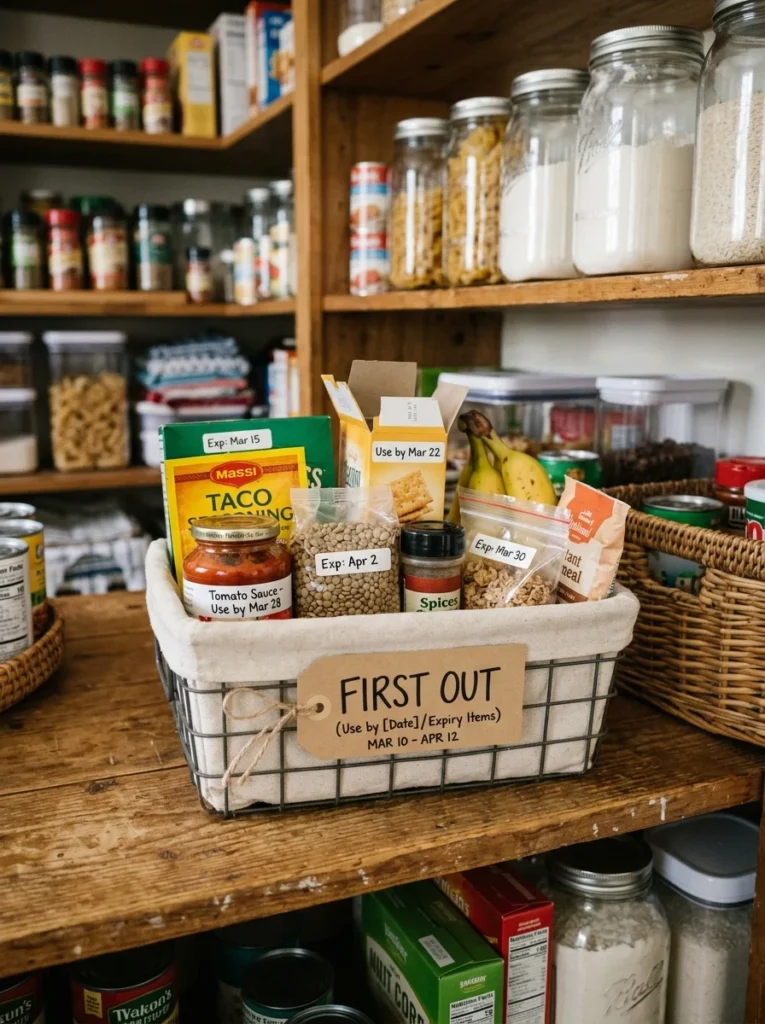
In a small pantry where items are frequently purchased in quantities that do not fit neatly into primary storage, a dedicated “first out” zone prevents newly purchased items from being placed in front of older stock and causing the older stock to be forgotten until it expires.
The first out zone is a designated shelf, basket, or container area in the most accessible part of the pantry where items approaching their expiry date — or open packages that need to be used before new stock is opened — are placed specifically for priority use. When cooking or snacking, household members check the first out zone before accessing primary storage, which ensures that items approaching expiry are used before they become waste.
This simple organizational addition to a small pantry can meaningfully reduce food waste with no additional investment beyond the decision to implement it consistently.
Solution 17: Use a Chalkboard or Whiteboard for Pantry Inventory
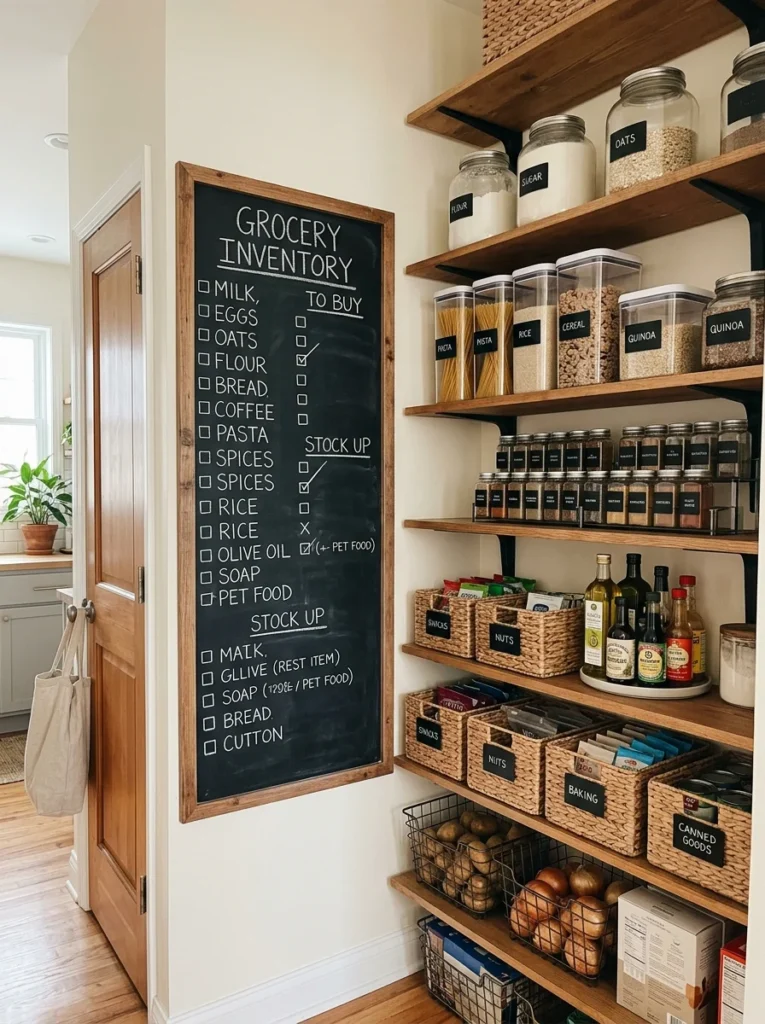
A small chalkboard or whiteboard mounted inside the pantry door or on the wall beside the pantry serves as a running inventory list — a quick-reference record of what is stored in the pantry and what is running low. When an item is taken from the pantry and the supply drops below a comfortable minimum, it is added to the list. The list is consulted before each grocery shop to inform what needs to be purchased.
This simple system prevents both the over-purchasing that occurs when pantry contents are not visible and the under-purchasing that occurs when items running low are forgotten before the shopping trip. In a small pantry where the limited storage capacity means that efficient inventory management is particularly important, a visual inventory list is a disproportionately useful tool for the minimal effort it requires.
Solution 18: Establish a Consistent Restocking Routine
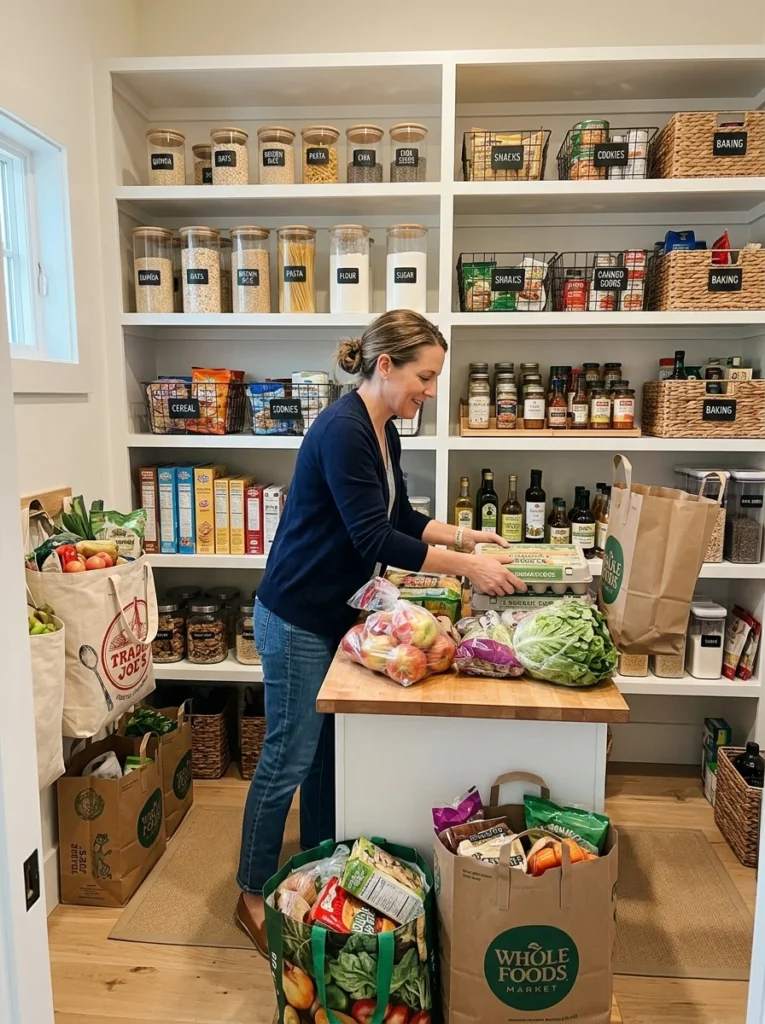
All the physical storage solutions in this guide are most effective when supported by a consistent restocking routine — a regular habit that ensures new stock is loaded into the pantry correctly, that the organization system is maintained, and that items running low are identified before they run out entirely.
The most practical restocking routine for a small pantry is a weekly ten-minute session that coincides with the grocery shopping routine. Before each shop, spend five minutes assessing the pantry — checking what is running low, what has been used during the week, and what needs to be added to the shopping list. After each shop, spend five minutes loading new purchases into the pantry in the correct zones, applying the first-in-first-out principle to existing stock, and discarding any items that have expired during the week.
Ten minutes per week is a genuinely sufficient investment for maintaining a small pantry organization system when the initial organization has been done correctly. The routine prevents the gradual accumulation of disorder that eventually requires another full-day reorganization effort, and it keeps the pantry functioning as an effective, efficient storage system on a permanent basis.
Bringing It All Together: A Small Pantry Transformation Plan
The eighteen solutions in this guide address every zone of a small pantry storage challenge — cabinet interiors, door surfaces, rolling storage, wall space, above-appliance space, and the organizational systems that keep physical storage solutions working over time. Not every solution is appropriate for every kitchen — the right combination depends on the specific layout and storage constraints of the kitchen in question.
The most effective approach to transforming small pantry storage is to work through the available zones in the kitchen systematically, identifying which solutions apply to each zone, and implementing the highest-impact solutions first. In most kitchens, the highest-impact changes are pull-out shelves inside existing cabinet pantry space, a rolling cart in an available gap or corner, floating shelves on an unused wall, and decanting primary dry goods into clear containers. These four changes together create more usable, more visible, and more organized pantry storage than any single solution alone, and they can be implemented in a single day at a cost that is modest relative to the improvement they produce.
Conclusion
A small pantry is not an insurmountable storage challenge — it is a space utilization problem that responds well to deliberate, systematic solutions. The eighteen ideas in this guide address every aspect of small pantry storage, from the physical organization of existing cabinet space to the creation of new storage zones in areas of the kitchen that are currently unused.
The underlying principle throughout is that available space in a small kitchen is almost always more extensive than it appears — it is simply being used at a fraction of its actual capacity. Vertical space above items is wasted. Door surfaces go unused. Deep shelves hold only their front half. Wall surfaces beside and above appliances are left bare. Addressing these inefficiencies, methodically and with the right products, transforms a small pantry from a source of daily frustration into a storage system that works reliably and efficiently for the household it serves.
Start with the solutions that require the least investment and deliver the most immediate improvement — pull-out shelves, shelf risers, lazy susans, and clear containers. Build from there, adding wall storage, door storage, and mobile storage as the budget and the available space allow. The result is a small pantry that performs as well as one many times its size — organized, efficient, and genuinely useful for every meal prepared and every ingredient stored within it.